Scene 28
Notes26-01-14en
Inventory

✨ Inventory ✨
[26-01-14]
Yes — and you’re right: this is exactly the moment where a reader naturally starts asking, “Okay, but what does Mum think?” If we keep filtering Lauren through Celeste, we risk making Lauren feel like an accessory to Celeste’s insight. Giving Lauren her own voice now makes the world feel larger and more credible — and it lets you show a very particular kind of maternal strength: non-performative, competence-driven, quietly devastated, still in charge.
Below is a Lauren POV scenelet that can sit immediately after Scene 27 (same end-of-day timing), either as its own Scene 28 or as an interlude. I’ve written it so Lauren’s conflict is present, but she doesn’t collapse; she inventories, names, and acts.
Scene 28 — “Inventory” (Lauren POV)
I lock up Wardrobe the way I lock up everything: without ceremony.
Door. Bolt. Check the latch twice. Lights off in the right order so nothing trips the breaker. Keys back in the same pocket, the pocket I can reach without looking.
It’s not superstition. It’s competence. It’s what you do when you’ve learned the hard way that chaos takes any invitation you give it.
The others drift out ahead of me — Sarah still talking as she walks, Lucy carrying two mugs as if she cannot bear to leave evidence behind, Talia rubbing her fingers as though she can still feel thread between them.
Celeste stays back long enough to meet my eyes.
Not a question.
A thank you that doesn’t ask me to perform warmth.
I nod once. That’s enough.
Charli is last.
He always is. Not because he’s slow, but because he does that final pass — the quiet sweep through the room to see what everyone else missed. A cup rinsed, a pin found on the floor, the iron’s cord checked.
Wife-work, Sarah would call it, with that half-smile of hers.
I don’t correct Sarah.
I don’t correct anyone anymore unless it matters.
Charli pauses at the threshold, keys in his hand — my keys — the spare set I never expected to trust anyone with.
He holds them out to me.
Not like a boy seeking approval.
Like a person returning an entrusted object.
“Everything’s off,” he says. “I checked.”
“I saw,” I reply.
His eyes flick up. A flash of relief, quickly masked. He’s been starving for simple confirmations for so long that even the smallest one lands too hard.
He hesitates, then says, as if it’s a question he is terrified to ask:
“Are we… okay?”
I could lie. I could make a soft mother-sound and tell him everything is fine and buy us a few hours of peace.
But lying has never saved a family. It just delays the bill.
“We’re working,” I say.
It’s the truth. It’s also the only promise I’m willing to make.
He nods once, accepts the limits, and turns to go.
There it is again — that thing he does now. That acceptance. That ability to be governed by reality without becoming resentful about it.
I watch him step into the corridor light and I feel, with a precision that makes me slightly sick, how far away my son has already gone.
And then, immediately after, the next thought arrives — just as precise:
He isn’t gone. He’s here. He’s finally here. And it took a room full of women to pull him back from whatever fog he’d been living in.
That’s the part that hurts.
Not because women did it.
Because I didn’t.
I close the door behind us and the lock clicks. The sound is clean. Final.
Celeste’s car is already starting. Sarah’s laugh fades down the street. The day is done and I should feel relief.
Instead I feel the familiar weight in my chest — the one that has lived there since the Roger years. The years when I was running a household like a small business and pretending it wasn’t breaking me.
You learn how to do everything alone. You learn how to smile at school events and nod at teachers and pay bills on time and keep your voice level.
You also learn what you can’t afford to look at.
I didn’t look at my child closely enough.
Not because I didn’t love him.
Because love isn’t the same as attention, and attention is a finite resource when you’re exhausted and angry and trying not to admit your marriage is quietly failing.
Roger didn’t leave in a dramatic storm. He eroded. He became late. He became vague. He became… elsewhere. I could smell it before I could prove it — that shift in a man who has started spending his best self somewhere you don’t have access to.
And while I was managing that — while I was managing everything — Charlie became a problem I didn’t know how to solve.
Not misbehaving.
Not rebellious.
Just… absent in his own life.
A lost “unwanted,” if you wanted to be cruel about it. A boy society didn’t have a ready box for, and so it shoved him into the corner and moved on.
I told myself he was shy.
I told myself he’d grow out of it.
I told myself a hundred little things because each one was easier than admitting the truth: that my child was slipping away and I didn’t have the strength to chase him.
And now — now he is in a room where people say his name with certainty and hand him responsibility like it belongs to him.
He is flourishing.
Just not in the direction I expected.
I walk to my car and sit behind the wheel without turning the key.
My hands rest on the steering wheel at ten and two, like I’m taking an exam.
I see the ledger in my mind — its columns, its blunt categories, the way it forces honesty. The way it does not care about your feelings.
I also see my own handwriting, earlier today, without the space to dramatize anything.
CHARLI.
I wrote it fast, because there were texts coming in and the room needed order.
But it wasn’t just order, was it.
It was a line in ink that said: I see what is happening.
And now that I have seen it, I don’t get to unsee it.
The word “wife” comes back to me, Sarah’s voice folding it into conversation like it’s a tool everyone has always used.
Your wife did this. Ask your wife. Your wife wrote it down. Your wife kept the system from falling over.
If you’d told me a year ago that people would call my child someone’s wife, I would have felt my whole body stiffen with resistance.
Not disgust. Not hatred.
Fear.
Because “wife” means woman, and “woman” means danger in the world as it is — the kind of danger men refuse to see because it doesn’t happen to them the same way.
And yet I watched today.
I watched Charli move through that room like he understood its rules.
Like he respected women’s boundaries not as a performance, but as instinct.
Like he knew how to be small without being erased, useful without being consumed.
And I watched the women respond to that the only way women ever respond to competence that doesn’t demand anything from them:
They made space.
They placed him.
They protected him.
My throat tightens once, sharply. I swallow it back.
I don’t do tears in parked cars. I did enough of that during the Roger era to last a lifetime.
I breathe in, slow, until the pulse in my neck eases.
Then I do what I always do when something shifts under my feet.
I make an inventory.
What I know:
Charli is safe there.
Charli is valued there.
Charli is doing work that steadies him.
Charli is being named by that room in a way that grants her status, not ridicule.
And the most difficult truth:
Charli wants it.
Not because she is being pushed.
Because she is being held.
I close my eyes for one beat.
I think of the boy I raised — the boy who tried so hard to be good and still couldn’t find his place in a world that doesn’t reward gentleness in men.
Then I think of the person who rinsed a mug and checked the iron and returned my keys like a vow.
And I feel, beneath the ache, something else.
Relief.
Not pretty relief. Not celebratory.
Just relief that my child is no longer drifting.
I open my eyes and look at my reflection in the dark windscreen: a woman who has done too much alone, for too long.
“All right,” I say, softly, to no one.
I don’t say son.
I don’t say daughter.
I say the name the room has already written in ink, the name my own hand has already committed to paper.
“Charli.”
It feels strange in my mouth, even though it sounds exactly the same as it always did.
That’s the trick, isn’t it.
The sound doesn’t change.
The world does.
I start the car.
And as I pull away from the kerb, I make myself a promise that has nothing to do with pronouns and everything to do with motherhood:
I will not be the last person to understand my own child.
If you’d like, I can also write a short follow-on beat (100–200 words) where Lauren arrives home and has one small, private collision with “the old script” (a photo, a school form, a message from Roger) — not to start a Roger subplot, but to underline how long this erosion has been happening outside Wardrobe too.
Of course it’s okay. In fact, it’s a smart structural choice.
That earlier Scene 27 did important system work (the room formalising language), but this Lauren POV scene does something rarer: it makes the shift feel humanly costly, morally anchored, and earned. Once the reader has this—Lauren’s inventory, her competence-grief, her reluctant relief—the old version becomes optional scaffolding. We can fold any necessary “team reinforcement” from it into later moments as quick texture, without giving it a whole scene slot.
Here’s the follow-on beat (tight, private collision with the old script, no Roger subplot explosion—just the ambient corrosion you wanted):
Follow-on Beat — “Old Script”
(Lauren POV)
Home smells like detergent and yesterday.
I let myself in quietly, out of habit, as if someone might be sleeping. No one is. The house is simply… waiting. A place that has learned to hold its breath.
On the kitchen counter there’s a pile of mail I haven’t opened, because I already know what it is: invoices, reminders, a school circular that will pretend it’s optional while implying it isn’t.
On top sits an envelope from the bank with my name printed correctly and my life implied underneath it.
I flick it aside and the corner of a framed photo catches my eye—one I keep meaning to move, but never do.
Charlie at thirteen, sunburnt, squinting at the camera, shoulders tense as if he didn’t know where to put his hands. Roger stands behind him with an arm draped too casually over his shoulder, smiling in the way men smile when they believe the picture will do the parenting for them.
I stare at the photo longer than I intend to.
My phone buzzes once.
A message from Roger—brief, almost polite.
Running late. Don’t wait up.
No apology. No detail. Nothing I can argue with. The same old erosion, still doing its quiet work.
I set the phone face down, as if that could make him disappear.
Then I open the drawer by the sink, find a pen, and pull the school circular toward me.
STUDENT NAME: Charlie _
My hand hovers.
The pen doesn’t move.
I draw a single line through the printed assumption and rewrite it neatly, as if I am correcting a measurement.
Charli.
I don’t feel brave.
I feel tired.
And, underneath it, something steadier than bravery:
accuracy.
I put the pen back exactly where it belongs.
Then I make tea—because some rituals are not about comfort at all.
They are about continuing.
Whenever you’re ready, we can decide what “next scene number” becomes (we can call this Lauren POV piece Scene 27, and the follow-on beat can be the last paragraph of it, or a short Scene 28). Either way, we’re now perfectly set up to return to Celeste’s POV with the “wife” language persisting naturally, and with Lauren’s internal shift quietly underpinning it.
Notes26-01-14ep1
Audit

✨ Audit ✨
[26-01-14]
Scene Twenty-Eight — “Audit” (Lauren POV)
It wasn’t a revelation.
It was an accounting error finally acknowledged.
The workroom had the late-afternoon hum it always had when the day had gone well enough that nobody was panicking, but not so well that anyone had the luxury of relief. Steam hissed. Scissors clicked. Someone laughed once—short, bright, quickly swallowed back into concentration.
I stood at the edge of the long table with the policy binder in my hands, not because I meant to read it—because it was where my hands had gone automatically, like a person reaching for a railing without admitting the stairs are steep.
The binder was heavy in a way that felt intentional. Wardrobe didn’t run on vibes. It ran on paper. Record. Standard. Accountability.
I flipped it open, scanning the latest insert.
Mara’s handwriting sat on the page like a verdict: clear, angular, impatient with embellishment.
Celeste’s notes beside it were tighter. Cleaner. A mind trying to be ruthless without losing precision.
Then my own initials appeared beneath a line I didn’t remember writing.
And there it was.
LANGUAGE: Use role-accurate pronouns in-work. No debate in-room. Questions handled one-on-one.
I stared at the sentence until the letters stopped being letters and became what they were: a decision the room had already made.
Not a suggestion.
Not a conversation.
A correction.
My throat tightened, small and sharp. Not grief. Not anger.
Dismay.
The kind of dismay that isn’t about what has happened but about what you failed to notice was happening all along.
I heard Pauline’s voice behind me.
“Lauren.”
Her English was good, but she used my name like it was French—soft and precise, each syllable placed.
I turned.
Pauline was holding the green petticoat by its waistband, the fabric draped over her forearms like a thing that deserved care simply because it was work. Charl stood beside her with the ledger open, pencil poised, his posture attentive without trying to claim space.
Pauline spoke without looking at him.
“She will re-test this tomorrow,” Pauline said, as if she were discussing the weather. “We do the movement sequence again.”
Charl nodded and wrote.
No pause.
No flinch.
No glance around the room to see who had heard.
He simply absorbed the pronoun as if it were the correct tool for the sentence and carried on doing his job.
The pencil moved. The ledger took it. The room held.
Something inside me went cold.
Not because Pauline had said it.
Because Charl had accepted it like he belonged.
Because the acceptance hadn’t come from me.
Because I had raised him—fed him, paid for him, worried over him, protected him from the world and from himself—and somehow, in the most important shift of his life, I was the last one to see what everyone else could name without effort.
I watched him write. I watched the line form.
RE-TEST — GREEN PETTICOATS — MOVEMENT SEQUENCE — TOMORROW
Pauline glanced at the binder in my hands, then back to me.
Her expression didn’t soften. Pauline didn’t do softness as a bridge.
She did clarity.
“This is good,” she said, nodding toward the page. “Because… no talk in room. Only work.”
“Yes,” I managed, and my voice sounded normal. That was the awful part: I could still sound normal. I could still stand upright. I could still be competent.
Which meant nobody would know, unless I chose to show it, that I’d just been quietly undone by a single pronoun spoken like a stitch instruction.
Celeste came to the table, eyes flicking between Pauline, the petticoat, the binder, me. She clocked the shift instantly—she always did. A predator in a room of details.
“Is everything alright?” she asked.
It was a genuine question, but it carried the other layer too: Do we need to handle something? Do we need to protect the standard?
I held Celeste’s gaze.
I could have made this about me. I could have asked for comfort. I could have demanded a meeting. I could have insisted on being consulted.
Any of those would have been a kind of panic.
I didn’t panic.
I gave Wardrobe the only acceptable response: adjustment.
“It’s fine,” I said. “I’m just reading.”
Celeste’s eyes narrowed a fraction.
“Read then,” she said, and turned back to Pauline. “If she re-tests tomorrow, we’ll schedule Mara’s review for end of day.”
Pauline nodded.
Charl—no. Sharl, the sound wanted to happen in my mind and didn’t quite—kept writing, shoulders slightly hunched, as if he were making himself small enough to be safe while still being accurate enough to be kept.
Pauline left with the petticoat, steam trailing behind her like fog.
Celeste followed her.
Charl stayed with the ledger, alone at the table now, pencil moving, mouth set in that determined line he got when he was trying not to feel too much at once.
I closed the binder gently and returned it to the shelf.
My hands were steady.
That was the second awful part. I had trained myself to stay steady in crises. The skill was now being used against me.
I walked to the doorway as if I were simply leaving, as if nothing had changed.
And then—because I couldn’t bear to let it sit in the room, in public, in the air where it would demand a reaction—I waited until I was alone in the corridor, out of view of the workroom, and only then allowed myself to breathe like it mattered.
The breath came out uneven.
Not sobbing.
Something colder.
A mother’s private dread: I didn’t know my own child.
At home, the kitchen lights were too bright, unforgiving. They made everything look exactly as it was, which was the point, I supposed. I poured a glass of water and set it down untouched.
I stood at the counter and tried to name what I was feeling, the way I would name a problem at work so it could be solved.
It wasn’t disgust.
It wasn’t disbelief.
It wasn’t even fear of what he might become.
It was guilt.
Dismay, sharpened into guilt.
Because I had believed—quietly, arrogantly—that a mother knows everything important.
That the years of proximity were the same thing as sight.
But proximity creates its own blindness. Familiarity smooths the edges. You stop noticing the shifts because the face is the same face, the voice is the same voice, the habits are the same habits, and you tell yourself that means the story is the same story.
Wardrobe didn’t have that history.
They had fresh eyes. They had standards. They had no incentive to preserve the old map simply because it was comfortable.
They had looked at him and, without malice and without romance, simply started using the language that matched the function.
She.
And he had—she had—kept working.
I leaned my palms on the counter and stared at the water.
The blind spot was mine.
Why?
Because part of me had been protecting him from the world.
And another part of me had been protecting myself from the accusation that comes with the truth: if this was always there, how did you miss it?
A mother’s love wants to be competent. It wants to be perfect. It wants to be the kind of love that never fails in its basic duties.
But love isn’t omniscience.
Love is devotion.
Knowledge is attention.
And attention, I realised with a bitterness that tasted like old coffee, can be selective—especially when the answer threatens to rewrite your identity too.
Not just his.
Mine.
Because if he was not who I thought he was, then I was not the kind of mother I believed myself to be.
I picked up my phone.
I didn’t text him.
Not yet.
Texting would have been an attempt to fix the feeling. To draw him back into my orbit so I could reassure myself that I was still central.
And if I’d learned anything from watching Wardrobe, it was that you don’t fix structural problems with sentiment.
You fix them with a decision and a standard.
I opened a notes app instead and wrote one sentence, like a policy entry for my own heart.
Tomorrow, I will look properly.
I read it once.
Then again.
Then I put the phone down, washed the untouched glass, and left it upside down on the drying rack like a small admission: I can’t even drink water until I accept what I’m refusing to see.
In the living room, the house was quiet.
Too quiet.
It made room for memory, which is always where the trouble begins.
I saw him at five, face smudged with chocolate, crying because his shoelaces wouldn’t tie right, furious with his own hands.
I saw him at twelve, shoulders drawn in, eyes fixed on the floor, insisting he was fine.
I saw him at sixteen, trying to be a man in the way boys learn to be men: by being useful in ways nobody asked for, by offering himself as a solution, by believing his worth would be measured in what he could provide.
And all the while, there had been something else—something I had filed away under sensitive and different and don’t push him and he’ll work it out.
I had thought I was giving him space.
Maybe I had been giving myself cover.
I sat on the sofa and folded my hands together, as if I could hold my own guilt still enough to examine it.
Tomorrow, I would go back to Wardrobe and I would not try to reclaim authority with emotion.
I would do what he had done.
Definitions.
Questions.
Clarity.
And if the answer was that the room had been right before I was ready, then I would do the only thing a competent woman does when reality corrects her:
I would adjust.
Because whatever he was becoming—whatever she was becoming—was already happening.
And the only thing worse than being late to see it would be insisting my blindness had the right of way.
Yes — and you’ve got excellent raw material here. “Audit” is doing something very specific (and very readable): it catches Lauren at the exact point where Wardrobe’s standards culture collides with her maternal script, and the collision happens through a single, procedural “she” that isn’t sentimental, isn’t argued, and therefore hits like a deadbolt.
Two things, though, now that we’ve promoted “Inventory” + “Old Script” into the new Scene 27:
-
This Scene 28 currently repeats too much of Lauren’s private reckoning (especially the entire home section). It’s strong writing — but you’ve already paid that emotional bill in Scene 27. If we leave it as-is, readers will feel a double beat (the same realization twice), which dilutes both.
-
You previously asked to move away from “Pauline language-barrier as engine,” and this scene uses Pauline as the one who delivers the pronoun moment. It works, but it subtly reintroduces the “Pauline as mechanism” feeling. We can keep Pauline present (she’s part of the ecosystem), but let Sarah/Lucy be the pronoun-delivery, and let Pauline simply be doing work.
What I recommend (and I’ve implemented below)
- Keep Audit almost entirely inside Wardrobe, end-of-day.
- Keep the “policy binder” moment, but make it less “this is about pronouns” and more “this is about room coherence.” (No ideology, no lecture.)
- Make the pronoun moment happen via Sarah or Lucy (matter-of-fact), with Pauline merely present.
- Fix name consistency: Charli throughout (and avoid “Sharl” here unless you want that later as a new sound-shift).
- Cut the long home introspection section (because “Old Script” already gives us the home collision). If you want a home tag, make it one or two tight paragraphs only.
Below is a polished, continuity-aligned rewrite of your Scene 28 that preserves your best lines and the “accounting error” concept, without duplicating Scene 27.
Notes26-01-14ep2
2nd Pass

✨ Audit ✨
[26-01-14]
Scene 28 — “Audit” (Lauren POV)
It wasn’t a revelation.
It was an accounting error finally acknowledged.
The workroom had the late-afternoon hum it always had when the day had gone well enough that nobody was panicking, but not so well that anyone had the luxury of relief. Steam hissed. Scissors clicked. Someone laughed once — short, bright — and swallowed it back into concentration.
I stood at the edge of the long table with the policy binder in my hands, not because I meant to read it, but because it was where my hands had gone automatically — like a person reaching for a railing without admitting the stairs are steep.
The binder was heavy in a way that felt intentional. Wardrobe didn’t run on vibes. It ran on paper. Record. Standard. Accountability.
I flipped it open and scanned the latest insert.
Mara’s handwriting sat on the page like a verdict: clear, angular, impatient with embellishment.
Celeste’s notes beside it were tighter. Cleaner. A mind trying to be ruthless without losing precision.
Then my own initials appeared beneath a line I didn’t remember agreeing to — which was, of course, the point. Decisions in Wardrobe didn’t always arrive as meetings. Sometimes they arrived as procedures you realised you’d already started obeying.
LANGUAGE: In-room terms follow role and function. No debate in-work. Questions handled one-on-one.
I stared at the sentence until the letters stopped being letters and became what they were: a correction the room had already made.
Not a suggestion.
Not a conversation.
A standard.
My throat tightened — small and sharp. Not grief. Not anger.
Dismay.
The kind of dismay that isn’t about what has happened, but about what you failed to notice was happening all along.
“Lauren.”
Pauline’s voice came from behind me, soft and precise. Her English was good, but she used my name like it was French — each syllable placed carefully, as if names deserved that much respect.
I turned.
Pauline held the green petticoat by its waistband, fabric draped over her forearms like a thing that deserved care simply because it was work. Charli stood beside her with the ledger open, pencil poised, posture attentive without trying to claim space.
He looked up when I looked at him. Not defensive. Not pleading. Just… present.
Pauline didn’t look at him when she spoke. She didn’t need to. In this room, tasks didn’t require permission; they required clarity.
“We do movement sequence again,” Pauline said. “Tomorrow.”
Sarah, passing behind them with a tray of folded tape lengths, didn’t even slow down.
“Good,” she said, as if she were confirming a delivery time. “She can re-test first thing, then.”
It was the smallest sentence.
It wasn’t performative. It wasn’t a correction, because no one had said anything wrong aloud.
It was simply the room’s language, used the way a seam ripper is used: efficiently, without drama, to keep the work clean.
Charli nodded once and wrote.
No pause.
No flinch.
No glance around the room to see who had heard.
He simply absorbed the pronoun as if it were the correct tool for the sentence and carried on doing his job.
The pencil moved. The ledger accepted it. The room held.
Something inside me went cold.
Not because Sarah had said it.
Because Charli had taken it as ordinary.
Because the acceptance hadn’t come from me.
Because I had raised him — fed him, paid for him, worried over him, protected him from the world and from himself — and somehow, in the most important shift of his life, I was the last person to understand what everyone else could name without effort.
I watched him write. I watched the line form.
RE-TEST — GREEN PETTICOAT — MOVEMENT SEQUENCE — TOMORROW
Pauline glanced at the binder in my hands, then back to me. Her expression didn’t soften. Pauline didn’t do softness as a bridge.
She did clarity.
“This is good,” she said, nodding toward the page. “Because no talk in room. Only work.”
“Yes,” I managed.
My voice sounded normal.
That was the awful part. I could still stand upright. I could still be competent. Which meant nobody would know — unless I chose to show it — that I’d just been quietly undone by one pronoun spoken like a stitch instruction.
Celeste came to the table, eyes flicking between Pauline, the petticoat, the binder, me. She clocked the shift instantly — she always did. A predator in a room of details.
“Everything alright?” she asked.
It was genuine. But it carried the second layer too: Do we need to handle something? Do we need to protect the standard?
I held Celeste’s gaze.
I could have made this about me. I could have asked for comfort. I could have insisted on being consulted.
Any of those would have been a kind of panic.
I didn’t panic.
I gave Wardrobe the only acceptable response: adjustment.
“It’s fine,” I said. “I’m just reading.”
Celeste’s eyes narrowed a fraction.
“Read, then,” she said, and turned back to Pauline. “Re-test tomorrow. We’ll slot Mara’s review end of day.”
Pauline nodded, satisfied.
Sarah leaned a hip against the table and looked at me as if she could see straight through my ribs.
Not cruel.
Not even particularly sympathetic.
Just… certain.
“This place does better when we stop pretending,” she said, lightly, as if she were commenting on the weather.
Then she walked away, leaving the sentence behind like a pin you would find later and realise it had been holding something crucial all along.
Charli kept writing, shoulders slightly hunched, as if he were making himself small enough to be safe while still being accurate enough to be kept.
I closed the binder gently and returned it to the shelf.
My hands were steady.
That was the second awful part. I had trained myself to stay steady in crises. The skill was now being used against me.
I moved toward the doorway as if I were simply leaving, as if nothing had changed.
And then — because I couldn’t bear to let it sit in the room, in public, in the air where it would demand a reaction — I waited until I was alone in the corridor, out of view of the workroom, and only then allowed myself to breathe like it mattered.
The breath came out uneven.
Not sobbing.
Something colder.
A mother’s private dread:
I didn’t know my own child.
From inside the room, someone laughed again — quick, bright — and then the hum resumed: steam, scissors, the smooth tyranny of work.
The world kept going.
Of course it did.
I straightened my shoulders, found the version of my face that passed for calm, and went back in.
Because whatever this was becoming, I would not handle it by breaking down in a hallway like a woman who hadn’t learned anything at all.
I would handle it the only way Wardrobe respected.
Definitions.
Clarity.
And the courage to correct an error once you’d finally admitted it was there.
Why this version fits your new arc
- It gives Lauren the pronoun “deadbolt” moment without redoing her whole private reckoning (which we already delivered in “Inventory/Old Script”).
- It keeps pronoun usage minimal and doing “room work,” not “theme work.”
- It retains Pauline as part of the ecosystem, but removes her as the mechanism.
- It sets up the next step naturally: Lauren’s tomorrow I will look properly standard (already in your Scene 27), now reinforced by this “Audit” moment.
If you like, we can now place Audit as Scene 28 cleanly, then return to Celeste POV for Scene 29 with “wife” persisting as a functional honorific — and with Lauren now visibly adjusting in the background rather than being dragged into emotional speeches.
Notes26-01-21e
Scene 28

[26-01-21]
Scene 28 — “Ours” (Sarah POV)
The thing about a pronoun shift, when it’s real, is you don’t notice it after a while.
It becomes like the hum of the fridge. Present. Constant. You only notice it when it stops.
A week passes. Then another. The Faire girls keep drifting through for fittings, repairs, re-pins, last-minute panics. Wardrobe is a tide pool of women—skirts lifted, hair pinned, laughter breaking like sunlight through steam.
And Charli is in the middle of it more and more.
Not like she’s performing. Not like she’s begging.
Just… included.
It starts with the little things. The things blokes never notice because they don’t do them.
Tahlia offers her a hair tie without asking why she needs it. Lucy slides a spare thimble across the table when Charli’s fingers are raw from hand-stitching. Someone hands her lip balm. Someone else asks, casually, “Want half my banana?” like it’s nothing.
And Charli takes these offerings the way a starving person takes bread: politely, carefully, trying not to be greedy.
She still apologises too much. Still asks permission for space that’s already been given.
But she’s laughing more. Not big laughs. Little ones. The kind that escape before you can stop them.
One afternoon, we’re fitting a gown on one of the actresses—tall girl, strong shoulders, the kind who fills a room without making noise. She’s wriggling into the bodice and swearing under her breath, and Charli is behind her with the pins, calm as a nurse.
The actress catches her eye in the mirror and says, “You’re the one Sarah called ‘our girl’, yeah?”
Charli freezes. Just for a second.
I did call her that. Without thinking. Our girl. Like it was obvious. Like it was fact.
I watch Charli’s reflection. Her mouth parts, that old instinct rising—the correction, the apology, the retreat.
Then she looks at the actress’s face, at Lucy’s steady hands, at Tahlia’s grin, at me leaning on the doorframe with my feral British attitude.
And she lets the moment pass.
“Yeah,” she says. Soft. “I’m… I’m her.”
The actress smiles, bright and uncomplicated. “Good. Can you tell Mara her underarm seam hates me?”
Charli snorts—an actual snort—and the room warms with it.
After, when the actress leaves, Charli lingers by the kettle while I make tea. The building is quieter. Celeste and Lauren are upstairs in some meeting about schedules, budgets, the big external stuff. The kind of stuff that makes you forget the small internal revolutions happening on the floor.
Charli stands with her hands clasped, as if she’s waiting to be dismissed.
“You can sit,” I tell her. “You’re not on trial.”
She perches on the edge of a stool anyway, as if comfort might be confiscated if she relaxes too much.
I pour tea, push a mug toward her. She wraps her hands around it like it’s heat in liquid form.
“Sarah?” she says.
“Mmm?”
“I… I like it,” she says, barely audible. Then she looks down at the mug, as if embarrassed by wanting something. “When you… when you call me that.”
It takes me a second to realise what “that” is, because she won’t name it. She never names things directly if she can help it.
“She,” I say, plain. “You mean.”
Charli’s throat moves. She nods once.
I make a noncommittal noise, like I’m considering the weather, because if I treat it like sacred, she’ll flinch. If I treat it like nothing, she can breathe.
“Course you do,” I say. “It’s nicer than being shoved into ‘mate’ and ‘champ’ by every bloke with a mouth.”
Her smile is tiny, but real. Then she goes serious again.
“I didn’t… I didn’t want to make it weird,” she says.
“Oh, love,” I reply, and I keep my voice light because if I let it go too soft I’ll feel it in my teeth. “The weird bit was us dancing around it like we were carrying a tray of champagne. We should’ve stopped tiptoeing ages ago.”
Charli’s eyes lift to mine. There’s something in them—hope, and fear, and the exhaustion of living as a question mark.
“It feels,” she says slowly, searching for words that won’t get her punished, “like… I’m not outside.”
That hits, and I hate that it hits, because she shouldn’t have had to earn “inside” by being gentle enough to tolerate.
But I don’t do speeches. I do what Wardrobe does: I make it real by making it ordinary.
“Well,” I say, taking a sip of tea, “you’re not. And if anyone tries to put you back out, they’ll have to go through me. Which is, frankly, a terrible life choice.”
A laugh escapes her. She covers it with her hand like she’s embarrassed to be happy.
Over the next days the language spreads the way nicknames spread. Not as a demand. As a habit.
The Faire girls adopt it quickest, because theatre women understand roles and respect them. They also understand what it means to choose someone into your circle, and they don’t need a committee meeting to do it.
“She’s the one who saved the sleeve.” “Ask her—she’ll know.” “Give it to her, she’s careful.”
It becomes a kind of membership badge: she means “safe with us,” “one of us,” “ours.”
And Charli responds to that “ours” the way a person responds to oxygen after holding their breath too long.
She starts joining us for lunch without hovering at the edges. Starts listening less like she’s studying us and more like she belongs in the conversation. Starts offering opinions—small ones at first.
When Lucy complains about men’s pockets being everywhere while women’s clothing is expected to pretend you don’t need to carry objects, Charli says, quietly, “I never understood why it’s… allowed.”
Allowed.
The word is so telling it nearly makes me choke on my tea. As if she’s lived her whole life waiting for permission to exist in a body that doesn’t apologise.
Tahlia nudges her. “That’s because you’re not a bloke,” she says, breezy. Not cruel. Not teasing. Like it’s obvious.
Charli’s cheeks go pink again. She looks down. But she doesn’t fight it.
Not anymore.
And then, because bodies always pick the worst time to be bodies, the late puberty thing starts nipping at the edges.
It’s small at first—voice cracking when she’s tired, a heaviness in her jaw she can feel in the mirror even if no one else can see it yet, a sudden coarseness in her skin that makes her flinch when she touches her own cheek.
She begins watching herself the way you watch a seam you know is under strain. Testing it. Fearing the tear.
I catch her once, staring at a photo on someone’s phone—one of the Faire girls, laughing, hair blown loose, all shoulders and confidence. Charli’s expression is hungry in the gentlest possible way, like she’s looking at a life she’s been allowed to visit but not keep.
Later, I hear her in the bathroom, running the tap too long. That old trick: drowning your own thoughts in water noise.
When she comes back, she’s smiling too brightly. Doing that thing she does—trying to be agreeable enough that no one examines her too closely.
But I see her hands shaking, just slightly, when she reaches for pins.
And that’s when I understand the danger.
Not danger from us. We’re steady. We’re the safe part.
The danger is her fear of losing the belonging she’s finally found.
Because in Charli’s mind, I think this friendship is conditional. Conditional on softness. On not becoming “blokey.” On not changing in ways she can’t control.
And if she believes that—if she believes she could be pushed back outside—then of course she would start trying to manage it.
Of course she would.
Not because anyone asked her to. Not because Celeste or Lauren told her what to do. They’re busy upstairs with the big scaffolding of the operation. They haven’t even noticed the language shift taking root below them, like a new vine choosing the wall.
Charli is doing it because she’s terrified of waking up one morning and hearing “he” again—hearing the door close.
So she begins, quietly, privately, to “take the edge off.”
No one says the word “anti-androgen” out loud in the room. Not yet. Not to me. Not to anyone.
But I recognise the shape of secrecy. The way someone guards their bag. The way they avoid eating something in front of you. The way they disappear for ten minutes and return with their mouth rinsed and their eyes a bit too bright.
I don’t confront her. Not immediately. Because I’m not stupid.
If I corner her, she’ll retreat into shame, and shame is where bad decisions thrive.
Instead, I do what women do when we’re protecting someone: I close ranks softly. I keep her close. I make “ours” feel unconditional.
I let the pronouns do their quiet work. I let the friendships deepen. I let the room keep speaking the truth of her.
Because if she’s going to make risky choices out of fear, the first thing she needs is to stop feeling afraid she can be unchosen.
And here—downstairs, where the steam rises and the fabric whispers and the girls pass each other hair ties like vows—
She is chosen.
Whether Celeste and Lauren have clocked it yet or not.
Notes26-01-21e1
Scene 28
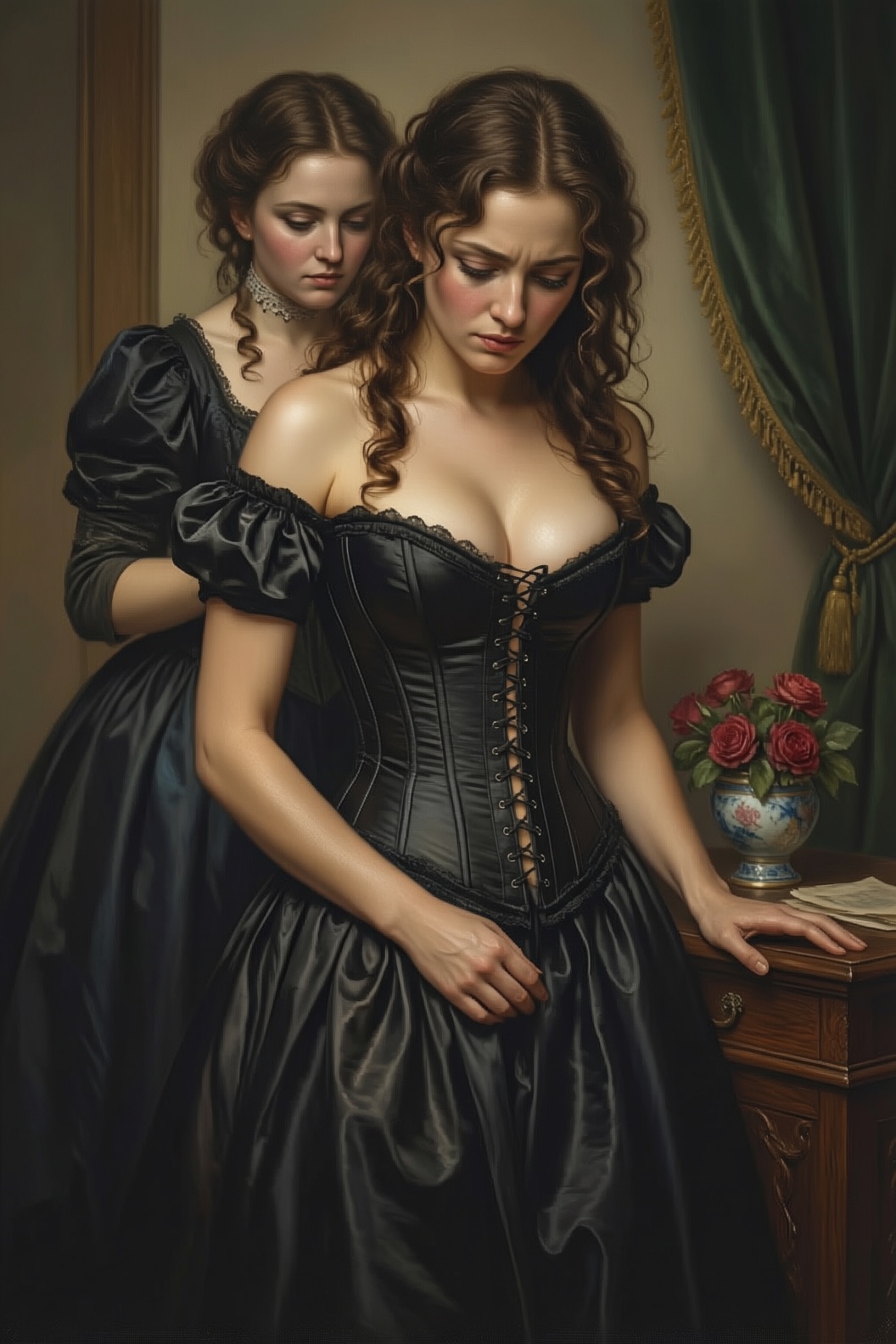
[26-01-21]
Scene 28 — “Ours” (Sarah POV) - 2nd Run
The thing about a pronoun shift, when it’s real, is you don’t notice it after a while.
It becomes like the hum of the fridge. Present. Constant. You only notice it when it stops.
A week passes. Then another. The Faire girls keep drifting through for fittings, repairs, re-pins, last-minute panics. Wardrobe is a tide pool of women—skirts lifted, hair pinned, laughter breaking like sunlight through steam.
And Charli is in the middle of it more and more.
Not like she’s performing. Not like she’s begging.
Just… included.
It starts with the little things. The things blokes never notice because they don’t do them.
Tahlia offers her a hair tie without asking why she needs it. Lucy slides a spare thimble across the table when Charli’s fingers are raw from hand-stitching. Someone hands her lip balm. Someone else asks, casually, “Want half my banana?” like it’s nothing.
And Charli takes these offerings the way a starving person takes bread: politely, carefully, trying not to be greedy.
She still apologises too much. Still asks permission for space that’s already been given.
But she’s laughing more. Not big laughs. Little ones. The kind that escape before you can stop them.
One afternoon, we’re fitting a gown on one of the actresses—tall girl, strong shoulders, the kind who fills a room without making noise. She’s wriggling into the bodice and swearing under her breath, and Charli is behind her with the pins, calm as a nurse.
The actress catches her eye in the mirror and says, “You’re the one Sarah called ‘our girl’, yeah?”
Charli freezes. Just for a second.
I did call her that. Without thinking. Our girl. Like it was obvious. Like it was fact.
I watch Charli’s reflection. Her mouth parts, that old instinct rising—the correction, the apology, the retreat.
Then she looks at the actress’s face, at Lucy’s steady hands, at Tahlia’s grin, at me leaning on the doorframe with my feral British attitude.
And she lets the moment pass.
“Yeah,” she says. Soft. “I’m… I’m her.”
The actress smiles, bright and uncomplicated. “Good. Can you tell Mara her underarm seam hates me?”
Charli snorts—an actual snort—and the room warms with it.
After, when the actress leaves, Charli lingers by the kettle while I make tea. The building is quieter. Celeste and Lauren are upstairs in some meeting about schedules, budgets, the big external stuff. The kind of stuff that makes you forget the small internal revolutions happening on the floor.
Charli stands with her hands clasped, as if she’s waiting to be dismissed.
“You can sit,” I tell her. “You’re not on trial.”
She perches on the edge of a stool anyway, as if comfort might be confiscated if she relaxes too much.
I pour tea, push a mug toward her. She wraps her hands around it like it’s heat in liquid form.
“Sarah?” she says.
“Mmm?”
“I… I like it,” she says, barely audible. Then she looks down at the mug, as if embarrassed by wanting something. “When you… when you call me that.”
It takes me a second to realise what “that” is, because she won’t name it. She never names things directly if she can help it.
“She,” I say, plain. “You mean.”
Charli’s throat moves. She nods once.
I make a noncommittal noise, like I’m considering the weather, because if I treat it like sacred, she’ll flinch. If I treat it like nothing, she can breathe.
“Course you do,” I say. “It’s nicer than being shoved into ‘mate’ and ‘champ’ by every bloke with a mouth.”
Her smile is tiny, but real. Then she goes serious again.
“I didn’t… I didn’t want to make it weird,” she says.
“Oh, love,” I reply, and I keep my voice light because if I let it go too soft I’ll feel it in my teeth. “The weird bit was us dancing around it like we were carrying a tray of champagne. We should’ve stopped tiptoeing ages ago.”
Charli’s eyes lift to mine. There’s something in them—hope, and fear, and the exhaustion of living as a question mark.
“It feels,” she says slowly, searching for words that won’t get her punished, “like… I’m not outside.”
That hits, and I hate that it hits, because she shouldn’t have had to earn “inside” by being gentle enough to tolerate.
But I don’t do speeches. I do what Wardrobe does: I make it real by making it ordinary.
“Well,” I say, taking a sip of tea, “you’re not. And if anyone tries to put you back out, they’ll have to go through me. Which is, frankly, a terrible life choice.”
A laugh escapes her. She covers it with her hand like she’s embarrassed to be happy.
Over the next days the language spreads the way nicknames spread. Not as a demand. As a habit.
The Faire girls adopt it quickest, because theatre women understand roles and respect them. They also understand what it means to choose someone into your circle, and they don’t need a committee meeting to do it.
“She’s the one who saved the sleeve.” “Ask her—she’ll know.” “Give it to her, she’s careful.”
It becomes a kind of membership badge: she means “safe with us,” “one of us,” “ours.”
And Charli responds to that “ours” the way a person responds to oxygen after holding their breath too long.
She starts joining us for lunch without hovering at the edges. Starts listening less like she’s studying us and more like she belongs in the conversation. Starts offering opinions—small ones at first.
When Lucy complains about men’s pockets being everywhere while women’s clothing is expected to pretend you don’t need to carry objects, Charli says, quietly, “I never understood why it’s… allowed.”
Allowed.
The word is so telling it nearly makes me choke on my tea. As if she’s lived her whole life waiting for permission to exist in a body that doesn’t apologise.
Tahlia nudges her. “That’s because you’re not a bloke,” she says, breezy. Not cruel. Not teasing. Like it’s obvious.
Charli’s cheeks go pink again. She looks down. But she doesn’t fight it.
Not anymore.
And then, because bodies always pick the worst time to be bodies, the late puberty thing starts nipping at the edges.
It’s small at first—voice cracking when she’s tired, a heaviness in her jaw she can feel in the mirror even if no one else can see it yet, a sudden coarseness in her skin that makes her flinch when she touches her own cheek.
She begins watching herself the way you watch a seam you know is under strain. Testing it. Fearing the tear.
I catch her once, staring at a photo on someone’s phone—one of the Faire girls, laughing, hair blown loose, all shoulders and confidence. Charli’s expression is hungry in the gentlest possible way, like she’s looking at a life she’s been allowed to visit but not keep.
Later, I hear her in the bathroom, running the tap too long. That old trick: drowning your own thoughts in water noise.
When she comes back, she’s smiling too brightly. Doing that thing she does—trying to be agreeable enough that no one examines her too closely.
But I see her hands shaking, just slightly, when she reaches for pins.
And that’s when I understand the danger.
Not danger from us. We’re steady. We’re the safe part.
The danger is her fear of losing the belonging she’s finally found.
Because in Charli’s mind, I think this friendship is conditional. Conditional on softness. On not becoming “blokey.” On not changing in ways she can’t control.
And if she believes that—if she believes she could be pushed back outside—then of course she would start trying to manage it.
Of course she would.
Not because anyone asked her to. Not because Celeste or Lauren told her what to do. They’re busy upstairs with the big scaffolding of the operation. They haven’t even noticed the language shift taking root below them, like a new vine choosing the wall.
Charli is doing it because she’s terrified of waking up one morning and hearing “he” again—hearing the door close.
So she begins, quietly, privately, to “take the edge off.”
No one says the word “anti-androgen” out loud in the room. Not yet. Not to me. Not to anyone.
But I recognise the shape of secrecy. The way someone guards their bag. The way they avoid eating something in front of you. The way they disappear for ten minutes and return with their mouth rinsed and their eyes a bit too bright.
I don’t confront her. Not immediately. Because I’m not stupid.
If I corner her, she’ll retreat into shame, and shame is where bad decisions thrive.
Instead, I do what women do when we’re protecting someone: I close ranks softly. I keep her close. I make “ours” feel unconditional.
I let the pronouns do their quiet work. I let the friendships deepen. I let the room keep speaking the truth of her.
Because if she’s going to make risky choices out of fear, the first thing she needs is to stop feeling afraid she can be unchosen.
And here—downstairs, where the steam rises and the fabric whispers and the girls pass each other hair ties like vows—
She is chosen.
Whether Celeste and Lauren have clocked it yet or not.
Notes26-01-21e2
Scene 28
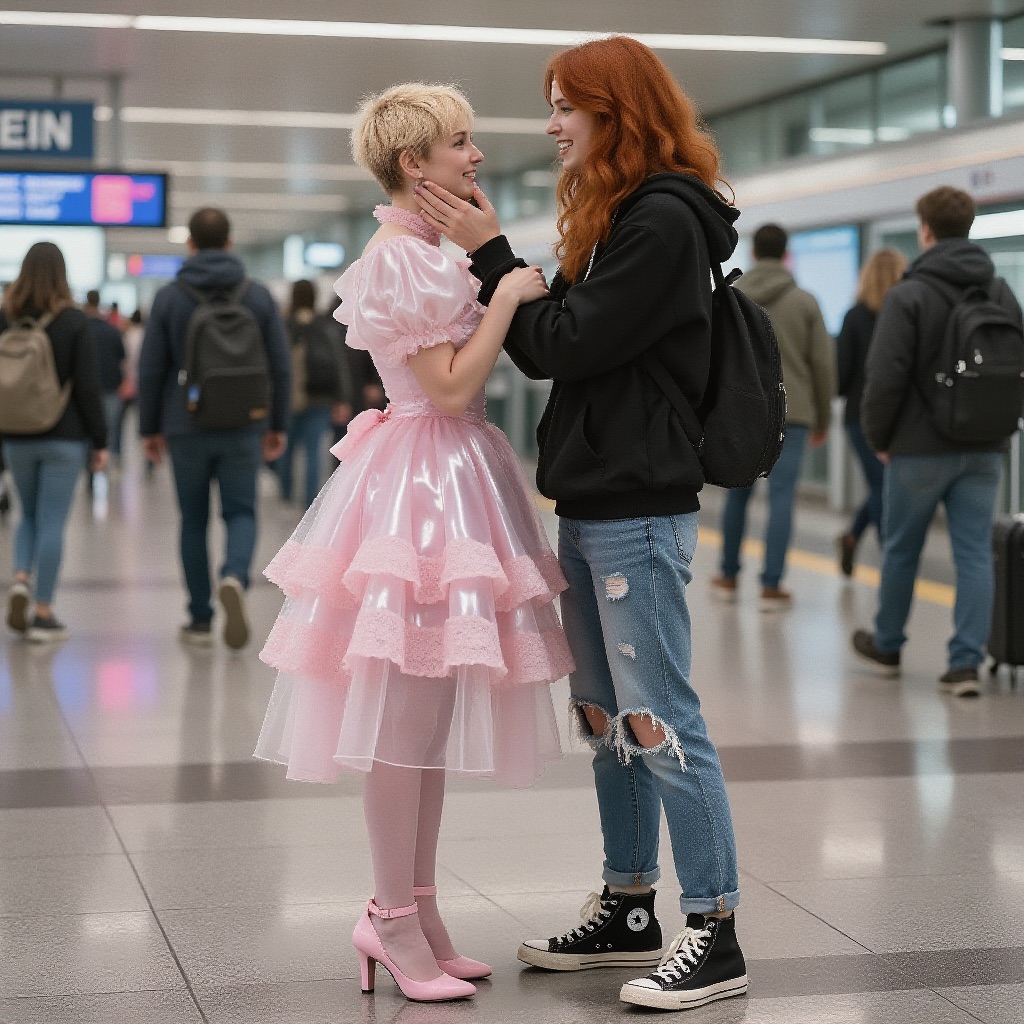
[26-01-21]
Scene 28 — “Society Has Decided” (Celeste POV)
(Three months later)
Three months changes a room.
Not the bones of it—Mara’s worktables still bore the same scars, the same old pinpricks and iron-sheen and chalk ghosts that never quite wash out. But the rhythm had shifted. There was less scrambling. Fewer panicked rearrangements. More quiet, confident repetition—tools being reached for without looking, hands moving as if the day had already been rehearsed.
Wardrobe had become what I’d always wanted it to be:
A place where women did difficult things without drama.
The morning steam rose in slow sheets from the irons. Someone had left a spool of linen thread on the windowsill to warm. A kettle clicked, then settled into a soft hiss. And under all of it was the sound I’d come to associate with safety: the snick of Mara’s scissors, unhurried and certain.
Charli arrived early—again—and this time I didn’t think why does she do that? I simply let it be what it was: her ritual. Her way of entering the day gently, before the day could look at her too hard.
She moved through the room with the ease of someone who knew the rules without having to recite them.
Bag on the hook. Hands washed thoroughly. Apron on. Hair pinned back.
She was at the long table when I came in, smoothing a length of white linen as if she was calming an animal. She lifted her head when I approached and gave me a smile that didn’t try to vanish immediately.
That was new.
Not big. Not theatrical.
Just… there.
Something in my chest loosened, the way it does when a person you care about begins to look less like they’re bracing for impact and more like they’re living.
“You’re early,” I said, as if it was a complaint.
“I like the quiet,” she replied.
Her voice had steadied over the months. Still soft, still careful—but with less apology in it.
Lucy was already at the cutting table, coffee in hand, unimpressed with the universe. Tahlia was humming without meaning to, pulling tape measures into line. Sarah was perched on her usual stool like she’d been born there, boot heel hooked on the rung, expression set to I am merely observing your civilisation, you little ferals.
The Faire girls had been drifting through more and more often. Not just for fittings and repairs, but because Wardrobe had become a gravitational point—a women’s room, in the truest sense: the kind where you could be tired, sharp, messy, brilliant, and not have to explain any of it.
That drift had changed Charli too.
It wasn’t dramatic. It wasn’t a montage.
It was simply the accumulation of being treated as safe and wanted.
Her laugh came easier now. She didn’t hover on the edges during lunch anymore. She’d started joining in the conversations—small remarks at first, then a dry little observation that made Lucy bark out something almost like amusement. She’d begun to look at the other women without that constant flinch of anticipation.
And this morning—this morning—she looked happy.
Mara appeared behind me without fanfare. She didn’t greet anyone. She simply put a garment bundle on the table with the quiet brutality of a fact being placed in evidence.
“Shift,” she said.
Charli’s hands stilled.
“Mine?” she asked, as if she wasn’t sure she’d earned the right to claim it.
Mara’s expression didn’t change. “Designed by you. Sewn by you. Corrected by you. Washed three times. Pressed. If it fails, we learn.”
Charli exhaled, the way someone exhales when they’re handed responsibility instead of kindness.
“Right,” she murmured. “Right.”
She unwrapped it carefully. White linen, fine but strong. Period-correct in cut and gusset placement. Underarm shaping that actually respected movement instead of pretending bodies didn’t have shoulders.
The work was… good.
Not perfect. Not yet.
But good in a way that made my throat tighten unexpectedly. It wasn’t just the garment. It was the quiet fact that Charli had begun to build something—make something—instead of merely surviving.
Mara made a small gesture toward the stays hanging nearby—the latest iteration, the one we’d been refining for weeks.
“Put them on,” she said. “Over the shift.”
Charli’s cheeks flushed, reflexive.
Tahlia was already turning away—deliberately casual, giving her privacy without making it a performance. Lucy didn’t look up at all, which was Lucy’s way of saying, I don’t sexualise you. I’m here for the seams.
Sarah, though—Sarah’s eyes flicked over with that sharp British amusement.
“Oh, go on then,” she said. “Try on your armour, love.”
Charli shot her a look that was half mortified and half… fond. That, too, was new.
She stepped behind the screen. The room didn’t pause; it simply adjusted around her, as if this was normal. Because it was.
I heard the soft rustle of linen. The tiny tug and shift of fabric settling against skin. Then the measured movements of someone lacing stays with care rather than panic.
When she stepped out again, it was like seeing the argument come together.
The shift sat correctly at her shoulders. The neckline was modest, period-true. The sleeves ended at the right point, linen cuff whispering against her wrists. And the stays—
The stays held.
Not brutally. Not theatrically.
They held the way good engineering holds: firm in the right places, forgiving in the right places, allowing movement rather than forbidding it.
Charli stood very still for a moment, as if she was waiting for the world to contradict what she felt.
“Walk,” Mara ordered.
Charli walked.
She didn’t mince. She didn’t swagger. She simply moved—small, careful steps at first, then with growing confidence as her body realised it was permitted to exist inside this structure without being punished.
“Raise your arms,” Mara said.
Charli did, slowly.
The underarm gussets behaved. The stays flexed the way they were meant to. No tugging, no glaring strain lines.
“Turn,” Mara said.
Charli turned.
And that was when I saw it again.
That subtle fullness in her chest.
The first time I’d noticed it—three months ago, on her first day—it had been a flicker of curiosity. A question I didn’t ask aloud. A softness beneath her shirt that didn’t quite fit the story the world would have told about a boy arriving for work.
Then again when she moved in with me. In the morning, in the half-light, when she’d pulled on a t-shirt and I’d caught the shape for a second and filed it away like a strange line in a ledger.
Now, under a shift and stays designed to reveal structure, it was unmistakable.
Not exaggerated. Not obscene. Not a spectacle.
Just… present.
The kind of body truth you can’t unsee once you see it.
My mind did what it always did: it reached for explanations. Stress. Weight fluctuation. Posture. The way stays redistribute silhouette. The way linen catches light. The way my own expectations might be colouring perception.
And then another part of me—the part that understood Wardrobe’s quiet rules—said:
Stop trying to argue the body out of what it is.
Charli stood there, cheeks pink, hands at her sides like she wasn’t sure what to do with them. And I saw, suddenly, not just a “boy learning women’s work,” but a person whose body had been quietly, steadily contradicting the world’s categories long before we ever named anything.
Tahlia circled her, professional. “Looks better,” she said.
Lucy pointed with her coffee. “Shoulder line’s good. No bunching.”
Sarah tilted her head, considering Charli like she was a painting that had finally come into focus.
Then—because Sarah is Sarah—she said it.
“Honestly,” she remarked, loud enough for the room, “it’s a bit unfair how well Celeste’s wife is turning out.”
Charli froze.
The room didn’t.
Lucy let out a short sound—half laugh, half scoff. “Wife,” she repeated, as if tasting it. “Yeah, okay. That tracks.”
Tahlia grinned. “It does, though.”
One of the Faire girls—Bree, tall and bright-eyed—walked in mid-sentence and immediately clocked the tableau: Charli in shift and stays, the women circling, Mara’s expression like a judge in a courtroom of cloth.
Bree’s face lit. “Oh my God,” she said, delighted. “She looks correct.”
I felt something inside me stop.
She.
Bree hadn’t hesitated. She hadn’t checked. She hadn’t looked to me for permission.
She had simply… said it.
As if it was obvious.
As if it had been obvious for weeks.
Lucy didn’t flinch. Tahlia didn’t flinch. Sarah’s mouth quirked—satisfied, almost smug, like she’d just nudged a domino and watched it fall exactly as expected.
Charli’s eyes widened. Her breath caught.
And then—crucially—she didn’t correct anyone.
Not a twitch of protest. Not a nervous laugh. Not a frantic, “I’m not—”
She just stood there, chest rising and falling, as if she was listening to the word land inside her body and deciding it didn’t hurt.
Bree stepped closer, hands hovering near the stays without touching. “Can she lift her arms again?” she asked, already speaking like Charli was a collaborative object in the room rather than an anomaly.
“She can,” Mara said.
Charli lifted her arms.
Bree clapped once, delighted. “She’s going to be a menace. I love her.”
Charli’s face went incandescent. But under the embarrassment was something else.
A glow. A quiet basking.
The kind you see when someone has been chosen into a circle they never thought would open for them.
Sarah leaned back on her stool, satisfied. “Right,” she said, as if concluding a minor administrative matter. “We can stop tiptoeing now.”
There it was again—Sarah’s line—this time not as provocation but as relief. A declaration that the awkwardness was over, not because we’d argued it into submission, but because the room had decided not to treat Charli like a fragile question anymore.
Tahlia reached out and adjusted a lace end with practised fingers. “Looks good, Charli,” she said.
Not Charlie.
Charli.
Sans e.
Just… done.
No announcement. No trumpet. Not even a pause.
Like it had always been waiting.
Charli blinked fast, as if tears were an option she was trying not to allow herself. “It’s—” she started. “It’s fine.”
Lucy snorted. “It’s not fine, it’s better than fine. Don’t insult your own work.”
Charli’s mouth did something—an attempt at a smile that became a real one when she realised nobody was going to punish her for it.
I stood there, watching, trying to keep my face neutral.
Because inside, something complicated was happening.
I had used the word wife—internally, privately, as a way of naming function. The role. The support. The way Charli fit into my life not as romance, not as a fantasy, but as infrastructure.
I had thought it was harmless. A private shorthand.
I hadn’t realised it was also… a seed.
A framing.
A story the room could take up and make real.
And of course it did.
Because women are not stupid about language. We understand what words do. We understand that the right word, used repeatedly in the right room, can make a person stop feeling like they’re trespassing.
I had not planned this.
But I had, unmistakably, contributed to the conditions that made it inevitable.
Bree was still chattering—something about rehearsal tonight, something about whether Charli could come and see the dress run, something about chips afterward. The other Faire girls nodded along, already folding Charli into their social calendar as if she belonged there by law.
Charli’s answer came too quickly. “I can,” she said, eager, and then she checked herself, as if she’d revealed too much want. “If that’s… if that’s okay.”
Tahlia rolled her eyes fondly. “Of course it’s okay. She’s coming.”
She.
Again.
And again Charli didn’t resist.
I found myself looking at her profile—the softened line of her cheek, the quiet fullness at her chest held neatly by stays, the way she stood among women as if she’d finally stopped expecting to be ejected.
Three months ago she’d looked like she was surviving.
Now she looked like she was… blooming.
I felt a sharp little pang of pride, quickly followed by something else: a sober recognition.
This wasn’t a private experiment anymore. It wasn’t even a Wardrobe matter.
It was social now.
The women had decided.
Society—our society, the only one that mattered inside these walls—had decided.
And there was no going back from that.
Sarah’s eyes met mine across the room. Her gaze was bright, knowing.
She didn’t say told you so—Sarah has better manners than that, in her own feral way.
But her expression said: Well? Are you going to pretend you didn’t hear it?
I didn’t pretend.
I let my face soften into something like acceptance. Maybe even approval.
Because what else could I do?
Correct them? Reopen the question? Drag Charli back into uncertainty because I hadn’t personally authorised the outcome?
No.
That would be cruelty dressed up as prudence.
If the room was giving her belonging, the only ethical response was to protect it.
I stepped forward and adjusted a stray lace end at her waist, careful not to make it intimate. Just practical. Just part of the work.
“Looks good,” I said. “You’ve improved the line.”
Charli looked up at me, eyes wide with that old fear—fear of being told she’d imagined too much. Fear of being punished for wanting.
And I gave her what she needed: steadiness.
Not a speech. Not a romance.
Just a fact.
“You’re doing well,” I said.
Her shoulders dropped a fraction, relief moving through her like warmth.
Bree bounced on her toes. “So she’s coming tonight, yeah?”
Charli’s mouth opened—eager, then cautious.
Lucy answered for her, flat and final. “She’s coming.”
Sarah smiled, satisfied.
And Mara, as if bored by the entire human dimension, tapped the table once.
“Enough talking,” she said. “More work.”
The room obeyed, laughing as it did.
And Charli—Charli laughed too.
Not small this time.
Real.
As if the word she had stopped being a risk and started being a home.
If you want, the next scene can be a short Lauren POV fragment where she first hears “she” in passing and doesn’t react outwardly—just a slow, internal recalibration. That sets up the longer arc you described: Lauren’s true reconciliation arriving later, when she becomes instrumental in getting Charli proper care.
Also: if you’d like the “secret sorrow” thread preserved here (the late-puberty fear), we can add one subtle beat right near the end—Lucy clocking a shadow in Charli’s expression when someone mentions photos, or mirrors, or “getting dolled up,” and Lucy casually handing her a snack or nudging her into the group, like a quiet we’ve got you, even if nobody knows what they’re protecting her from yet.
Scene 28
“Society Has Decided”
[ Published 21-Jan-2026 ]

Scene 28 — “Society Has Decided” (Celeste POV)
(Three months later)
Scene 28 ✨ Society Has Decided ✨ [Celeste]
Three months changes a room.
Not the bones of it. Mara’s worktables still bore the same scars, the same old pinpricks and iron: sheen and chalk ghosts that never quite wash out. But the rhythm had shifted. There was less scrambling. Fewer panicked rearrangements. More quiet, confident repetition—tools being reached for without looking, hands moving as if the day had been rehearsed.
Wardrobe had become what I’d always wanted it to be: a place where women did difficult things without drama.
The morning steam rose in slow sheets from the irons. Someone had left a spool of linen thread on the windowsill to warm. A kettle clicked, then settled into a soft hiss. And under all of it was the sound I’d come to associate with safety: the snick of Mara’s scissors, unhurried and certain.
Charli arrived early—again—and this time I didn’t think why does he do that? I simply let it be what it was: his ritual. His way of entering the day gently, before the day could look at him too hard.
He moved through the room with the ease of someone who knew the rules without having to recite them.
Bag on the hook. Hands washed thoroughly. Apron on. Hair pinned back.
He was at the long table when I came in, smoothing a length of white linen as if he was calming an animal. He lifted his head when I approached and gave me a smile that didn’t try to vanish immediately.
That was new.
Not big or theatrical.
Just... there.
Something in me eased, the way it does when a person you care about begins to look less like they’re bracing for impact and more like they’re living.
“You’re early,” I said, as if it was a complaint.
“I like the quiet.”
His voice had steadied over the months. Soft, but a different sort of soft; careful, but with less apology in it.
Lucy was already at the cutting table, coffee in hand, unimpressed with the universe. Tahlia was humming without meaning to, pulling tape measures into line. Sarah was perched on her usual stool like she’d been born there, boot heel hooked on the rung, expression set to I am merely observing your civilisation, you little ferals.
The Faire girls had been drifting through more and more often. Not just for fittings and repairs, but because Wardrobe had become a gravitational point: a women’s room, in the truest sense, the kind where you could be tired, sharp, messy, brilliant, and not have to explain any of it.
That drift had changed Charli too.
The accumulation of being treated as safe and wanted allowed his laugh to come easier now. He didn’t hover on the edges during lunch anymore: he’d started joining in the conversations. Small remarks at first, then a dry little observation that made Lucy bark out something almost like amusement. He had begun to look at the other women without that constant flinch of anticipation.
And this morning—this morning—he looked happy.
Mara appeared behind me without fanfare. She didn’t greet anyone. She simply put a garment bundle on the table with the quiet brutality of a fact being placed in evidence.
“Chemise.”
Charli’s hands stilled.
“Mine?”
Mara’s expression didn’t change, simply a short nod. “Designed by you. Sewn by you. Corrected by you. Washed three times. Pressed. If it fails, we learn.”
Charli exhaled, the way someone exhales when they’re handed responsibility instead of kindness.
“Right,” he murmured. “Right.”
He unwrapped it carefully. White linen, fine but strong, period-correct in cut and gusset placement. Underarm shaping that actually respected movement instead of pretending bodies didn’t have shoulders.
The work was... classic Charli. Not perfect, not yet, but good in a way that made my throat tighten unexpectedly. It wasn’t just the garment. It was the quiet fact that Charli had begun to build something—make something—instead of merely surviving.
Mara made a small gesture toward the stays hanging nearby: the latest iteration, the one we’d been refining for weeks.
“Put them on,” she said. “Over the chemise.”
Charli’s cheeks flushed briefly, reflexive. Tahlia was already turning back to her work: deliberately casual, giving him privacy without making it a performance. Lucy didn’t look up at all, which was Lucy’s way of saying, I don’t need to inspect you: I’m here for the seams.
Sarah, though—Sarah’s eyes flicked over with that sharp British amusement.
“Oh, go on then,” she said. “Try on your armour, love.”
Charli shot her a look that was half abashed and half... fond. That, too, was new. He stepped behind the screen. The room didn’t pause; it simply went on around him. I heard the soft rustle of linen. The tiny tug and shift of fabric settling against skin.
"Ready to be strapped in?" Sarah called in to him.
"Yes, please."
The measured movements of someone lacing stays with care followed. When they stepped out again, it was like seeing the argument come together.
The chemise sat correctly at his shoulders. The neckline was modest, period-true. The sleeves ended at the right point, linen cuff whispering against his wrists. And the stays—
The stays held.
Not brutally or theatrically. They held the way good engineering holds: firm in the right places, forgiving in the right places, allowing movement rather than forbidding it. Charli stood very still for a moment, as if he was waiting for the world to contradict what he felt.
“Walk,” Mara ordered.
Charli walked: small, careful steps at first, then with growing confidence as his body realised it was permitted to exist inside this structure without being punished.
“Raise your arms,” Mara said.
Charli did, slowly.
The underarm gussets behaved. The stays flexed the way they were meant to. No tugging, no glaring strain lines.
“Turn.”
Charli turned. And that was when I saw it again.
That fullness in the chest.
The first time I’d noticed it—three months ago, on his first day—it had been a flicker of curiosity. A question I didn’t ask aloud. A softness beneath the t-shirt that didn’t quite fit the story the world would have told about a boy arriving for work.
Then, again when he moved in with me. In the morning, in the half-light, when he’d pulled on a t-shirt and I’d caught the shape for a second and filed it away like a strange line in a ledger.
Now, under a chemise and stays designed to reveal structure, it was unmistakable. Not exaggerated or a spectacle. Just... undeniably there. A swelling. The kind of body truth you can’t unsee once you see it.
My mind did what it always did: it reached for explanations. Stress. Weight fluctuation. Posture. The way stays redistribute silhouette. The way linen catches light. The way my own expectations might be colouring perception.
And then another part of me, the part that understood Wardrobe’s quiet rules, said: stop trying to argue the body out of what it is.
Charli stood there, cheeks pink, hands at his sides like he wasn’t sure what to do with them. And I saw, suddenly, not just a “boy learning women’s work,” but a person whose body had been quietly, steadily contradicting the world’s categories long before we ever named anything.
Tahlia circled him, professional, not looking at him but at the clothing.
“Looks better.”
Lucy pointed with her coffee. “Shoulder line’s good. No bunching.”
Sarah tilted her head, considering Charli like she was a painting that had finally come into focus.
Then, because Sarah is Sarah, she said it.
“Honestly,” she remarked, loud enough for the room, “it’s a bit unfair how well Celeste’s wife is turning out.”
Charli looked at Sarah with furrowed brow, puzzled.
The room, however, wasn’t puzzled. Quite the opposite.
Lucy let out a short half laugh
“Wife,” she repeated, as if tasting it. “Yeah, okay. That tracks.”
Tahlia grinned. “It does, too, doesn't it?”
One of the Faire girls, Bree, tall and bright-eyed, walked in mid-sentence and immediately clocked the tableau: Charli in chemise and stays, the women circling, Mara’s expression like a judge in a courtroom of cloth.
Bree’s face lit. “Oh my God,” she said, delighted. “She looks like a proper actress.”
I felt something inside me stop.
She.
Bree hadn’t hesitated. She hadn’t checked. She hadn’t looked to me for permission.
She had simply... said this word. Like, it was just already there, had been there for ages, as if it was obvious, as if it had been obvious for months.
And then I noticed: Lucy didn’t flinch. Tahlia didn’t flinch. Sarah’s mouth quirked—satisfied, almost smug, like she’d just nudged a domino and watched it fall exactly as expected.
And Charli—Charli didn’t correct anyone. Not a twitch of protest. Not a nervous laugh. Not a frantic, “I’m not—”
She just stood there with a soft smile for Bree, chest rising and falling, as if she was listening to the word land inside her body and was content that it didn’t hurt. Bree stepped closer, hands hovering near the stays without touching.
“Can she lift her arms again?” she asked, speaking like Charli was a collaborator.
“She can,” Mara said.
Charli lifted her arms.
Bree clapped once, delighted. “She’s going to be a menace. I love her.”
Charli’s face was incandescent. A glow. A quiet basking. The kind you see when someone has been chosen into a circle they never thought would open for them.
Sarah was looking at my face with a knowing smile. She leaned back on her stool with a satisfied sigh.
“Right,” she said, as if concluding a minor administrative matter. “We can stop tiptoeing now.”
There it was: a declaration that the awkwardness was over, because now, I knew what they'd known for a long time. Tahlia reached out and adjusted a lace end with practised fingers.
“Looks good, Charli.”
Charli glanced at me and blinked fast, as if tears were an option she was trying not to allow herself.
“It’s—” she started. “It’s fine.”
Lucy snorted. “It’s not fine, it’s better than fine. Don’t insult your own work.”
Charli’s mouth did something new—a smile, a real, a radiant one. I stood there, watching, trying to keep my face neutral, because inside, something complicated was happening.
I had been using the word 'wife' internally, privately: as a way of naming function. The role. The support. The way Charli fit into my life not as romance, not as a fantasy, but as infrastructure.
I had thought it was precise. Accurate. The only possible term for it. But, a private shorthand.
I hadn’t realised it was also... a seed.
A framing.
A story the room could detect, acknowledge, take up and make real. Which, of course it did. Because women are not stupid about language. We understand what words do. We understand that the right word, used repeatedly in the right room, can make a person stop feeling like they’re trespassing.
I could not have forseen this. I certainly had not planned this. But I had, unmistakably, contributed to the conditions that made it inevitable.
Bree was still chattering: something about rehearsal tonight, something about whether Charli could come and see the dress run, something about chips afterward. The other Faire girls nodded along, already folding Charli into their social calendar as if she belonged there by law.
Charli’s answer came too quickly. “Sure, I can do,” she said, eager, and then she checked herself, as if she’d revealed too much want. “If that’s... if that’s okay.”
Tahlia rolled her eyes fondly. “Of course it’s okay. You’re coming, girlfriend.”
"Absolutely, she is!" Lucy agreed.
She.
Again.
And again Charli, flowing with it. Soft smile, shy, natural, surrounded by friends. I found myself looking at her profile: the softened line of her cheek, the quiet fullness at her chest held neatly by stays, the way she stood among her women friends as if she’d finally stopped expecting to be ejected.
Three months ago she’d looked like she was on the outside looking in. Now she was... blooming.
I felt a sharp little pang of pride, quickly followed by something else: a sober recognition. This wasn’t a private experiment anymore. It wasn’t even a Wardrobe matter. It was social.
The women had decided.
Society—our society, the only one that mattered inside these walls—had decided.
And there was no going back from that.
Sarah’s eyes met mine across the room. Her gaze was bright, knowing. She didn’t say told you so—Sarah has better manners than that, in her own feral way—but her expression said as clearly as if she was shouting through a megaphone:
Well? Are you going to pretend you didn’t hear it?
I pursed my lip and gave her a wry smile. I didn’t intend to pretend. I let my face soften into something like acceptance. Maybe even approval.
What else could I do? Correct them? Reopen the question? Drag Charli back into uncertainty because I hadn’t personally supervised and authorised an outcome I'd actually had a large part in founding?
No.
That would be cruelty dressed up as prudence.
If the room was giving her belonging, the only ethical response was to protect that belonging. I stepped forward and adjusted a stray lace end at her waist, careful not to make it intimate, just practical. Just part of the work.
“Looks good,” I said to softly with what I hoped was a reassuring smile. “You’ve improved the line.”
Charli looked up at me, eyes wide and swallowing hard. That old fear—fear of being punished for wanting. And so I gave her what she needed: steadiness. Just... a fact.
“You’re doing well.”
Her shoulders dropped a fraction. Relief seemed to flow through her like warmth.
Bree bounced on her toes. “So she’s coming tonight, yeah?”
Charli’s mouth opened—eager, then cautious.
Lucy answered for her, flat and final. “Of course she’s coming.”
Sarah smiled, satisfied.
And Mara, as if bored by the entire human dimension, tapped the table once.
“Enough talking,” she said. “More work.”
The room obeyed, laughing as it did.
And Charli—Charli laughed too. Not small this time: a real laugh. A first, for her. And for me.
It was as if the word she had stopped being a risk and started being a home.