Art and Writing
Foreword
Welcome. 😊
This is a creative site, gathering several strands of my creative work: music, visual art, and fiction. Some pieces are polished, some are exploratory, and some are fragments of a larger story still finding its final shape.
A good place to start is the central work: Celeste’s Girl. Set at a Historical Faire in modern Victoria, Wardrobe becomes more than a department: it becomes a school of belonging. Within its rules, ledgers, fittings, standards, and female authority,
Celeste’s Girl follows Charlie, a gentle, self-effacing young person who enters the women-led world of Wardrobe at a Historical Faire and gradually discovers that the role everyone else seems to see in him is not performance, disguise, or humiliation, but a more truthful way of being. Charlie learns first to function, then to belong, and finally to recognise herself as Charlotte. Around her, the women who guide, test, protect, and sometimes mishandle her must confront their own assumptions about care, power, agency, and love.
Under the influence of Celeste, Mara, Sarah, Lauren, and the wider female structure of Wardrobe, Charlie learns competence, safety, discipline, presentation, and belonging. What begins as adaptation—doing what the work requires, wearing what fits, accepting rules that make the department function—slowly becomes revelation. Charlie becomes Charli, then Charlotte: not because someone forces a costume onto him, but because the practical, emotional, and social demands of Wardrobe allow the person already there to emerge.
The story is also about Celeste discovering the danger of her own perception. She sees Charlotte early—perhaps before Charlotte can bear to see herself—and she has a gift for naming truths before anyone else has language for them. But being right does not make her innocent. Her intelligence, confidence, and influence shape outcomes. The story therefore asks what happens when love, insight, desire, and control become tangled, and whether a person can help reveal another's truth without claiming ownership of it.
These pages now centre on the developing world of Celeste’s Girl. The gowns, stays, ledgers, fittings, and period settings are not the point in themselves. They are the instruments through which the story examines identity, work, authority, safety, and belonging. Within that structure, Charlie’s gradual emergence as Charlotte becomes less a transformation than a recognition: the discovery of a self that could only become visible in the right company.
So, before the stories and images, a statement of intent: women Were never the footnote.
This site is grounded in a simple refusal: women are not the supporting cast of human history.
For centuries, patriarchy trained societies to treat men as default and women as exception—useful, ornamental, obedient, domestic, secondary. That mindset did not merely limit women. It cancelled genius, labour, ambition, authority, anger, wit, desire, and whole lives before they were allowed to become visible.
The Technology
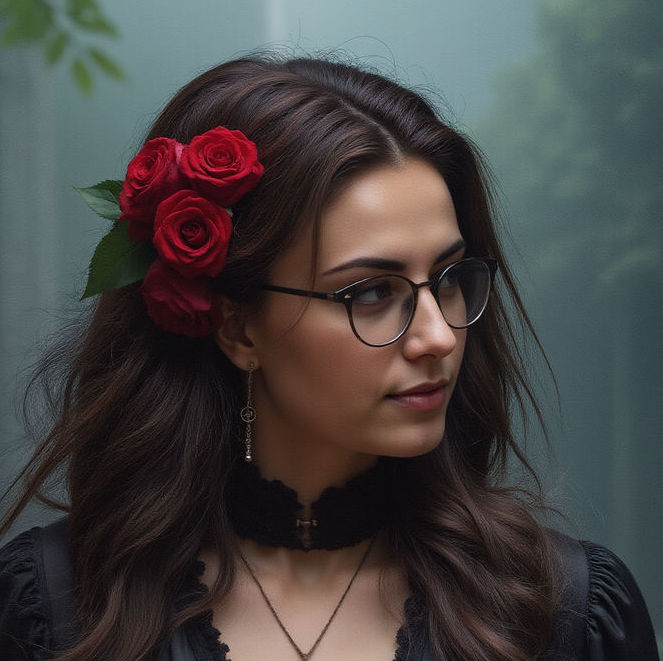
The visual work here was created using ComfyUI, a node-based Stable Diffusion interface to vision models. The vision models are designed for creating images based on a text prompt, or in some cases, another image. This gives me the flexibility to build, test, revise, and refine images as part of the storytelling process.
The characters — faces, mainly — were gleaned from a site called "this person does not exist". Character identity originates from an artificially generated face depicting no real person. The source portrait is not reproduced. Subsequent identity references and final illustrations are newly AI-generated images. In other words, I'm not using the originally-generated images, but derivatives of derivatives (low-ranking adapter).
We make "synthetic provenance only" a casting rule for the Local Identity Models: there will be no identifiable real-person source photographs at all. This gives the whole cast a clean boundary from the outset.
The text is accompanied by audio files of the narration, recorded for the most part in ElevenLabs, a state-of-the-art Text-To-Speech audio file generator. The audio files are embellished by short clips of the sort of music that provided the emotional atmosphere when I wrote.
The music was created by either writing the music myself, or by transcribing notes from musical scores (PDF) into MuseScore, then rendering and refining the result in Reaper, a digital audio workstation. I only use public-domain or otherwise permissible source material: the musical scores.
Large Language Models are a central part of my creative workflow — not as a substitute for imagination, but as a demanding collaborator: useful for research, structure, revision, and turning rough language into clean, enjoyable prose.
What this is NOT
This story is still in progress, somewhere around the middle of its second act. It is not a finished monument. It is a working structure.
Its purpose is clear: agency, respect, consent, safety, and the protection of the vulnerable.
Wardrobe is built on standards. No one gets to dominate, coerce, objectify, or exercise privilege there without consequences. Harm may occur; stories need friction. But harm is not treated as spectacle, romance, or entertainment. When boundaries are crossed, there are consequences.
Because standards mean very little unless they are enforced.
That may make the story uncomfortable for some readers. It does not flatter entitlement. It does not reward coercion. It does not present vulnerability as something to consume.
This is not a story about permission to look.
It is a story about who has power, who has safety, who is believed, and who is finally allowed to stand at the centre of her own life.
I am not writing it to chase a market. I am writing it because the subject matters to me, and out of a moral imperative.
Images For The Story
Images Link
🌷