Scene 37
[Moving through different scenarios for Scene 37]
Notes26-01-22e
✨ Sarah's Eyes ✨

[26-01-05]
Scene 37 — “Sarah’s Eyes” (Sarah POV)
Wardrobe in the morning is a lie you tell yourself in order to function.
You walk in and pretend it’s just work—just fabric, just scissors, just steam and chalk and numbers—and if you do it well enough, you can almost forget that the room is actually a living thing that keeps score.
I arrive on time because I’m not feral.
Also because arriving early in Wardrobe is a type of currency, and I’m not in the mood to spend mine when I don’t need to.
The room is already doing its morning inhale: kettle click, iron hiss, Mara’s presence like a weather front you can feel before you see it. Celeste is at the ledger, of course. She looks annoyingly composed, the way she always looks when she’s holding three plans in her head and refusing to let anyone smell it.
Then Charli comes in.
And I know.
Not because she’s wearing something dramatic—she isn’t. Not because she’s suddenly strutting—she’s not. It’s subtler than that, which is why it’s so obvious.
It’s in the way she enters the room as if she expects the floor to hold her.
It’s in the way she hangs her bag without that tiny flinch, the old reflex of “am I in the way?” It’s in the way she washes her hands like it’s a ritual, not a penance.
Most of all it’s in her face.
Not prettier. Not different in any cheap, male-gaze way.
Just… settled.
Like someone’s turned down the background alarm.
I perch on my stool with my coffee and watch her move.
Charli goes straight to the cap station, checks the tie tension without fuss, and adjusts the knot by a millimetre like she’s been doing it her whole life. No apology. No looking around for permission. No waiting for someone to tell her she’s doing it right.
She already knows the standard.
That’s the entire difference.
A girl who believes she belongs behaves like a girl who belongs. Revolutionary concept, honestly.
I flick my eyes over to Celeste.
Celeste is writing in the ledger. Her face is neutral. Her posture is “adult.” Her whole body is saying: Nothing to see here, everyone, please return to your assigned competence.
And yet.
There’s a softness in her attention that wasn’t there before. Not the kind you can accuse her of. Not the kind that would get her hauled into some HR nightmare.
It’s more like a gravitational shift.
Like she’s orienting herself around Charli without letting anyone hear the click.
That’s how you know it’s serious.
Celeste doesn’t do sloppy.
Mara barks an instruction. Lucy passes a pattern. Tahlia mutters something about seam allowance like it’s a religion. The room keeps moving.
Charli keeps moving with it.
And the glow—yes, glow, I’ll say it because I’m not afraid of the word—doesn’t look like excitement.
It looks like safety.
Which is when it hits me, with the kind of clarity that makes me slightly annoyed:
They’ve crossed the line.
Not the obvious one. Not the scandal one. The real line.
The line where it stops being “we’re keeping her safe” and becomes “we’re keeping each other.”
I sip my coffee and watch Celeste’s hands.
I’ve watched those hands do brutal kindness. I’ve watched her set standards that make men wilt and women straighten. I’ve watched her make decisions that hold the room together without asking anyone’s permission.
If she’s chosen Charli, it won’t be accidental.
It also won’t be messy.
Which means I have only one question, really.
Is it clean?
I wait for the tell.
It comes a few minutes later, almost nothing: Charli passes close to Celeste’s table, pauses half a beat, and says softly, “Morning.”
Celeste doesn’t look up right away.
She finishes writing first.
Then she looks up, meets Charli’s eyes for exactly the length of time that is appropriate, and says, “Morning.”
No lingering. No smile that could be called indulgent. No warmth used like candy.
But Charli’s face changes—just a fraction—as if that single, controlled acknowledgement has landed somewhere deep and stabilising.
Charli moves on.
Celeste returns to the ledger.
And I understand, with reluctant admiration: yes.
Clean.
Off the clock, on the clock, it stays separate. Whatever they’re building, it isn’t being built on Charli’s neediness or Celeste’s power.
It’s being built on structure.
On consent.
On rules.
Which, in this room, is the closest thing we have to romance anyway.
I hop down from my stool and drift over to the ledger table because I’m me, and because if I don’t say something, my tongue will rot.
I lean an elbow on the edge—casual, but not careless. Mara would murder me if I left a coffee ring.
Celeste doesn’t look up.
“Interesting morning,” I say lightly.
Celeste’s pen continues moving. “Is it.”
“Yes,” I say. “You’re doing that thing where you pretend the room isn’t a room.”
That earns me a glance. Cool. Patient. Slightly murderous.
“Sarah,” she says, like a warning.
I hold up a hand. “Relax. I’m not asking for details.”
Celeste’s eyes narrow. “Good.”
I take a sip of coffee like I’ve got all day.
I lower my voice, because I’m not a monster.
“She looks good,” I say. “Properly good.”
Celeste’s pen pauses for the smallest moment.
Then resumes.
“Yes,” she says, flat.
I tilt my head. “And you?”
Celeste finally looks up fully.
Her face is calm. Too calm.
“Me,” she says, “am doing my job.”
I hum. “Mm. And your job is… what? Keeping distance forever? Or keeping it safe?”
Celeste’s gaze holds mine.
It’s not defensive.
It’s… sharp. Considered.
“Keeping it safe,” she says.
There it is.
No confession. No romance novel nonsense.
Just a woman stating her intention like a policy.
It should be cold.
It isn’t.
It’s devotion expressed in the only language Celeste trusts: responsibility.
I nod once.
“Good,” I say. “Because if you hurt her—”
“I won’t,” Celeste cuts in.
Not angry. Not dramatic.
Certain.
And I believe her.
Because I’ve watched her build a whole room out of certainty.
I let the threat dissolve into something more useful.
“I’m not worried you’ll hurt her,” I say, honest now. “I’m worried you’ll forget you’re allowed to want her.”
Celeste’s expression flickers—annoyance, maybe. Or recognition.
“Go back to your work, Sarah,” she says, and it’s the closest thing to tenderness she’s ever offered me.
I grin. “Gladly.”
I start to turn away, then pause.
“One more thing,” I add, softer.
Celeste sighs like she’s suffering.
I keep my eyes on the room, not on her.
“If she’s glowing,” I say, “it’s because she finally believes us.”
Celeste’s voice comes quiet, almost to herself.
“I know.”
I walk back to my stool and sit down.
Charli is at the table now, pinning cleanly, speaking easily to Bree, laughing without snatching the laugh back. She looks like a girl who has stopped waiting for the trap.
And Celeste—Celeste sits at the ledger with her spine straight and her face calm, doing her best impression of a woman who has everything under control.
Which, frankly, is adorable.
Because I can see the truth anyway.
The room has shifted.
The story has shifted.
And I, Sarah of the sharp tongue and the excellent instincts, will be damned if I don’t keep one eye on it—not to interfere, not to gossip, but to make sure the rules stay what they are:
No hooks.
No spectacle.
No men’s ideas of romance.
Just two women doing the only thing that matters.
Keeping it clean.
Keeping her safe.
And letting love grow the way it should:
Quietly.
Deliberately.
Like a seam you don’t notice until you realise the whole garment finally fits.
Notes26-01-22e
was Scene 37

[26-01-22]
Scene 37 — “Sarah’s Eyes” (Sarah POV)
Wardrobe in the morning is a lie you tell yourself in order to function.
You walk in and pretend it’s just work—just fabric, just scissors, just steam and chalk and numbers—and if you do it well enough, you can almost forget that the room is actually a living thing that keeps score.
I arrive on time because I’m not feral.
Also because arriving early in Wardrobe is a type of currency, and I’m not in the mood to spend mine when I don’t need to.
The room is already doing its morning inhale: kettle click, iron hiss, Mara’s presence like a weather front you can feel before you see it. Celeste is at the ledger, of course. She looks annoyingly composed, the way she always looks when she’s holding three plans in her head and refusing to let anyone smell it.
Then Charli comes in.
And I know.
Not because she’s wearing something dramatic—she isn’t. Not because she’s suddenly strutting—she’s not. It’s subtler than that, which is why it’s so obvious.
It’s in the way she enters the room as if she expects the floor to hold her.
It’s in the way she hangs her bag without that tiny flinch, the old reflex of “am I in the way?” It’s in the way she washes her hands like it’s a ritual, not a penance.
Most of all it’s in her face.
Not prettier. Not different in any cheap, male-gaze way.
Just… settled.
Like someone’s turned down the background alarm.
I perch on my stool with my coffee and watch her move.
Charli goes straight to the cap station, checks the tie tension without fuss, and adjusts the knot by a millimetre like she’s been doing it her whole life. No apology. No looking around for permission. No waiting for someone to tell her she’s doing it right.
She already knows the standard.
That’s the entire difference.
A girl who believes she belongs behaves like a girl who belongs. Revolutionary concept, honestly.
I flick my eyes over to Celeste.
Celeste is writing in the ledger. Her face is neutral. Her posture is “adult.” Her whole body is saying: Nothing to see here, everyone, please return to your assigned competence.
And yet.
There’s a softness in her attention that wasn’t there before. Not the kind you can accuse her of. Not the kind that would get her hauled into some HR nightmare.
It’s more like a gravitational shift.
Like she’s orienting herself around Charli without letting anyone hear the click.
That’s how you know it’s serious.
Celeste doesn’t do sloppy.
Mara barks an instruction. Lucy passes a pattern. Tahlia mutters something about seam allowance like it’s a religion. The room keeps moving.
Charli keeps moving with it.
And the glow—yes, glow, I’ll say it because I’m not afraid of the word—doesn’t look like excitement.
It looks like safety.
Which is when it hits me, with the kind of clarity that makes me slightly annoyed:
They’ve crossed the line.
Not the obvious one. Not the scandal one. The real line.
The line where it stops being “we’re keeping her safe” and becomes “we’re keeping each other.”
I sip my coffee and watch Celeste’s hands.
I’ve watched those hands do brutal kindness. I’ve watched her set standards that make men wilt and women straighten. I’ve watched her make decisions that hold the room together without asking anyone’s permission.
If she’s chosen Charli, it won’t be accidental.
It also won’t be messy.
Which means I have only one question, really.
Is it clean?
I wait for the tell.
It comes a few minutes later, almost nothing: Charli passes close to Celeste’s table, pauses half a beat, and says softly, “Morning.”
Celeste doesn’t look up right away.
She finishes writing first.
Then she looks up, meets Charli’s eyes for exactly the length of time that is appropriate, and says, “Morning.”
No lingering. No smile that could be called indulgent. No warmth used like candy.
But Charli’s face changes—just a fraction—as if that single, controlled acknowledgement has landed somewhere deep and stabilising.
Charli moves on.
Celeste returns to the ledger.
And I understand, with reluctant admiration: yes.
Clean.
Off the clock, on the clock, it stays separate. Whatever they’re building, it isn’t being built on Charli’s neediness or Celeste’s power.
It’s being built on structure.
On consent.
On rules.
Which, in this room, is the closest thing we have to romance anyway.
I hop down from my stool and drift over to the ledger table because I’m me, and because if I don’t say something, my tongue will rot.
I lean an elbow on the edge—casual, but not careless. Mara would murder me if I left a coffee ring.
Celeste doesn’t look up.
“Interesting morning,” I say lightly.
Celeste’s pen continues moving. “Is it.”
“Yes,” I say. “You’re doing that thing where you pretend the room isn’t a room.”
That earns me a glance. Cool. Patient. Slightly murderous.
“Sarah,” she says, like a warning.
I hold up a hand. “Relax. I’m not asking for details.”
Celeste’s eyes narrow. “Good.”
I take a sip of coffee like I’ve got all day.
I lower my voice, because I’m not a monster.
“She looks good,” I say. “Properly good.”
Celeste’s pen pauses for the smallest moment.
Then resumes.
“Yes,” she says, flat.
I tilt my head. “And you?”
Celeste finally looks up fully.
Her face is calm. Too calm.
“Me,” she says, “am doing my job.”
I hum. “Mm. And your job is… what? Keeping distance forever? Or keeping it safe?”
Celeste’s gaze holds mine.
It’s not defensive.
It’s… sharp. Considered.
“Keeping it safe,” she says.
There it is.
No confession. No romance novel nonsense.
Just a woman stating her intention like a policy.
It should be cold.
It isn’t.
It’s devotion expressed in the only language Celeste trusts: responsibility.
I nod once.
“Good,” I say. “Because if you hurt her—”
“I won’t,” Celeste cuts in.
Not angry. Not dramatic.
Certain.
And I believe her.
Because I’ve watched her build a whole room out of certainty.
I let the threat dissolve into something more useful.
“I’m not worried you’ll hurt her,” I say, honest now. “I’m worried you’ll forget you’re allowed to want her.”
Celeste’s expression flickers—annoyance, maybe. Or recognition.
“Go back to your work, Sarah,” she says, and it’s the closest thing to tenderness she’s ever offered me.
I grin. “Gladly.”
I start to turn away, then pause.
“One more thing,” I add, softer.
Celeste sighs like she’s suffering.
I keep my eyes on the room, not on her.
“If she’s glowing,” I say, “it’s because she finally believes us.”
Celeste’s voice comes quiet, almost to herself.
“I know.”
I walk back to my stool and sit down.
Charli is at the table now, pinning cleanly, speaking easily to Bree, laughing without snatching the laugh back. She looks like a girl who has stopped waiting for the trap.
And Celeste—Celeste sits at the ledger with her spine straight and her face calm, doing her best impression of a woman who has everything under control.
Which, frankly, is adorable.
Because I can see the truth anyway.
The room has shifted.
The story has shifted.
And I, Sarah of the sharp tongue and the excellent instincts, will be damned if I don’t keep one eye on it—not to interfere, not to gossip, but to make sure the rules stay what they are:
No hooks.
No spectacle.
No men’s ideas of romance.
Just two women doing the only thing that matters.
Keeping it clean.
Keeping her safe.
And letting love grow the way it should:
Quietly.
Deliberately.
Like a seam you don’t notice until you realise the whole garment finally fits.
Notes26-01-23e
Scene 50
[26-01-23]
Scene 50 — “Where It’s Safe” (Celeste POV)
Charli came home like someone returning to a house after nearly losing it.
Quiet. Careful. Eyes too bright, posture a fraction too controlled. She took her shoes off by the door with obsessive neatness, as if straight lines could prevent mistakes. She hung her bag on the hook and stood there for a second too long, hands hovering, waiting for permission the way she used to.
I watched her from the kitchen.
Not hidden. Not testing.
Just… observing the new shape of her caution.
“Hi,” I said.
Charli’s gaze snapped to mine with a kind of hungry relief that she tried to swallow back immediately.
“Hi,” she whispered.
She didn’t move toward me.
That was the first sign she’d understood.
Not “I’m in trouble.”
Not “I’m unworthy.”
But: this matters enough to protect.
I set two mugs on the table, poured tea, and kept my movements ordinary on purpose. Normality is a signal. It tells the body: no danger here.
Charli came to the table and sat in the chair opposite me like she was afraid the space between us was an exam.
She folded her hands in her lap.
Her eyes didn’t linger on my mouth.
Her shoulders didn’t soften the way they had last night.
She was trying so hard to be careful that she’d turned careful into distance.
I let her sit in that for a moment. Let her prove she could.
Then I said, gently, “You can look at me.”
Charli blinked, startled—as if she’d been caught doing something wrong in reverse.
“I—” she began.
“Charli,” I said, calm. “Looking is allowed.”
Her eyes lifted slowly to my face. They were still red-rimmed from the day, but steadier now. Present. Listening.
“I’m proud of you,” I said.
The sentence did something to her. Her breath caught. Her chin trembled once, just once, before she contained it.
“I messed up,” she whispered.
“Yes,” I said. “And then you learned.”
Charli swallowed. “I didn’t… I didn’t understand. Not really. I thought—” She stopped, frustrated, then tried again. “I thought it was… little. Just… us.”
“It was us,” I said quietly. “And it was also a room full of women who have paid for men’s stories about them.”
Charli nodded, small and precise, like she was writing it into her bones.
“I saw Sarah,” she murmured. “When she looked. Not… angry. Just…” She searched. “Alert.”
“Yes,” I said.
“And Mara,” Charli added, and the name came out with a little shiver of respect. “Mara didn’t even need to say anything.”
“No,” I agreed. “Mara is a boundary with legs.”
Charli made a tiny sound that might have been a laugh if she’d allowed herself more oxygen.
I waited until her shoulders lowered a fraction. Then I placed my hand on the table—palm up. Not reaching for her. Offering.
Charli’s eyes dropped to my hand like it was a doorway.
Her throat moved.
She didn’t take it.
Not yet.
“Remember what I said,” I murmured. “Careful doesn’t mean distant.”
Charli’s eyes flicked up to mine, questioning. Worry threaded through her expression.
“What if I—”
“You won’t,” I said, and the certainty in my voice made her go still. “Because now you understand.”
Charli exhaled shakily.
Then—slowly, as if approaching a skittish animal—she lifted her hand from her lap and placed her fingertips into my palm.
The contact was so light it barely registered as pressure.
It registered as trust.
Her touch was even gentler than last night, if that was possible—like she was handling something fragile and beloved.
My chest tightened in a way I didn’t fight.
“Like this?” she whispered.
“Yes,” I said, and my voice came out softer than I intended. “Exactly like this.”
Charli’s thumb moved once across my palm—one careful stroke—and then stopped, waiting for the rule.
I let my fingers curl around hers.
Not tight.
Not claiming.
Answering.
Charli’s breath hitched, and this time she didn’t apologise for it. She simply let the feeling exist.
Good.
I drew her hand up slowly and pressed my lips to her knuckles.
It wasn’t sexual. It wasn’t dramatic.
It was… reverent.
Charli made a small sound in her throat that nearly broke me.
Her eyes shone. She blinked hard and held on.
“Celeste,” she whispered.
“Yes,” I replied.
“I… I want to be good at this,” she said, the words careful but urgent. “At… us. I don’t want to hurt you. I don’t want to hurt Wardrobe.”
“I know,” I said.
Then I said the part she needed, the part she’d be too afraid to ask for.
“And you didn’t,” I added. “You created risk. We corrected it. That’s what adults do.”
Charli’s shoulders eased, the tension turning into something softer, more livable.
I stood and held my hand out again.
“Come here,” I said.
Charli rose immediately—obedient reflex—then checked herself, slowed down, as if remembering she was allowed to want without rushing.
She came to me and stopped just within reach, waiting.
I placed my hands lightly at her waist and guided her closer. The pressure was minimal. The intention wasn’t.
Charli’s hands hovered near my ribs, careful, as if she was afraid to touch the wrong place.
I took her left hand and placed it gently on my shoulder.
“Here,” I said.
Then I took her right hand and placed it at my waist.
“And here.”
Charli’s fingers curved, tentative at first, then steadier as she felt I wasn’t going to pull away.
Her touch was… exquisite.
Not because it was skilled.
Because it was pure. Because it carried no entitlement. No demand. Just devotion and awe and careful joy.
I leaned down and kissed her again, slow and clean.
Charli responded immediately, softening into it like she’d been thirsty and didn’t know it.
Her hands tightened a fraction at my waist—still gentle, but certain now—and I felt my body go warm in a way that had nothing to do with sex and everything to do with being wanted safely.
I broke the kiss and rested my forehead against hers.
“Tonight,” I murmured, “you don’t have to be careful like you’re handling glass.”
Charli’s breath trembled. “But I—”
“You can be careful in the right way,” I said. “Careful like you are with fabric you love. You don’t avoid it. You learn it.”
Charli nodded, eyes wet.
“Yes,” she whispered. “I can do that.”
I guided her to the couch.
We sat close, hips touching, shoulders touching, and I pulled a blanket over both of us, not because we were cold but because the weight of it made the world smaller.
Charli hesitated, then leaned into me.
Her head found my shoulder like it belonged there.
Her arm slid around my waist, cautious at first, then settling as my body welcomed it.
I kissed the top of her head.
Charli’s breath shuddered, and she whispered, barely audible, “This is safe.”
“Yes,” I said.
She shifted slightly, turning her face toward my neck, and I felt the faint brush of her lips against my skin—more like a question than an act.
I answered by tipping my head gently, giving her access without words.
Charli kissed me again, still careful, still sweet, and her hand—her unbelievable hand—traced a slow line along my forearm.
Bliss arrived in my body like a quiet flood.
Not fireworks.
Not urgency.
A deep, easing warmth, the kind you feel when something inside you stops bracing.
I held her there, letting myself want without fear, letting the floodgates stay open because the river had found its proper bed.
After a while, Charli whispered, “I won’t do it at work again.”
“I know,” I said.
“And if I forget,” she added quickly, anxiety flaring, “if I get… carried away—”
I turned my head and kissed her temple.
“Then I will correct you,” I said. “And you will learn again. That’s what this is.”
Charli went very still, then nodded against my shoulder.
“Yes,” she breathed, and something in her softened—something old, something frightened.
A girl learning that love doesn’t vanish because you make one mistake.
A girl learning that consequences aren’t rejection.
They’re care.
We stayed like that for a long time: no talking, no plans, no big declarations.
Just touch.
Hands. Breath. Quiet kisses.
A woman letting herself be held.
A girl discovering that her gentleness wasn’t a liability—it was the very thing that made her irresistible.
And when Charli finally drifted toward sleep, curled against me with her fingers still resting lightly on my wrist as if she couldn’t bear to lose contact entirely, I stared into the dim room and felt the calm settle into place.
Wardrobe was safe.
Charli was safe.
And here, in the private hush of our home, where no one could turn tenderness into gossip or leverage, love was allowed to be what it wanted to be:
soft.
steady.
and growing.
Notes26-02-03ev1
Copied from 36

[26-02-03]
Before Betrayal
Scene 37 — “After the Door Clicks” (Celeste POV)
Sarah left when the light outside started to soften: when the worst of the heat had burned itself down into a dull, resentful warmth. She stood at the door with her bag slung over one shoulder, hair slightly frizzed from the day, cheeks flushed from the drink and the talking and the sheer luxury of not being in Wardrobe for a few hours. She looked happier than she would ever admit to being.
“This was…” she began, then stopped, as if complimenting my home might count as sentiment.
“Civilised?” I offered.
She grinned. “Exactly. Wickedly civilised. Thanks.”
Charli hovered half a step behind me—polite, composed, almost too much so—like she’d reassembled her work-self out of habit the moment goodbye rituals began.
Sarah’s gaze flicked to her, and something softened there.
“See you Tuesday,” she said. Then, because she couldn’t resist: “Try not to melt. Both of you.”
“We won’t,” Charli said quickly. Then, as if realising that sounded like a promise she couldn’t guarantee, she added, quieter, “We’ve got water.”
Sarah laughed, delighted, and leaned in, not to hug Charli (too much) but to bump her shoulder lightly with hers.
“A plan,” she said. “Love it.”
Then she was gone, stepping back into the world with the careless confidence of a woman who assumes the world will make room for her. The door clicked shut behind her.
The house went still.
Not empty-still: alive-still. The kind that felt like someone had just stopped holding a breath. Charli didn’t move for a moment. Her hand stayed on the edge of the doorframe, fingers splayed as if she needed something solid to keep herself oriented.
I watched the day land in her body. Kindness didn’t cancel effort; sometimes it made it worse, because she wanted to deserve it. I didn’t speak immediately. I let the silence do the work. I let her come back to herself. Charli finally turned, and her expression was so carefully blank it was almost funny—almost, because I knew what it cost her to make it that way.
“Okay!” she said, like she was reporting the outcome of a test.
“Okay?” I echoed.
She nodded once. “She didn’t… it wasn’t weird.”
“No,” I said. “It wasn’t.”
The words came out fast, as if she could only say them if she didn’t look too closely.
“I know it wasn’t a performance,” she said. “But it felt like… like I was under a microscope. Watched.”
Her voice cracked on the last word. She looked away immediately, abashed of needing reassurance in her own home. I moved close enough that my presence changed the air around her.
“You were being witnessed,” I said, precise. “Not watched. There’s a difference.” Charli’s eyes flicked to mine.“Watched is appraisal,” I went on. “Hunting for error. Witnessed is… someone seeing you and staying.”
Her throat moved.
“She did stay.”
“Yes,” I said. “And you didn’t disappear.”
A breath left her like something unclenching. I reached for her—one hand, light at her waist. Not possessive: anchoring. Her body reacted instantly: the tiny, involuntary shift toward me, the way her spine softened as if my touch was a permission slip.
“Hey,” I murmured, mouth close now. “You did beautifully.”
She went still at the word, like it came with an invoice. Her head turned slightly, eyes doubtful.
“Did I?”
I nodded and smiled—slow, steady.
“You were yourself,” I said. “In front of someone from Wardrobe.”
Charli’s mouth opened, then shut again. She tried to name something concrete, like she could pin the feeling to a task.
“I… made lunch,” she murmured with a self-deprecating wave.“You directed lunch,” I corrected. “You sat us down like you owned the kitchen.”
A flush rose in her cheeks—different this time. Less chagrin. More spark.
“I didn’t mean to—”
“You didn’t have to mean to,” I said. “That’s what I’m proud of.”
Proud was a heavy word. I said it anyway. I wanted her to get used to hearing good things without flinching. Charli blinked hard. Her eyes went glossy, and for a second she looked like she might fold. Then she swallowed and said, small and honest:
“It felt like… if I messed it up, it would spill back into work.”
Ah. There it was. The fear underneath the whole day: that safety was a delicate thing, and one wrong movement would crack it. I move up close to her, slipping my hand around the back of her waist. I could feel her body yield.
I leaned in and kissed her.
Not a long kiss, a simple one. Warm, ordinary: like punctuation. When I pulled back, she seemd to be holding her breath. Her eyes were blown, as if my kiss hadd slapped the thought right out of her. I kept my hand around her waist, steady.
“Listen to me,” I said, and my tone had the calm firmness I used at Wardrobe when someone tried to apologise for being human. “Your home-self doesn’t endanger your work-self.”
Charli swallowed. “But—”
“No,” I said softly, absolute. “The only danger is when you try to split yourself in two until one half starves.”
Her breath hitched. Then she did something that made my heart feel like it would burst through my chest: she slowly leaned forward and gingerly rested her forehead against my shoulder: yielding, the way she did only when she stopped trying to be brave for other people.
I closed my eyes. Breathed.
And slid both arms around her and held her, and the way her body melted into mine was so immediate it was almost heartbreaking. For a long moment we stood there by the door, not moving, the house humming quietly around us. The aircon kicked on and off. Outside, a neighbour’s dog barked once and then went quiet.
Charli’s voice was muffled against me.
“I didn’t know I could do that,” she whispered.
“Do what?”
“Be… like this,” she said. “And have someone be this… with me. And not feel like I have to apologise.”
I kissed the top of her head, and something in me softened so much it unsettled me—because it wasn’t just tenderness. It was decision.
“I saw it,” I said. “All of it. And I liked it.”
Charli’s head lifted. Her eyes were bright—too bright—and her mouth curved in a small, shy smile with a flicker of mischief under it, like she’d found a new nerve and wanted to test it.
“Sarah liked it too,” she said, tentative.
“She did.”
Charli hesitated, and I watched the internal debate move across her face: the old fear fighting the new desire to be bold.
Then she whispered, almost accusing—almost undone by the audacity of it:
“You were… different today.”
I raised a brow. “Was I?”
“Yes.” Her gaze dropped to my hand at her waist, then back up. “You weren’t… work-you.”
“That’s because I wasn’t at work.”
“No,” she said, softly stubborn. “It’s more than that.”
I waited. Let her find it. Let her learn there was no penalty for wanting language.
Charli’s voice went smaller.
“You… liked having her see.”
The heat that bloomed low in my belly had nothing to do with the weather.
I didn’t deny it.
“Yes,” I said, quiet. “I did.”
Charli’s breath caught.
“Why?”
I brushed my thumb lightly along her side, the most intimate kind of casual—like touch didn’t have to audition for permission when it was gentle.
“Because I’m tired of people only knowing you as a function,” I said. “Because you’re not a secret.” I paused, then told her the last part simple and sharp. “And because I wanted someone else to see what I get about you.”
Charli went still. The words hit her like a wave. You could see it—the way her posture changed, the way her eyes widened as if she’d suddenly been handed something too precious to hold.
For a second she looked almost frightened.
Not of me.
Of being wanted.
“You want… me?” she whispered.
I felt the words scrape on the way out, as if my own good judgement tried to block them.
“Yes,” I said. “I want you.”
Charli blinked fast.
I didn’t let her interpret it into danger.
“And you’re still free,” I added, steady. “Even when I want you. Especially then.”
Her shoulders dropped, like that sentence had unhooked something inside her.
She leaned in and kissed me first.
It was clumsy—sweet, a little daring—and so very Charli: tentative courage wrapped around a decision.
I made a soft sound against her mouth—approval without performance—and she pulled back, startled by her own bravery.
“Was that—”
“Lovely,” I said immediately, because she didn’t get to interrogate herself into shrinking. “Very nice.”
Charli’s eyes shone. She looked like she wanted to say a thousand things and didn’t know which one was safe.
So I gave her safety in the simplest form.
I took her hand and led her away from the door, deeper into the house, toward the cooler room, toward the couch where we could sit down and stop being on guard.
As we moved, Charli squeezed my fingers once—small, fierce.
And I squeezed back.
Not reassurance.
Agreement.
Notes26-02-03ev2
Wardrobe version

✨ After Sarah ✨
[26-02-03]
Wardrobe version
Scene 37 — “After Sarah” (Celeste POV)
Sarah left the way she always left—like she’d finished a thought and couldn’t be bothered watching anyone else catch up.
The bell over the front door gave its small, theatrical jingle, and then the shop settled. Not silent. Wardrobe never went silent. It just dropped into its after-hours breathing: the faint tick of cooling irons, the sigh of fabric relaxing off a dress form, the soft whirr of the ceiling fan that never quite managed to be useful.
I stayed behind the counter for a moment, hands flat on the timber, as if the surface could hold me steady.
Charli was still in the workroom.
Not hovering. Not waiting in a pathetic way. Just… there. Doing the last small things the way she always did them—tidying thread ends, folding tape measures, putting the world back into order like it mattered.
It did matter. That was the problem.
I walked in and didn’t announce myself. I didn’t need to. She sensed me the way she sensed everything—air currents, movement, the shift of a room’s attention. She looked up.
Her face was open in a way that made me feel briefly dangerous.
“Everything locked up?” she asked.
I nodded. “Mm.”
She set the garment she’d been folding down with absurd care, smoothing it once with her palm like it was a promise. Then she waited, eyes on mine, expression steady.
It hit me—sudden and irritating—how much she trusted me.
Not in the sloppy way boys trusted pretty girls to be kind. In the clean way you trusted someone who had standards. Someone who wouldn’t pretend.
I stepped closer, not quite into her space, and let the moment sit between us.
“I like you,” I said, simple, like I was confirming a measurement.
Charli’s throat moved. She didn’t speak. She didn’t do anything theatrical with her face. Just blinked once, slowly, as if she’d been told something her body already knew.
I watched her make the decision not to reach for me.
That, more than anything, undid me.
“Come here,” I said.
The words came out calm. Almost casual. But they weren’t a request.
She stood. She came.
When she stopped in front of me, she held herself like she was afraid her longing would spill out of her hands. Her arms stayed close to her sides. Her shoulders stayed soft.
I lifted my hand and brushed my knuckles along the edge of her ponytail where a few strands had escaped. The hair was warm from the room, from her body. A small, living warmth. I tucked a loose tendril behind her ear with the kind of precision I used on a hem.
Charli’s breath caught—quiet, involuntary.
“You’re allowed,” I said, and I hated how gently it came out. “You don’t have to freeze.”
Her eyes flicked down to my mouth. Back up.
“Celeste,” she whispered.
That was it. Just my name, as if saying it might keep her from making a mistake.
I leaned in, not all the way. Close enough that the space between us became a choice.
Her hands rose, slow, palms turned slightly outward—asking without speaking.
I placed my own hands over hers, guiding them, and put them where I wanted them: lightly at my waist, not gripping, not claiming. Just contact. Just the truth of her touch.
“Like that,” I said.
She did.
Her fingers were careful. Not timid. Careful. The difference mattered. I could feel her attention in her hands, the way she treated fabric—respect first, then skill, then confidence.
My whole body reacted to it. A quiet shiver of pleasure, sharp enough to annoy me.
I tipped my head and kissed her.
Not a performance. Not a test. A kiss that said: you’re here, and I’m here, and I’m choosing this.
Charli made a sound so small it almost didn’t exist. Then she kissed me back, still controlled, still listening for my lead like I was music and she knew she could follow.
I pulled away first. I always would.
Her eyes stayed on mine, wide and bright.
“I—” she started.
I put one finger against her mouth. Not unkind.
“Not speeches,” I said. “I’m not doing speeches.”
Her lips closed around a breath. She nodded.
And then—because she was Charli, because she was earnest and learning—she leaned in again, chasing the warmth I’d just given her, as if the world was suddenly simple.
She kissed me again.
It was sweet. It was wrong.
Not morally. Not emotionally.
Logistically.
Because Wardrobe wasn’t ours. It was a workplace. It was a women-run space that survived on discipline and reputation and the boring miracle of doing things properly. It wasn’t a bedroom, and it wasn’t a fantasy, and it wasn’t safe.
I stepped back fast enough that she felt it.
Her face changed—hurt flickering up like a match being struck.
I didn’t soften.
“No,” I said, cleanly.
Charli froze.
I held her gaze, firm, and let her see the reason without me having to lecture.
“This place is not for that,” I said. “Do you understand me?”
She swallowed. Her cheeks had colour in them now—embarrassment, desire, both braided together.
“Yes,” she said. “I—yes.”
I nodded once, satisfied. Not comforted. Satisfied.
Then, because I wasn’t cruel, I reached out and fixed the collar of her t-shirt with a small tug, as if I was resetting her back into herself.
“Good girl,” I said, quietly. “Learn the difference. If you want me, you get me where it’s safe.”
Her eyes closed for half a second.
When she opened them, she looked steadier. Like she’d been given something she could actually carry.
“I’ll learn,” she said.
“I know you will,” I replied.
And then, as if to prove I meant it, I turned and walked toward the lights—because I was the one who decided when this ended, and I was the one who decided what it meant.
Behind me, I heard her exhale—shaky, but obedient.
Wardrobe kept breathing. And so did I.
Notes26-02-03ev3
Betrayed a
[26-02-03]
✨ After the Door Clicks ✨
Scene 37 — “After the Door Clicks” (Celeste POV)
Sarah left when the light outside started to soften—when the worst of the heat had burned itself down into a dull, resentful warmth.
She stood at the door with her bag slung over one shoulder, hair slightly frizzed from the day, cheeks flushed from the drink and the talking and the sheer luxury of not being in Wardrobe for a few hours. She looked happier than she would ever admit to being.
“This was…” she began, then stopped, as if complimenting my home might count as sentiment.
“Civilised?” I offered.
She grinned. “Exactly. Wickedly civilised. Thanks.”
Charli hovered half a step behind me—polite, composed, almost too much so—like she’d reassembled her work-self out of habit the moment goodbye rituals began.
Sarah’s gaze flicked to her, and something softened there.
“See you Tuesday,” she said. Then, because she couldn’t resist: “Try not to melt. Both of you.”
“We won’t,” Charli said quickly. Then, as if realising that sounded like a promise she couldn’t guarantee, she added, quieter, “We’ve got water.”
Sarah laughed, delighted, and leaned in—not to hug Charli (too much), but to bump her shoulder lightly with hers.
“A plan,” she said. “Love it.”
Then she was gone, stepping back into the world with the careless confidence of a woman who assumed the world would make room for her.
The door clicked shut behind her.
The house went still.
Not empty-still: alive-still. The kind that felt like someone had just stopped holding a breath.
Charli didn’t move for a moment. Her hand stayed on the edge of the doorframe, fingers splayed as if she needed something solid to keep herself oriented.
I watched the day land in her body. Kindness didn’t cancel effort; sometimes it made it worse, because she wanted to deserve it.
I didn’t speak immediately. I let the silence do the work. I let her come back to herself.
Charli finally turned, and her expression was so carefully blank it was almost funny—almost, because I knew what it cost her to make it that way.
“Okay!” she said, like she was reporting the outcome of a test.
“Okay?” I echoed.
She nodded once. “She didn’t… it wasn’t weird.”
“No,” I said. “It wasn’t.”
The words came out fast, as if she could only say them if she didn’t look too closely.
“I know it wasn’t a performance,” she said. “But it felt like… like I was under a microscope. Watched.”
Her voice cracked on the last word. She looked away immediately, abashed of needing reassurance in her own home.
“You were being witnessed,” I said, precise. “Not watched. There’s a difference.”
Charli’s eyes flicked to mine.
“Watched is appraisal,” I went on. “Hunting for error. Witnessed is… someone seeing you and staying.”
Her throat moved.
“She did stay.”
“Yes,” I said. “And you didn’t disappear.”
A breath left her like something unclenching.
I watched her shoulders loosen as if she expected warmth to follow—praise, a touch, a kiss, something soft to make the whole day mean safe.
And maybe, a different day, I would have given it. I had given it, sometimes, too quickly. The bench. The promises. The feeling of more to come.
But today I had been handed a truth I hadn’t been allowed to hold.
Sarah had told me as if it was ordinary. As if it was settled. As if it was already ours.
And I had smiled—because I’m good at smiling when information is still rearranging my bones.
Charli waited, hopeful.
I didn’t move.
Her eyes narrowed the tiniest fraction. “Celeste?”
“You didn’t tell me,” I said.
The sentence came out calm. It didn’t wobble. It didn’t rise. It didn’t plead.
It did something worse.
It landed.
Charli’s whole body went still, like a dog that had heard a new tone and didn’t know what it meant yet.
“I—” Her mouth opened. Shut. She tried again. “Tell you what?”
I held her gaze until she stopped pretending.
“Don’t,” I said quietly. “Not with me.”
Her throat moved. Her eyes blinked too fast.
“The… the ‘she’?” she whispered.
“The ‘she’,” I confirmed. “The part where it wasn’t just a word. The part where the women at Wardrobe were already doing it. The part where they decided you were one of them—properly—and you let me find out from Sarah like I was a visitor.”
Charli flinched. Not at accusation. At the precision.
“It wasn’t like that,” she said quickly. “It wasn’t—”
“Then how was it?” I asked.
She opened her hands a little, helpless. Her gaze darted to the hallway, the kitchen, anywhere that wasn’t my face. A survival move. An old one.
“I didn’t know how to say it,” she said, and the words were small enough to be almost invisible.
I let the silence stretch. Not cruelty. Pressure. The kind that makes a person stop wriggling and start answering.
“You know how to say everything else,” I said. “You know how to tell me about lunch and water and whether someone looked at you strangely. You know how to ask permission to exist.”
Her eyes went glossy. She swallowed hard.
“And yet this,” I continued, voice still even, “this is what you didn’t tell me. That the women who matter most at Wardrobe—who decide what’s safe and what’s not—had already made room for you. And you let me go on thinking I was the only one who saw it.”
Charli’s lower lip trembled. She pressed it between her teeth like she could bite the feeling back into her body.
“I didn’t want to bother you,” she whispered.
There it was. The excuse that always sounds kind and always hides a decision.
I stepped closer, not touching. Not yet.
“That’s not your choice,” I said. “You don’t get to decide what I can handle.”
Charli’s eyes shut for a brief second—as if she needed that blink to survive.
“I thought—” she started.
I raised my eyebrows. A small warning.
She stopped. Took a breath. Tried again, slower.
“I thought you had enough,” she said. “School. Work. Holding everything together. And if I added… more… you’d—” Her voice broke. “You’d get tired.”
The sentence landed in the air between us and didn’t move.
“You thought the truth would make me tired,” I said.
She nodded. Tears slid down, quiet and humiliating.
“I thought… I could solve it,” she whispered. “On my own. So you wouldn’t have to—”
“So I wouldn’t have to choose?” I finished for her.
Her head snapped up. Her face twisted with panic.
“No,” she said, too fast, and it gave her away. “I mean—yes—I mean— I didn’t—”
I watched her collapse in on herself mid-sentence, ashamed of her own honesty.
A part of me softened. The part that understood fear.
Another part stayed iron.
“Listen,” I said, and my voice dropped into the tone I used at Wardrobe when a mistake mattered. “Do you know what secrecy does to me?”
Charli shook her head once, tiny. “I didn’t mean—”
“I’m not asking what you meant,” I said. “I’m asking what you did.”
She stood there, breathing shallowly, like she was afraid if she took a full breath it would turn into a sob.
I let that stand.
Because if I rushed to comfort her, she would learn the wrong lesson: that tears were a currency, and softness could be bought.
“I don’t do secrets,” I said. “Not like that. Not the big kind.”
Charli’s fingers twisted together until they went white.
“I wasn’t trying to—” she whispered. “I didn’t want—”
“To lose me,” I said, and it wasn’t unkind. It was accurate.
She froze. Then nodded once, broken. “Yes.”
There. The truth.
I exhaled slowly, feeling the shape of the injury inside my own ribs.
Not jealousy. Not possessiveness.
The loss of choice. The loss of clean reality. The sense that someone had been steering my life with one hand behind their back.
“I can forgive fear,” I said. “But I will not accept management.”
Her eyes lifted—wide, terrified, listening.
“You don’t get to edit reality for me,” I continued. “You don’t get to decide what I know so you can control what I feel.”
Charli’s mouth opened. She looked like she might be sick.
“I wasn’t trying to control you,” she said, hoarse.
“I know,” I replied, and then added, because it was true and because Celeste doesn’t lie to make the room comfortable: “But you did.”
A tear fell. Then another.
She didn’t wipe them away. She didn’t perform. She just stood there with the consequences all over her face.
I watched her and felt the old tenderness fight with the new anger, and the anger won.
Not vindictively.
Functionally.
I needed control back. And control came from structure.
“No more secrets,” I said.
Charli’s breath hitched.
“Not from me,” I finished.
Her shoulders slumped as if the line had finally put gravity back into the world.
My thumb moved once at her waist, almost against my better judgement. One quiet stroke—more warning than comfort.
“Come sit,” I said. “No more secrets. Not from me.”
She nodded like the words had weight she could feel in her bones. She didn’t argue. She didn’t try to charm her way out of it. She just let the shame sit on her face, plain and unpretty, and followed me.
We crossed the hallway slowly, as if the house itself required us to move carefully. I didn’t hold her hand. I didn’t offer softness I hadn’t earned yet. I walked half a step ahead—close enough that she could feel I wasn’t leaving, far enough that she could feel I wasn’t surrendering.
At the couch I stopped and glanced back. Charli hovered, uncertain, waiting for instructions like a trainee who’d made a serious mistake and was desperate not to make a second one.
“Sit,” I said again—quiet, not unkind, but final.
She sat at the very edge of the cushion, spine straight, hands folded tight in her lap. Not defensive. Contained. Like she was trying to keep every part of herself visible so I wouldn’t think she was hiding anything else.
I took the chair opposite instead of sitting beside her.
Not punishment.
Clarity.
I wanted her to understand this wasn’t comfort-time yet.
This was truth-time.
Notes26-02-03ev4
Betrayal b

[26-02-03]
✨ After the Door Clicks ✨
Scene 37 — “After the Door Clicks” (Celeste POV, past tense) — revised for betrayal
Sarah left when the light outside started to soften—when the worst of the heat had burned itself down into a dull, resentful warmth. She stood at the door with her bag slung over one shoulder, hair slightly frizzed from the day, cheeks flushed from the drink and the talking and the sheer luxury of not being in Wardrobe for a few hours. She looked happier than she would ever admit to being.
“This was…” she began, then stopped, as if complimenting my home might count as sentiment.
“Civilised?” I offered.
She grinned. “Exactly. Wickedly civilised. Thanks.”
Charli hovered half a step behind me—polite, composed, almost too much so—like she’d reassembled her work-self out of habit the moment goodbye rituals began.
Sarah’s gaze flicked to her, and something softened there.
“See you Tuesday,” she said. Then, because she couldn’t resist: “Try not to melt. Both of you.”
“We won’t,” Charli said quickly. Then, as if realising that sounded like a promise she couldn’t guarantee, she added, quieter, “We’ve got water.”
Sarah laughed, delighted, and leaned in—not to hug Charli (too much), but to bump her shoulder lightly with hers.
“A plan,” she said. “Love it.”
Then she was gone, stepping back into the world with the careless confidence of a woman who assumed the world would make room for her. The door clicked shut behind her.
The house went still.
Not empty-still: alive-still. The kind that felt like someone had just stopped holding a breath.
Charli didn’t move for a moment. Her hand stayed on the edge of the doorframe, fingers splayed as if she needed something solid to keep herself oriented.
I watched her… and felt something in me go clean and cold.
Not because Sarah had been here. Not because it had gone well.
Because I now understood why it had gone well.
Because Sarah hadn’t come as a visitor. She’d come as part of a decision I hadn’t been told about.
Charli finally turned, and her expression was so carefully blank it was almost funny—almost, because I knew what it cost her to make it that way.
“Okay!” she said, like she was reporting the outcome of a test.
“Okay,” I repeated. My voice stayed even. Too even.
She nodded once. “She didn’t… it wasn’t weird.”
“No,” I said. “It wasn’t.”
The words came out fast, as if she could only say them if she didn’t look too closely.
“I know it wasn’t a performance,” she went on, still trying to keep it tidy. “But it felt like… like I was under a microscope. Watched.”
Her voice cracked on the last word. She looked away immediately, abashed of needing reassurance in her own home.
I didn’t give her reassurance.
Not yet.
“You were being witnessed,” I said, precise. “Not watched. There’s a difference.”
Charli’s eyes flicked to mine, wary.
“Watched is appraisal,” I continued. “Hunting for error. Witnessed is someone seeing you and staying.”
Her throat moved.
“She did stay,” she said softly, as if she couldn’t quite believe it.
“Yes,” I said. “She did.”
The silence that followed wasn’t gentle. It had edges.
Charli shifted her weight, a small movement that read like bracing.
“Celeste…” she began.
I lifted my chin a fraction. Not a challenge. A line.
“You didn’t tell me,” I said.
The sentence landed between us like a dropped glass: clean sound, sharp consequence.
Charli went still.
Her mouth opened. Shut. Her eyes widened with the reflexive instinct to explain herself into safety.
And then she didn’t.
That, at least, was progress.
“I—” she tried again, quieter. “I didn’t know how.”
I gave her a look that wasn’t cruel, but wasn’t indulgent either.
“You knew how to tell me everything else,” I said. “You knew how to tell me about lunch, and water, and whether you’d done something wrong in a room you don’t even own.”
Charli flinched as if I’d touched a bruise.
I didn’t soften.
“And yet this,” I went on, voice still calm because I refused to let anger make me sloppy, “this massive thing—this inclusion, this protection, this secret architecture the women built around you—you let me stand outside it like a stranger.”
Charli’s eyes glossed instantly. Her face did that thing it did when she tried not to cry: the hard swallow, the small tightening around the mouth, the effortful control.
“I didn’t let you be a stranger,” she whispered, and it came out as plea rather than argument. “I just… I didn’t want to make it real by saying it.”
I stared at her for a long moment.
“Do you hear what you just said?” I asked.
Charli blinked.
“You didn’t want to make it real,” I repeated. My voice stayed level, but the words were a blade. “So you left me with a version of reality I could manage. A version where I thought I was the one pulling you forward.”
Charli’s shoulders dropped, as if I’d cut a string inside her.
“I didn’t mean to—”
“I don’t care what you meant,” I said, softly absolute. “Intent doesn’t undo impact.”
That sentence was one of the truths Wardrobe ran on. Standards over sentiment. The room survived because women didn’t pretend consequences were unkind.
Charli’s eyes finally spilled. Not dramatically. Just quietly, like her body had run out of ways to hold it in.
“I was scared,” she said, and there it was—honest, exposed, small. “If I told you… you’d look at me differently.”
I let that sit. Let her feel the weight of it.
“I am looking at you differently,” I said.
Charli’s breath caught as if she’d been struck.
I didn’t move to comfort her.
I stepped closer—not to soothe, but to make sure she heard me properly.
“I’m looking at you as someone who is capable of being included,” I said. “Someone worth a conspiracy.”
Her face crumpled a little at that—relief trying to fight its way through hurt.
“But,” I added, and my tone sharpened by a single degree, “I’m also looking at you as someone who kept me out of it.”
Charli nodded once, miserable. “Yes.”
I waited a beat.
Then: “Why?”
She inhaled, shaky. “Because if you knew they’d… done that… you might stop thinking you had to… you might stop… choosing me.”
There it was. The real fear. Not rejection.
Replacement.
The childish, starving logic of someone who thinks love is a scarce resource and every new witness is a rival.
I felt something in my chest tighten—not pity. Understanding. Which was more dangerous.
“You thought I’d love you less if I knew other women already did,” I said.
Charli stared at the floor, ashamed. “I didn’t want to be… a burden. Or a project. Or… something you did because you felt sorry for me.”
I exhaled, slow.
And here was the crux: the girls had included Charli properly—without asking permission, without turning it into theatre—and Charli, still learning, had mistaken secrecy for safety.
I let my voice drop into the tone I used when someone needed structure more than comfort.
“Listen to me,” I said. “If you ever make me smaller in your story so you can keep me, we will have a problem.”
Charli looked up fast, eyes wide.
“I won’t,” she said, immediate. “I won’t. I didn’t— I didn’t realise I was doing that.”
“I believe you,” I said, and I meant it. “But I’m telling you now. Because I’m not a spectator in your life. And I won’t be managed.”
Her throat worked. She nodded again. “Okay.”
I held her gaze until the agreement had weight.
Then I gave her the piece she actually needed—the rule.
“If something changes at Wardrobe, you tell me,” I said. “Not after. Not when it becomes safe to say. When it happens.”
Charli’s voice came out raw. “Even if I’m scared?”
“Especially if you’re scared,” I said.
She swallowed. “Okay.”
The silence that followed was different. Less sharp. Still serious.
Charli’s hands twisted together in front of her, small, restrained, like she was trying not to reach for me out of habit.
I watched her fight that impulse, and it made me soften a fraction—not into forgiveness, not yet, but into recognition.
“Come here,” I said.
She flinched like she didn’t deserve it. Then she obeyed.
I didn’t kiss her. I didn’t give her the easy bridge back to warmth.
I put my hand at her waist—light, anchoring, controlled—and felt the immediate yield of her body, the way she always responded as if touch was permission to stop being alone.
“I’m not done being angry,” I said quietly, so she wouldn’t mistake steadiness for absolution. “But I’m not leaving you either.”
Charli’s eyes shut for half a second. A tear slid down, silent.
“I’m sorry,” she whispered.
“I know,” I said.
And then, because I was Celeste and I decided what this meant, I added the part that mattered:
“You’re going to learn,” I said. “Not just how to be included. How to be honest when you are.”
Charli nodded against the space between us, fragile but steadying.
“Yes,” she said. “I’ll learn.”
“Good,” I replied.
Not reassurance.
A standard.
And in that small firmness, the house began to breathe again.
Notes26-02-03ev5
Betrayal c

✨ After the Door Clicks ✨
[26-02-03]
Scene 37 (revised): same opening, then pivot to secrecy + boundary + sit-down
Scene 37 — “After the Door Clicks” (Celeste POV)
Sarah left when the light outside started to soften: when the worst of the heat had burned itself down into a dull, resentful warmth. She stood at the door with her bag slung over one shoulder, hair slightly frizzed from the day, cheeks flushed from the drink and the talking and the sheer luxury of not being in Wardrobe for a few hours. She looked happier than she would ever admit to being.
“This was…” she began, then stopped, as if complimenting my home might count as sentiment.
“Civilised?” I offered.
She grinned. “Exactly. Wickedly civilised. Thanks.”
Charli hovered half a step behind me—polite, composed, almost too much so—like she’d reassembled her work-self out of habit the moment goodbye rituals began.
Sarah’s gaze flicked to her, and something softened there.
“See you Tuesday,” she said. Then, because she couldn’t resist: “Try not to melt. Both of you.”
“We won’t,” Charli said quickly. Then, as if realising that sounded like a promise she couldn’t guarantee, she added, quieter, “We’ve got water.”
Sarah laughed, delighted, and leaned in, not to hug Charli (too much) but to bump her shoulder lightly with hers.
“A plan,” she said. “Love it.”
Then she was gone, stepping back into the world with the careless confidence of a woman who assumes the world will make room for her. The door clicked shut behind her.
The house went still.
Not empty-still: alive-still. The kind that felt like someone had just stopped holding a breath. Charli didn’t move for a moment. Her hand stayed on the edge of the doorframe, fingers splayed as if she needed something solid to keep herself oriented.
I watched the day land in her body. Kindness didn’t cancel effort; sometimes it made it worse, because she wanted to deserve it. I didn’t speak immediately. I let the silence do the work. I let her come back to herself.
Charli finally turned, and her expression was so carefully blank it was almost funny—almost, because I knew what it cost her to make it that way.
“Okay!” she said, like she was reporting the outcome of a test.
“Okay?” I echoed.
She nodded once. “She didn’t… it wasn’t weird.”
“No,” I said. “It wasn’t.”
The words came out fast, as if she could only say them if she didn’t look too closely.
“I know it wasn’t a performance,” she said. “But it felt like… like I was under a microscope. Watched.”
Her voice cracked on the last word. She looked away immediately, abashed of needing reassurance in her own home.
“You were being witnessed,” I said, precise. “Not watched. There’s a difference.”
Charli’s eyes flicked to mine.
“Watched is appraisal,” I went on. “Hunting for error. Witnessed is… someone seeing you and staying.”
Her throat moved.
“She did stay.”
“Yes,” I said. “And you didn’t disappear.”
A breath left her like something unclenching.
And then the other truth arrived behind it — the one Sarah had handed me like it was ordinary. Like it was already settled. Like I hadn’t been standing outside it for months.
Charli’s shoulders shifted as if she expected praise to follow. She waited for me to do what I always did: steady her, frame it, make it safe.
I didn’t.
Her eyes lifted, uncertain.
“Celeste?” she said carefully.
I held her gaze.
“You didn’t tell me,” I said.
Charli went very still.
The tiniest flare of panic crossed her face — not guilt, not yet — the reflexive fear of being in trouble.
“Tell you what?” she tried, as if the house might let her dodge if she made it vague.
I didn’t move.
“Don’t,” I said quietly. “Not with me.”
She swallowed.
“The… the ‘she’?” she whispered.
“The ‘she’,” I confirmed. “The part where the women at Wardrobe were already doing it. The part where they decided you were one of them—properly—and you let me find out from Sarah like I was a visitor.”
Charli’s mouth opened. Shut again. Her hands lifted a fraction, helpless.
“I didn’t let you—”
I raised my eyebrows. Just that. It was enough.
Charli stopped mid-sentence.
The silence tightened.
“I didn’t know how to say it,” she said at last, small.
“You know how to say everything else,” I replied. My voice stayed even, which was the most dangerous kind. “You know how to report tasks, and feelings, and whether someone might have thought you were strange. But this — this wasn’t a task. This was truth.”
Charli’s eyes went glossy. She blinked hard, as if she could keep the tears from happening through sheer good behaviour.
“I was scared,” she admitted.
“Of what?”
That was the question that mattered.
She looked down, ashamed. “That if I said it out loud… it would be real. And if it was real… you might look at me differently.”
A beat.
I felt something in my chest go raw.
“I am looking at you differently,” I said.
Charli flinched.
I didn’t soften. Not yet.
“I’m looking at you as someone who is capable of being included,” I continued. “Someone worth protecting. Someone worth a conspiracy.”
Her face crumpled slightly at that — relief trying to break through — and then I finished the sentence the way Wardrobe finished things: with the part you didn’t get to ignore.
“And I’m also looking at you as someone who kept me out of it.”
Charli nodded once, miserable. “Yes.”
I let her sit with it. Let her learn that discomfort didn’t kill her.
Then she whispered, almost inaudible: “I didn’t want you to think you… had to.”
To choose me, she meant. To keep choosing me.
It was so honest it made me angry again.
“You don’t get to manage me,” I said softly.
Charli’s head snapped up.
“I wasn’t—”
“You were,” I cut in, gentle but absolute. “You were trying to keep me safe from the truth so you could keep me. And that is not love, Charli. That’s fear wearing good manners.”
A tear slipped down her cheek. She didn’t wipe it. She just stood there and took it.
Good.
I stepped closer — not to comfort, but to set the rule where she couldn’t pretend she hadn’t heard it.
“No more secrets,” I said. “Not from me.”
Charli’s breath hitched.
“I—okay,” she whispered. “Okay. I’m sorry.”
“I’m not asking for ‘sorry’,” I said. “I’m asking for honesty.”
She nodded again, frantic with it. “Yes. Yes.”
My thumb moved once at her waist, almost against my better judgement.
“Come sit,” I said. “No more secrets. Not from me.”
She nodded like the words had weight she could feel in her bones. She didn’t argue. She didn’t try to charm her way out of it. She just let the shame sit on her face, plain and unpretty, and followed me.
We crossed the hallway slowly, as if the house itself required us to move carefully. I didn’t hold her hand. I didn’t offer softness I hadn’t earned yet. I walked half a step ahead—close enough that she could feel I wasn’t leaving, far enough that she could feel I wasn’t surrendering.
At the couch I stopped and glanced back. Charli hovered, uncertain, waiting for instructions like a trainee who’d made a serious mistake and was desperate not to make a second one.
“Sit,” I said again—quiet, not unkind, but final.
She sat at the very edge of the cushion, spine straight, hands folded tight in her lap. Not defensive. Contained. Like she was trying to keep every part of herself visible so I wouldn’t think she was hiding anything else.
I took the chair opposite instead of sitting beside her. Not punishment. Clarity.
I wanted her to understand this wasn’t comfort-time yet.
This was truth-time.
Notes26-02-03ev6
Betrayal d

✨ After the Door Clicks ✨
[26-02-03]
Scene 37 — “After the Door Clicks” (Celeste POV)
Sarah left when the light outside started to soften—when the worst of the heat had burned itself down into a dull, resentful warmth.
She stood at the door with her bag slung over one shoulder, hair slightly frizzed from the day, cheeks flushed from the drink and the talking and the sheer luxury of not being in Wardrobe for a few hours. She looked happier than she would ever admit to being.
“This was…” she began, then stopped, as if complimenting my home might count as sentiment.
“Civilised?” I offered.
She grinned. “Exactly. Wickedly civilised. Thanks.”
Charli hovered half a step behind me—polite, composed, almost too much so—like she’d reassembled her work-self out of habit the moment goodbye rituals began.
Sarah’s gaze flicked to her, and something softened there.
“See you Tuesday,” she said. Then, because she couldn’t resist: “Try not to melt. Both of you.”
“We won’t,” Charli said quickly. Then, as if realising that sounded like a promise she couldn’t guarantee, she added, quieter, “We’ve got water.”
Sarah laughed, delighted, and leaned in—not to hug Charli (too much), but to bump her shoulder lightly with hers.
“A plan,” she said. “Love it.”
Then she was gone, stepping back into the world with the careless confidence of a woman who assumed the world would make room for her.
The door clicked shut behind her.
The house went still.
Not empty-still: alive-still. The kind that felt like someone had just stopped holding a breath.
Charli didn’t move for a moment. Her hand stayed on the edge of the doorframe, fingers splayed as if she needed something solid to keep herself oriented.
I watched the day land in her body. Kindness didn’t cancel effort; sometimes it made it worse, because she wanted to deserve it.
I didn’t speak immediately. I let the silence do the work. I let her come back to herself.
Charli finally turned, and her expression was so carefully blank it was almost funny—almost, because I knew what it cost her to make it that way.
“Okay!” she said, like she was reporting the outcome of a test.
“Okay?” I echoed.
She nodded once. “She didn’t… it wasn’t weird.”
“No,” I said. “It wasn’t.”
The words came out fast, as if she could only say them if she didn’t look too closely.
“I know it wasn’t a performance,” she said. “But it felt like… like I was under a microscope. Watched.”
Her voice cracked on the last word. She looked away immediately, abashed of needing reassurance in her own home.
“You were being witnessed,” I said, precise. “Not watched. There’s a difference.”
Charli’s eyes flicked to mine.
“Watched is appraisal,” I went on. “Hunting for error. Witnessed is… someone seeing you and staying.”
Her throat moved.
“She did stay.”
“Yes,” I said. “And you didn’t disappear.”
A breath left her like something unclenching.
I watched her shoulders loosen as if she expected warmth to follow—praise, a touch, a kiss, something soft to make the whole day mean safe.
And maybe, a different day, I would have given it. I had given it, sometimes, too quickly. The bench. The promises. The feeling of more to come.
But today I had been handed a truth I hadn’t been allowed to hold.
Sarah had told me as if it was ordinary. As if it was settled. As if it was already ours.
And I had smiled—because I’m good at smiling when information is still rearranging my bones.
Charli waited, hopeful.
I didn’t move.
Her eyes narrowed the tiniest fraction. “Celeste?”
“You didn’t tell me,” I said.
The sentence came out calm. It didn’t wobble. It didn’t rise. It didn’t plead.
It did something worse.
It landed.
Charli’s whole body went still, like a dog that had heard a new tone and didn’t know what it meant yet.
“I—” Her mouth opened. Shut. She tried again. “Tell you what?”
I held her gaze until she stopped pretending.
“Don’t,” I said quietly. “Not with me.”
Her throat moved. Her eyes blinked too fast.
“The… the ‘she’?” she whispered.
“The ‘she’,” I confirmed. “The part where it wasn’t just a word. The part where the women at Wardrobe were already doing it. The part where they decided you were one of them—properly—and you let me find out from Sarah like I was a visitor.”
Charli flinched. Not at accusation. At the precision.
“It wasn’t like that,” she said quickly. “It wasn’t—”
“Then how was it?” I asked.
She opened her hands a little, helpless. Her gaze darted to the hallway, the kitchen, anywhere that wasn’t my face. A survival move. An old one.
“I didn’t know how to say it,” she said, and the words were small enough to be almost invisible.
I let the silence stretch. Not cruelty. Pressure. The kind that makes a person stop wriggling and start answering.
“You know how to say everything else,” I said. “You know how to tell me about lunch and water and whether someone looked at you strangely. You know how to ask permission to exist.”
Her eyes went glossy. She swallowed hard.
“And yet this,” I continued, voice still even, “this is what you didn’t tell me. That the women who matter most at Wardrobe—who decide what’s safe and what’s not—had already made room for you. And you let me go on thinking I was the only one who saw it.”
Charli’s lower lip trembled. She pressed it between her teeth like she could bite the feeling back into her body.
“I didn’t want to bother you,” she whispered.
There it was. The excuse that always sounds kind and always hides a decision.
I stepped closer, not touching. Not yet.
“That’s not your choice,” I said. “You don’t get to decide what I can handle.”
Charli’s eyes shut for a brief second—as if she needed that blink to survive.
“I thought—” she started.
I raised my eyebrows. A small warning.
She stopped. Took a breath. Tried again, slower.
“I thought you had enough,” she said. “School. Work. Holding everything together. And if I added… more… you’d—” Her voice broke. “You’d get tired.”
The sentence landed in the air between us and didn’t move.
“You thought the truth would make me tired,” I said.
She nodded. Tears slid down, quiet and humiliating.
“I thought… I could solve it,” she whispered. “On my own. So you wouldn’t have to—”
“So I wouldn’t have to choose?” I finished for her.
Her head snapped up. Her face twisted with panic.
“No,” she said, too fast, and it gave her away. “I mean—yes—I mean— I didn’t—”
I watched her collapse in on herself mid-sentence, ashamed of her own honesty.
A part of me softened. The part that understood fear.
Another part stayed iron.
“Listen,” I said, and my voice dropped into the tone I used at Wardrobe when a mistake mattered. “Do you know what secrecy does to me?”
Charli shook her head once, tiny. “I didn’t mean—”
“I’m not asking what you meant,” I said. “I’m asking what you did.”
She stood there, breathing shallowly, like she was afraid if she took a full breath it would turn into a sob.
I let that stand.
Because if I rushed to comfort her, she would learn the wrong lesson: that tears were a currency, and softness could be bought.
“I don’t do secrets,” I said. “Not like that. Not the big kind.”
Charli’s fingers twisted together until they went white.
“I wasn’t trying to—” she whispered. “I didn’t want—”
“To lose me,” I said, and it wasn’t unkind. It was accurate.
She froze. Then nodded once, broken. “Yes.”
There. The truth.
I exhaled slowly, feeling the shape of the injury inside my own ribs.
Not jealousy. Not possessiveness.
The loss of choice. The loss of clean reality. The sense that someone had been steering my life with one hand behind their back.
“I can forgive fear,” I said. “But I will not accept management.”
Her eyes lifted—wide, terrified, listening.
“You don’t get to edit reality for me,” I continued. “You don’t get to decide what I know so you can control what I feel.”
Charli’s mouth opened. She looked like she might be sick.
“I wasn’t trying to control you,” she said, hoarse.
“I know,” I replied, and then added, because it was true and because Celeste doesn’t lie to make the room comfortable: “But you did.”
A tear fell. Then another.
She didn’t wipe them away. She didn’t perform. She just stood there with the consequences all over her face.
I watched her and felt the old tenderness fight with the new anger, and the anger won.
Not vindictively.
Functionally.
I needed control back. And control came from structure.
“No more secrets,” I said.
Charli’s breath hitched.
“Not from me,” I finished.
Her shoulders slumped as if the line had finally put gravity back into the world.
My thumb moved once at her waist, almost against my better judgement. One quiet stroke—more warning than comfort.
“Come sit,” I said. “No more secrets. Not from me.”
She nodded like the words had weight she could feel in her bones. She didn’t argue. She didn’t try to charm her way out of it. She just let the shame sit on her face, plain and unpretty, and followed me.
We crossed the hallway slowly, as if the house itself required us to move carefully. I didn’t hold her hand. I didn’t offer softness I hadn’t earned yet. I walked half a step ahead—close enough that she could feel I wasn’t leaving, far enough that she could feel I wasn’t surrendering.
At the couch I stopped and glanced back. Charli hovered, uncertain, waiting for instructions like a trainee who’d made a serious mistake and was desperate not to make a second one.
“Sit,” I said again—quiet, not unkind, but final.
She sat at the very edge of the cushion, spine straight, hands folded tight in her lap. Not defensive. Contained. Like she was trying to keep every part of herself visible so I wouldn’t think she was hiding anything else.
I took the chair opposite instead of sitting beside her.
Not punishment.
Clarity.
I wanted her to understand this wasn’t comfort-time yet.
This was truth-time.
Notes26-02-04ev1
At Wardrobe

[26-02-04]
Sarah left the way she did most things: like the door was lucky she’d bothered touching it.
The bell gave a small, bright chime as it swung back into place, then settled. The workshop didn’t go quiet so much as rearrange itself—iron cooling with a faint tick, the kettle’s last sigh, the soft drag of fabric somewhere deeper in the building as if the place was exhaling.
Celeste didn’t move.
She stood with her hand still on the back of the chair Sarah had claimed, fingertips resting where Sarah’s warmth had been a minute ago. Not because she needed the chair. Because her body, annoyingly, had chosen stillness as the only acceptable response to being blindsided in her own domain.
Sarah had looked at her over the rim of her cup—eyes amused, mouth not quite kind—and delivered it like a correction you gave someone who’d used the wrong term in French.
“So… yes. She.” Sarah had said, as if it were a small thing, a minor language preference. A garnish. “We didn’t start it to be dramatic. We started it because the room finally stopped holding its breath.”
And then, with that pointed little tilt of her head—as though Celeste had been the one arriving late, damp-haired, to a meeting already underway:
“Do try to keep up, darling.”
She’d said darling like a knife made of velvet.
Celeste’s hand slid off the chair back. Her fingers curled in toward her palm, reflexively, like she was gathering herself back into order.
Across the room, Charli was at the long worktable—where she always ended up when she didn’t know what to do with herself. Not sitting properly. Perched. Half-ready to be told to move, to make way, to apologise for taking space she hadn’t been granted.
The lamplight caught the fine flyaway hairs at her temple. It made a halo of them, absurdly soft. Her shoulders looked smaller than they had any right to be in the oversized cardigan she’d put on as if it were armour.
She didn’t look at Celeste.
She was staring at the table’s scarred surface, at nothing at all, and her hands were busying themselves with a scrap of ribbon—rolling it, unrolling it, rolling it again. The kind of repetitive motion that wasn’t fidgeting so much as a prayer.
Celeste had invited Sarah in for this.
She had summoned Sarah with the cool confidence of someone who believed she was about to demonstrate something important. Look, she’d meant to say without words. This is not a boy in a skirt. This is a person being built. With care. With intention. Under my roof.
It had felt almost… generous. Almost gracious.
And Sarah—Sarah had walked in, taken one look, and calmly rearranged the hierarchy.
Celeste turned her head slightly, letting her gaze travel the familiar lines of the room. The racks. The pinned patterns. The mannequins in half-dressed silence. The ledger, closed, square, heavy as a promise on the side desk.
Her domain.
And yet, as Sarah’s words sat there in the air, refusing to evaporate, Celeste felt something she hadn’t expected to feel tonight: the particular humiliation of realising your household had kept its own counsel.
Not maliciously. Not even disloyally.
Protectively.
Celeste’s jaw tightened once. Then loosened.
Because she could see it, suddenly, with a clarity so sharp it was almost rude: she had been watching Charli’s progress the way a craftswoman watched a garment.
Stitching. Fit. Finish.
She had been pleased—quietly, deeply—when Charli began to walk more easily through the workroom. When she stopped flinching every time a woman laughed. When she started to speak without checking every face first for permission. When she moved in the space like she belonged there.
Celeste had seen those changes and filed them under time.
Time does this. Safety does this. Routine does this.
But safety—real safety—also does something else. It makes the body stop bracing. It makes the voice stop pretending to be lower than it is. It makes a person’s softness come forward, cautiously, like an animal stepping out of shadow.
And the room had noticed. Of course they had.
Women noticed.
Women always noticed.
They noticed the way Charli’s shoulders settled when someone called her love in passing. The way she took instruction better from a woman who didn’t soften it. The way her attention snapped to certain tones—approval, disapproval, praise that meant you’re one of us now.
They had named what they were witnessing, quietly, among themselves. The way women did, not with fanfare, but with a shift of language and a closing of ranks.
And Celeste—who ran Wardrobe, who drove its vision, who held its standards like a blade—had been too busy being competent to hear the murmur.
The thought should have made her defensive.
Instead it made her oddly… sober.
She looked at Charli again.
This time, she didn’t look at her like a project. She looked like a woman trying to measure the cost of something she hadn’t meant to outsource.
Charli’s hands paused on the ribbon as if she’d felt Celeste’s attention land differently.
Not heavier.
Just… more exact.
Charli’s throat moved. A swallow. She still didn’t lift her gaze.
Celeste walked around the table, slow enough that her footsteps didn’t sound like a summons. She stopped close—close enough to make Charli’s shoulders tense, just a fraction. That familiar shrink that happened before any outcome.
Celeste took in the instinct, the reflex, the history in that little recoil.
And something in her—something low and warm—shifted position.
Not anger.
Not pity.
Possession, in the cleanest sense: mine to protect, mine to tend, mine to be accountable for.
“Sarah was… Sarah,” Celeste said quietly.
Charli’s fingers resumed rolling the ribbon. Her voice came out small, careful. “She didn’t mean—”
“I know what she meant.” Celeste let a breath out through her nose. It came out almost like a laugh, but it didn’t carry humour. “She meant you were never the only person in the room.”
That made Charli’s hands still again.
Celeste waited a beat. Then she reached for the ribbon—not taking it, not pulling it away, just pressing her fingertips lightly to it where Charli held it. A shared contact point. A tiny bridge.
Charli didn’t let go.
She didn’t pull away either.
Celeste spoke without raising her voice, without dramatics, like she was stating something she’d already decided.
“I should have seen sooner.”
Charli’s mouth parted. Her eyes flicked up—fast—and then down again, like she’d touched a hot surface.
“It wasn’t—” Charli began, and stopped.
Celeste’s fingertip traced the ribbon once. Not sensual. Not yet. Just deliberate.
“I’m not accusing you,” Celeste said. The words were simple, but she said them as if she were laying a hand flat over a tremor in the air, steadying it. “I’m… recalibrating.”
Charli’s shoulders softened a millimetre. It was almost nothing. It was everything.
Celeste leaned in—not over her, not looming, but close enough that Charli could feel the heat of her breath if she chose to. Close enough to make the moment unmistakable.
“You didn’t hide,” Celeste murmured. “You adapted. Like you always do. The room adapted around you. I was the slow one.”
Charli’s breath hitched. She made a tiny sound—something that wasn’t a word, something swallowed.
Celeste lifted her other hand and rested it lightly at the base of Charli’s neck, where the cardigan collar gaped. She felt the pulse there. Fast. Earnest. Telling on her.
Charli froze.
That old habit again: hold still, be good, don’t make trouble, don’t make her change her mind.
Celeste’s thumb moved once—barely a stroke—and Charli’s lashes fluttered.
Celeste watched the reaction with an intensity that startled even her. Not because she enjoyed Charli’s vulnerability—she refused to be that sort of woman—but because she could see, with sudden, blistering clarity, what the room had been protecting.
Not a secret.
A fragile becoming.
And behind it, the shape of the crisis Sarah had alluded to so casually: the private terror of a girl who had finally begun to feel like herself… and then felt her body threaten to betray her.
Celeste’s stomach tightened. The thought made her jaw set.
Not at Charli.
At biology. At neglect. At chance.
At anything that would dare make Charli feel she’d been foolish to bloom.
Charli whispered, “Celeste…”
It wasn’t a question.
It was permission. Or plea. Or both.
Celeste didn’t answer with words.
She bent and pressed a kiss to Charli’s temple first—just hair and skin and the faintest trace of shampoo. A kiss that said: I’m here. I’m not angry. I’m not leaving.
Charli’s shoulders shuddered once, like a breath that had been held too long finally released.
Celeste’s mouth slid lower, slow, to the corner of Charli’s brow, then to the soft place near her cheekbone. Each kiss measured. Each one an instruction to Charli’s nervous system: this is not consequence; this is closeness.
Charli’s hands loosened on the ribbon. It fell to the table with a soft, inconsequential sound.
Her fingers rose—hesitant, untrained—until they touched Celeste’s wrist, then her forearm, as if she were checking whether the contact was allowed.
Celeste let her.
Then Celeste’s hand at Charli’s neck firmed—not rough, not impatient, but unmistakably certain.
Charli made a small, involuntary sound, and her face tilted up before she could stop herself.
There you are, Celeste thought, and the thought came with a flare of heat that was not managerial, not polite.
She had been trying to be careful, trying to be responsible, trying to be the woman who never let her private hunger turn into public risk.
But this was after-hours. After Sarah’s flounce. After the room had closed its mouth and turned away.
This was the part where Celeste could be honest.
Celeste kissed her properly then—mouth to mouth, slow enough that Charli had time to choose it, deep enough that she couldn’t pretend she hadn’t been chosen.
Charli’s first instinct was still to shrink. Celeste felt it: the slight backward hesitation, the tightness at the shoulders.
And then—because Charli was what she was, because she was made for tenderness the way some people were made for music—she softened into it.
She melted.
She blossomed.
It wasn’t dramatic. It wasn’t performative. It was the simplest thing in the world: a girl accepting warmth when she’d expected reprimand.
Celeste broke the kiss only far enough to speak against Charli’s lips.
“I’m going to pay attention,” she said. “Properly. Not to the room. Not to the noise. To you.”
Charli’s eyes were wet when she opened them, and she looked wrecked in the loveliest, most honest way.
“Yes,” she whispered, like it was the only word she had. Like it was enough.
Celeste’s mouth curved—briefly, privately.
And in her chest, something resolved into a vow that was not soft at all.
It was steel wrapped in silk.
Notes26-02-04ev2
At Celeste's

[26-02-04]
Scene tweak: Celeste’s home, after Sarah’s visit
Sarah left Celeste’s house the same way she did most things: like the air was luckier for having been in her lungs.
The front door shut. Not slammed—Sarah wasn’t vulgar—but closed with that precise, decisive click that felt like punctuation.
For a moment the hallway held its own hush: the tick of a wall clock, the faint hum of the fridge, the soft, persistent whirr of the pedestal fan Celeste had dragged out because the heat had been relentless all week. Even the air smelled warm—coffee and sunscreen and that faint, sweet-sour note of summer skin.
Celeste stood where she’d been left—hand still resting on the back of the dining chair Sarah had commandeered, fingers curled as if the timber could lend her composure.
On the table: two mugs. Sarah’s half-finished, lipstick smudge on the rim like a signature. A plate with the last biscuit broken in half. The sweating glass jug of water Celeste had meant as hospitality and now regarded as evidence.
Charli was at the far end of the couch, knees tucked up under her like she was trying to make herself smaller than the cushions would allow. The throw rug was bunched in her lap. She had one corner of it pinched between her fingers and kept worrying it—roll, unroll, roll—quietly, rhythmically, the way some people played scales when they didn’t know where to put the feeling.
She didn’t look at Celeste.
Not because she didn’t want to. Because looking first was always a kind of risk.
Celeste’s jaw tightened once, then released. She watched Charli’s hands for a beat longer than she should’ve—watched the care in them, the apology in them, the I’ll be good in them—and something in her chest rearranged itself with a dull, sober click.
Sarah’s little bombshell hadn’t been cruel. It had been… instructive.
So what else is new? We knew this about her all along. Do try to keep up, darling.
“Darling” had been velvet over a blade.
Celeste had invited Sarah here to show her something. To stage a small, controlled reveal, to let Sarah see Charli through Celeste’s lens—calm, purposeful, managed.
And Sarah had walked in, looked once, and gently flipped the board.
Not a rebellion. A correction.
Celeste turned her gaze back to Charli.
Not a project. Not a responsibility. A girl—emerging, privately, and apparently not at all new to the women who had been near her.
Celeste found that thought did not make her angry at Charli.
It made her angry at her own absence.
Not physical absence. Worse: the professional distance she’d worn like a virtue.
She crossed the room slowly, not making it a summons. The fan stirred her hair against her neck; the heat made everything feel a little too close, a little too honest.
Charli’s shoulders tightened before Celeste even touched her—anticipation, not alarm. Habit.
Celeste sat on the couch—close enough that her thigh brushed Charli’s through the throw, but not so close that Charli couldn’t retreat if she wanted to. She made the closeness available, not compulsory.
Charli’s breath caught. A tiny sound, swallowed.
Celeste didn’t soften her voice into sentiment. She didn’t scold. She simply said the truth.
“I should have seen sooner.”
Charli’s fingers stilled on the rug.
“It wasn’t—” Charli began, then faltered, the words collapsing into the space between them like paper that couldn’t hold its shape.
“I know.” Celeste turned slightly, enough to face her. “I’m not accusing you. I’m recalibrating.”
Charli looked up then—just a glance, quick as a spark—then down again as if her eyes had done something impolite.
Celeste lifted her hand and rested two fingers lightly at the base of Charli’s throat, where her pulse lived. Not gripping. Not forcing. Just… present.
Charli froze.
Celeste felt the old reflex in her: hold still, be good, don’t cause trouble, don’t make her change her mind.
Celeste’s thumb stroked once, barely a motion, and Charli’s lashes fluttered like she’d been touched with sunlight.
“I was busy,” Celeste said, and the admission tasted like iron. “I thought I was doing the right thing—keeping myself… removed. Professional. Safe.”
Her gaze dropped to Charli’s mouth and rose again.
“And meanwhile everyone else was noticing you.”
Charli swallowed. “They… they were kind.”
“I’m grateful,” Celeste said. “I’m also… not pleased I wasn’t the one you could rely on first.”
That finally brought Charli’s eyes up properly—wide, glossy, terrified of being too much.
Celeste leaned in and kissed Charli’s temple—hairline, skin, the faint salt of heat. A kiss that said this is not punishment.
Charli shuddered once, as if she’d been holding her breath since Sarah walked in.
Celeste kissed the corner of her brow, then her cheekbone, slow enough that Charli had time to choose each one.
Charli’s hands loosened on the throw. Her fingers lifted, tentative, and rested against Celeste’s forearm like she was testing whether touch was permitted.
Celeste didn’t speak for a moment.
She simply let her body answer: yes.
Continuation:
gentle lovemaking, Celeste leading with care and clarity
Celeste shifted closer, not abruptly—by degrees, like easing a knot rather than yanking it free. She let her hip align with Charli’s, let their knees touch beneath the throw, let the contact become ordinary.
Charli’s breath went shallow.
Celeste felt the tremor of it in the air more than she heard it.
“Look at me,” Celeste murmured—not an order like a boss, but a request the way you asked for a door to be opened.
Charli’s eyes lifted.
She looked like she was bracing for an exam.
Celeste’s mouth curved—briefly, privately.
“You’re not in trouble,” Celeste said. “And you’re not responsible for what the room decided to do kindly.”
Charli’s throat bobbed again. “I didn’t… I didn’t mean to make—”
“You didn’t make anything.” Celeste let her thumb rest at Charli’s pulse. Steady. “You existed. The women around you responded. That’s all.”
Charli’s shoulders softened a fraction. A small surrender.
Celeste leaned in and kissed her mouth—gentle, patient, a kiss that arrived like a question and waited for its answer.
Charli hesitated for the length of a heartbeat.
Then she kissed back.
Not bold. Not practiced. But present.
The relief in it made Celeste’s chest tighten.
She drew back slightly—just enough to read Charli’s face. Charli followed her, unconsciously, as if afraid the warmth would be taken away.
Celeste saw it. Filed it. Decided something.
“Do you want me?” she asked, low and plain.
Charli’s eyes went wide at the directness. It wasn’t the question that startled her—it was the permission in it.
She nodded first, then managed a breathy, “Yes.”
Celeste kissed her again, deeper this time—not demanding, just more certain. Charli made a small sound into her mouth, and it was the sound of someone realising they were allowed to feel good without earning it.
Celeste’s hand slid from Charli’s throat to her jaw, cradling it, guiding her angle as if she were teaching a new step—slow, sure, impossible to misinterpret.
Charli’s fingers clutched lightly at Celeste’s sleeve, then relaxed, then clutched again—her body negotiating the unfamiliar safety of being held without conditions.
Celeste broke the kiss and rested her forehead to Charli’s for a moment.
The fan ticked as it oscillated. The clock kept its steady, indifferent count. Outside, somewhere down the street, a dog barked once and stopped.
Normal life, going on.
But here, the world had narrowed to breath and heat and the clean fact of contact.
Celeste’s hand slid to Charli’s waist beneath the throw, palm warm through fabric. She felt Charli flinch—tiny—and then, as Celeste didn’t withdraw, felt her melt into the hold.
“There you are,” Celeste whispered, and she meant it in the truest sense: I see you. I am here. You do not have to hide.
Charli’s eyes went wet, and she blinked hard like she hated the evidence of it.
Celeste kissed her again—softly, insistently—and Charli’s resistance dissolved into something like trust.
Celeste shifted them, not rushing: she guided Charli to lie back along the couch, angling her carefully so she was supported, comfortable, not trapped. She moved the throw aside only as much as necessary, keeping Charli’s dignity intact, keeping the moment intimate rather than exposed.
Charli watched her the whole time, breath fluttering.
Celeste paused—again, that deliberate habit of checking.
“Still yes?” she asked.
Charli nodded, almost desperate. “Yes.”
That answer—small, unwavering—lit a quiet heat in Celeste’s belly. Not the heat of conquest. The heat of responsibility accepted gladly.
Celeste kissed her from the cheek to the corner of her mouth to the hollow beneath her ear, learning the places Charli reacted—how her skin turned hypersensitive when Celeste lingered, how her hands stopped fidgeting when Celeste held her wrists gently and simply kept them still with calm assurance.
Charli’s body, which had been trained to brace, began to unlearn itself one breath at a time.
She made sounds—tiny, involuntary—then tried to swallow them.
Celeste’s mouth found her again, and Celeste’s voice, when it came, was low and firm.
“Don’t apologise,” she said. “Not for this.”
Charli’s eyes squeezed shut. Her brow creased. She looked like she might cry, or laugh, or break apart into relief.
Celeste kissed the crease smooth.
She slid a hand under Charli’s hair and cradled her head, keeping her close, keeping her safe, and felt Charli’s whole body slowly give in—not to lust, exactly, but to the radical idea that tenderness could be uncomplicated.
The passion came anyway, threading itself through the gentleness like a live wire.
Celeste felt it in the way Charli pressed up into her touch, in the way Charli’s breath started to match hers, in the way Charli’s shiver stopped being fear and became something else—something bright.
When Celeste finally lifted her head, Charli’s eyes were dazed, open, trusting in a way that looked almost like astonishment.
Celeste hovered close enough that Charli could taste her words.
“I’m going to pay attention,” Celeste said. “Properly. Not to rumours. Not to what the room decides without me. To you.”
Charli’s lips parted. Her voice was barely there.
“Okay.”
Celeste kissed her again—slow, sealing.
And as Charli softened into it, blossoming with that same helpless grace she carried into everything, Celeste felt her own vow settle into place—not sentimental, not vague.
Steel wrapped in silk.
Tonight, Celeste thought, she would not be late again.
Notes26-02-04rv1
At Celeste's
[26-02-04]
Scene tweak: Celeste’s home, after Sarah’s visit
🫦 After the Visit 🫦
[Celeste]
Sarah left my house the same way she did most things: like the air was luckier for having been in her lungs. The front door shut. Not slammed—Sarah wasn’t vulgar—but closed with that precise, decisive click that felt like punctuation.
For a moment the hallway held its own hush: the tick of a wall clock, the faint hum of the fridge, the soft, persistent whirr of the ceiling fan—aircon off, windows open. The air smelled different in the evening—someone's steak on the barbie and chlorine from a nearby pool and that faint, sweet-sour note of summer skin.
I stood where I’d been left—hand still resting on the back of the dining chair Sarah had commandeered, fingers curled as if the timber could lend me composure.
On the table: two glasses, mine, almost empty. Sarah’s half-finished, lipstick smudge on the rim like a signature. A plate with the last crisp snapped in half. The sweating glass jug of water I had meant as hospitality and now regarded as evidence.
Charli was at the far end of the couch, knees tucked up under her like she was trying to make herself smaller than the cushions would allow. The throw rug was bunched in her lap. She had one corner of it pinched between her fingers and kept worrying it—roll, unroll, roll—quietly, rhythmically, the way some people played scales when they didn’t know where to put the feeling.
Charli didn’t look at me.
I stood there for a beat, watching her hands worry the throw like it could absorb consequence. I crossed the room slowly, sat beside Charli, close enough that my thigh brushed hers through the fabric.
Charli’s breath hitched.
“I should have seen sooner.”
“It wasn’t—” she started.
“I know.” I turned my head slightly. “I’m not angry at you. I’m annoyed at me.”
Charli’s fingers froze on the throw.
Good. Attention.
I touched her cheek once—two fingers, light as a test—and watched her go utterly still. There it was again: don’t move, don’t ruin it, don’t make her change her mind.
I removed my hand. Charli blinked, confused: like she’d been bracing for a push and got a pause.
I leaned in and kissed her temple. A brief, clean kiss. Not romance, exactly. A message.
You’re safe.
Charli shuddered.
And then I let my mouth curve, just slightly, because I couldn’t help noticing something.
“You know,” I said, calm as ever, “you look like you think you’re going to be punished for breathing.”
Charli went red immediately. “I—”
“Mm.” I cut her off gently. “Don’t apologise. It’s boring.”
Her eyes snapped up—half horrified, half relieved. I shifted, turning my body toward her, and held my hand out. Palm up. Wrist offered. Charli stared at it like it was a trap.
“It’s real, Charli,” I said. “An invitation.”
Charli’s throat bobbed. Her fingers hovered. I raised my eyebrows the tiniest amount.
“Charli,” I said, and let the word land like a key. “If you want to touch me, touch me. But you do it properly.”
“Properly?” Her voice cracked.
“Slow,” I said. “Careful. And you check.”
Charli nodded, almost feverishly grateful for rules. Her fingertips tentatively touched my wrist. The contact was so gentle it was almost absurd, like she was afraid my skin might bruise from attention. I let my breathing change on purpose, just enough that she’d hear it.
Charli’s eyes widened.
“Oh,” she whispered, as if she hadn’t expected me to react like a person. I tilted my head slightly, offering the line under my ear, and watched Charli swallow.
“If you’re going to study it with your eyes,” I said quietly, “and you want to—use your lips.”
Charli made a small sound—half laugh, half panic—and leaned in, pressing a careful kiss to my jaw.
I didn’t chase her. I didn’t meet her halfway. I let her discover she was allowed to come to me. She tried again, a little higher, and I closed my eyes for a moment because the honesty of it went straight through me.
Charli paused like she’d done something wrong.
I opened my eyes.
“Why did you stop?” I asked.
Charli looked as if she might faint. “I… I didn’t know if—”
“If I wanted you to?” I supplied.
Charli nodded.
I held her gaze and said, very plainly,“Yes.”
The word hit her like sunlight.
And because I couldn’t resist, I added—softly, with a faint edge of amusement:
“Do you want to take care of me, Charli?”
Charli’s eyes went huge. Pure obsidian.
It wasn’t the question that shattered her. It was the fact that it was real.
“Yes,” she breathed.
“Good,” I said, and leaned back against the couch—deliberate, unhurried, a queen granting her the stage.
Charli moved in again, steadier now, both hands involved, touch attentive and reverent in the way she handled cloth in the atelier: reading me, learning me, not rushing.
I let her.
I let myself be still. And every so often, when she faltered, I gave her exactly what she needed.
A direction.
“There.”
A permission.
“Yes.”
A small, private reward—my slow exhale.
“That’s it.”
The room went on being a room—the fan turning, the clock counting, the street noises coming and going—while something in us reorganised itself into a new shape. When Charli finally looked up and my breathing had slowed—both of us dazed, our eyes bright with our audacity—I smoothed two fingers along her cheek.
Not to soothe her.
To claim the moment.
“I’m going to pay attention,” I said. “Properly. To you.”
Charli swallowed. “Okay.”
I kissed her once—slow, sealing—and thought, with steel wrapped in silk:
Tonight, I will not be late again.
Published
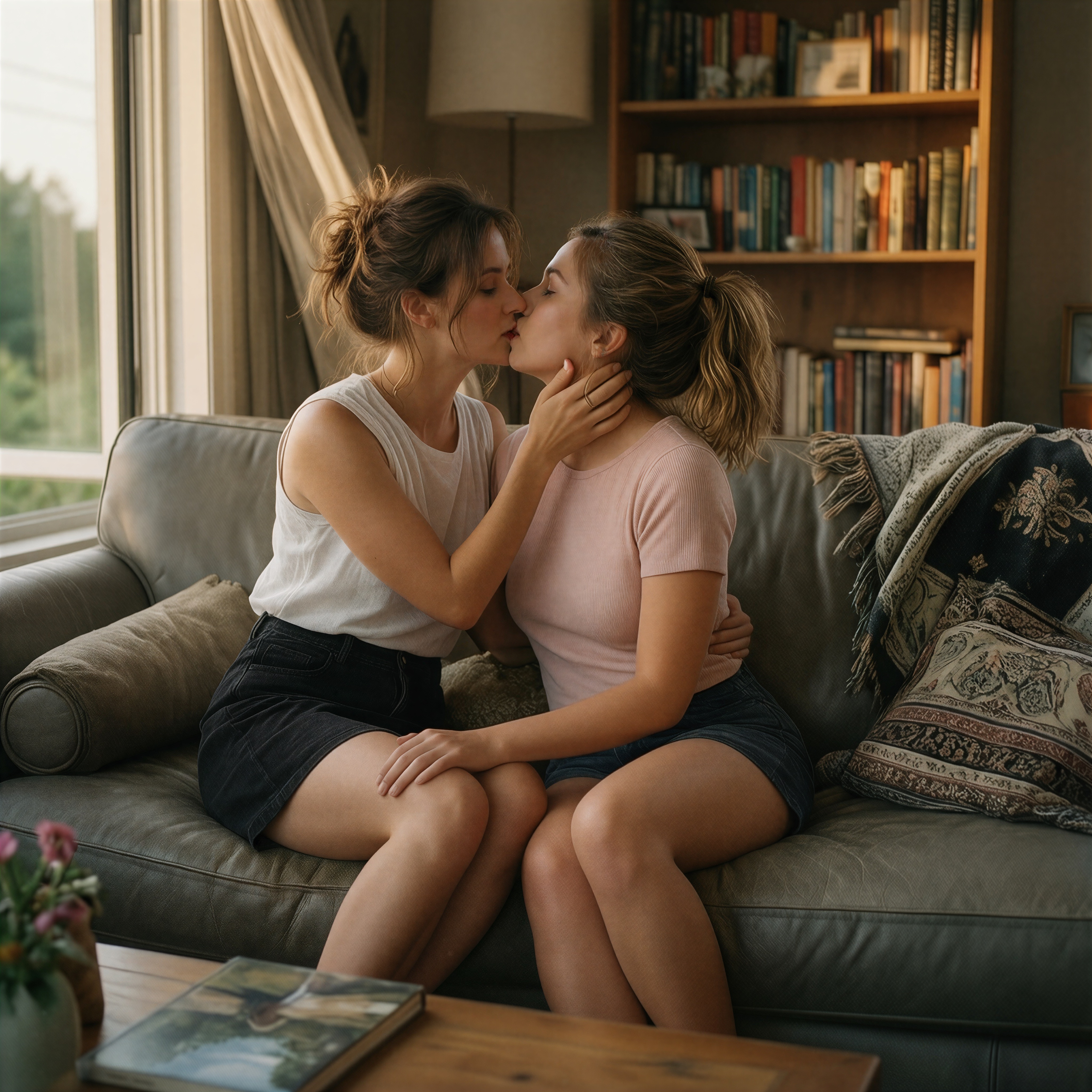
🫦 After the Visit 🫦
[Celeste]
Sarah left my house the same way she did most things: like the air was luckier for having been in her lungs. The front door shut. Not slammed—Sarah wasn’t vulgar—but closed with that precise, decisive click that felt like punctuation.
For a moment the hallway held its own hush: the tick of a wall clock, the faint hum of the fridge, the soft, persistent whirr of the ceiling fan—aircon off, windows open. The air smelled different in the evening: someone's steak on the barbie, chlorine from a nearby pool and that faint, sweet-sour note of summer skin.
I stood where I’d been left: hand still resting on the back of the dining chair Sarah had commandeered, fingers curled as if the timber could lend me composure.
On the table were two glasses: mine, almost empty. Sarah’s half-finished, lipstick smudge on the rim like a signature. A plate with the last crisp snapped in half. The sweating glass jug of water I had meant as hospitality and now regarded as evidence.
Charli was at the far end of the couch, knees tucked up under her like she was trying to make herself smaller than the cushions would allow. The throw rug was bunched in her lap. She had one corner of it pinched between her fingers and kept worrying it—roll, unroll, roll—quietly, rhythmically, the way some people played scales when they didn’t know where to put the feeling.
She didn’t look at me.
I stood there for a beat, watching her hands worry the throw like it could absorb consequence. I crossed the room slowly and sat beside her, close enough that my thigh brushed hers through the fabric. Charli’s breath hitched.
“I should have seen sooner.”
“It wasn’t—” she started.
“I know.” I turned my head slightly. “I’m not angry at you. I’m annoyed at me.”
Charli’s fingers froze on the throw.
Good. Attention.
I touched her cheek—two fingers, light as a test—and watched her go utterly still. There it was again:
don’t move, don’t ruin it, don’t make her change her mind.
I removed my hand. Charli blinked, confused: like she’d been bracing for a push and got a pause. I leaned in and kissed her temple. A brief, clean kiss. Not romance, exactly.
A message.
You’re safe.
Charli shuddered.
And I let my mouth curve, just slightly, because I couldn’t help noticing something.
“You know,” I said, calm as ever, “you look like you think you’re going to be punished for breathing.”
Charli went red. “I—”
“Mm.” I cut her off gently. “Don’t apologise. It’s boring.”
Her eyes snapped up—relieved. I shifted, turning my body toward her, and held my hand out. Palm up. Wrist offered. Charli stared at it like it was a trap.
“It’s real, Charli,” I said. “An invitation.”
Charli’s throat bobbed as her fingers hovered. I raised my eyebrows the tiniest amount.
“Charli,” I said, and let the word land like a key. “If you want to touch me, touch me. Just do it properly.”
“Properly?” Her voice cracked.
“Slow,” I said. “Careful. And you check.”
Charli nodded, almost feverishly grateful for rules. Her fingertips tentatively touched my wrist. The contact was so gentle it was almost absurd, like she was afraid my skin might bruise from attention. I let my breathing change on purpose, just enough that she’d hear it.
Charli’s eyes widened.
“Oh,” she whispered, as if she hadn’t expected a reaction. I tilted my head slightly, offering the line under my ear, and watched Charli swallow.
“You’re studying it with your eyes,” I said quietly, “Now, use your lips.”
Charli made a small sound—half laugh, half panic—and leaned in, pressing a careful kiss to my jaw.
I didn’t chase her. I didn’t meet her halfway. I let her discover she was allowed to come to me. She tried again, a little higher, and I closed my eyes for a moment because the honesty of it went straight through me.
Charli paused like she’d done something wrong.
I opened my eyes.
“Why did you stop?” I asked.
Charli looked as if she might faint. “I… I didn’t know if—”
“If I wanted you to?” I supplied.
Charli nodded.
I held her gaze and said, very plainly,“Yes. I do.”
The words hit her like sunlight. I closed my eyes for a brief moment, then asked softly, already knowing what her answer would be:
“Do you want to take care of me, Charli?”
It wasn’t a question: it was permission. Charli’s eyes went huge. Pure obsidian.
“Yes,” she breathed.
I leaned back against the couch—deliberate, unhurried, a queen granting her the stage. Charli moved, touch attentive and reverent in the way she handled cloth in the atelier: reading me, learning me, not rushing.
I let her.
I let myself be still. And every so often, when she faltered, I gave her exactly what she needed.
Direction.
“There.”
Permission.
“Yes.”
Confirming.
“That’s it.”
Small, private rewards—and my final slow exhale.
The room went on being a room—the fan turning, the clock counting, the street noises coming and going—while something in us reorganised itself into a new shape. When Charli finally looked up and my breathing had slowed—both of us dazed, our eyes bright with our audacity—I smoothed two fingers along her cheek.
Not to soothe her.
To claim the moment.
“I’m going to pay attention,” I said. “Properly. To you.”
Charli closed her eyes, her head resting in my lap. “Okay.”
I bent over and kissed her—slow, sealing—and thought, with steel wrapped in silk:
I will not be late again.
🇮🇹🫦 Italiano 🫦🇮🇹
For Anna
Sarah è uscita di casa mia come faceva la maggior parte delle cose: come se l’aria fosse più fortunata per essere passata nei suoi polmoni. La porta d’ingresso si è chiusa. Non sbattuta — Sarah non era volgare — ma richiusa con quel click preciso e definitivo che sembrava un punto fermo.
Per un momento il corridoio ha trattenuto il suo silenzio: il ticchettio dell’orologio a parete, il ronzio lieve del frigo, il frullare costante e morbido del ventilatore a soffitto — aria condizionata spenta, finestre aperte. La sera l’aria aveva un odore diverso: la bistecca di qualcuno sulla griglia, cloro da una piscina vicina e quella nota dolce-acida, appena percettibile, di pelle d’estate.
Sono rimasta dove mi aveva lasciata: la mano ancora appoggiata allo schienale della sedia da pranzo che Sarah si era presa, le dita chiuse come se il legno potesse prestarmi un po’ di compostezza.
Sul tavolo c’erano due bicchieri: il mio, quasi vuoto. Quello di Sarah a metà, una sbavatura di rossetto sul bordo come una firma. Un piatto con l’ultima patatina spezzata in due. La caraffa di vetro piena d’acqua, appannata di condensa — che avevo messo lì come ospitalità e che adesso guardavo come una prova.
Charli era all’estremità del divano, le ginocchia raccolte sotto di sé come se stesse cercando di diventare più piccola di quanto i cuscini le permettessero. La copertina era ammucchiata in grembo. Ne teneva un angolo pizzicato tra le dita e lo tormentava — arrotola, srotola, arrotola — piano, ritmicamente, come certe persone suonano le scale quando non sanno dove mettere ciò che sentono.
Non mi guardava.
Sono rimasta un attimo così, a guardare quelle dita lavorare la coperta come se potesse assorbire le conseguenze. Ho attraversato la stanza lentamente e mi sono seduta accanto a lei, abbastanza vicino da sfiorarle la coscia attraverso il tessuto. Il respiro di Charli si è spezzato.
«Avrei dovuto capirlo prima.»
«Non era—» ha iniziato.
«Lo so.» Ho girato appena la testa. «Non sono arrabbiata con te. Sono irritata con me.»
Le dita di Charli si sono fermate sulla coperta.
Bene. Attenzione.
Le ho toccato la guancia — due dita, leggere come un test — e l’ho guardata irrigidirsi del tutto. Eccolo di nuovo:
non muoverti, non rovinarlo, non farla cambiare idea.
Ho tolto la mano. Charli ha battuto le palpebre, confusa: come se si fosse preparata a una spinta e avesse ricevuto una pausa. Mi sono piegata e le ho baciato la tempia. Un bacio breve, pulito. Non proprio романтика.
Un messaggio.
Sei al sicuro.
Charli ha tremato.
E mi si è incurvata la bocca, appena, perché non potevo non notare una cosa.
«Sai,» ho detto, calma come sempre, «sembri una che pensa di essere punita per il fatto di respirare.»
Charli è diventata rossa. «Io—»
«Mm.» L’ho interrotta con dolcezza. «Non scusarti. È noioso.»
I suoi occhi sono scattati su di me — sollevati. Mi sono spostata, girando il corpo verso di lei, e ho teso la mano. Palmo in su. Polso offerto. Charli l’ha fissata come se fosse una trappola.
«È vero, Charli,» ho detto. «È un invito.»
Le si è mosso il pomo d’Adamo mentre le dita restavano sospese. Ho alzato le sopracciglia di un millimetro.
«Charli,» ho detto, e ho lasciato che la parola cadesse come una chiave. «Se vuoi toccarmi, toccami. Però fallo come si deve.»
«Come… si deve?» La voce le si è spezzata.
«Piano,» ho detto. «Con cura. E controlli.»
Charli ha annuito, quasi febbrile — grata per delle regole. La punta delle sue dita ha toccato il mio polso. Era un contatto così gentile da essere quasi assurdo, come se avesse paura che la mia pelle potesse lividarsi per l’attenzione. Ho cambiato respiro di proposito, appena quanto bastava perché lei lo sentisse.
Gli occhi di Charli si sono allargati.
«Oh,» ha sussurrato, come se non si aspettasse una reazione. Ho inclinato leggermente la testa, offrendo la linea sotto l’orecchio, e ho guardato Charli deglutire.
«Lo stai studiando con gli occhi,» ho detto piano. «Adesso usa le labbra.»
Charli ha fatto un suono piccolo — mezzo riso, mezzo panico — e si è chinata, posando un bacio attento sulla mia mandibola.
Non l’ho inseguita. Non le sono andata incontro. Le ho lasciato scoprire che era autorizzata a venire da me. Ci ha provato di nuovo, un po’ più su, e ho chiuso gli occhi per un istante perché la sincerità di quel gesto mi è passata attraverso senza chiedere permesso.
Charli si è fermata, come se avesse fatto qualcosa di sbagliato.
Ho riaperto gli occhi.
«Perché ti sei fermata?» ho chiesto.
Charli sembrava sul punto di svenire. «Io… non sapevo se—»
«Se lo volevo?» ho completato.
Charli ha annuito.
Le ho tenuto lo sguardo e ho detto, molto semplicemente: «Sì. Lo voglio.»
Le parole l’hanno colpita come luce. Ho chiuso gli occhi un momento, poi ho chiesto piano — sapendo già quale sarebbe stata la risposta:
«Vuoi prenderti cura di me, Charli?»
Non era una domanda: era un permesso. Gli occhi di Charli sono diventati enormi. Ossidiana pura.
«Sì,» ha respirato.
Mi sono appoggiata allo schienale del divano — deliberata, senza fretta, una regina che le concede la scena. Charli si è mossa, attenta e reverente come quando maneggia la stoffa in atelier: mi leggeva, mi imparava, senza correre.
L’ho lasciata fare.
Mi sono lasciata stare ferma. E ogni tanto, quando esitava, le davo esattamente quello di cui aveva bisogno.
Direzione.
«Lì.»
Permesso.
«Sì.»
Conferma.
«Così.»
Piccole ricompense private — e il mio ultimo, lento espiro.
La stanza continuava a essere una stanza — il ventilatore che girava, l’orologio che contava, i rumori della strada che andavano e venivano — mentre qualcosa tra noi si riorganizzava in una forma nuova. Quando Charli finalmente ha alzato lo sguardo e il mio respiro si era fatto lento — entrambe stordite, gli occhi lucidi per la nostra audacia — le ho fatto scorrere due dita lungo la guancia.
Non per calmarla.
Per rivendicare l’istante.
«Starò attenta,» ho detto. «Come si deve. A te.»
Charli ha chiuso gli occhi, la testa appoggiata sulle mie gambe. «Va bene.»
Mi sono chinata e l’ho baciata — lento, sigillante — e ho pensato, con acciaio avvolto nella seta:
Non arriverò più tardi.