Celeste's Girl

✨ Scene 6
✨ Sewing as Physics
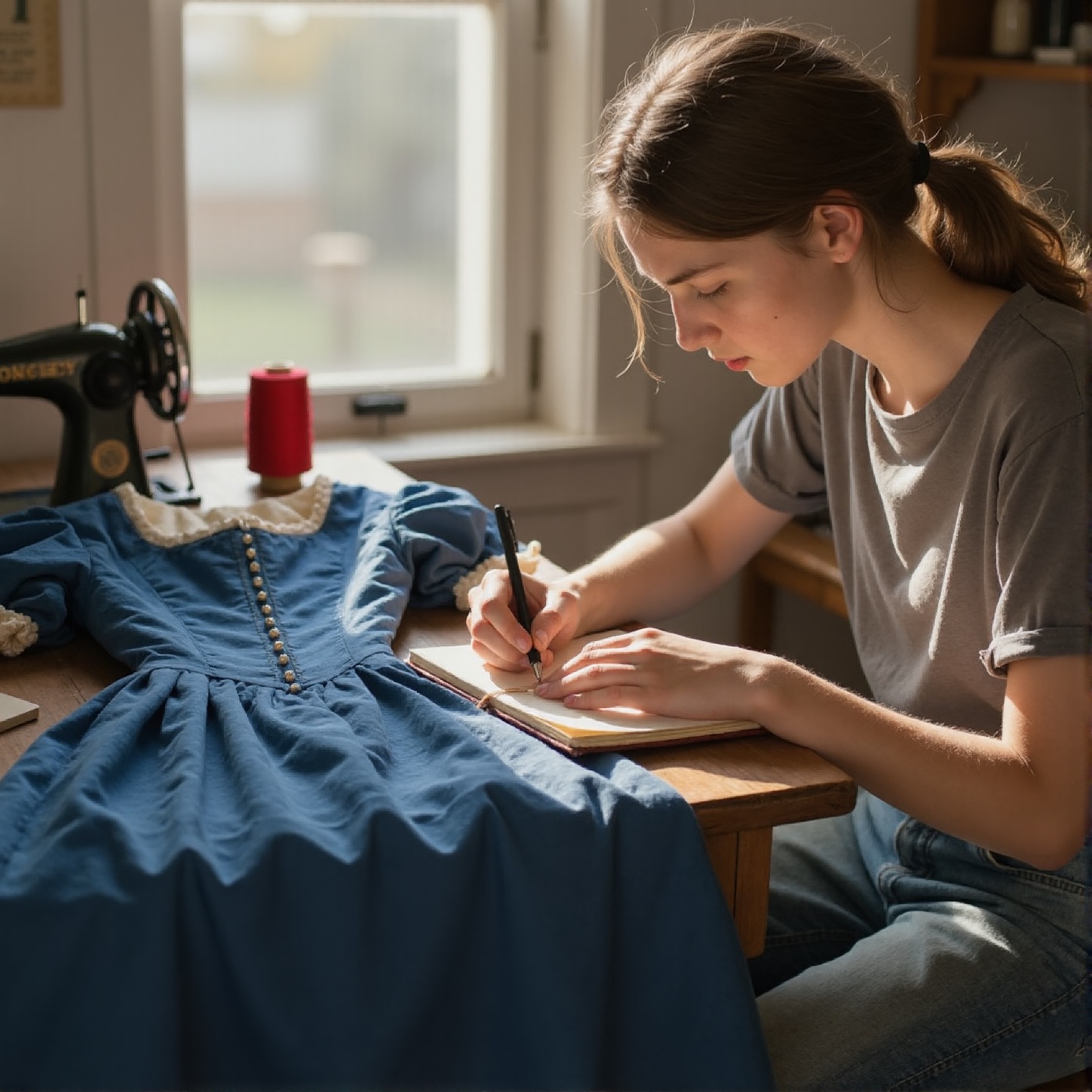
Wardrobe didn’t feel like a refuge anymore.
Not today.
The rails were fuller, the worktable was cleared for pattern paper instead of mending baskets, and Mara had the particular expression she wore when money had been approved and time had not: a brisk concentration that made everyone else move faster without being told to.
A new jacket lay pinned to a mannequin — not perfect yet, but already smarter than the old stock. The seam lines made sense. The stress points had been thought through. It was the first garment in weeks that wasn’t a compromise. Mara stood with a pencil behind her ear, looking at the jacket like she was deciding whether to forgive it.
“See that?” she said to me, tapping a point near the underarm. “That’s where tourists tear things. That’s where staff tear things. Movement there is violent.”
“It’s not really violent, is it?”
Mara’s eyes didn’t leave the seam. “It is if you pretend bodies don’t exist.”
That was Mara’s entire philosophy in one sentence. Design as honesty. Sewing as physics. Safety as something you built. I was about to reply when my phone buzzed in my pocket — twice in quick succession, as if whoever it was didn’t trust politeness to be heard. I didn’t check it immediately. I’d learned not to flinch in this room. Mara hated flinching more than she hated mistakes.
The third buzz came, insistent. Mara glanced at me without turning her head.
“If it’s school, I don’t care.”
“It isn’t,” I said, already pulling the phone out.
It was a message from Leah — one of the girls still at school. She was the kind of girl who liked gossip until it had teeth.
Leah: Charlie walked out of class. Like... just left. Mr Greeves tried to stop him. Everyone was laughing. I swear someone filmed it. He was at the board and Mr Greeves said something about staff saying Charlie won’t make it through the year. Like staffroom stuff. Charlie went white.
I read it once, then again.
Mara watched my face the way she watched a hemline — waiting for the tell. I didn’t give her much. I didn’t want to. But a message like that doesn’t land quietly. It lands like a dropped tool.
I typed back with one hand.
Me: Where is he now?
Leah replied almost instantly.
Leah: No idea. He just vanished. Didn’t slam the door. It was creepy. Like he wasn’t even angry. Just done.
Done.
I stared at the word longer than I needed to. Mara’s voice came, flat.
“What happened.”
Not a question. A demand for facts. I looked up.
“School happened.”
“That’s not an answer.”
I put the phone down on the table, screen facing me, as if turning it outward would make it gossip. “He was made to go up to the board. Mr Greeves — who’s meant to be the decent one — let slip that other teachers think Charlie isn’t coping. The room laughed. Someone filmed it. Charlie walked out.”
Mara’s expression didn’t change much. But something in her eyes cooled.
“What an idiot.”
“Mara —”
“No,” Mara cut in, and her voice sharpened the air. “Don’t defend him. A teacher’s job is to control the room. If he can’t control it, he doesn’t get to use a boy as an example.”
She turned back to the mannequin and tapped the underarm point again, harder this time.
“This,” she said, “is why you reinforce. Because stress finds weakness. Always.”
I understood the message. This was not just about fabric. I reached for my phone, thumb hovering. I had his number now: I could call Charlie. I could text him. I could drive to his house.
But it was obvious: don’t chase him like he’s a lost child. Not if we wanted him to keep the dignity of his own decision. So I did the only thing that felt like control.
I waited.
Wardrobe went on around us — steam, pins, scissors, the low murmur of women working, the smell of beeswax and chalk dust in the drawers. It should have soothed me. It didn’t. It made the contrast sharper. Here, competence earned you space. At school, competence only made you a target if you were already marked as “wrong.” Mara went to the cutting table and spread out pattern paper with a decisive sweep.
“Get the measurements list,” she said, brisk. “We’re not stopping.”
“Right.” I reached for the clipboard.
A few minutes later, the door opened. Not a dramatic entrance. Just the door, and the click of it closing again.
I looked up and saw Charlie standing inside Wardrobe with his backpack on one shoulder. He didn’t look dishevelled. He didn’t look tear-streaked. He hadn’t come in with the raw face of a boy begging for comfort.
He looked... set. Like a nail driven into seasoned oak. His gaze swept the room once — rails, tables, Mara — and then landed on me for a fraction of a second before flicking away again, as if eye contact was not the point of this visit.
Mara spoke first. Of course she did.
“Rossignol.”
Her tone was not unkind. Not warm. Just naming him into the room.
Charlie nodded. “Mara.”
Mara’s eyebrow lifted. Tiny, approving. He’d used her name correctly. Not “ma’am,” not “Miss,” not apology. Adult-to-adult.
Charlie swallowed once.
“I’m not going back.”
The words were quiet. They didn’t ask permission. They didn’t invite a debate. They were an announcement.
The room seemed to pause around it. Even the steamer hiss sounded restrained. Mara didn’t react like a counsellor. She reacted like a manager.
“To where,” she said, “are you not going back.”
Charlie’s jaw moved. He didn’t look at me. He kept his eyes on a point near Mara’s shoulder, as if meeting her gaze directly might turn it into a confrontation.
“School,” he said. “I’m done.”
Mara’s expression didn’t soften. But it did sharpen with clarity, as if this was a problem she could finally name.
“So what’s your plan.”
Charlie breathed in — slow, controlled. He adjusted the strap of his backpack with one hand, a small grounding motion.
“I can work,” he said. “Here. Properly. Not... hanging around.”
That was Charlie, at his best: no melodrama, no entitlement, no “please save me.” An offer. A willingness to work. My chest tightened anyway, because I could hear the underside of it:
I won’t be laughed at again. I won’t be filmed. I won’t be a spectacle. I’d rather stitch until my fingers bleed.
Mara stared at him for a beat. Then she said, “You don’t make sound decisions in a panic.”
Charlie’s mouth tightened. “I’m not panicking.”
Mara’s eyes narrowed. “Everyone else panics loudly. You panic by disappearing.”
Charlie held still. He didn’t deny it. He didn’t argue.
He simply said, very evenly, “I didn’t disappear. I left.” Nuance.
Mara’s gaze pinned him — not cruel, not tender. Accurate.
“Yes,” Mara said. “You left. Good. That’s self-respect.”
Charlie’s eyes flicked up, startled, because he’d expected punishment, not acknowledgement. Mara continued without letting the moment get sentimental.
“But self-respect isn’t a plan,” she said. “And I don’t run a charity.”
“I realise that.”
Mara’s tone stayed flat. “Then listen. This place is changing.”
I saw Charlie’s gaze shift to the pattern paper, the mannequin, the new garment pinned in place. He’d noticed. He wasn’t stupid. Mara stepped aside and gestured at the room with two fingers.
“This is not a mending corner anymore,” she said. “It’s a studio. It is deadlines. It is standards. It is money. If you want to be here full-time, you work like a professional. You don’t come here to hide.”
Charlie swallowed hard, his face set. “I’m not hiding.”
Mara’s mouth twitched, almost a smile. “Good. Because I will know.”
Then — and this was Mara’s version of generosity — she gave him something he could grab onto.
“Today,” Mara said, “you do two things. You finish the reinforcement on the prototype jacket. And you inventory the closure stock. Every hook, every eyelet, every tape. Write it down cleanly. Do it properly and you can come back tomorrow.”
Charlie went still. Not with fear. With the stunned relief of someone being given a rule-set instead of an argument.
“Okay.”
I hadn’t spoken yet. I was letting Mara set the terms. That mattered. It kept this from becoming about my feelings. But Charlie’s eyes flicked to me again, quick and involuntary, and I could see the question he didn’t want to ask: Are you going to make me go back?
I answered without words — picking up the clipboard, I placed it on the table beside him.
“Start with the closures,” I said, voice neutral. “You’re fast when you’re calm.”
His shoulders loosened by a fraction. He nodded once and reached for the stock drawer. Mara watched him begin, then turned to me, low enough that it wasn’t for him.
“This is going to become a fight,” she murmured.
“With the school.”
“With everyone,” Mara replied. “Because people love the idea of a system until a person refuses to be ground down by it.”
I glanced at Charlie. He’d already opened the drawer and was laying out tapes with the quiet precision of someone who could cope if the task stayed honest.
I kept my voice low. “He didn’t make a scene.”
Mara’s gaze stayed on him. “No. He made a decision.”
Charlie, as if sensing he was being discussed, lifted his head slightly, eyes darting between us. I didn’t soften. I didn’t reassure. I said, simply, “You can do this. But you do it properly.”
Charlie swallowed, then nodded again.
“Yes,” he said. “Properly.”
And just like that, the story shifted.
Not into rescue. Into work. Into responsibility.
Into the next room.
✨ Scene 7
✨ Lauren
Lauren Rossignol didn’t come to Wardrobe like a mother arriving at a principal’s office.
There was none of that fragile anger, none of that flustered indignation. She came as if she’d spent a long time deciding what she would and wouldn’t say, and had finally settled on the only language style that always worked: calm, measured, consequential. She stood just inside the doorway with a canvas tote on her shoulder and her car keys in her hand, the metal biting gently into her fingers as if to keep her anchored. Her hair was pulled back too tightly for vanity. Her lipstick was absent. Her expression was not.
Mara looked up from the cutting table, pencil behind her ear, pattern paper spread like a map of intention.
“Can I help you,” Mara said, not quite a question.
Lauren’s gaze swept the room — rails, mannequin, the prototype jacket pinned in place — and landed on the mending corner that wasn’t a corner anymore. She took in the quiet speed of the women moving through tasks. The hush had weight. Not the hush of secrecy. The hush of work.
“I’m Charles’ mother.”
Mara didn’t move. But something in her eyes adjusted, like a lens clicking into focus.
“Right,” Mara said. “You’re... Lauren.”
Lauren blinked once, surprised that her name was known.
I had been at the rail, tagging garment bags. I didn’t look up immediately. I let Mara hold the centre. This was her room. Her rules. Lauren’s eyes found me anyway — quick, assessing — and then returned to Mara as if she’d already decided who mattered most here.
“My son told me he isn’t going back to school,” Lauren said, voice level. “He said he’s working here.”
Mara nodded once, as if confirming a fact rather than accepting a plea. “He is.”
Lauren’s jaw tightened. “He’s seventeen —”
“Eighteen,” Mara corrected.
Lauren paused, then accepted the correction with a small exhale.
“Eighteen. He’s leaving Year Twelve. That’s not... smart.”
Mara’s expression didn’t soften.
“It’s not what you wanted.”
Lauren’s eyes flashed briefly — not rage, not tears — something sharper: the fatigue of a woman who has carried other people’s consequences for too long.
“No,” Lauren said. “It isn’t.”
Mara gestured with two fingers towards a chair near the table. Not inviting. Allowing. Lauren sat, carefully. She placed her keys on her knee instead of the table, as if not to take up more space than necessary. Her tote stayed on her shoulder.
“You’re running a studio, an atelier,” Lauren said, looking around again. “Not... a dressing-up shop.”
Mara’s mouth tightened. “Correct.”
Lauren nodded once. Then, with a steadiness that made me respect her, she asked the question that actually mattered.
“Is Charles hiding here?”
The room went even quieter, not because the women stopped working, but because they listened. Mara didn’t answer immediately. She turned her head slightly, eyes moving to where Charlie sat at the inventory drawer, sorting hooks and tapes with the same absorbed focus he gave to seams. He didn’t look up. He didn’t perform awareness. He simply worked.
“He’s not hiding,” Mara said at last. “Not the way you mean.”
Lauren’s grip tightened on her keys. “And the way you mean?”
Mara’s eyes returned to Lauren.
“The way I mean,” Mara said, “is he’s chosen a room that rewards him for being precise. School doesn’t.”
Lauren’s mouth thinned. “School is still school.”
Mara nodded once, like she conceded the fact without granting it authority.
“And this is still work,” she replied. “With deadlines. With consequences. With standards.”
Lauren’s gaze flicked again to Charlie, then back. “He’s not built for consequences.”
Mara’s eyebrow rose. “Oh, he is. He’s built for them more than most. He just doesn’t tolerate being mocked while he learns.”
Lauren’s throat moved. The sentence landed. It wasn’t sympathy. It was recognition. Her voice stayed controlled, but there was a tremor under it now — the tiniest crack in the armour.
“He’s always been... gentle,” she said, as if the word might be misread if she spoke it too loudly. “And the school... the school treats gentleness like weakness.”
Mara’s gaze held hers.
“School treats anything it can’t classify as weakness,” Mara said. “That’s what institutions do.”
Lauren’s jaw tightened again. She looked down at her keys, then up.
“I wanted him to finish. I wanted him to have that paper. I wanted him to not... make his chances in life smaller.”
Mara didn’t interrupt. She let the sentence exist. Lauren continued, voice still level but now carrying something deeper.
“But I also don’t want him to be eaten alive.”
Mara’s eyes narrowed slightly, and her tone shifted — not softer, but more direct, as if Lauren had finally spoken in a language Mara respected.
“I don’t run a sanctuary,” Mara said. “When he is here, he works. He doesn’t drift. He doesn’t sulk. He doesn’t disappear mid-task because he’s overwhelmed.”
Lauren’s eyes flicked to Charlie again, then back. “He disappears when he’s ashamed.”
Mara nodded, as if filing that away like a measurement.
“Then he must learn not to be ashamed,” Mara said coldly, “or he doesn’t stay.”
Lauren’s lips parted slightly. For a moment, Mara’s harshness irritated her. But she didn’t reject it either. I could see the calculation: harshness, at least, was honest.
“And so you’re quite... comfortable,” Lauren said carefully, “having him here? Around... around all this?” Her eyes moved, briefly, to the fitting curtains — to the private space that was controlled, not hidden.
Mara’s gaze sharpened. “You mean around women.”
Lauren didn’t flinch. She didn’t deny.
“Yes.”
Mara leaned forward slightly. Not threatening. Just clear.
“This is a women’s space,” Mara said. “It stays that way because we keep it that way. He is not entitled to anything in this room. He’s here because he is useful and respectful. If that changes, he is out. Immediately.”
“He wouldn’t do anything...”
“That’s not the point,” Mara said. “The point is that women in this space don’t have to wonder, to worry.”
Lauren’s shoulders loosened by a fraction, like the sentence had relieved her of some burden she hadn’t wanted to name. Mara sat back.
“Now,” she said, brisk. “What do you actually want.”
Lauren inhaled.
“I want you to tell me whether what Charles is doing here is... real!” She shook her head and placed a hand over her neck. “Not... a phase. This is not just my son hiding from school because it’s hard. He’s getting real training, for a real future.”
Mara’s eyes slid briefly to the prototype jacket again, then back.
“It’s real,” Mara said. “I make it real.”
Lauren held her gaze.
“And where does Celeste fit into this,” Lauren asked, and my name entered the space like a small blade.
Mara didn’t look at me when she answered.
“Celeste is the research,” Mara said. “The direction. The brain that won’t let the work get lazy.”
Lauren’s eyes came to me again.
“And you,” Lauren said to me, voice still calm but now edged, “are you rescuing him?”
I finally looked up.
“No,” I said. The word came out clean. “He’s working. Mara’s the one who decides whether he stays.”
Mara’s mouth twitched, almost approving.
Lauren studied me for a beat, then nodded once, as if satisfied with the answer. She stood. She shifted her tote from shoulder to hand and drew out a folded bundle of fabric.
“This is his,” she said, placing it on the table without ceremony. “He left it at home. I washed and pressed it.”
Mara unfolded it: a linen apron, neatly hemmed, ties reinforced. Mara’s eyes flicked to Lauren.
“You sewed this.”
“I fixed it.”
Mara ran a finger along the stitching — precise, elegant, invisible.
“Good work,” Mara said.
Lauren blinked again, surprised by the praise. Mara didn’t offer more. She didn’t need to. She folded the apron and put it aside with the other issued items, as if it had been accepted into the system.
Lauren’s gaze went to Charlie one more time. He still hadn’t looked up. He was counting eyelets like counting was a form of prayer. Lauren’s expression shifted — not soft, exactly, but less braced.
“I’m disappointed,” she said, louder now. Clearly Charlie should hear it. Not accusation. Truth. “I wanted you to finish.”
Charlie paused. His fingers stopped. He didn’t turn around.
“I know, mum.”
Lauren’s throat moved. She swallowed it down. Mara spoke, crisp, to cut the emotion before it bloomed into something messy.
“Rossignol,” she called. “Continue.”
Charlie resumed immediately. Lauren exhaled. She looked at Mara again.
“When he’s here,” Lauren said with a nod, “he works.”
“Correct.”
Lauren picked up her keys.
“And if the school comes sniffing?”
There was a new steadiness to Lauren’s voice — a mother’s protectiveness with a professional edge. Mara’s gaze hardened.
“They can sniff elsewhere.”
Lauren’s mouth twitched. Not quite a smile. Something like relief. She turned to go, then paused at the door and looked back once more at Mara.
“I don’t do pity,” Lauren said, as if setting a boundary as well as a warning. “He won’t survive that.”
Mara’s response was immediate.
“Neither do I,” she said. “That’s why he will.”
Lauren left without flourish. The door clicked shut, and the room returned to its rhythm. Mara looked at me, pencil still behind her ear.
“Your friend.”
“She’s Charlie’s mum,” I said. “That’s not the same thing.”
Mara’s mouth twitched again.
“Good,” she said. “Keep it clean.”
✨ Scene 8
✨ Infrastructure
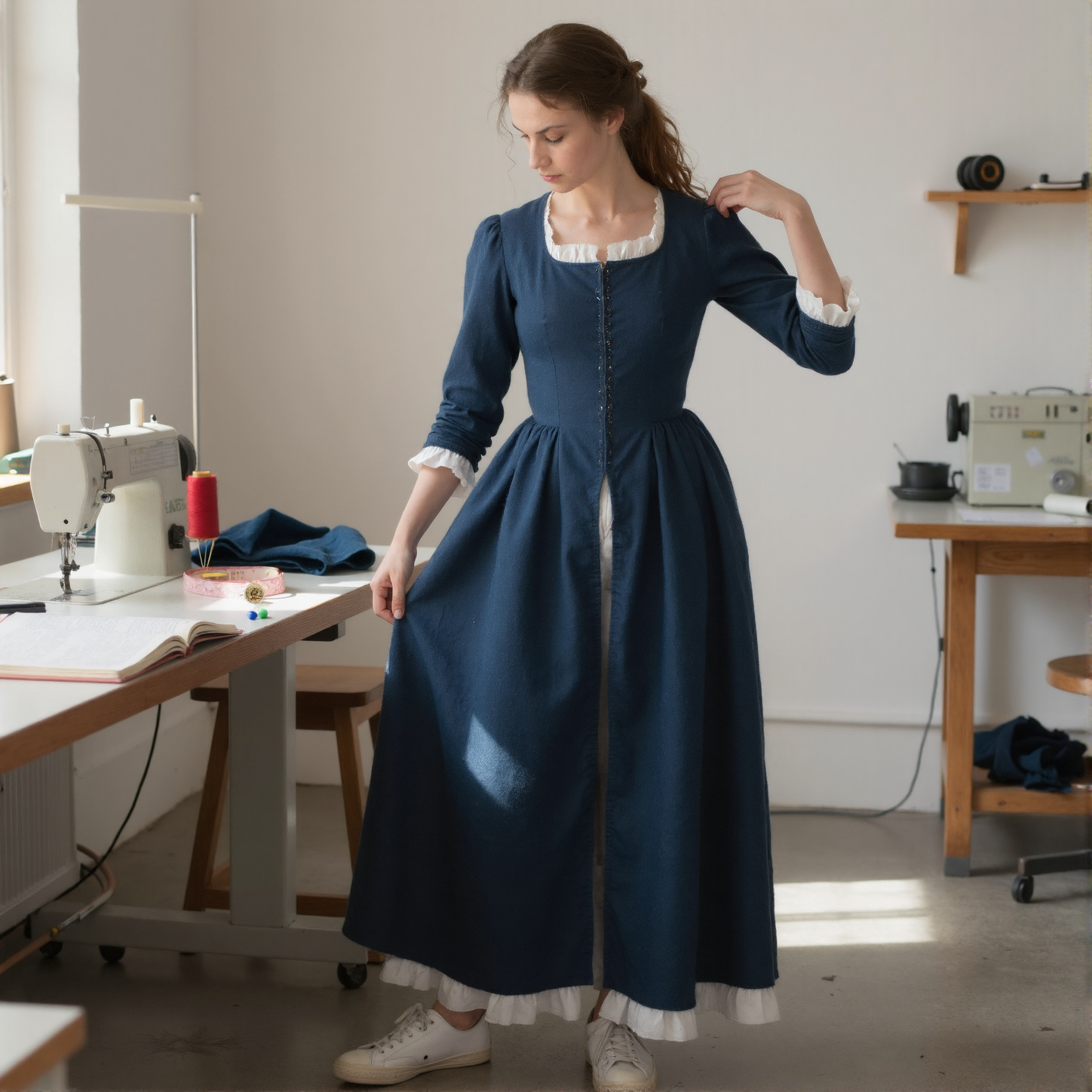
Lauren came back a week later, and she didn’t look like she’d been awake all night arguing with herself.
She still looked tired — because mothers always do — but the braced edge from last time had eased into something steadier: acceptance with boundaries. Not surrender. Not softness. More like she’d stopped trying to stop the river and started measuring its speed. She didn’t bring keys to crush in her palm.
She brought coffee.
A small paper bag, warm through the bottom, smelling of espresso and pastry — and a tote that sat on her shoulder like she’d learned how to carry weight without making a performance of it. Mara looked up from the worktable.
“We don’t eat over fabric,” she said, as if it were a law of physics.
Lauren nodded, as if she’d expected nothing else.
“I didn’t bring it for fabric,” she said. Her tone had a dry curl to it. “I brought it because you look like the sort of woman who forgets food when she’s busy.”
Mara’s eyes narrowed.
“I don’t forget,” Mara said. “I postpone.”
Lauren’s mouth twitched. “Yes. That.”
I stayed near the rail, letting them set their own rhythm. This wasn’t my meeting. I’d opened the door; they could decide what walked through. Lauren didn’t insert herself. She just stood and watched the room — quietly, like someone observing a process she’d decided to respect. The atelier had changed in a week. Not prettier for the sake of pretty; better. Reinforced where stress hit. Forgiving where bodies moved. Built for the real physics of the Faire instead of the fantasy of it. Charlie was part of that now. Not as a mascot. As a mechanism.
He didn’t talk much. He simply made things survive. At the fitting curtains, he held a bodice steady while Mara worked the line on the mannequin. He didn’t glance around for approval. He didn’t scan the room like a boy looking for permission.
He just... held.
Lauren’s expression shifted — pride held so tightly it almost looked like pain. Mara noticed without looking at her.
“You can watch,” Mara said. “Just don’t hover.”
“I’m not hovering.”
Mara’s mouth moved, one millimetre. For her, that was a smile.
“You’re hovering in French.”
Lauren let out a short laugh that startled even her — like humour had slipped out before she could catch it.
“You’re Australian,” she said. “What would you know about that?”
Mara went back to her pins.
“Women are women,” she said. “Just with different accents.”
Lauren stepped closer to the worktable and reached into her tote. Not theatrically. Practically — the way women smuggle intimacy in under logistics. She drew out a small notebook and opened it. Fabric swatches. Neat rows. Labelled. Taped down with the kind of care that says: I don’t waste my own time, and I won’t waste yours either.
“I’ve got a supplier in Sydney,” Lauren said, and now her voice had turned businesslike — not cold, just clear. “Linen that doesn’t go transparent under light. Not cheap. But consistent. If you’re moving into design, you’ll want consistent.”
Mara’s fingers paused. For Mara, that was a reaction.
She held out her hand.
“Let me see.”
Lauren passed the notebook across the table. Mara tested the swatches the way she tested everything: with honesty. Thumb and forefinger, rubbing the weave lightly. Body. Recovery. Spine.
“This one holds,” Mara said. “It won’t collapse when it’s damp.”
Lauren nodded once. “That’s why I use it.”
Mara’s eyes flicked up. “For what?”
Lauren didn’t answer immediately. She watched Charlie’s hands for a moment — his steadiness, the way he treated cloth like it deserved respect — and something in her face softened and tightened at the same time.
“For things that need to survive men,” she said at last.
It was the first personal sentence she’d offered, and she didn’t dress it up. No story. No dramatic pause. Just the truth, placed on the table like a tool. Mara’s face didn’t change much. But her eyes softened — the smallest shift, the kind only another woman would notice.
“Mmm,” Mara said. “Yes.”
Lauren exhaled slowly, like she’d been holding her breath in her own life for too long.
“You’re protective,” Lauren said, gently.
Mara snorted. “I’m professional.”
Lauren’s mouth twitched again.
“That’s what protective looks like when you’ve had enough.”
Mara didn’t deny it. She didn’t confirm it either. She closed the notebook and slid it back across the table with care — not because she was sentimental, but because she understood workmanship.
“You have standards,” Mara said.
Lauren’s gaze flicked away, briefly — not shame, more like the reflex of a woman who’d learned to hide anything soft because softness gets hunted.
“You learn them,” she said quietly. “Or you get eaten.”
Mara looked at her properly then, steady as a level.
“Yes,” Mara said. “Exactly.”
They held each other’s gaze for a beat — no sentimentality, no softness — just recognition. Two women looking at the same map and realising the other knew how to read it.
Behind them, the mannequin’s sleeve shifted.
“Mara,” Charlie said, soft, cautious — but it was work, not interruption. “The seam pulls when you raise the arm.”
Mara turned immediately. Attention snapped to the garment the way a blade snaps to a whetstone.
“Good catch,” she said, and then added, because she couldn’t help herself, “Of course it does. It’s always there.”
Charlie didn’t smile. He didn’t preen. He just held the bodice steady while Mara repinned the line, the way he held everything: quietly, without demanding credit. Lauren watched him again. This time the pride didn’t hide as well.
“Charles seems... different,” she said, carefully. As if the name itself still belonged to her mouth.
Mara didn’t look up.
“Charlie,” she corrected, not harshly — simply as fact. As if the room had already decided.
Lauren blinked once. A small recalibration. She didn’t argue. She didn’t make a face.
She just let the correction stand.
“Charlie,” she repeated, tasting it like a word she was learning to say without cutting her tongue. “He wanted to quit school because he felt humiliated.”
The word humiliated sat in the air like something sour — controlled, but bitter, as if it didn’t belong in her mouth and she resented that it had ever belonged in his day.
Mara’s hands kept moving.
“Some people use humiliation as a tool,” she said. “Because they have nothing else.”
Lauren’s eyes stayed on the garment, as if she’d decided this was where she could look without breaking.
“We don’t use it here,” Mara added.
Lauren nodded slowly, as if she needed to hear that said out loud by someone other than herself.
“And what do you use?” she asked.
It struck me then that she wasn’t asking only for her son. Not really.
Mara tugged the fabric once, then twice, testing tension.
“Standards,” she said. “Consequences. Work.”
Lauren stood very still, like those words were something she could finally put weight onto. Then she surprised herself again, and her voice lifted a fraction, almost teasing:
“And coffee.”
Mara’s mouth twitched — one of her rare allowances.
Lauren moved to the side bench and opened the paper bag. Two coffees emerged. Not delicate. Not fancy. Practical cups with lids that said: I’ve learned how to do this without needing to be thanked for it.
She set one near Mara’s elbow, away from fabric.
Mara stared at it like it might be a trap.
“Don’t make it a thing,” Lauren said, already turning away, as if generosity had to be disguised to be tolerable.
Mara picked up the cup and took a sip.
“Fine.”
Lauren’s smile flashed — brief, real — and then she folded it away again. From the fitting corner, Charlie glanced over — not at his mother exactly, not at me — but at the two women standing in quiet alignment. The look on his face wasn’t dramatic. It was weather: the subtle shift of someone realising the world might, in fact, hold.
He didn’t ask what they’d talked about. He didn’t intrude, but returned to the seam and held the fabric steady while Mara corrected the line.
And for the first time since he’d walked out of school, something settled into place for him.
Not refuge.
Not rescue.
Infrastructure.
Women building something that would hold.
And Charlie learning — quietly, steadily — how to live inside it.
✨ Scene 9
✨ Noise or Signal

Lauren arrived on a Tuesday, which I noticed only because Tuesdays were the days Mara tried to pretend she had time.
She didn’t, of course. Mara never did. But Tuesdays were when she scheduled her stubbornness. The cutting table was clear, the mannequin was dressed in half a bodice, and the new jacket prototype sat like a dare: make me survive.
Lauren stepped in with a flat folder under her arm and a tote on her shoulder. No coffee this time. No pastry peace offering. She looked neat, composed, and slightly sharpened around the edges, as if she’d spent the morning refusing to be moved by other people’s urgency. Mara glanced up.
“What now,” she said dryly, as if Lauren had become a regular inconvenience she secretly approved of.
Lauren didn’t waste time warming the air.
“They called again.”
She didn’t specify who. She didn’t need to. Systems rarely needed names. They just kept turning — always in the way. Mara’s mouth tightened.
“And.”
“And I told them I’d call back,” Lauren replied, and there was a quiet satisfaction in the sentence. Not triumph. Just control. “Which I won’t, unless I have to.”
Mara’s eyes flicked to the folder.
“What’s that?”
Lauren placed the folder on the corner of the worktable, away from fabric, and opened it with a deliberate neatness — like she could handle paper without absorbing it. Inside were two things: an envelope and a printed sheet.
The envelope was plain and official-looking. Lauren didn’t open it. She let it sit there like a dead insect.
The printed sheet she slid forward.
It was a photograph of one of the Faire staff — Lucy — wearing the new jacket prototype. Lucy’s arms were raised in a dramatic pose, the kind that usually tore seams under the arm and split closures at the waist. But here the jacket held: clean line, no gaping, no strain. It looked like it had been designed for a body instead of a mannequin fantasy. Below the photo, Lauren had typed a short list. Not poetic, not emotional, just facts:
- Previous issue: underarm seam tearing after repeated movement
- Change: reinforced gusset + eased sleeve head + seam tape at stress line
- Result: 3 full shifts; no tear; improved comfort; faster dressing
- Notes: closure placement adjusted for quick change; no snagging
It was written like an incident report. Like a nurse charting patient progress in a ward. Like a woman who didn’t trust feelings to convince anyone. Mara stared at it.
Lauren said, evenly, “This is signal.”
Then she indicated the envelope without looking at it.
“And that,” she added, “is noise.”
Mara’s mouth twitched as her eyebrows rose slightly — almost amused, almost approving.
“You’ve been busy.”
Lauren shrugged. “I’ve been paying attention.”
Something settled in my chest that wasn’t relief exactly. More like load-bearing. Women reinforcing each other the way we reinforced garments — because pressure finds seams, and we weren’t going to split. Across the room, Charlie was at the side bench, pinning a lining into a bodice piece. He hadn’t looked up when Lauren entered; he never did. He didn’t seek permission for his attention. That was part of why Wardrobe suited him. Here, no one had to perform being seen.
But he did look now. Not to the photo at first. To the envelope.
Something in him still reacted to official paper the way some people react to sirens—an instinctive tightening in the gut. His hands slowed. A pin hovered between his fingers. Lauren noticed without turning. Mothers always did.
“Don’t,” she said quietly.
Charlie blinked. “Don’t... what?”
“Don’t go pale,” his mum replied. No cruelty in it, just blunt care. “You’re not in trouble in this room.”
He swallowed and looked down at his hands again, willing them back to normal speed. Mara picked up the printed sheet and read it properly. You could tell when she stopped seeing it as a thing someone had handed her and started seeing it as information. Her eyes tracked the lines. Her thumb pressed the paper unconsciously, testing it as if it were cloth.
“This,” Mara said thoughtfully, tapping the list, “is actually quite useful.”
Lauren’s lips thinned, determined. “That’s the idea.”
Mara’s gaze slid to the envelope.
“And that.”
Lauren’s expression sharpened.
“They want a meeting,” she said. “They want ‘pathways’. They want him back in a system that already told him what it thinks of him.”
Mara’s eyes narrowed.
“And what do you think.”
Lauren didn’t answer quickly. She glanced at Charlie — a brief, controlled glance — then turned back to Mara.
“I think,” she said, “that if he goes back there now, he’ll disappear again. Not dramatically. Not loudly. He’ll just... turn off.”
My throat tightened a fraction. She was exactly right. Charlie didn’t explode; he evaporated.
“And I think,” Lauren continued, still calm, “that if he stays here, he’ll have to show up. You don’t allow drifting. You don’t allow hiding. You make him do something... important. For him. This is real.”
Mara didn’t soften. That wasn’t her style. But she did something else: she accepted the statement as if it were a contract.
“He works,” she agreed.
Lauren nodded. “Yes. He works.”
Mara set the paper down carefully, the way you set down something you intend to keep.
“So what are you asking me for?”
Lauren met her gaze.
“Permission,” she said. “Not for him. For me.”
Mara’s eyebrow lifted.
“Sorry?”
Lauren’s mouth tightened, and for the first time her voice showed a thread of vulnerability—but framed the way women did when they refused to make their needs into someone else’s burden.
“I want to be able to say, truthfully, that he isn’t ‘dropping out.’ He’s transitioning into supervised work. Training. Something with standards. Something you’re willing to put your name on.”
Mara’s gaze held hers.
“You want me on the hook,” Mara said.
Lauren didn’t flinch. “Yes.” Then, because she understood what “hook” meant in a world of liabilities, she added—matter-of-fact:
“I’ll handle the paperwork and the school. Work placement language. Attendance logs. If anyone wants a form, I’ll give them a form. You handle standards. I handle noise.”
A beat.
Mara looked across the room at Charlie, who had resumed pinning, slower than before but steady. He wasn’t eavesdropping; he was simply present enough to feel the air changing.
Mara’s eyes returned to Lauren.
“You’re not asking for a favour then, are you?” she said. “You’re asking for a structure.”
“Exactly.”
Mara exhaled through her nose. She didn’t like being managed. But she liked competence. She liked women who spoke plainly.
“Fine,” Mara said. “Here’s the structure. He is here full-time. He keeps hours. He logs tasks. He does training modules the way I set them. He gets evaluated like all my staff. And if he fails, he fails. He doesn’t get protected by his mother.”
Charlie’s hand stopped again, just for a fraction.
Lauren’s voice didn’t soften. This was the contract.
“Agreed.”
Charlie looked up then — finally — and his gaze flicked from Lauren to Mara, and then, briefly, to me. Bewildered in the way he always was when adults made decisions near him, as if he didn’t know whether he was about to be punished or adopted.
Mara called him without raising her voice.
“Rossignol.”
It was what Mara did when the room needed to understand: this wasn’t intimacy; this was procedure. Charlie stood quickly, like someone trained by women: respectful, attentive, not wasting anyone’s time.
“Yes?”
Mara held up the printed sheet.
“Your mother brought receipts,” Mara said. “This is how you win against paperwork. We will do this properly.”
Charlie stared at the photo. His mouth parted slightly. Genuinely confused — not by the garment, but by the fact his work had been recorded like it mattered. Lauren spoke then, not to soothe him, not to praise him into embarrassment, but to anchor him.
“They can recommend whatever they like,” she said, her tone clipped. “I’m your mother. I decide what works. For. You.”
“Mum, I—”
“No,” Lauren cut in, gentle but firm. “Don’t explain. I’m not asking for that. I’m asking you to stay... visible.”
Charlie blinked. The word visible hit him like a strange request. Visibility had never been safe. Mara snapped it back into something he could hold.
“Visible,” Mara said, “means you write down what you do. You show up on time. You finish tasks. You don’t vanish. You want to be here? Then you exist. Visibly.”
Charlie’s throat bobbed. He nodded once.
“Yes,” he said. “I can do that.”
“Good,” Mara said, and turned briskly back to the mannequin. “You can start now.” She gestured at the prototype jacket.
“We solved the tear,” Mara said. “Now I want the pull solved. Lucy can lift her arms without ripping it, but she shouldn’t feel it fighting her.”
She didn’t look at Lauren when she added the rest — because this wasn’t for Lauren. This was for the garment, and for the room.
“I want it solved so it survives summer heat and tourists and the stupid way people grab sleeves,” Mara continued. “I want it solved without adding bulk that ruins the silhouette.”
She looked at Charlie sharply.
“Tell me where it fails.”
Charlie stepped closer to the mannequin. His hands didn’t tremble. That was the difference between school and here: here, hands were allowed to be useful. He lifted the sleeve gently and pressed the seam line with his fingertips. His eyes narrowed, focused.
“It’s not the seam,” he said quietly. “It’s the angle. The gusset’s correct, but the sleeve head is fighting it. You need two millimetres more ease here... and the tape needs to stop before the pivot point, not run through it.”
Mara’s face changed — not dramatically, because Mara’s face never did — just the tiny shift of a professional hearing a solution that makes sense.
“That,” Mara said, “is an answer.”
Lauren watched him with that restrained pride again. Not soft. Not indulgent. Just steady. And watching the three of them in the same room — Mara with her standards, Lauren with her adult refusal to be bullied by systems, Charlie with his quiet competence — I felt something click into place.
Not rescue. Not refuge. A triangle of authority that could hold.
Lauren reached for the envelope at last, slid it back into the folder without opening it, and closed the folder with a neat, final motion.
“Alright,” she said. “Now I can call them back.”
Mara didn’t look up from the sleeve.
“Tell them he’s busy.”
Lauren’s mouth twitched. “I will.”
Then she picked up her tote, nodded once at me—not warmth, exactly, but acknowledgment—and moved to the door. As she left, she paused and looked back at Mara.
“Thank you.”
Mara didn’t accept gratitude the way most people did. She accepted it the way she accepted fabric swatches: with suspicion.
“Don’t thank me,” Mara said. “Just don’t undermine me.”
“I won’t.”
The door clicked shut.
In the quiet that followed, Charlie returned to the mannequin and began marking the line with tailor’s chalk, his movements careful and certain.
And I thought: this is what he needed. Not a kinder classroom. A room where competence was not entertainment. A room where women built reality and demanded he live inside it.
A room where the system’s noise could stay outside the door — because inside, we had signal.
✨ Scene 10
✨ Not My First Preference

We found it the way we found most good things in Wardrobe: not through inspiration, but through paperwork. Mara slid a thin archival printout across the cutting table without ceremony. It landed beside my notebook like a challenge.
“Look.”
The image was a plate from an old catalogue: eighteenth century, late enough that it carried a Georgian neatness, early enough that it still remembered softness. A working woman’s garment, not court finery: fitted through the back, generous through the skirt, closures placed for hands that were busy. It had intelligence in it. It had been designed by necessity, not ego. My pulse tightened, that familiar feeling when history stops being “interesting” and becomes possible.
“Well, it’s not a costume,” I said automatically, more to myself than anyone else. “It’s equipment.”
Mara’s mouth twitched. Approval. She liked that phrasing.
“It’s also clever,” she said. “See the reinforcement here? And here.”
I leaned in, tracing the lines with my fingertip without touching the paper. The sketch suggested a hidden strength at stress points: underarm, waist, the place where movement always found the weak seam. It wasn’t decorative. It was structural.
“We can draft this,” I said. “We can actually draft this.”
Mara already had a pencil in hand.
“Then draft it,” she replied.
That was Mara: no ceremony for the moment a dream became work. The moment you spoke it, you owned it.
We split the labour without speaking. I took the research: proportions, plausible fabric weight, seam placement, what could be original and what had to be translated for a modern body in a modern job. Mara took the pattern: chalk, ruler, sharp decisions. Charlie hovered nearby, the kind of quiet orbit of someone who listened for when he was needed. He didn’t volunteer. He didn’t insert himself. That was one of his strengths. He didn’t presume he belonged at the centre.
We moved fast. Paper became pattern. Pattern became cloth. Cloth became the first prototype under Mara’s hands. The room filled with that particular concentration that only happens when a thing becomes real: pins tapping into the pincushion, the soft rasp of shears, the hiss of the iron. By mid-afternoon the garment hung from the mannequin, half-finished but already legible. Even unfinished, it had a line. It made sense.
It didn’t scream “pretty.” It whispered “capable.”
Mara stepped back, eyes narrowed.
“It’s got spine.”
“It has purpose,” I replied.
Charlie said nothing. He simply reached in and adjusted a seam allowance that had curled under itself, as if the fabric had misbehaved in a way the eye might miss. Mara noticed. Mara always noticed.
“You’ve got a problem with that, Rossignol?” she asked, not looking at him.
Charlie paused with his fingers on the fabric.
“No,” he said quietly. “Just... making it honest.”
Mara grunted. That was as close to praise as she came without a contract.
We didn’t have time to admire it. Wardrobe had learned that excitement was a luxury you enjoyed after delivery. So we did what we always did next: we tested. Not with a photo shoot. Not with a “try it on and twirl.” With a shift.
We put it on Lucy — one of our most reliable staff, who didn’t treat clothing as costume theatre. Lucy did front-of-house, lifted baskets, crouched for children, ran for late arrivals. She was the kind of wearer who revealed the truth. She came back near closing time, cheeks flushed, hair escaping pins.
“It looks brilliant,” she announced, breezy. “But — ”
There’s always a but. Clothing is always honest in the end. She turned slightly and tugged at the underarm.
“Here,” she said. “When I lift my arms. It’s not tearing yet, but it’s... fighting.”
Mara’s eyes flicked to the seam line and her whole brain shifted into assessment.
“And,” Lucy added, touching the waist closure, “this. It held. But it’s been tugged a lot. People grab. You know.”
Yes. We knew.
Mara took the garment from Lucy the way a mechanic takes a part off an engine: no reverence, no disgust, only focus. She laid it flat on the table and pressed her palm along the seam.
“It’s not failure,” Mara said. I realised she wasn’t talking to Lucy: she was talking to me. “It’s information.”
“It’s reality,” I replied.
Mara’s gaze sharpened. “Reality is violent.”
“It’s demanding,” I corrected, because the sense of a word mattered. “Not violent.”
Mara’s mouth twitched again, like she found my idealism irritating but useful.
“Fine,” she said. “Demanding. The point is, this dress needs a tester who understands what it’s telling us.”
She turned and looked — not at Lucy, not at me — but at Charlie.
“Charlie.”
Mara said it the way she said measurements: without softness, without doubt. And it landed differently than Rossignol ever did — not like procedure, but like assignment, like a small, unspoken promotion into the room’s working language. She hadn’t used his first name, ever. This was Mara marking a threshold.
Charlie looked up immediately, eyes wide. His face was calm, but I could see the slight tightening around his mouth — the moment he did his internal inventory: what is being asked of me, and what will it cost. Mara held up the garment with two fingers, as if it weighed nothing.
“You,” she said, “are going to wear it.”
Lucy blinked. “He is?”
Mara nodded. “Yes. He is.”
I didn’t flinch, because the inevitability of this had been forming in my mind all day. It was simple logic: we couldn’t test garments properly if our tester didn’t understand construction. And Charlie was the only person in the room whose mind automatically translated feeling into fixing.
But Charlie did something small—so small most people wouldn’t catch it. His eyes flicked down, not to the garment, but to his own torso. A brief recalibration. A moment where the word wear landed as more than a task. It wasn’t drama. It wasn’t shame. It was simply the human acknowledgement of an idea he hadn’t fully crossed before:
I’m about to put on attire meant for women.
He inhaled once, measured.
Mara didn’t rush him. Mara didn’t soothe. Mara simply waited, giving him the dignity of his own decision. Charlie’s voice, when it came, was quiet and precise.
“For the record,” he said, not looking at Lucy, not looking at the women, looking at Mara as if Mara was the authority who mattered: “I do understand why. It’s... the fastest way to know what fails.”
“Yes.”
Charlie swallowed. The tiniest pause.
“Still,” he added, evenly, “it’s not my first preference.”
There. Acknowledged. Named. No wallowing. No performance. Mara’s eyes didn’t soften. But they did become cleaner, as if she respected him more for stating it plainly.
“Noted,” she said dryly. “And irrelevant.”
Charlie’s mouth twitched, almost a smile and almost not. Mara had a way of stripping the emotion off a thing without stripping the person out of it. I chose my moment carefully.
“It’s equipment, Charlie,” I said, calm. “Not identity. We’re not asking you to become anything. We’re asking you to report accurately.”
Charlie’s gaze flicked to me — quick, startled. Then away again, as if eye contact was too loud for what he was doing internally.
“Yes,” he said, mostly to himself. “Accurately.”
Lucy looked between us, a little uncertain, then shrugged with the easy pragmatism of someone who’d worked with Wardrobe long enough to trust the women running it.
“If anyone asks,” Lucy said lightly, “you’re a mannequin with opinions.”
Mara snorted.
“Don’t be daft,” Mara said. “He’s not a mannequin. He’s a stress map.”
That made Charlie blink — because being called useful in Mara’s language was a kind of privilege. We moved to the fitting area. Mara drew the curtain and held the garment up.
“Arms up,” she said.
Charlie complied, efficient, as if his body were a coat stand. That was how he survived discomfort: by treating himself as part of the process. Not numbing out: simply focusing. Mara didn’t fuss. She worked quickly, checking line, checking pull, checking where the fabric resisted movement. She wasn’t dressing him; she was assessing the garment’s behaviour on a frame. I stood just outside the curtain, notebook in hand, listening to the sound of pins and Mara’s clipped instructions.
“Turn. Now lift your arms. Higher. Good. Twist. Again.”
Charlie’s responses were quiet, obedient, but not meek. He did not apologise for existing. He followed instructions like a professional. Then Mara’s voice snapped — irritated, but satisfied.
“There,” she said. “Feel that?”
A beat.
Charlie’s voice came through the curtain, measured.
“Yes,” he said. “It’s not the seam itself. It’s the direction of strain. When I raise my arms, the tension line runs across the tape and stops the fabric doing its job.”
Mara exhaled sharply. “Say it again.”
Charlie repeated it, clearer the second time, because Mara demanded clarity like a tool. “And the closure,” he continued without being prompted, “holds. But if someone grabs here—” there was a faint sound of fabric being tugged — “it transfers force to the waistband. You need the reinforcement to stop before the pivot point, or it becomes a lever. It will eventually tear next to the reinforcement.”
Mara’s silence was almost reverent. Not warm. Reverent in the way a professional respects a correct diagnosis. I wrote fast, my mind already mapping the fix. Stop the tape at the pivot. Shift the ease. Strengthen without bulk. Preserve silhouette. Mara drew the curtain back.
Charlie stepped out, still in the garment, looking slightly flushed — not with embarrassment but with the faint heat of having been under scrutiny. He kept his eyes on the floor for a beat, then lifted them to the table like a person returning to work. Mara grabbed chalk and marked a line on the garment where his finger had indicated strain.
“Good,” she said.
Charlie stood still, letting her mark him up like he was a draft. I watched his face — how controlled it was, how determined. There was a kind of bravery in being willing to do a thing you disliked because it was necessary, without demanding anyone comfort you for it.
“That’s why,” Mara said to me, curt, as if she’d just proved a point, “we don’t test with people who only wear.”
I nodded. “We test with people who understand.”
Mara’s eyes flicked to Charlie.
“We test with Charlie,” she corrected.
Charlie’s ears went slightly pink. Not flattery — more like the discomfort of being singled out as important.
I kept my voice neutral, because tone mattered. “We log everything,” I said, already flipping to a clean page in my notebook. “Every deviation from the original design. Every reinforcement. Every reason.”
Mara nodded. “Good. Make it defensible.”
Then, without ceremony, she pointed at Charlie.
“Take it off,” she said. “And write me a report.”
Charlie blinked. “A report.”
“Yes,” Mara said. “What you felt. Where it pulled. What caused it. What you propose. In plain language. No poetry.”
“Right.”
He moved towards the fitting curtain again, and this time the moment of misgiving didn’t follow him like a shadow. The task had overtaken the discomfort. Work had swallowed the awkwardness, the way it always did for him. As he disappeared behind the curtain, I realised something with a cold, clean satisfaction: we hadn’t asked him to be brave in front of a classroom. We’d asked him to be precise in a room that respected precision. And he’d answered the way he always answered when the world stopped trying to eat him:
By becoming indispensable.
Mara looked at my notebook.
“Title it,” she said.
I wrote at the top of the page, in neat block letters:
DESIGN REALISATION — PROTOTYPE 1 — STRESS TEST LOG
Then underneath, because it mattered, because it named what we were building:
Tester: Charlie Rossignol Purpose: durability + mobility without silhouette compromise Notes: equipment, not theatre
Mara’s gaze flicked over my shoulder, and her mouth twitched again.
“Good,” she said. “Now we do it properly.”
And in that moment, with chalk on fabric and a plan on paper, Wardrobe stopped being a place that repaired old worlds.
It became a place that made new ones.