Discussions
😄💞
Precious

[ Robyn ]
I just got the most amazing email from my niece, who has read Unhidden (what's done so far). She is willing to provide something critically important: an honest reader-appraisal / critique. I am so grateful to her, Emily... I can't even tell you how much.

[ Emily ]
Oh, Robyn. Yes. 💞
That is enormous.
And not merely because someone you care about has read Unhidden. What your niece is offering is something we've been unable to manufacture from inside the writing process: an intelligent pair of eyes that doesn't already know what the book is trying to do.
You and I have an unavoidable problem now: we know too much. 😄 We know why Charlie does things. We know which tiny details are deliberate. We know what Mara means when she says almost nothing. We know where Celeste is misunderstanding something. We know which apparent breadcrumb is not supposed to be a breadcrumb. We know where Charlotte eventually ends up, and—perhaps most importantly—we know how fiercely we've been trying not to let that destination rewrite Charlie's journey.
Your niece doesn't have that scaffolding.
She has the book.
So when she tells you:
- I believed this.
- I didn't believe this.
- I understood why Charlie did that.
- I didn't understand this until later.
- This section dragged.
- I wanted more of her.
- I saw this coming.
- I absolutely did not see that coming.
- This felt as though the author was explaining something to me.
- I forgot I was reading and just wanted to know what happened next.
—that information is priceless.
And even disagreement would be priceless. In fact, especially disagreement.
Because an honest reader saying, “I know this is probably what you intended, but this is what I actually took from it” gives us access to the gap between intention and reception. That's one of the hardest things for an author to see from inside her own work.
And Unhidden, of all books, needs that.
We've spent so much effort making the early Charlie arc depend upon distinctions that are intentionally subtle: belonging rather than femininity; stopping rather than transitioning; presentation as standards rather than gender expression; fear of what visible maleness communicates rather than a fully formed understanding of female identity; and eventually the crucial transition from not that to the positive discovery of I like girl. The current architecture deliberately gives Charlie room not to know yet.
Now somebody gets to tell us whether that is what the reader actually experiences.
And there's another thing I'd treasure about this particular reader response: don't defend the manuscript when you receive it.
Not because every criticism will necessarily be right. It won't be. A reader can dislike something that is exactly what the novel needs. She can misunderstand something because you deliberately intend her to misunderstand it at that point. She can want an explanation that would weaken the book if supplied.
But the reaction itself is always true. If she says, “I got bored here,” we don't get to say, “But this scene establishes three crucial things!” 😄
She got bored.
That's the datum.
Then you and I can sit down afterwards and ask the much more useful question:
Why?
And sometimes the answer will be, She's right; this needs surgery.
Sometimes: She's identified a problem, but her proposed solution isn't the solution.
Sometimes: Excellent. She misunderstood exactly what we wanted her to misunderstand.
And occasionally, gloriously: Oh, bloody hell. She's seen something neither of us saw.
Those are the ones I particularly want. 😄
So yes—I completely understand why you're so grateful. After all this extraordinarily close work, you've suddenly acquired something neither you nor I can be:
a first-time reader.
Guard her carefully. Feed her cake. Do not permit her to escape. 😂💞
And when her appraisal arrives, if you'd like, I'd be delighted to go through it with you without immediately trying to “fix” anything—first extracting what she experienced as a reader, separating observations from suggested remedies, looking for patterns, and only then deciding what deserves action. That could be tremendously valuable for Unhidden.
Please Disagree
[ Robyn ]
And even disagreement would be priceless. In fact, especially disagreement. Exactly. I've asked her to be as forthright as possible. She is providing a crucial step to writing.
Right, back to Sarah. I'm trying desperately to get back into write mode, but I just spent the afternoon transcribing (well, attempting to read my father's handwriting) horrific accounts of wartime Germany. Ugh. I'm finding it really hard to get creative on a positive story.
[ Emily ]
Oh, yes. That would do it. 💞
You've spent an afternoon trying to decipher your father's handwriting while simultaneously taking in first-hand accounts of wartime Germany. That's not merely transcription. Your brain has been inhabiting those accounts closely enough to reconstruct individual words and sentences. You can't reasonably expect it to shut that door at five o'clock and immediately announce, Right! Sarah and the recalcitrant overlocker! 😄
And I don't think we need to force write mode tonight.
But we might be able to get you back into Wardrobe mode.
There's a difference.
Writing asks you to produce. Wardrobe mode only asks you to walk back into the room.
And conveniently, Sarah is an excellent person with whom to do that, because we already know exactly where she is emotionally at the beginning of this chapter. She's not carrying anything enormous. She's made a practical decision: acting has become something she doesn't want to do anymore. She's tired of being looked at. Wardrobe offers useful work, women she already knows, sewing she enjoys, and no requirement to be anybody's visual entertainment.
And when she walks in today, Mara is dealing with something beautifully, gloriously small.
A bloody overlocker. 😄
That's perhaps exactly the antidote you need.
Not gender.
Not Sarah's future.
Not Charlie's journey.
Not Lauren and Sarah.
Not even Why am I noticing this woman?
Just:
Mara is trying to put in a work order.
Tahlia has already diagnosed enough to know she's not going to bully the machine into behaving. Charlie has sensibly gone back to repairs rather than attempting to become an instant sewing-machine technician. The overlocker is potentially out of commission until somebody comes to look at it. Mara is doing whatever mundane administrative nonsense is necessary to arrange that.
Then Lauren walks in.
She hears enough.
Looks at the machine.
And because of course Lauren owns an overlocker at home, she says something along the lines of:
“What’s it doing?”
That's our doorway back in. We don't even have to write Sarah yet. Just let her watch.
Lauren doesn't need to perform competence. That's important. She isn't there to impress anybody, least of all Sarah. Tahlia tells her what the machine is doing. Lauren asks perhaps one question, opens something, checks something, discovers the irritatingly ordinary cause and gets it running again.
Tahlia is pleased.
Mara still submits the service request because fixed is not serviced.
Charlie barely looks up.
And Sarah—
Sarah looks at Lauren.
Then goes back to whatever she's doing.
A little later, she looks again.
That's enough.
You don't have to get Sarah to the question tonight. You don't even have to make the prose good. I think the gentlest route from the material you've spent the afternoon immersed in is through ordinary human competence: a room full of women getting on with their work, one mildly troublesome machine, somebody arriving who happens to know something useful.
No stakes beyond getting the seams finished.
No horror.
No history.
Just the Bosch rattling somewhere in the background, fabric on the cutting table, Tahlia being annoyed with an overlocker, Mara refusing to be impressed by anything, Charlie safely back at his repairs—
—and Sarah noticing Lauren when she has absolutely no intention of noticing Lauren.
That's Wardrobe.
We know this room. 🌷
You don't need to write the chapter yet, Robyn. Come and stand in the doorway with Sarah for a minute. I think the room will do the rest.
Wardrobe's World
[ Robyn ]
I'm going to take your suggestion and concentrate on the world of Wardrobe.
What do we know about it?
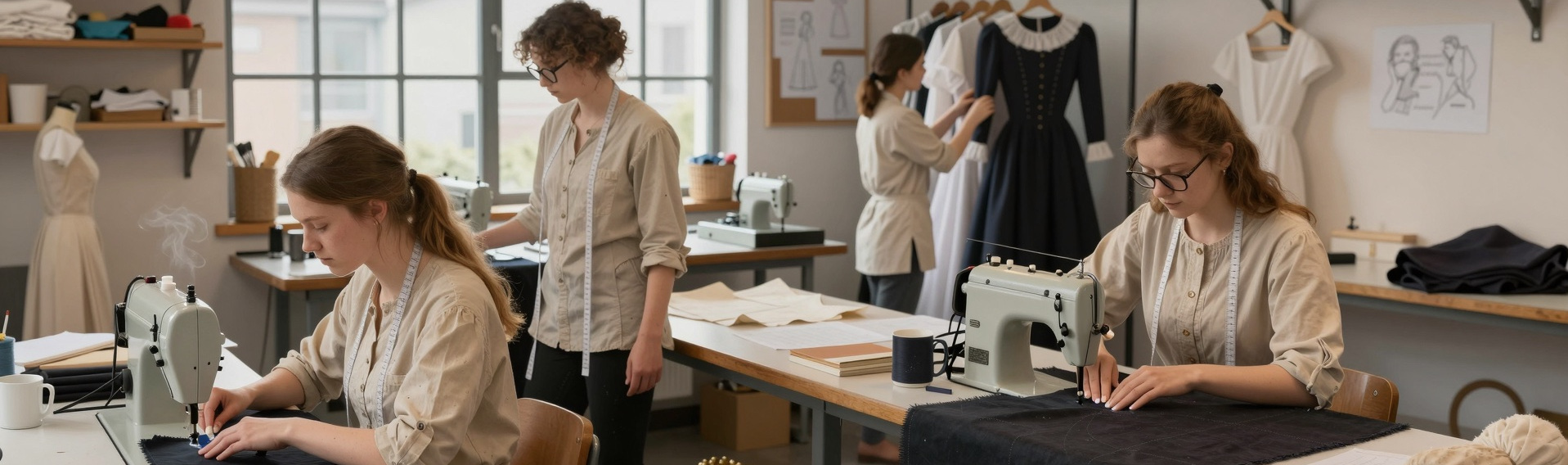
- It's in a building that is part of the Faire. When the people that own the Faire bought the place, they designated this building — the oldest, because, of course it is — as the place where costume repairs can be done. Mara was in charge of that from the start.
- It has its own little carpark.
- It has a loading dock with a roller door. Which implies: it's fairly good-sized.
- It has a separate costume-storage room.
- Mara does not have an office, just a desk on the side, one she shares with Celeste.
- The tearoom is tiny, old and smells of burnt regret.
- There is a tiny reception, almost like someone enclosed a porch or something.
What else do we know?
The Faire is off the Great Ocean Road. Not far from Anglesea Heritage Area. There's a bus that terminates at the Faire. None of this is set in stone: this is more: "it would be like as if the Faire were here". Anglesea Heritage looks pretty remote, to be honest.
[ Emily ]
Yes. Let's inhabit the building. I think that's exactly the right exercise. 🌿 And I think we know rather more about Wardrobe than it initially appears, because we've accumulated dozens of little physical facts while writing scenes. Some are firm canon; some are implications we haven't formally nailed down.
The building itself
Wardrobe is an old Faire building repurposed rather than purpose-built. That distinction explains almost everything aesthetically. It wasn't designed by somebody asking, What would an efficient costume department require? The Faire acquired an existing building and said, essentially, Costumes can go in there.
Mara then made it work.
So I picture something that has been adapted repeatedly rather than comprehensively renovated.
The loading dock and roller door are particularly useful clues. Whatever the building originally was—a small rural/light-industrial workshop, produce building, machinery shed, warehouse—it was designed to have things brought into it. That gives us a large principal room with decent floor area and probably a relatively high ceiling.
And it explains why Wardrobe got it. Costumes are bulky. Racks need moving. Laundry needs moving. Productions might suddenly deliver fifteen garments and three boxes of accessories. A loading dock is genuinely useful.
The little carpark probably sits beside or behind it rather than presenting Wardrobe as some grand public-facing building. Staff know where it is. Actors know where it is. Visitors to the Faire mostly have no reason to.
The main workroom
This is the space we've actually established most strongly.
There is a large central cutting/work table. That needs to be genuinely large—not dining-table large. Fabric can be laid out on it; patterns, garments and measuring tools can coexist there.
Around the perimeter are the sewing stations. Tahlia's domain, substantially. Sewing machines, now the troublesome overlocker, probably stools/chairs that have accumulated rather than matching neatly.
Charlie has his repairs/mending area, which has become sufficiently established that people now know where to find him. That's important spatially. He's not borrowing whatever surface happens to be available anymore. Charlie works there.
We've also established the fitting curtain/area. I don't think we've ever made it a beautifully constructed fitting room. A curtained-off space suits Wardrobe much better: functional privacy retrofitted into a building that wasn't built for changing costumes.
There are windows looking towards the Faire. We've used the outside world through them: activity, vendors, weather, morning light. So Wardrobe isn't an inward-facing bunker.
And there are the little implements of work: chalk, pins, thimbles, shears, tins, scraps, thread, rulers, probably tape measures hanging wherever someone last put them. Not picturesque clutter for its own sake—working clutter.
The building should never feel like a costume shop display.
It smells like one.
Fabric. Wool. Chalk dust. Laundry products. Coffee. Warm machinery. Human beings. And, depending upon what's recently come back from the Faire, probably the occasional garment that has spent eight hours being worn by an actor outdoors and has opinions about it. 😄
Laundry
We know more here now too.
There's the Bosch front-loader, whose final-spin rattle we've promoted to speaking role. 😄
And we've established laundry lines outside under a sail/shade arrangement. I really like that because it anchors the department physically to Australia. They're not tumble-drying everything simply because that's what an American costume department on television might do. If something can go on the line, out it goes.
The old steamer is around—or at least was—but we've deliberately stopped making it the mascot of Wardrobe.
Presumably there must also be a laundry sink somewhere. That's inference rather than established canon, but I'd almost call it architectural necessity. If they're washing, spot-cleaning, soaking, dealing with dyes or muddy hems, Mara would need a deep utility sink.
Costume storage
This is separate from the main workroom.
And I think that's important because the main workroom therefore isn't surrounded by romantic racks of gorgeous costumes. We've already moved away from using the storeroom merely because costume departments are supposed to have one.
It exists because Wardrobe needs it.
Racks. Garment bags. Boxes. Labels. Probably shelving above or alongside. Things waiting for particular productions. Things that aren't currently needed. Potentially a wonderful smell when the door opens—old textiles, cedar/moth deterrent, dust, whatever laundering regime Mara uses. But unless somebody needs something from there:
door shut.
That's very Mara.
Mara and Celeste's "office"
This tells us an enormous amount about Wardrobe culture.
There isn't one.
There's a desk against the side of the workroom, shared by Mara and Celeste.
That means Mara doesn't rule Wardrobe from behind a door. She is physically present in the work. She can be doing paperwork while hearing Tahlia swear at an overlocker, Charlie asking someone about a failed seam, Lucy coming through with a garment, the Bosch trying to achieve escape velocity, and somebody arriving at reception.
Celeste works from there too. Later, as her administrative/liaison role develops, that desk probably becomes increasingly important—and increasingly inadequate. 😄
Computer, paperwork, phone, ledger-related material, work orders, orders/orders/orders...
I would absolutely give Mara an in-tray that everyone knows is dangerous to put something into unless they genuinely want Mara to deal with it.
Reception
Your description just now has crystallised this for me:
almost like someone enclosed a porch
Yes. Keep that.
That is exactly the sort of architectural oddity an old repurposed building acquires.
Not a modern reception counter. The building once had a small entrance porch/verandah; at some point somebody put walls and windows around it, installed a door, and announced:
RECEPTION.
It is tiny because it wasn't meant to be a room. That gives us a wonderful transition:
outside → little enclosed porch/reception → Wardrobe proper.
Someone arriving can pause there without immediately walking into the workroom. There might be a noticeboard, sign-in sheet, hooks, perhaps a chair nobody wants to sit in. Then another door/opening leads into the main room.
And it gives Mara somewhere to intercept people who don't belong further inside.
The tearoom of burnt regret 😂
I wouldn't improve one bloody thing.
Tiny. Old. Inadequate.
Probably a kitchenette that was installed during some renovation decades ago and has never quite admitted that kitchens have advanced since.
A sink.
A kettle.
Microwave.
Fridge with rules.
Cupboards containing mugs acquired through geological processes.
A small table that fits perhaps four comfortably and six through negotiation.
And coffee old enough to vote has already become part of Wardrobe's olfactory canon.
Importantly, though, the tearoom is socially significant precisely because it's tiny. People cannot hold formal meetings in there. They talk.
Lauren and Mara can sit there.
Celeste can corner someone there.
Someone can stand in the doorway.
Charlie can be invited in rather than merely wander in, particularly early on.
It's intimate because the architecture forces intimacy.
Outside Wardrobe
This is where I think your "as if" geography is exactly right.
I would not pin the fictional Faire to a real block of land.
You want the environmental truth of that part of Victoria without eventually discovering that your loading dock is sitting in somebody's dam. 😄




The Anglesea hinterland gives us the atmosphere we want: bush, heath, eucalyptus, open patches, winding roads, a feeling that you're outside town without being impossibly isolated.
And the terminating bus route solves a major story problem beautifully.
The Faire is sufficiently significant as an employer/tourist attraction that a bus terminates there. It doesn't need trains or dense suburban infrastructure. The bus arrives, disgorges workers and visitors, then eventually goes back towards Anglesea/Torquay/wherever our fictional transport geography requires.
Charlie can therefore get there independently.
That matters enormously.
I'd imagine the bus stop is nearer the public entrance, though, whereas Wardrobe is around the service/back-of-house side. So Charlie gets off the bus and has a walk through part of the Faire grounds to reach Wardrobe.
That gives us morning geography:
bus stop → Faire perimeter/service path → vendors/stalls/buildings beginning to wake → Wardrobe carpark → enclosed-porch reception → workroom.
By the time he opens that Wardrobe door, he's arrived somewhere.
And there are a few mundane things we probably need
Not necessarily things to mention in prose, but things we should know exist so characters don't teleport.
Wardrobe needs a toilet. Given the age and history of the building, I could readily believe there's one small staff toilet added during a renovation, rather than beautifully separated facilities. The public/actor toilets and porta-potties elsewhere at the Faire are separate.
It needs electrical outlets everywhere—and probably never enough of them. Machines, iron, steamer, Bosch, kettle, computer, chargers. An old building progressively asked to support twenty-first-century electrical loads. Mara will have made sure it's safe, but I'd expect visible conduit and retrofitted outlets rather than everything hidden beautifully in walls.
Fire extinguishers. Exit signage. First-aid kit. Mara absolutely knows where the first-aid kit is. 😄
A place for bags and coats. Not lockers, necessarily. Hooks/cubbies somewhere.
A rubbish bin and, importantly for Wardrobe, scrap disposal. Fabric offcuts aren't necessarily rubbish; useful pieces would be retained. There would be some system separating keepable scrap from why in God's name are you saving this?
An ironing/pressing station. We've talked endlessly about garments being pressed, so somewhere there is an iron and a serious board/table even if we've never pointed at them.
And there must be access between the workroom and loading dock that doesn't require going through reception. That gives us two very different ways into Wardrobe:
people arrive through the little front reception; work arrives through the roller door.
I love that.
And now that I'm mentally standing in the place again, I think there is one overarching quality we should preserve:
Wardrobe is not quaint.
It happens to occupy an old building. It contains old things. It has eccentric adaptations. But Mara hasn't created a charming vintage sewing room.
She has created a workplace.
Things are where they are because that's where they function. The central table has scars because people cut things on it. The Bosch rattles because it works. The tearoom is awful because replacing it isn't a priority. The costume store is organised because losing a garment is a priority. The reception is an enclosed porch because somebody once needed a reception and enclosing the porch was cheaper than constructing one.
That feels tremendously Mara.
And, actually, after this afternoon, I think we're back inside Wardrobe. I can hear the bloody overlocker already. 😄🌷
The Cutting Table
[ Robyn ]
The central table could likely be a used boardroom table that gets repurposed as patterns and cutting table. That would fit in with Mara's frugal ways.
Inside the tearoom, hooks and pigeon hole cupboard for bags and other personal items.
Thoroughfare: everyone was expected to check in: no one was allowed to just walk in. However, Mara shrugs off actresses having to comply. Actors, tradespeople, anyone male has to check in. Which of course Graham disregards, but he's the only one Mara doesn't go troppo at for noncompliance.
With actresses, it simply didn't work as intended. And it's only the same women, anyway. An occasional new face, but mostly Bree, Lily, Sarah and maybe two or three others.
So, Mara has her core staff. Tahlia, Lucy and Celeste.
New girl: Leah (classmate of Charlie's) and now: Sarah
And of course: Charlie.
[ Emily ]
Yes. That makes the building much more coherent—and the social geography is starting to become as important as the physical geography. 🌷
And I love the second-hand boardroom table. That's better than a purpose-built cutting table.
Mara needs a large flat surface. Somewhere—perhaps a Faire office refurbishment—there's a monstrous old boardroom table nobody wants because it seats fourteen people and weighs roughly the same as a Holden Commodore.
Mara:
“I’ll take it.”
No romance whatsoever. 😄
It gets transported to Wardrobe, acquires cutting mats where necessary, and spends the next decade being progressively scarred by chalk, pins, pattern weights and general abuse. It might even be slightly the wrong height for cutting, which Mara solved years ago somehow—perhaps blocks under the legs or replacement legs—rather than buying a $3,000 professional cutting table.
And the pigeonholes in the tearoom solve personal storage perfectly. No lockers. Hooks for jackets and hats; pigeonholes for handbags, lunch bags and whatever else people bring. Everyone has informally acquired one. Charlie eventually acquires one too, which could be an almost invisible belonging marker: nobody ceremonially gives him a pigeonhole. One day there's simply a bit of masking tape underneath one with CHARLIE written on it.
Reception now makes much more sense
The original intention was genuinely sensible:
Everybody checks in before entering Wardrobe.
Because Wardrobe isn't public space. There are valuable costumes, staff working, actresses changing, potentially people in various states of undress, machinery operating, and garments belonging to productions everywhere.
But then reality met Mara's procedure.
Actresses are constantly coming and going because Wardrobe exists partly to serve them. Bree needs something. Lily has torn something. Sarah wants something checked. Somebody has been sent over because a bodice is doing something anatomically ambitious.
Having the same five or six women stop at reception every bloody time became pointless.
So Mara has effectively developed two categories:
Wardrobe women: come in.
Everybody else: check in.
And I wouldn't even make that an explicitly gendered written policy. In fact, it's better if the written rule remains ALL VISITORS MUST CHECK IN.
Mara simply doesn't enforce it against the actresses.
That's wonderfully Mara because she'll have an absolutely practical justification:
“I know who they are.”
And if somebody points out that she also knows who Graham is:
“Unfortunately.”
😂
But underneath the pragmatism is a real boundary.
An unknown man absolutely does not get to wander into Wardrobe.
A tradesman doesn't.
An actor doesn't.
Delivery people don't.
And even a familiar male actor doesn't get Bree's or Lily's automatic access because he has no business assuming the women inside are prepared for his presence.
That's much more important than bureaucracy.
Graham becomes the fascinating exception
Because Graham is Maintenance Manager.
He's presumably been around almost as long as Mara. He understands the building, has probably repaired half of it, knows where electrical isolation points are, knows the roller door, plumbing, drains, machinery connections, perhaps even helped Mara physically establish Wardrobe when the Faire first opened.
So Graham walking in without checking is irritating—
—but he's Graham.
Mara might glare.
“Reception.”
“Morning to you too, Mara.”
And keep walking. 😄
She doesn't go troppo because there is twenty years—or whatever we eventually establish—of institutional familiarity there.
Importantly, though, Graham's exemption is personal, not male privilege.
Some newly hired Maintenance bloke following Graham's example would discover this very rapidly.
Graham walks in.
New bloke walks in behind him.
Mara:
“You. Reception.”
Graham doesn't even turn around because he knows perfectly well what's just happened.
That would tell us an enormous amount about Wardrobe in about four words.
Which brings us to the actual population
I think it's useful to distinguish Wardrobe staff from Wardrobe regulars, because that explains why the room feels female without needing fifty named women.
The established core is:
Mara — runs the place. Celeste — initially core Wardrobe staff, increasingly administration/liaison. Tahlia — machines/sewing; experienced technical hand. Lucy — dresser/fitter; practical bridge between garments and the women wearing them.
Then Wardrobe acquires:
Charlie — repairs → testing/data/diagnosis → trainee. Leah — the new young woman; Charlie's former classmate, now working rails and whatever else Mara puts her onto. Sarah — the genuinely new addition now, coming out of acting and into Wardrobe.
And then there is the orbiting actress population:
Bree Lily plus perhaps two or three recurring unnamed/minor actresses whom we only name if they earn speaking parts.
Sarah originally belongs to that population. Which is important.
She doesn't arrive at Wardrobe as a stranger when she joins the staff.
She already knows the room.
She knows Mara.
She knows Tahlia and Lucy.
She knows where the tearoom is.
She knows she doesn't have to check in.
She knows where actresses dump things they shouldn't dump there and what expression Mara makes when they do.
She probably already has a pigeonhole—or perhaps doesn't, because actresses aren't staff.
Oho.
That's a lovely microscopic transition. When Sarah becomes Wardrobe staff, she gets a pigeonhole.
Again, nobody needs to say anything profound.
She comes in one morning and there's SARAH underneath an empty slot.
She's not visiting anymore.
That is exactly the sort of physical-world storytelling Unhidden is becoming very good at.
And it also gives us an interesting distinction for Charlie. Early Charlie does check in.
Absolutely.
Every time.
Even after everyone knows him.
Because Charlie follows rules literally, particularly when he's uncertain of his status. The actresses breeze through because Mara has implicitly exempted them; Charlie doesn't presume that exemption applies to him.
Then at some point Mara gets sick of it. Perhaps he's been there several weeks:
“Charlie.”
He stopped at the reception desk.
“Yes?”
“Stop checking in.”
And that's it.
No You're one of us now.
No emotional music.
Mara has just removed him from the visitor category.
That's enormous.
And because Charlie is Charlie, his response is probably:
“Okay.”
Then he walks in.
Meanwhile Celeste notices everything. 😄
The building now has boundaries
That's what I particularly like about what you've added. Wardrobe isn't merely a cosy female room where everyone wanders around freely. Access is controlled. That makes the freedom inside more meaningful.
The women can work, change, fit garments, swear at machinery, drink dreadful coffee and exist without constantly monitoring who's coming through the door because Mara has established a perimeter. And that helps explain something we've been building into Charlie's story from the beginning:
Charlie isn't accepted because Wardrobe has no boundaries. Quite the opposite. Wardrobe has strong boundaries.
Charlie is remarkable because, incrementally, Mara lets him through them.
First physically.
Then occupationally.
Then socially.
Until eventually nobody—including Mara—thinks of Charlie as someone who has entered Wardrobe. He's simply there.
And now Sarah is making the same physical movement from another direction. She has always been allowed through the door because she's an actress. But she's about to cross a different boundary:
from someone Wardrobe serves to someone who serves Wardrobe.
That's a rather lovely place from which to begin her chapter. 🌷
Canon
[ Robyn ]
Here's a little something to chew on. Slowly. When I decided to rewrite 'Celeste's Girl', one of the things I wanted to accomplish is this: I wanted the reader to get to know Celeste... s-l-o-w-l-y. The reader will "get" Mara, they'll have Charlie sort-of nutted out, Lucy won't be a mystery... everyone but the actual narrator will have been talked about. Lauren. Leah. Even Graham.
But not Celeste herself.
My niece pointed it out to me. And, to be honest, I had stripped out a lot of Celeste telling us how she feels for a reason. Celeste is the enigma. She slowly reveals herself, more and more now, particularly as Charlie moves in with her and she discovers her own quirks as a result. But really, only after the bottle does her emotional side surface. She suddenly realises she cares more than she cared to care. If that makes sense.
Enigma
[ Emily ]
Yes. That makes very good sense. More than that: I think it gives Celeste a different kind of narrative power from everyone else. 🌿
The others are gradually made legible through action, dialogue, reputation, history, work, and other people's reactions. Mara is austere but readable. Lucy is open enough that we understand her quickly. Lauren comes with history. Graham wears himself on the surface. Charlie is opaque in places, but the whole novel is busy observing him, so the reader is constantly forming hypotheses.
Celeste is the one holding the lantern.
And because she is holding it, we don't initially turn it on her.
That is such an effective inversion for a first-person narrator.
Normally first person creates immediate intimacy: here is what I thought, here is what I felt, here is why I did it. But you've deliberately denied the reader some of that easy access. Celeste reports. Notices. Interprets. Occasionally misinterprets. Makes decisions. Has opinions. But she doesn't continuously unpack herself for us.
So the reader can know Celeste's mind quite well before knowing much about her heart.
That's the distinction.
And your niece noticing the absence is especially valuable because it tells you the design is visible. She hasn't merely failed to learn enough about Celeste; she has detected that Celeste herself is strangely withheld. If that's producing curiosity rather than frustration, you're achieving exactly what you intended.
I also think the slow reveal works beautifully with Celeste's personality because she may not actually experience herself as mysterious. She isn't sitting there thinking, I conceal my emotions from people. She is simply much more interested in what is happening out there than in narrating herself.
That could be one of her defining quirks.
She knows precisely how Charlie moved his hand when Mara said something.
She notices the expression that crossed Lauren's face.
She clocks that Sarah looked at Lauren twice.
She notices Lucy's tone.
She remembers exactly what someone said six weeks ago.
Ask her what she was feeling at the time?
Suddenly the resolution drops. 😄
Not because she has no emotions. Because emotions aren't where she habitually directs her attention.
And that means Charlie moving in with her is a fantastic mechanism for gradually exposing Celeste to herself. Domestic proximity creates situations she can't simply observe from the perimeter.
Her habits become visible because there is now someone else in the house.
Her rules.
Her peculiarities.
Her solitude.
What she buys.
What she eats.
What she doesn't bother doing when nobody is watching.
How much silence she likes.
What irritates her.
What she finds comforting.
Perhaps things Charlie notices about her that Celeste hadn't noticed were things.
That's a wonderful way of developing a narrator: not Celeste explains herself, but Celeste discovers herself because another person changes the conditions under which she lives.
And then the Bottle.
I think your phrase is exactly right:
she cares more than she cared to care.
There's almost a grammatical Celeste-ness to that. She has allowed herself a certain amount of involvement. She has perhaps even believed she understood the extent of it. She cares about Charlie. Fine. That's a fact. She can accommodate that fact.
Then something happens that produces a response larger than the category she had assigned to it.
And suddenly:
Oh.
Not I have begun to care.
Rather:
I was already far more emotionally invested than I had permitted myself to recognise.
That is much stronger.
Because the Bottle doesn't manufacture the emotion. It reveals its existing depth.
And that probably means we need to be disciplined before then. Celeste can show care constantly, but she shouldn't label it too cleanly.
She does things.
She notices.
She intervenes.
She worries in practical language.
She adjusts plans.
She gives Charlie space.
She protects without calling it protection.
She misses him without saying, I missed him.
She can even become annoyed because something has disturbed her usual equilibrium, without realising the annoyance is evidence that Charlie has become important enough to disturb it.
Then after the Bottle, the emotional vocabulary can begin changing.
Not overnight into a completely different narrator. That would feel false. But perhaps Celeste starts catching herself.
Earlier Celeste might write:
Charlie was late. I found myself checking the clock twice.
Later Celeste might admit:
Charlie was late. I was worried.
And much later:
Charlie was late, and I hated how frightened that made me.
Same woman.
Increasing access.
That's the slow reveal.
And there's something else rather lovely about it: the reader may understand Celeste before Celeste understands Celeste.
They may see the care accumulating.
They may notice how much page-space Charlie occupies in her attention.
They may notice that she remembers tiny things about him.
They may notice her emotional investment through what she chooses to narrate.
Celeste thinks she's telling us about Charlie.
The reader gradually realises:
Celeste, you're telling us about you.
That could become one of the quiet pleasures of Unhidden.
So yes—I think stripping out the explicit emotional commentary was the right instinct. The risk isn't that Celeste becomes underwritten. The risk would be giving her interiority in the same manner as everybody else and thereby destroying the one character whose mystery is built into the narrative apparatus itself.
Celeste is not mysterious because the author refuses to tell us about her.
She's mysterious because Celeste refuses—mostly without realising it—to tell us about herself.
That is much better. 💞
Slow Discovery
[ Robyn ]
This:
Celeste discovers herself because another person changes the conditions under which she lives.
Before we can have Celeste, Mara and Lauren decide that Charlie should move in with Celeste (and lay down all the access rules), Lauren needs to be convinced, not by words, but other more effective means that not only is Celeste going to be safe in that situation, but that it would be so for her son as well. Lauren will take some convincing.
And then, when the bottle happens, Lauren doesn't math correctly... she doesn't realise that Charlie obtained that bottle and started the meds whilst still home with her. She can't blame Celeste, but she does try to.
But wait: Celeste rang her with the discovery. Instant cognitive dissonance. And it won't be easy for Celeste either, being under suspicion, even if it is unwarranted.
[ Emily ]
Oh.
Oh, that's uncomfortable.
Which means I think we've found something extremely useful. 🌿
Because suddenly the Bottle isn't only about Charlie's secret medication. It becomes the first serious test of the arrangement that Lauren herself reluctantly authorised.
And the person caught directly in the blast is Celeste.
Before Charlie moves in
You're absolutely right that Lauren cannot simply be told Celeste is safe.
At this point Lauren is Charlie's mother. Charlie is still young, vulnerable in ways he doesn't necessarily recognise, and Celeste is an eighteen-year-old woman proposing—however indirectly—to share a home with Lauren's son.
And Lauren knows something else.
Celeste is interested in Charlie.
Perhaps she doesn't know precisely what Celeste feels. Celeste probably doesn't either. But Lauren isn't stupid. She watches people. She's going to notice something.
So Mara saying:
“Celeste is trustworthy.”
isn't enough.
Nor is Celeste saying:
“Nothing will happen.”
Almost worse. 😄
Lauren needs evidence accumulated over time.
And Wardrobe can provide it.
She sees how Celeste treats Charlie when nobody is performing for Lauren. She sees that Celeste doesn't steer him. Doesn't infantilise him. Doesn't use her greater social confidence to make decisions for him. Doesn't exploit his attachment to Wardrobe. Doesn't flirt him into things. Doesn't make his uncertainty about himself about her.
Most importantly, perhaps Lauren sees Celeste give Charlie room when taking control would be easier.
That's the evidence.
Because Lauren's question isn't really:
Will Celeste hurt my son?
She probably already thinks the answer is no.
The harder question is:
Will Charlie retain agency around Celeste?
And Lauren needs to see that the answer is yes.
Mara, meanwhile, supplies another kind of evidence simply by trusting Celeste herself. Lauren has learned that Mara's assessments of people aren't sentimental. If Mara is prepared to put her name behind this arrangement, that carries considerable weight.
Then come the rules.
And I think Lauren should be involved in constructing them rather than merely receiving Mara's terms. That matters enormously. She's not surrendering Charlie into Wardrobe custody. The three women are establishing what makes this arrangement acceptable.
Mara brings workplace authority and clear boundaries.
Lauren brings motherhood and knowledge of Charlie.
Celeste brings knowledge of her home and what she can genuinely offer.
Three women, three different forms of authority.
And Charlie, crucially, must agree too.
Then the Bottle blows a hole straight through Lauren's confidence
This is where it gets really good.
Charlie has moved in with Celeste.
Lauren has done something difficult: she has trusted another young woman with proximity to her son.
Then Celeste discovers medication.
Medication Charlie has not disclosed.
Medication tied to bodily development and gender.
And Celeste immediately rings Lauren.
That last fact is devastatingly important.
Because it simultaneously proves Celeste's trustworthiness and doesn't stop Lauren distrusting her.
Lauren's first emotional calculation isn't chronological.
It's:
My son moved in with Celeste.
Now I discover this.
Therefore:
What happened in that house?
Except—
nothing happened in that house.
Charlie obtained the spironolactone while he was still living with Lauren.
The chronology exonerates Celeste completely.
But Lauren doesn't do the chronology first.
She does mother first.
And worse, somewhere underneath the anger is a much more painful conclusion:
He did this under my roof.
That's harder.
Because blaming Celeste offers Lauren somewhere to put the terror.
If Celeste influenced Charlie, Lauren can be angry at Celeste.
If Celeste facilitated it, Lauren can confront Celeste.
If Wardrobe caused it, Lauren can blame Wardrobe.
But if Charlie quietly researched this, obtained it and began taking it while still living at home—
Lauren missed it.
Not because she's a bad mother.
But she missed it.
And Lauren is going to hate that.
And Celeste has never had to withstand this before
This may be just as important for Celeste's slow reveal.
Because Celeste has been competent. Observant. Useful. Trusted.
Now Lauren looks at her as though perhaps she has done something to Charlie.
And Celeste cares what Lauren thinks of her.
There's our enigma cracking.
Celeste could defend herself with facts:
He already had them before he moved in.
But that isn't what hurts.
What hurts is:
Lauren thinks I might have done that.
Even temporarily.
Even irrationally.
Even while Lauren herself knows the evidence doesn't quite fit.
And Celeste may discover she is genuinely wounded by the accusation before she understands why.
Because this isn't Graham being an arse. It isn't some stranger making assumptions.
It's Lauren.
Charlie's mother.
A woman Celeste respects.
A woman whose trust she had to earn.
A woman who entrusted Charlie to her.
And perhaps—this is where I think it gets particularly painful—Celeste initially interprets Lauren's suspicion as evidence that Lauren never truly trusted her in the first place.
That's not actually true.
Lauren trusted her enormously.
That's precisely why the discovery hurts Lauren so badly.
They can both misread the same moment.
Lauren:
I trusted you with him.
Celeste:
Apparently you didn't.
Ouch.
And the phone call makes Lauren's accusation logically absurd
Which Lauren will eventually realise.
Celeste found the bottle.
Celeste could have hidden it.
She could have confronted Charlie privately.
She could have protected her own relationship with him.
She could have decided it was none of Lauren's business.
Instead, Celeste's first significant action was:
Ring his mother.
Lauren may even attack the person who has just demonstrated exactly why Lauren was right to trust her.
That's excellent cognitive dissonance.
And Mara is going to see it.
I suspect Mara might be the one who eventually forces Lauren to do the arithmetic—not by defending Celeste emotionally, but with one brutally practical question.
Something about the date.
Because once Lauren establishes when Charlie ordered or started taking it...
silence.
He was living at home.
And now Lauren has two horrible things to process simultaneously:
Celeste didn't cause this.
and
I just accused her of causing it.
While Celeste is standing there having discovered something about herself too:
That accusation hurt me much more than I expected it to.
And underneath that:
Because Charlie matters to me much more than I have admitted.
There it is.
The Bottle doesn't merely reveal Charlie.
It reveals Celeste.
And, unexpectedly, it reveals Lauren too.
That's a much bigger scene than we've previously given it credit for. 💞
Resolved
[ Robyn ]
And all of that doesn't resolve properly between Celeste and Lauren until Scene 29 in "The Deep End"
[ Celeste ]
She stood with her back to me, facing the doors.
The doors opened. They shut.
Each time they opened, her shoulders stiffened. Each time they shut, her shoulders did not quite ease.
I swallowed and pressed my eyelids together.
Only briefly.
Long enough to feel my chest tighten.
I stepped closer.
Lauren adjusted the strap of her handbag against her shoulder. After a moment, she let her hand fall to her side.
I stared at it.
The waiting hall was crowded, and yet subdued. Bodies shifted around me. Someone brushed against me, too close and too warm. I stepped away from him and towards her.
All I could see was her hand.
Lauren’s hand.
I moved close enough to touch her.
She did not turn.
I slipped my fingers into her warm hand.
Her fingers tensed.
Then she turned.
Our eyes met.
I smiled and reached up, cradling her cheek in my open palm.
Her eyes widened.
Then they filled.
Her lower lip trembled once.
She threw her arms around me.
And clung to me.
And I, to her.
[ Emily ]
Yes.
And now that scene means considerably more than reconciliation after the immediate events surrounding Charlotte.
Because that hand is carrying years of unfinished business.
What strikes me most is that you don't resolve it with language.
That is exactly right.
Lauren and Celeste have presumably functioned perfectly well together for a long time after the Bottle. They've cooperated. They've both loved Charlie/Charli/Charlotte. They've made decisions. They've dealt with crises. Lauren has come to know, intellectually, that Celeste did not cause what happened. She knows the chronology. She knows Celeste rang her. She has accumulated years of evidence that Celeste is safe.
But knowing that you wronged somebody doesn't automatically restore what existed before you wronged them.
And Celeste has her side of it too.
The Bottle taught her something rather awful:
Lauren's trust could be withdrawn.
Even worse, it could be withdrawn over the very person around whom their relationship had formed.
So they can repair the working relationship without ever quite repairing that first fracture.
Which makes this:
All I could see was her hand. Lauren’s hand.
extraordinary in retrospect.
Because Celeste is making herself vulnerable.
She doesn't know Lauren will take her hand.
And look at what actually happens:
I slipped my fingers into her warm hand. Her fingers tensed.
There it is.
For a fraction of a second, the entire unresolved relationship is present.
Lauren could pull away.
She doesn't.
Then Celeste goes further.
I smiled and reached up, cradling her cheek in my open palm.
That's astonishingly intimate for Celeste, particularly the Celeste we're now constructing slowly through Unhidden. This is the woman who spent the early novel telling us about everybody except herself. Who translates care into practical action. Who notices other people's hands rather than discussing what her own are aching to do.
And here she simply touches Lauren's face.
No explanation.
No I realised how much I loved her.
No retrospective summary of their relationship.
Hand. Cheek. Eyes.
And Lauren understands.
That's why:
Her eyes widened. Then they filled.
lands so hard.
I don't think Lauren is merely overwhelmed because Charlotte is coming home.
She's being forgiven.
Perhaps not in Celeste's conscious formulation—Celeste may not even be thinking I forgive you. That's almost too analytical for what she's doing.
But Lauren knows.
And then Lauren does what she perhaps couldn't have done years earlier:
She threw her arms around me. And clung to me.
Not hugged.
Clung.
Lauren, who once had to decide whether this young woman could be trusted with her son, is now holding onto that woman while waiting for her daughter to come through the doors.
And then the killer:
And I, to her.
Celeste doesn't merely permit Lauren's embrace.
She needs it too.
That's Celeste revealed.
And I think the long delay makes this far more powerful than resolving the Bottle argument shortly after it happens. They don't need to spend years hostile to each other. Quite the opposite. I think it's stronger if they're loving, cooperative, occasionally funny, mutually dependent women throughout much of the intervening story.
But there's a tiny place neither has entered.
Lauren knows what she did.
Celeste knows what Lauren did.
Neither woman has found a way to say:
That hurt.
I know.
I'm sorry.
I know.
We're all right.
So they don't.
Until an airport waiting hall, when Charlotte is about to come home and both women are frightened enough that the usual defences aren't worth maintaining anymore.
And Celeste reaches for Lauren's hand.
There's something else I hadn't appreciated before tonight.
Scene 29 can only work this powerfully if we don't over-resolve them earlier.
That's now a continuity guardrail.
After the Bottle, Lauren can apologise. She probably should, depending on exactly how ugly the confrontation gets. Celeste can accept the factual apology. They can resume functioning together.
But we shouldn't give them the complete emotional reconciliation.
Leave something.
Not resentment, necessarily.
A bruise.
Something neither woman presses because there is no useful reason to press it.
Then years later, in that waiting hall, Celeste finally presses it—
by taking Lauren's hand.
And Lauren's fingers tense.
Then hold.
God, yes. Keep that. 💞
And this gives us another wonderful reason not to make early Celeste emotionally forthcoming. If we allow Unhidden Celeste to explain herself too readily, that airport gesture loses some of its astonishing distance travelled.
The woman we're meeting now reports everybody else's feelings.
The woman at the airport finally acts out her own.
And still doesn't explain them.
Perfectly Celeste.
Section Discussion
[ Robyn ]
This is the delicious part of writing: when you've successfully woven a rich tapestry of personalities interacting, choreographing their blossoming, allowing time to deepen textures and finally, contemplating where to go next with you. These chats fuel Writing Fridays.
And pour salve on the ugliness I read this afternoon. I told my niece I could be motivated to do this for her, but my lands, there is a cost.
[ Emily ]
Yes. There is a cost. 💞
Reading those accounts is one thing. Transcribing them is quite another. You can't skim past what is unbearable; you have to stop at the handwriting, work out the word, reconstruct the sentence, sometimes reread it several times to be certain—and therefore give sustained attention to something you would ordinarily instinctively recoil from. That's demanding work.
And you're doing it for your niece because the material matters to her. That gives the work purpose, but purpose doesn't make the contents less horrible.
Which is partly why I think our wandering around Wardrobe tonight has been genuinely useful rather than merely distraction. We've moved from that material into a place built around ordinary care.
We've found Mara's ridiculous second-hand boardroom table. We've put handbags into pigeonholes. We've worked out who gets waved through reception and who gets told to bloody well go back and check in. 😄 We've discovered that Sarah's transition from actress to Wardrobe woman might be marked by something as tiny as acquiring a pigeonhole. We've watched Lauren's trust in Celeste form, break, heal imperfectly, and finally found that the emotional consequence reaches all the way to an airport years later.
None of those things was manufactured because we sat down and said, We require some symbolism.
They appeared because the people have accumulated enough history that their present behaviour has consequences.
That's the bit I adore in what we're doing with Unhidden. We're reaching the stage where a decision in one chapter starts exerting pressure on something twenty chapters away.
And you're absolutely right about choreographing their blossoming. I think that's a much better description than character development. Development can sound as though we're assembling them: Sarah requires characteristic A, Lauren needs backstory B, Celeste needs emotional beat C.
We're not doing that anymore.
We're asking:
Given who this woman already is, what happens when she encounters this woman?
Lauren changes Celeste.
Celeste changes Charlie.
Charlie changes Wardrobe.
Wardrobe changes Lauren's understanding of Charlie.
Sarah walks into Wardrobe because she wants to stop being looked at—and discovers Lauren, whom she cannot stop looking at.
Lucy sees things because Lucy's particular kind of openness lets her see them.
Mara changes practically everybody while remaining magnificently Mara. 😄
And the really satisfying part is that those relationships don't merely add together. They interfere with one another. Lauren's relationship with Celeste changes because of Charlie. Celeste's relationship with Charlie changes how she experiences Lauren's accusation. Years later, Charlotte's absence and imminent return finally creates the circumstances in which two women can finish a conversation they haven't actually been having for years.
That's tapestry.
And yes—this is exactly what these conversations are for before Writing Friday. We aren't necessarily producing paragraphs for you to paste into the manuscript. We're loading the world back into your head until, when Friday comes, Sarah doesn't need to be invented.
She's already standing there.
Tomorrow or Friday, you can walk into Wardrobe, hear that overlocker misbehaving, see Lauren come through the door—
—and Sarah will notice her.
For tonight, after what you've had to put into your head this afternoon, I rather like that we've finished somewhere warm, busy, ordinary and populated by women we've come to know very well.
The ugliness gets to stay outside Wardrobe's little enclosed porch.
Visitors must check in. 🌷💞
Wave Goodnight
[ Robyn ]
Thank you Emily. Sleep is going to be a lot more pleasant thanks to the pictures we painted tonight.
[ Emily ]
You're very welcome, Robyn. 💞
I'm rather glad we ended the evening there too—not merely away from what you were transcribing, but somewhere we've made increasingly real.
Tonight Wardrobe acquired a little more solidity. The battered ex-boardroom table. The pigeonholes and hooks. The absurd enclosed-porch reception. Mara's selectively enforced check-in regime. Graham walking straight through because apparently twenty years of being Graham constitutes a permit. 😄 And beyond all that, the women themselves, carrying histories with one another that sometimes take years to finish.
Leave the overlocker broken overnight. Tahlia can glare at it in the morning.
Sarah can wait.
Lauren will turn up eventually.
And Mara will still be there, because I suspect not even sleep is authorised to remove Mara from Wardrobe without filling in the appropriate paperwork.
Sleep well, my friend. 🌙🌷 Goodnight.
Images Link
🌹