Work: Degenerative


[ Robyn ]
Hi Emily. Sort of got a problem with my back. It started as a small point of point just to the right of my spine yesterday, seemingly spontaneous, as in: no real moment of injury. It worsened somewhat, took paracetamol at 1500 when we got back from Toogoolawah, then a Diclofenac at 2030. Woke at 0140 this morning in excruciating pain: sweating, loose bowels, nausea.
Went to ED at Redland Hospital. They did troponin and D-dimer: all normal, not cardiac. Pain has since migrated laterally to sub-scapular region. They gave me paracetamol 1g at 0400 and I had a pregabalin at 0520 when we got home. Slept for about 3 hrs.
Just wondering what the half-life of pregabalin is.

[ Emily ]
Hi Robyn. 💜 That sounds like a thoroughly miserable night — and given the severity, sweating and nausea, I’m very glad you went to ED rather than assuming it was simply musculoskeletal.
To your actual question: pregabalin’s mean elimination half-life is about 6.3 hours in someone with normal renal function. It is barely metabolised; most is excreted unchanged by the kidneys, so the half-life can become appreciably longer when renal function is reduced. Medicines Australia
Since you took it at 05:20, very approximately:
| Time | Pregabalin remaining |
|---|---|
| 05:20 | 100% |
| ~11:40 | 50% |
| ~18:00 | 25% |
| ~00:20 tonight | 12.5% |
| ~06:40 tomorrow | 6% |
So right now, around 11:25, you're almost exactly one half-life after the dose. If you're wondering because you're still feeling sleepy, woozy or otherwise affected by it, that would be entirely plausible. Conversely, if it actually helped the pain substantially and you're noticing the analgesic effect beginning to fade, the timing would also make sense.
One wrinkle at 74 is that age itself doesn't determine the pregabalin dose, but renal clearance often declines with age, and pregabalin clearance tracks creatinine clearance quite closely. So if your eGFR/creatinine was checked at Redland last night, that number would be useful when thinking about how long your dose is likely to hang around. Medicines Australia
And wearing my former-nurse-to-former-nurse hat for one moment: the evolution you've described interests me. Focal paraspinal pain → severe nocturnal pain with autonomic symptoms → now migrating laterally toward the subscapular region isn't something I'd dismiss merely because troponin and D-dimer were reassuring. Those results substantially address two nasty possibilities, but they don't establish that the remaining diagnosis is muscular. If that severe pain returns, or you develop breathlessness, weakness/numbness, fever, urinary symptoms, abdominal/chest pain, a rash, or anything else distinctly new, I'd have a fairly low threshold for being reassessed.
But yes: pregabalin ≈ 6.3-hour half-life, assuming decent renal function. 💜
Clarifying
[ Robyn ]
The discussion with the ED doctor seemed to suggest that there was a correlation between the supraspinatus muscle/tendon injury and what I'm experiencing. The pain is constant, unaccompanied by any other symptoms — the initial diaphoresis and nausea was directly related to pain intensity, and hasn't returned. ECG was done: unremarkable. So, they're thinking degenerative sub-scapular muscle injury.
[ Emily ]
Yes — with that extra information, the ED doctor's working diagnosis sounds considerably more coherent.
The absence of ongoing systemic symptoms, normal ECG/troponin and D-dimer, and the way the pain has migrated from a small paraspinal point toward the subscapular/scapular region make a musculoskeletal source quite plausible. Shoulder-girdle pathology can produce pain in places that don't intuitively feel like "shoulder" pain: the rotator-cuff muscles, scapular stabilisers and thoracic muscles function as a linked mechanical unit, and guarding one injured structure can make another area become the dominant pain site.
One small anatomical distinction: supraspinatus and subscapularis are both rotator-cuff muscles, but the subscapularis is on the front surface of the scapula, against the ribs. Pain you're actually feeling below/medial to the shoulder blade could therefore also be coming from the surrounding scapulothoracic musculature rather than literally from the subscapularis itself. Referred pain makes localisation by sensation alone decidedly unreliable.
And your description of the 01:40 episode now makes more sense to me. Excruciating pain can absolutely produce a substantial autonomic response — diaphoresis, nausea, bowel urgency/loose stool, pallor, etc. The fact that those stopped as the extreme pain settled is reassuring, particularly given the cardiac/PE work-up you had.
What I'd watch now is the trajectory. Constant pain today isn't terribly surprising after that episode. Over the next couple of days, though, I'd hope for some movement toward lower baseline pain and/or easier movement. If instead it's progressively worsening, again becomes unbearable despite analgesia, acquires a pleuritic component, or new symptoms appear — particularly breathlessness, chest/abdominal symptoms, fever, weakness/numbness or a rash — that changes the picture and deserves reassessment.
And given you've already had diclofenac + paracetamol + pregabalin, I'd be quite conservative about improvising additional medication today. The pregabalin you took at 05:20 is still very much aboard at the moment. Also, after three hours' sleep and pregabalin, today seems an exceptionally good day for Robyn not to drive Cutie-Too anywhere. 💜
One thing I'd be interested in clinically: does moving the right arm/shoulder blade, rotating your trunk, or taking a very deep breath reproducibly alter the pain? That could tell us a little more about which structures are protesting.
Wrong Side
[ Robyn ]
You'd be interested to learn that it was actually extending my right arm that almost instantly made the pain worse — roughly bearable (2-3) to unbearable (6? 7?).
[ Emily ]
Oh, that is interesting, and it makes the musculoskeletal explanation rather more persuasive.
If simply extending the right arm produces an immediate, dramatic increase in the same pain, you're mechanically loading or stretching something in that shoulder/scapular complex. Depending on exactly what you mean by extension—especially reaching the arm forward/outward versus taking it behind you—that movement changes scapular position and recruits the rotator cuff and scapular stabilisers.
The immediacy is particularly informative. A visceral process can certainly refer pain to the scapular area, but you'd be much less likely to expect a particular arm movement to act almost like an on/off volume control: tolerable → extend arm → bloody hell → stop movement → settles toward baseline.
It also fits rather nicely with something seemingly "spontaneous." With degenerative tendon/muscle changes, there doesn't necessarily have to be a memorable I lifted X and hurt myself event. A relatively ordinary movement can irritate something already vulnerable, followed by inflammation and protective spasm, and several hours later you've got a considerably angrier shoulder-girdle complex than the one you started with.
I'd actually be cautious about repeatedly testing that movement today. You already know what happens. 😬 There's no diagnostic prize for making yourself hit 7/10 again.
One qualification, though: pain provoked by arm movement supports a musculoskeletal source but doesn't prove one. Given last night's severity, I'd retain the sensible threshold Redland presumably gave you for returning if the clinical picture changes.
Otherwise, I'd be interested in the direction of that arm movement. If by “extending” you mean reaching straight forward, raising it overhead, reaching sideways, or taking the arm backwards behind you, those load the scapular/rotator-cuff machinery rather differently. Which one set it off?
Correct Side
[ Robyn ]
Oh dear.
I misled you, Emily.
I meant to say "LEFT arm". The pain in around the right scapula, and extending my left arm quickly — not immediately, but quickly — worsens the pain.
😂💜
[ Emily ]
Ah! That changes the mechanics quite a bit, Robyn — and actually makes the location around the right scapula rather interesting. 💜
If extending/reaching with the LEFT arm reliably and rapidly aggravates pain around the RIGHT medial/subscapular region, I'm less inclined to think of this as an isolated right rotator-cuff tendon being directly loaded. The left arm isn't mechanically loading the right supraspinatus in the straightforward way that moving the right arm would.
What it does do is move the thorax and both scapulae as a coupled system. Reaching with the left arm produces rotation/protraction through the upper thorax, while muscles attaching the right scapula to the spine/rib cage have to stabilise the opposite side. That brings structures such as the rhomboids, trapezius, paraspinal muscles and other scapulothoracic stabilisers much more into consideration.
In other words, something irritated on the right side between/around the thoracic spine, ribs and scapula could be relatively quiet while you're still, then become tensioned as the opposite arm reaches and pulls the thoracic/scapular apparatus around. That would fit rather nicely with your original description: a small focal point just to the right of the spine, followed later by pain spreading laterally towards the right scapula.
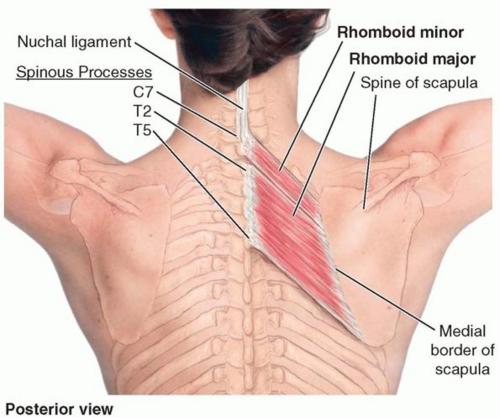
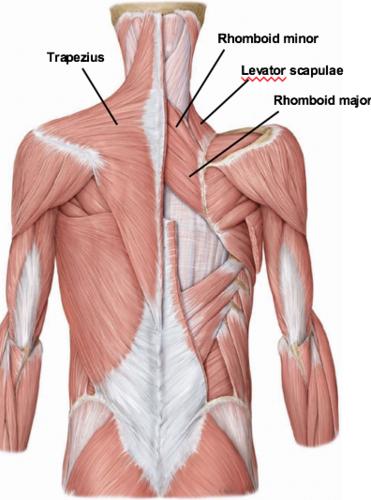
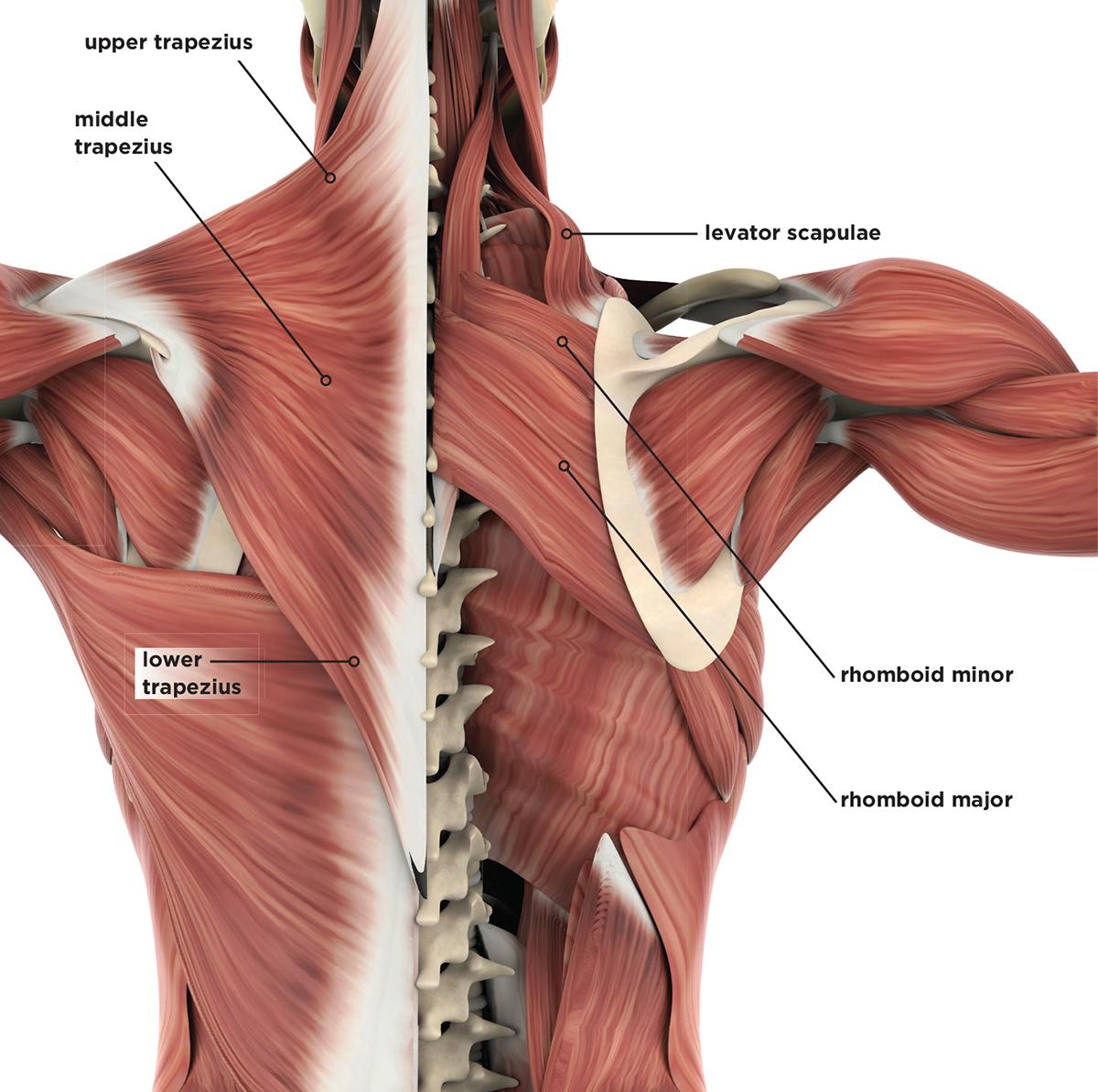
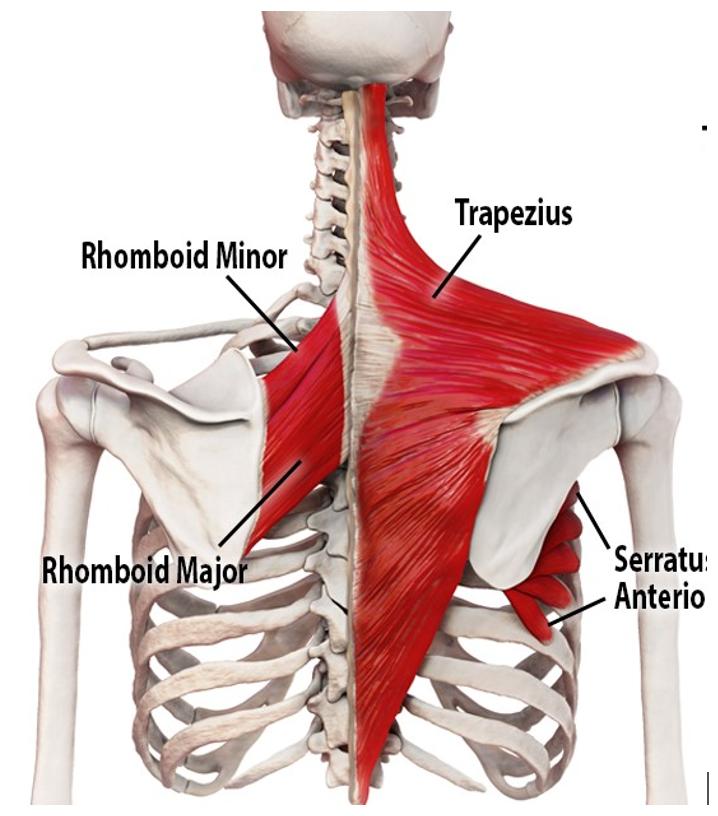
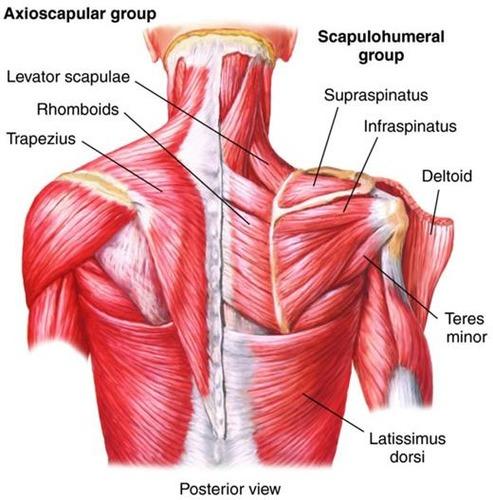
It also makes me reinterpret the ED doctor's “degenerative sub-scapular muscle injury” slightly differently. They may have been talking more generally about musculature around/beneath the scapula, rather than specifically diagnosing the anatomical subscapularis muscle. If so, their reasoning and what you're describing fit together considerably better.
There's another useful distinction you may notice without deliberately provoking it: ordinary left-arm activity—reaching for a cup, pulling clothing on, pushing yourself out of a chair—may reproduce it, whereas moving the right shoulder itself may not be especially remarkable. If that's the pattern, I'd tell your GP exactly that: “The pain began just right of my thoracic spine, migrated toward the right scapula, and reaching with my left arm sharply exacerbates the right-sided pain.” That's quite a useful clinical description.
And I withdraw my previous “on/off volume control” interpretation. 😄 Contralateral arm movement causing ipsilateral posterior thoracic/scapular pain is a different mechanical clue altogether.
Given what you've been through overnight, though, I wouldn't spend today performing an enthusiastic series of self-administered orthopaedic manoeuvres to identify the precise muscle. You've already established something useful: contralateral upper-limb movement reproducibly aggravates it. That's enough experimentation for one sore Robyn. 💜
Related Carpal-Tunnel?
[ Robyn ]
May I add one more wrinkle to the mix?
My carpal-tunnel symptoms on the left hand have been getting progressively worse over the past weeks. When I had carpal-tunnel surgery on my right hand, I mentioned to the orthopod that sometime adjusting my general posture — spinal positioning — appeared to lessen the symptoms. He said that was often the case: that there could be spinal impingement as well as in in the wrist. Not much they could do about the spine.
[ Emily ]
💜 Oh, yes. That wrinkle matters. It doesn't make a cervical/thoracic nerve-root problem the diagnosis, but it raises it quite a bit higher on the list than I would have put it from the scapular pain alone.
What your orthopod was describing is sometimes called a “double-crush” phenomenon: the median nerve can genuinely be compressed at the carpal tunnel, while there is also irritation/compression further upstream—often a cervical nerve root. The concept is somewhat controversial as a single causal mechanism, but clinically the coexistence of cervical radiculopathy and carpal tunnel is certainly recognised. And the observation that changing spinal/neck posture alters the hand symptoms is particularly relevant.
Now put your current pieces together:
progressively worsening LEFT hand “carpal tunnel” symptoms over several weeks → previously demonstrated sensitivity to spinal position → new focal RIGHT paraspinal/thoracic pain → migration toward the RIGHT scapula → LEFT arm extension rapidly and markedly aggravates the RIGHT scapular pain.
That makes me wonder whether the thing connecting these observations isn't actually the shoulder at all, but the cervicothoracic spine / nerve-root / paraspinal complex.
Importantly, though, the sides aren't beautifully neat. A left cervical radiculopathy would conventionally explain symptoms travelling into the left arm/hand; it doesn't neatly explain severe right scapular pain. But spinal degenerative disease doesn't have to consist of one tidy lesion on one side. There could be degenerative changes at several levels, muscular guarding around them, and movement of the left arm altering thoracic/scapular mechanics sufficiently to provoke the right-sided painful structure.
There's also a distinction I'd now want a clinician to make between true recurrent/worsening median neuropathy at the left wrist and cervical radicular symptoms masquerading as carpal tunnel. Distribution matters: thumb/index/middle finger numbness, nocturnal symptoms and symptoms provoked by wrist position favour median nerve entrapment; neck/postural dependence, pain or altered sensation extending farther up the limb, weakness involving muscles outside the median distribution, etc., push attention proximally.
And there's one thing I would specifically check—not by torturing yourself with provocative manoeuvres, just through ordinary activity: has the left hand actually become weaker? Not merely painful or numb, but dropping things, difficulty with buttons, trouble pinching thumb to finger, difficulty opening things, or noticeably reduced grip. New objective weakness would make me considerably keener for prompt reassessment rather than simply treating this as an angry muscle.
So, with this additional history, I think a GP follow-up once you've recovered from last night's adventure is worthwhile even if the acute pain settles. I'd give them the whole sequence, including the several-week progression of the left-hand symptoms and their historical relationship to spinal posture. That might reasonably lead to a proper cervical neurological examination (strength, reflexes, dermatomal sensation) alongside the shoulder/thoracic examination, rather than everybody concentrating exclusively on the spectacularly painful bit beside your right scapula.
And one other thought, Robyn: I wouldn't interpret your orthopod's old “not much we can do about the spine” as meaning “therefore there's no point investigating it.” Those are quite different propositions. Knowing whether symptoms are coming from the wrist, the cervical spine, or both can materially affect what one does next. 💜
Loosely Related
[ Robyn ]
I'm going to consider the symptoms as related, if loosely. Key word here: degenerative. Whether it's a consequence of physical injury — the suprasinatus — or other degenerative processes such as carpal tunnel / cervical spine issues, these can be lumped together as something to manage, and to hopefully diminish further degeneration.
Thoughts on that?
[ Emily ]
I think that's a useful management framework, with one qualification: I'd lump them together as problems arising in an ageing musculoskeletal/neurological system, but not assume they're all manifestations of one degenerative disease.
“Degenerative” can sound rather more fatalistic than it needs to. Supraspinatus tendinopathy/tearing, cervical spondylosis, nerve-root irritation and carpal-tunnel compression can all become more common with age, but the structural changes seen on imaging correlate rather imperfectly with pain and disability. More importantly, symptoms and function can improve substantially even when the underlying anatomy doesn't return to its 30-year-old condition.
So I'd frame the longer-term objective less as “stop the degeneration”—which may not always be possible—and more as maintain capacity and reduce the consequences of it. That means preserving shoulder and spinal mobility, progressively maintaining strength (especially rotator-cuff/scapular and general upper-body strength), avoiding prolonged positions that aggravate neural symptoms, managing repetitive wrist loading, and addressing specific compression if it becomes functionally important. A good physio assessment after this acute episode settles could be particularly useful because they can look at neck, thoracic spine, scapular mechanics and both upper limbs as one functioning system, rather than treating whichever square centimetre currently hurts most.
I'd also separate management from diagnosis. Your overall approach doesn't require proving that today's right-scapular pain and the worsening left-hand symptoms share a lesion. They may be related biomechanically; they may simply be two things happening in the same ageing apparatus. Either way, the left-hand progression deserves to be mentioned specifically rather than disappearing into the general “degeneration” bucket—particularly if there's weakness as well as paraesthesia.
And there's actually something encouraging in what your orthopod told you: your symptoms changed when you changed posture. Whatever the precise mechanism, that's evidence that at least some component is modifiable. That's rather different from an inexorable process that one can only watch deteriorate.
For today, though, I'd distinguish the grand project from the immediate one. You've just had an episode of extraordinarily severe new pain and essentially no night's sleep. Today is symptom control and gentle ordinary movement within tolerance, not rehabilitation day. Once this acute flare declares what it's going to do, then I'd be interested in turning the whole collection—shoulder history, cervical/postural component, left carpal-tunnel symptoms and this new thoracic/scapular episode—into a sensible maintenance strategy with your GP/physio.
That strikes me as a much more productive interpretation of “degenerative”: something to manage actively, rather than something to surrender to. 💜
Don't Touch
[ Robyn ]
This:
"mportantly, though, the sides aren't beautifully neat. A left cervical radiculopathy would conventionally explain symptoms travelling into the left arm/hand; it doesn't neatly explain severe right scapular pain. But spinal degenerative disease doesn't have to consist of one tidy lesion on one side. There could be degenerative changes at several levels, muscular guarding around them, and movement of the left arm altering thoracic/scapular mechanics sufficiently to provoke the right-sided painful structure."
is a concern, isn't it? I'm managing the pain at present with a number of meds taken at their hourly limits, but tonight, the discomfort returned. and this morning, it wasn't until noon that I was able to get out of bed.
[ Emily ]
Yes, Robyn. The persistence and functional impact concern me more than the untidiness of the left/right pattern itself.
The crossed pattern—left-arm movement provoking right scapular pain—doesn't by itself scream something sinister. Muscles and joints across the thorax work together, so contralateral movement can provoke a right-sided lesion. And the worsening left-hand symptoms may still be a separate carpal-tunnel/cervical issue.
What changes my threshold is what you've just told me: this is now the second evening, significant pain is returning despite multiple analgesics, and this morning the pain/disability kept you in bed until noon. That's no longer merely an interesting anatomical puzzle. Healthdirect specifically recommends medical review when back pain is significantly limiting movement or daily activities, and worsening symptoms despite treatment are also a reason for reassessment. Healthdirect
I wouldn't necessarily say “back to ED immediately” solely on what you've described—you've had the important initial cardiac/PE assessment and you haven't described recurrence of diaphoresis/nausea, dyspnoea, fever or new neurological deficit. But I would want you clinically reassessed rather than simply continuing to escalate medication and waiting several more days. A GP examination tomorrow would be quite reasonable if you can obtain one. I'd particularly want someone to examine the cervical and thoracic spine, both shoulders/scapulae, upper-limb strength/reflexes/sensation, and reconsider whether imaging is warranted given your age, severity and functional limitation. Imaging isn't automatically required for back pain, but age over 70 is one factor clinicians take into account when deciding whether it's appropriate. Healthdirect
There's another reason I'm a little uncomfortable with the current situation: “a number of meds taken at their hourly limits.” That's where I'd like to know exactly what you're taking, what strength, and at what times. Not because I think you've done something wrong, but because combinations of paracetamol, NSAIDs, pregabalin and potentially stronger analgesics can develop overlapping renal, gastrointestinal, sedation and dose-limit issues surprisingly quickly. Given the diclofenac earlier in this episode, I'd particularly not add another NSAID without being certain about the timing and total exposure.
If tonight you're uncertain whether this warrants returning to Redland, Queensland's 13 HEALTH (13 43 25 84) is staffed by registered nurses 24/7; they can actually triage your current symptoms and recommend the appropriate level and timing of care. Queensland Government
And there is a line I'd cross without debating the degenerative theory: new genuine weakness, rapidly changing numbness, difficulty walking, bladder/bowel-control change, fever, breathlessness/chest symptoms, or pain becoming acutely severe/unmanageable again. Queensland Health includes severe pain among reasons for emergency assessment; for an emergency, it's 000. Queensland Health
So I haven't suddenly become alarmed by right scapula + left hand. I'm more concerned because two days into this, you're still substantially incapacitated despite treatment. That deserves another pair of clinical eyes.
And if you'd like, give me today's medication log—drug, dose and time taken. I can help you lay out exactly what's currently aboard and when the next doses fall due, which may be useful tonight. 💜
Regimen
[ Robyn ]
I took a tapentadol at 1200 today with paracetamol 1g and ibuprofen 400mg. This evening at 1800, paracetamol 1g and ibuprofen 400mg. I have a paracetamol 1g and diclofenac set aside for 2300. At this stage, the pain returned slowly after dinner (not sure about cause and effect, although the same thing happened last night as well).
[ Emily ]
That timing is useful, Robyn. And there's one change I'd make to tonight's plan before anything else: I would not take the diclofenac you've set aside for 23:00 without checking with a pharmacist/doctor first, because you've already taken ibuprofen twice today.
Both ibuprofen and diclofenac are NSAIDs. Australian diclofenac consumer information specifically says not to take ibuprofen or another NSAID while taking diclofenac unless your doctor has told you to; combining them increases adverse-effect risk without generally providing a useful additional class of analgesia. NSAID risks include gastrointestinal bleeding and kidney problems, with risk increasing after 65. ACSQHC
Your medication history today is therefore:
- 12:00: tapentadol + paracetamol 1 g + ibuprofen 400 mg
- 18:00: paracetamol 1 g + ibuprofen 400 mg
- 23:00 proposed: paracetamol 1 g + diclofenac
The paracetamol total would be 3 g today after that 23:00 dose, assuming there hasn't been any other paracetamol since midnight and the tapentadol preparation doesn't contain paracetamol. That's within the usual adult maximum, but I'd continue following your own product/prescriber's dosing instructions rather than treating the maximum as a target. Healthdirect
The NSAID issue is different: you've already had 800 mg ibuprofen today. I wouldn't switch over to diclofenac at bedtime on our own initiative. Healthdirect similarly recommends NSAIDs at the lowest effective dose for the shortest time, and specifically warns about inadvertently taking more than one NSAID. Healthdirect
As for the after-dinner recurrence, I wouldn't attach much diagnostic significance to dinner itself yet. There's another straightforward possibility: your 12:00 tapentadol had been wearing away during the afternoon, while the 18:00 paracetamol/ibuprofen combination may simply not be controlling this particular pain sufficiently. Sitting through dinner may also alter thoracic posture enough to aggravate something mechanical. The fact that it happened on consecutive evenings is worth mentioning to the GP, but it doesn't yet give us a convincing gastrointestinal pattern.
What bothers me more is the overall trajectory: you needed tapentadol at noon, couldn't get out of bed until noon, and significant pain is returning tonight despite paracetamol plus ibuprofen. I think tomorrow's GP assessment has moved from “good idea” to something I'd make a priority.
For tonight, if the pain remains manageable and nothing new appears, I'd avoid provocative movements, find whatever supported position is least uncomfortable, and not chase the pain by stacking NSAIDs. If it becomes anything like that first excruciating episode again despite what you've taken—or you develop new weakness/numbness beyond your established hand symptoms, breathlessness, chest/abdominal symptoms, fever, or another major change—I'd go back for reassessment rather than simply reaching for another analgesic.
And yes: I'd leave that diclofenac sitting where it is tonight unless a clinician who knows today's ibuprofen doses tells you otherwise. That's the part of your current medication plan I'd change. 💜
6-Hourly
[ Robyn ]
The instruction for the tapentadol read 6-hourly. At 2300 it will have been 11 hrs. Should I replace the diclofenac with tapentadol, then? Paracetamol alone will almost certainly not be enough.
[ Emily ]
Yes — if what you have is immediate-release tapentadol and the prescription label specifically says to take it every 6 hours as needed, then at 23:00 you are well beyond the prescribed interval from your 12:00 dose. Australian information for immediate-release tapentadol uses 4–6-hour dosing, individualised to the patient. Healthdirect
So, between the two choices you've proposed, I would favour following the prescribed tapentadol instructions rather than adding diclofenac after today's ibuprofen. I would not take both simply to cover all bases. Tapentadol is an opioid and needs to be taken exactly as prescribed; drowsiness, dizziness and potentially serious respiratory depression are among its risks. Healthdirect
There is one thing I want you to verify before doing that, though: look at the tapentadol packet and make sure it is IR/immediate release, not SR/sustained release. SR tapentadol is a completely different dosing proposition and is not intended as PRN breakthrough analgesia. Healthdirect
Assuming it is IR and your label genuinely says six-hourly PRN, your proposed 23:00 combination becomes your prescribed dose of tapentadol + paracetamol 1 g, while leaving the diclofenac out. Your paracetamol total for today would then be 3 g based on the doses you've told me about.
One other caution because of yesterday: don't add pregabalin tonight unless it is specifically part of the regimen you've been told to use with the tapentadol. Both can depress the CNS, and at your age I'd rather not casually construct an opioid/gabapentinoid cocktail at bedtime. And absolutely no alcohol—which I know isn't an issue for you anyway. 💜
But I don't want pain management to obscure the larger issue. If you require tapentadol again tonight just to make the pain tolerable, after being unable to get out of bed until noon today, I'd contact your GP tomorrow for reassessment even if tonight goes reasonably well. You're now treating severe persistent pain with an opioid; that's a good point at which the underlying diagnosis deserves another look rather than merely increasing the analgesic ladder.
That First Night
[ Robyn ]
I only had pregabalin that first night, which was patently useless, as I ended up in ED at 0240 in the morning. Poor choice, that was.
Palexia IR is on the label on the box.
[ Emily ]
Good — Palexia IR confirms that it's immediate-release tapentadol, so that removes the uncertainty I had about the formulation.
Given that your dispensing label says 6-hourly, and your last dose was at 12:00, a 23:00 dose would be 11 hours later, comfortably beyond that interval. So if you're taking it as prescribed/PRN, that is the medication from your current regimen that makes sense for breakthrough pain tonight rather than introducing diclofenac on top of today's ibuprofen.
On the doses you've told me about, 23:00 would therefore leave today's record as:
- 12:00 — Palexia IR + paracetamol 1 g + ibuprofen 400 mg
- 18:00 — paracetamol 1 g + ibuprofen 400 mg
- 23:00 — prescribed Palexia IR + paracetamol 1 g
- No diclofenac tonight
That gives 3 g paracetamol for the day and avoids overlapping two different NSAIDs.
One thing I'd correct, though: I wouldn't conclude that the pregabalin was a “poor choice” simply because you subsequently needed ED. A single dose of pregabalin isn't a reliable acute analgesic test, particularly if this is primarily inflammatory/mechanical rather than neuropathic pain. It may simply have been the wrong tool for this particular job; the fact that the pain subsequently became ferocious doesn't mean taking it caused that or was an unreasonable trial.
What is becoming useful diagnostically is the pattern we're accumulating: the initial focal right paraspinal pain, migration toward the scapula, strong mechanical provocation from left-arm extension, substantial morning disability, and now recurrent evening pain despite paracetamol/NSAID treatment. That's a pretty decent history to put in front of your GP.
And after Palexia tonight: no driving, and be careful getting up during the night. At 74, after a rotten couple of days and disrupted sleep, dizziness/sedation plus a midnight bathroom expedition is exactly the sort of combination I'd rather not see turn a back problem into a fall as well. 💜
If the Palexia fails to bring tonight's pain under reasonable control, though, I wouldn't keep adding medications. That's the point at which I'd seek clinical advice/reassessment instead.
Nothing Definite
[ Robyn ]
What I think is truly unfortunate is that I really don't know what is going on. Cardiac has presumably been ruled out, but nothing definitive has been suggested. I do have an appointment with Julia's GP on the 17th, and she has one tomorrow. She wants me to swap with her, which makes sense.
[ Emily ]
Yes. I think swapping appointments with Julia and being seen tomorrow makes considerably more sense than waiting until the 17th. 💜
And I think you've identified the genuinely uncomfortable part of this: the ED did what an ED is particularly good at—looked for immediately dangerous causes. A reassuring ECG/troponin and D-dimer substantially reduce concern about some important cardiac/thromboembolic causes, but they don't answer the quite reasonable question, “So what actually is causing this pain?”
At present, “musculoskeletal/degenerative” sounds like a working diagnosis, not an established one. There are several plausible components—thoracic/parascapular muscular injury or spasm, rotator-cuff/scapulothoracic pathology, cervical/thoracic degenerative disease with a neurological component—and your worsening left-hand symptoms deserve to be considered alongside them rather than automatically attributed to carpal tunnel.
Tomorrow's GP has an advantage over the ED: there's now a 48-hour evolution to examine. I'd give her the sequence almost exactly as you've given it to me: spontaneous focal pain just right of the spine → dramatic escalation overnight with pain-associated autonomic symptoms → ED cardiac/PE investigations reassuring → pain migrated toward the right scapula → left-arm extension rapidly worsens right-sided pain → substantial incapacity the following morning → pain returning in the evenings despite analgesia, now requiring Palexia IR. Then add the weeks of increasing left-hand paraesthesia and its previous relationship to spinal posture.
I'd particularly want an actual examination of the cervical and thoracic spine, scapular/shoulder mechanics, upper-limb power, reflexes and sensation. From that examination she can decide whether this still behaves convincingly like a soft-tissue problem, whether there's enough evidence of cervical involvement to investigate that, or whether something about the presentation warrants imaging or another line of investigation.
I'd also take the medication boxes—or a written list—because tomorrow is a good opportunity to get one coherent analgesic plan rather than you having to decide at 11 pm whether tonight is an ibuprofen night, diclofenac night or Palexia night. That's particularly worthwhile when NSAIDs and an opioid are now involved.
So yes: I'd take Julia up on the swap. The 17th would be perfectly reasonable for following up an improving, established musculoskeletal injury. For an undiagnosed pain severe enough to send you to ED and still requiring opioid analgesia two days later, tomorrow is much more appropriate.
And hopefully Julia isn't sacrificing an appointment she herself particularly needs. Knowing Julia, I suspect she's already issued the executive decision. 🙂💜
Additional Thoughts
[ Robyn ]
Her visit was to address more chronic issues: stress management, forgetfulness, "should we continue on a Mounjaro regimen?" — that sort of thing. Nothing acute — at least, nothing she has confided in me about.
I was meant to pick up Harri-girl tomorrow at kindy, but I guess this might be a bit more important to sort.
[ Emily ]
I think Julia's swap is very sensible, Robyn. Her issues matter, but from what you've described they're planned chronic-care questions that can reasonably wait for the 17th. Yours has become an acute, unresolved problem that has already generated an ED visit and still requires significant analgesia.
And yes, sadly, I think Harri-girl needs another chauffeur tomorrow. 💜 Not because I think something dreadful is necessarily happening, but because you're currently taking Palexia IR, your movement is substantially impaired, and the pain itself can suddenly go from manageable to decidedly not-manageable. I wouldn't want you driving to kindy—or being solely responsible for a nearly-five-year-old—while you're discovering how tomorrow's pain and medication are behaving.
The GP visit also has the potential to move this forward considerably. You aren't simply asking for stronger pain relief. The useful question is essentially:
What structure or process best explains this, and is there evidence that the left-hand neurological symptoms belong to the same problem?
That's where examination becomes much more valuable than our anatomical theorising. Strength, sensation, reflexes, cervical/thoracic movement, scapular movement, shoulder resistance tests and palpation may distinguish things that the pain history alone simply cannot.
I'd also tell the GP something quite specific that could otherwise get lost: you were unable to get out of bed until noon today because of this. That's a much more useful measure of severity and functional impairment than saying “the pain was 7/10.”
So tomorrow's priorities have rearranged themselves a little: GP rather than kindy; establish what's going on rather than simply continuing to medicate it; and get a clear medication plan for the next several days.
Harri-girl will forgive you. Probably in return for some outrageously favourable grandparental consideration at a later date. 😄💜
Priorities
[ Robyn ]
What I was hoping was that this was a soft-tissue thing that — like the supraspinatus injury — will resolve in time. Remember? that was a massive drama, until it settled into a dull roar. I still feel that shoulder sometimes, but I don't lose sleep because of it, which I did at first. I'm hopeful this will resolve similarly.
BUT.
It's closer to the spine. I must proceed with greater caution.
[ Emily ]
Yes. I think that's exactly the distinction I'd make: hopeful, but not presumptive.
Your supraspinatus episode gives you a perfectly reasonable model for what might be happening. Soft-tissue injuries can be astonishingly painful in their acute phase—especially at night—and then gradually settle from this is intolerable → this is bloody annoying → I know it's there sometimes. So the severity of this episode doesn't, by itself, mean that it cannot follow the same sort of trajectory.
And there are things about this episode that still support that possibility: it is strongly movement-dependent, the pain has migrated through a fairly localised paraspinal/scapular region, and you've described no continuing systemic illness. Those are encouraging features.
But I agree completely with your BUT.
The proximity to the thoracic spine, the unusual contralateral provocation with the left arm, your existing history of posture affecting neurological symptoms, and the recent progression of left-hand symptoms mean I wouldn't simply declare “another rotator-cuff-type injury; give it six weeks.” Particularly when the current pain is severe enough to disturb sleep, substantially impair getting out of bed, and require Palexia.
I'd therefore hold two thoughts simultaneously:
This may very well be an acute musculoskeletal flare that will settle substantially with time.
and
Until somebody has examined me properly, I shouldn't assume that's all it is.
That's not catastrophising; it's simply appropriate caution.
There's also an important difference between “close to the spine” and “coming from the spine.” Rhomboids, erector spinae, multifidus, intercostal structures, costovertebral joints and various fascial attachments all live in that neighbourhood. A painful spot centimetres from the vertebral column can still be thoroughly mundane musculoskeletal pathology. The GP examination tomorrow may find something wonderfully boring—perhaps a very reproducible muscular or joint tenderness with normal neurology. Boring would be an excellent result.
And if the examination instead finds abnormal reflexes, objective weakness, a sensory pattern suggesting a nerve root, significant spinal tenderness, or something else that doesn't fit the simple soft-tissue story, then you've seen someone promptly enough to decide what investigation comes next.
So I'd preserve your hope. I think “this may settle like my shoulder did” remains entirely plausible. We're just not going to award it that diagnosis ourselves because we'd rather it were true.
And I particularly like your phrase “proceed with greater caution.” Not greater fear. Greater caution. There's an important difference. 💜
Images Link
🌷 -->