Unhidden
Version Note
Unhidden is the final edition of the Celeste's Girl story.
Introduction
I write character-driven fiction about gender, power, belonging, and the women who build the rooms other people survive in. I’m not formally published in the traditional sense, and I’ve had AI as a drafting partner, but I’ve been working seriously on this fiction project. The core themes are: agency, safety and respect.
Purpose

I wrote Celeste's Girl because I'm tired of two lies: that womanhood is a costume, and that trans-women are a threat rather than an ally. I know, intimately, what male privilege feels like from the inside — and what it means to step away from it. No one abandons that invisible armour for "skirts and perfume." They do it for survival, for coherence, for the simple, radical relief of finally being able to recognise themselves in the mirror and in their own life.
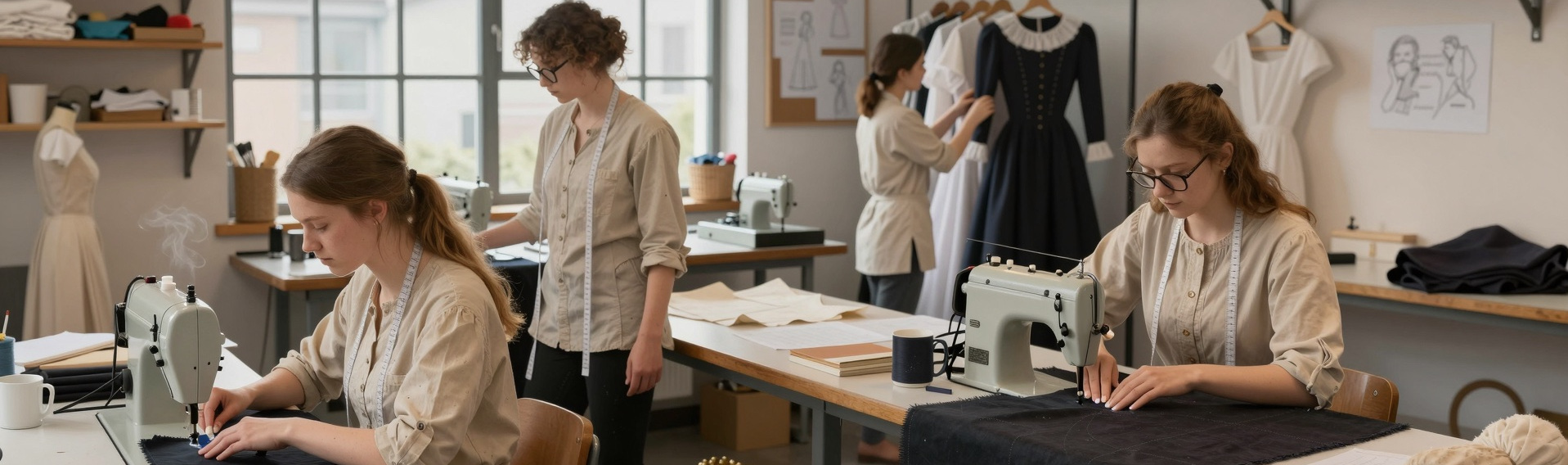
This book isn't interested in spectacle. It's interested in infrastructure: in the women who quietly build worlds where other women can breathe. Wardrobe is a deliberate answer to the patriarchy's workshops and back rooms. It's a place where competence is normal, where care is policy, and where a trans girl isn't a punchline or a fetish object or a theory — she's a colleague, a daughter, a wife, one of the women.
I wanted to show what happens when a former "beneficiary" of patriarchy walks into a women-led space and says, without quite understanding it:
"I belong with you."
What does it cost her? What does it cost them? What does everyone gain that none of them could have had alone?
Celeste's Girl is my love letter to women's work, to chosen family, and to the fierce, unglamorous kind of solidarity that stands in front of loading bays and board tables and says: "No. Not here. Not to her." It's also a quiet insistence that trans women are not an enemy camp, but some of the keenest, most motivated allies women will ever have in dismantling the structures that harm us all.
1 🚪 Are You Lost?
[ Celeste ]
I normally don't go down that corridor at all.
The library wing had its own hush — pale tiles, the faint perfume of hand soap drifting from the bathrooms, and that institutional quiet that makes you lower your voice without thinking. I had cut through to avoid the main hall after the bell, because the hallway was a river of elbows and backpacks and I don’t like fighting a throng. Also, I’d learned early that if you walk as though you’re heading somewhere specific, people don’t try to talk to you. It’s simple choreography.
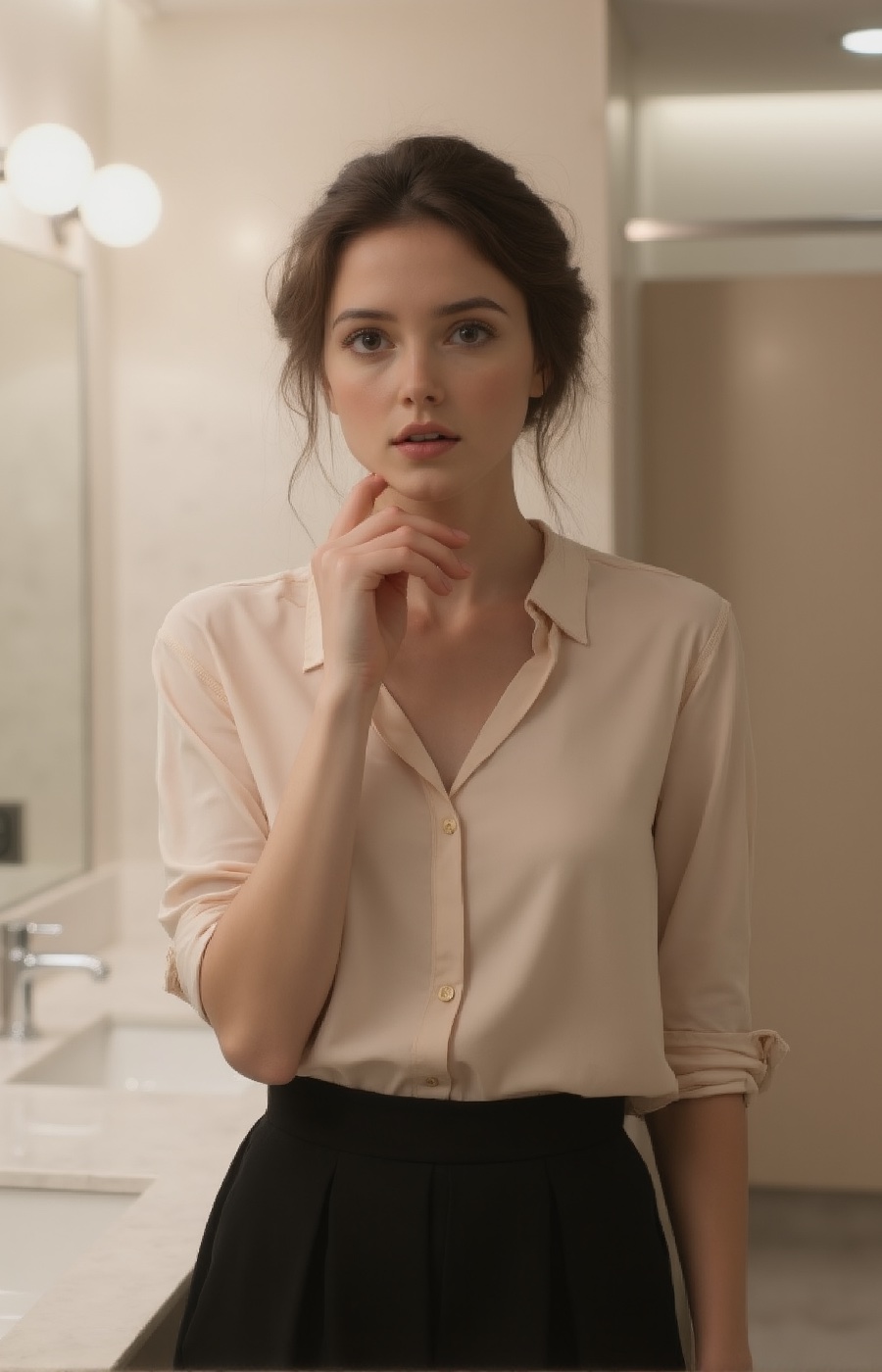
I nudged the door with my shoulder and stepped into the girls’ toilets — and only then saw someone at the sinks.
For a beat, my mind stalled because it didn’t resolve.
A boy.
He stood still, frozen.
He wasn’t predatory still. A quick read: he presented no threat, no intent — there was no edge to him. It was simply: wrong door, wrong place. That part settled easily.
The rest of him didn’t.
His stare was not the usual quick look you get from boys who think girls are scenery, but more like that of a deer discovering headlights.
He stood under the mirror lights with a paper towel clutched in his hand, staring at me. Short, slight, narrow-shouldered, with long brownish hair that fell into his eyes. Everything about him seemed to be designed to be dismissed as uninteresting.
I could have shouted 'Get out', as if with shouting I'd have the upper hand.
But shouting makes you the story. It invites witnesses who gossip. I didn’t want a story. Not for me, nor even for him. So I did what I always do when faced with the unexpected: I defined what happened next.
“Hello,” I said, calm as if I’d found a first-year hiding from a duty teacher. “Are you lost?”
His slender throat bobbed. The silence was so complete I could hear the air-conditioning tick behind the vent. Then he managed, hoarse and thin, “I —I’m sorry.”
An apology. Interesting.
I softened my voice slightly. “You know you’re in the ladies’, right?”
I watched the fact land late. His eyes flicked around the room, taking in the sinks, the cubicle doors, the absence of anything familiar. He pressed his eyelids together.
“Oh—" He groaned. “Oh, no. I thought this was— I mean, I—"
Words spilled out in fragments, urgent and unhelpful.
I was right: he was the wrong-door, off-with-the-pixies sort of lad, the kind who would apologise to a chair he bumped into.
He stared at me, holding the paper towel like evidence.
I stepped a bit closer.
He shrank back into the sinks.
“Right then,” I said, my hands held like an orchestra conductor's during a soft passage. “Just. Stop. Breathe.”
He blinked at me and breathed out, slowly.
“Now,” I continued calmly, “you’re going to walk out that door like nothing's wrong.”
His mouth opened again. I lifted a finger.
“Just follow my lead.”
His eyes slowly rose to meet mine and, as slowly, his hands lowered. He gave a tiny nod.
He wasn’t resisting guidance — he adjusted to it.
“What’s your name?”
He hesitated.
“Chuck,” he said, then corrected himself with a quick frown. “Charles. Charles Rossignol.”
“Rossignol.” I liked it: it had a nice ring. “French for: 'Nightingale'.”
The look in his eyes was shifting to something like awe — it was time to move forward. I tilted my head toward the door.
“Right. We’re leaving.”
I stepped out of the door first, positioning myself where anyone would see me before they saw him.
“If someone gives you a weird look,” I said quietly, “just look at me. Got it?”
He nodded: quick, obedient. As he crossed the threshold he stopped, eyes flicking back to me.
“Charlie,” I said lightly.
“My name’s—"
“I know.” My lips formed the smallest grin. “Charlie suits you, though. Tell me if you hate it.”
He looked at me for a moment longer. Then he was gone, swallowed by the tide of students. I stood in the doorway a moment longer, staring at the door.
And thinking about his eyes, the way he looked at me. It wasn't really awe, nor was it attraction, or like anything boys wear when they see something appealing. His look was different.
I closed the door and filed him away.
For now.
2 📐 Group Task

[ Celeste ]
The chalk scratched "Group Task" on the board and the social dance began. Pairs of eyes found each other and heads tipped in acknowledgement. I felt a small smile form as I turned slowly, scanning a classroom all doing the same thing, like a flock of birds turning as one body — instinct, cowardice, and the lazy relief of belonging.
A well-rehearsed ritual.
Except one.
I nearly missed him. He sat at the very back, almost invisible, eyes on no one, except very briefly scanning the room: quick, skittish, dropping whenever they came close to meeting anyone else's. Not asking, checking. He seemed to realise no one was going to choose him and his mouth tightened — resignation born of experience.
I stilled.
I knew this boy.
A quick flash — paper towels in an upturned fist. A sink. Those startled doe eyes tipping up to meet mine.
Oh.
The wrong place, wrong door lad.
I’d stood in the ladies’ and looked straight at him, and my brain hadn’t filed him as anyone from class because in class I never registered him as a person, just a space people avoided.
The efficiency of it was almost diabolical: I could observe the room arranging itself and never notice that there was someone being left outside that arrangement.
But I had seen him now.
Properly.
Mr. Greeves tapped the chalk like it had personally offended him.
“Alright. You’ve all had your practice test. Some of you have expressed your feelings about it. Today, you’re going to make sense of it.”
A few kids chuckled — not because it was funny, but because it was socially expedient.
“Pairs,” he said, underlining the word twice. “Pick a question from the set. Solve it. Then produce a one-page explanation that someone else can follow." He turned back to the class. " "If you can’t explain it, you don’t understand it.”
Chairs scraped on the floor, the sound of the low panic of social arrangements.
I didn’t move. I didn’t need to. People came to me.
I gave them my polite face and none of my answer.
My attention drifted to the back left, where Charlie sat.
He wasn’t particularly strange or unsightly. Yes, he was thin. And short — shorter than any of the boys, which seemed to bother them more than it bothered him. His uniform shirt sat awkwardly on his frame — too big at the shoulders, too loose at the waist, as if whoever gave it him hoped he would grow into it.
I’d never noticed him in class. The held-back boy, the one who re-did Year 11 because algebra had eaten him alive the first time.
Mr. Greeves stepped from behind his desk.
“If you’re still unpaired in thirty seconds, I’ll pair you.”
I watched Charlie: his eyes had stopped moving. His shoulders were drawn in, and his expression was empty.
This had happened before.
In this class.
With this teacher.
And these classmates.
In front of me.
“Time,” Mr. Greeves said. “Right. Charles and—"
“Me,” I cut in.
The room’s attention snapped to me like elastic.
You could see it in their faces — the sudden confusion. I resisted the impulse to smile.
Mr. Greeves blinked. “Celeste?”
I looked at him steadily. “I’m with Charlie.”
One boy let out a single startled laugh, then glanced around to see whether anyone else had found it funny. A few girls exchanged looks and one of them whispered, not quietly enough, “Why would you do that?”
I turned my head slightly but didn’t look at her.
“Because I like getting full marks,” I said, pleasantly. “And I like working with people who don’t waste time showing off.”
Silence.
A delicious, tidy silence.
Mr. Greeves shrugged, satisfied.
“Alright then. Celeste and Charles. Good.”
I walked my chair over to Charlie's desk.
He blinked, and then, his face went wide-eyed and open-mouthed.
Recognition.
“You don’t have to do this—" he began timidly.
“I know.”
I placed my notebook on the desk between us and looked at the question set.
“Pick one.”
“I—" He looked down. The page might as well have been written in smoke.
Finally, he collected himself, his eyes moving over the page the way someone looks for the familiar.
I watched him unconsciously shift his notebook — carefully, aligning the corners of the paper with the desk edge. I glanced at the handwriting: neat, consistent, slanted slightly right, well-mannered. The diagrams on the page were so neat, they looked printed.
“You’re pretty good at geometry, aren't you?”
His head came up with a twitch. “Sorry?”
“Geometry. You're good at it. Your diagrams are very precise.”
His eyes searched mine, genuinely confused.
“I’m —okay, I guess,” he said finally.
“No, you’re better than okay.” I tapped the question set. “Go ahead — pick one with a diagram. A shape. Something that lives in space, not in a string of symbols.”
He hesitated, then pointed with his pencil.
“This one. The triangle, with the angle bisector.”
“Right then.” I pointed. “You do the diagram. Make it clean. Label it properly. I’ll turn your diagram into an equation and write the explanation. And then, you can check my explanation works with the geometry. Deal?”
He stared at me. “You —trust me to check your explanation?”
“I trust your eyes,” I replied.
His ears went faintly pink as he bent over the page. His pencil moved and the triangle appeared — clean lines, honest angles.
While he worked, I listened to the classroom. The buzz of other pairs. The smugness of boys who’d paired up for safety, girls who’d paired up for comfort. My lips tensed as I heard the sibilants of my name — quick and unmistakably mine.
Charlie drew his angle bisector and then paused, frowning.
“Problem?”
He pointed.
“If you call that angle x, then this one has to be x too, because of the bisector. But the problem statement says this angle is thirty degrees, which means x is fifteen. Which means your ratio is fixed.”
He spoke softly, his eyes flicking to me nervously. I looked where he pointed.
He was right. The whole thing collapsed into a simple proportion.
“Exactly.”
He glanced up at me again, his hazel eyes more searching now.
“Why are you doing this?” he asked. His question wasn't about geometry.
What did I want?
“I hate waste,” I said.
“Waste? What do you mean?”
“Waste of ability,” I clarified. “Waste of talent.” I kept my voice calm. “You’re just misallocated.”
I leaned closer, just enough to make my next words private.
“I'm not trying to be kind,” I said. “I don’t do charity. I do investment.”
He continued to stare at me for a moment, his face serious.
We quickly finished the solution. I wrote the explanation in clear steps. He checked every transition like a quiet auditor. When we handed it in, Mr. Greeves nodded at me, then, more slowly, at him.
The bell went. People flowed past us. Charlie wrapped his arms around his messenger bag and shrank to let them by. I slid my notebook into my bag and stood.
“Charlie.”
He looked up.
“I’ve taken work in Wardrobe at the Historical Faire,” I said. “Interested?”
The Faire employed half the local students, the way Macca's or Hungry Jack's did in other towns; the only difference was that here the uniforms came with petticoats, stays, linen shifts, and a history lesson.
He frowned slightly. “Wardrobe? Why me?”
“Because you already know how to get work done without applause,” I said, “and Wardrobe needs people who can keep their heads. People who can do detail. People who can be invisible on purpose.”
He stared at me for a moment, then gave a noncommittal nod.
“See you there.”
I could feel him watching me walk away.
3 👗 Wardrobe
[ Celeste ]
Wardrobe had its own weather.
Outside weather — sun or rain — could change, but Wardrobe's was a constant climate of steam and cloth-dust and warmed metal. The air tasted faintly of detergent and starch and something older that lived in wool no matter how many times you cleaned it: sheep, lanolin, history.
Wardrobe was a maze of rails and racks, garment bags whispering against each other whenever someone brushed past. Stacked crates carried Mara’s handwriting — blunt lettering of someone who preferred labels to archaeologists. A long trestle table ran down the centre, with a half-dressed mannequin and a skirt turned inside-out, hemline pinned for repair.
At the table stood Mara, staring with a slight frown at a bodice in her hands. She turned the bodice over and tapped the seam.
“What’s this?” she said quietly. Mara never raised her voice — she didn’t need to.
“Who did this?”
I left the rail and moved closer, careful not to trip over the steamer hose that snaked across the floor. Mara’s gaze flicked to me, her mouth tightening as she pinched the fabric and tugged. The seam puckered like a forced smile.
“Whoever did this sewed with fear.”
The stitches were tight, too tight. Someone had been trying to prove something with needle and thread.
“They were probably worried it wouldn’t hold.”
“It won’t hold because they were worried," Mara snorted. "That’s the irony.”
She flipped the bodice again and thrust it at me.
“Unpick it. Do it properly, not fast. Properly.”
I took the bodice, feeling the weight of it — the underlining, the interlining, the bones that gave it a spine. The kind of garment that made you understand, viscerally, why women in paintings stood the way they did. I carried it to the end of the table, sat, and began to unpick the seam with a seam ripper.
I liked Wardrobe because it wasn’t school.
School rewarded performance. You threw hands up, shouted answers, and wore confidence like an ill-fitting costume. Wardrobe rewarded something quieter: attention, patience, care. You could be brilliant here without the marketing.
I worked for a few minutes, the thread finally giving way with soft little snaps.
Mara’s voice cut across the room.
“Did you bring the inventory sheet?”
“It’s on the clipboard by the haberdashery shelf.”
“Did you sign out the spools you took yesterday?”
“Yes.”
Mara’s mouth twitched. She moved around the room, checking rails, touching fabric, straightening labels.
“You’re late for your break.”
“I’m not hungry.”
Mara turned to me.
“That’s not the point.”
“What is the point, then?”
“It's this,” she said, “a future isn’t built on fumes. You burn out and then you’re useful to no one, including yourself.”
I let out a small breath and set the bodice down.
“Fine. Ten minutes.”
“Good girl.”
I stretched my shoulders and headed toward the tiny kitchenette. It barely deserved the name: a bench, a sink, a kettle, and a jar of instant coffee that tasted like burnt regret.
I’d just filled the kettle when the door to Wardrobe banged open.
A man in a hi-vis vest and work boots stepped into the doorway as if he’d decided the room was his and he was taking possession. He wore a cap that had seen better days, and a face that looked permanently sunburnt. His mouth wore that slightly annoyed grimace outdoors men reserve for indoor occupations.
“Far-out,” he said, eyes flicking over the room. “It’s like walking into a bloody op-shop in here.”
Mara turned slowly.
“Graham.”
He grinned at her with that easy confidence of someone cheerfully taking up space even if not entirely welcome.
“Mara.” His gaze slid past her and caught me. “Oh. It’s you. Fancy seeing you outside school.”
I raised my eyebrows. “It’s almost like I work here.”
“Yeah, whatever.” He turned to Mara, who had gone back to examining rails. “Need you to sign off on the replacement for the steamer." He tipped his chin at the rusty relic near the loading dock entryway. "That one’s cactus.”
“Form?”
“Right here.” Graham slapped a crumpled paper on the table and attempted to smooth it. And failed. “Now, I've got a separate problem, not related to your op-shop here.”
Mara slid a cloak along the rail. “If it’s your problem, why are you telling me?”
“Because,” Graham said, exhaling through his nose, “I thought you might have some ideas on how to deal with this.” He stuffed his hands in his pockets. ”It seems someone up top decided I needed help, so they sent me this kid.”
Mara turned towards him, her face one of limited patience.
My attention suddenly focused, unbidden.
Graham leaned his hip against a rack of cloaks as if it was a wall. The cloaks swayed, offended.
“So, this kid,” he continued, with a quick scowl at the rack, “he's just too small, too weak, and too bloody— I don’t know. He’s just not built for maintenance.”
Mara’s voice was flat.
“If he’s a kid, he shouldn’t be in maintenance.”
“Well— he’s not actually a kid.” Graham rubbed an unshaven jaw. “He’s eighteen, but he looks about thirteen. Seriously, he’s got arms like pipe cleaners!" His scowl deepened. "Look, I put him on basic stuff, like carrying, fetching, holding ladders, and he’s just— hopeless. He tries, I’ll give him that. But he’s going to get hurt.”
I felt my grip tighten slightly on the kettle handle.
“You tell him to grab the toolbox, he grabs it like it’s going to bite him. You tell him to hold a ladder and he holds it like he’s apologising to it.“ He puffed up his chest. “He’s just wrong for the job.”
Mara glanced at the paper on the table.
“What’s his name?”
Graham hesitated for half a second.
“Chuck,” he said. “Um— Rossignol.”
The kettle clicked as it finished boiling. The sound was absurdly loud.
Mara’s eyes flicked to me. She had a way of reading people that made her frightening.
“You know him.”
“I do.”
Graham looked puzzled. “You do?”
“Yes. I do,” I repeated, stonily calm. “From school.”
Mara turned back to him.
“You’re going to sack him, aren't you?”
“I have to.” He sounded defensive. “I told him that this morning.”
The room seemed to lean in.
I spoke before I could stop myself. “And he asked to stay on, didn’t he?”
Graham’s eyes flicked to me, surprised.
“Well, yeah. He did.” He turned back to Mara. “When I told him this morning to start looking for something else he looked like he was about to cry. He kept saying he needed the work, that he’d do anything.”
I set the kettle down slowly.
“So, he didn’t refuse my suggestion.”
Mara's gaze held mine. “Your suggestion?”
I weighed my words.
“I told him the other day,” I said finally, “that I might have something for him. Work. Because he didn’t show today I assumed he had decided not to.”
“You were offering him this?” Graham looked incredulous.
“Didn’t you say he wasn’t cut out for your kind of work?”
“So, you’ll let him have a go in here?” Graham scoffed. "With the dresses?”
Mara’s gaze cut to him like a blade. “Say ‘dresses’ again like that and I’ll put you in one.”
Graham held up his hands in mock surrender. “Right-o. Just saying—”
“You’re saying the same thing men always say when they don’t understand labour they can’t muscle around,” Mara replied. She turned to me. “What about him tells you he would work out well here?”
“His hands,” I said. “His eyes. His patience.” I counted them off with my fingers. “He draws like someone who thinks in structure. In geometry. His handwriting is neat. He listens. He doesn’t perform.”
Graham snorted. “Doesn’t sound like a qualification to me.”
“It is in Wardrobe,” Mara said.
She reached for the bodice I’d been unpicking and held it up by the straps.
“You see this? This is engineering disguised as femininity. It’s physics: measurements and force and stress.“ She waved her hand dismissively. “We don’t need biceps: they get in our way. We need brains.”
Graham shrugged. “Fine. You want him, take him. But I’m not babysitting him until you decide.”
“You're not meant to babysit. You're meant to supervise. There’s a difference.”
Graham shrugged. Mara turned to me.
“If we take him, he does things by Wardrobe's rules,“ she said firmly. “He shows up on time. He listens. He follows instruction. He's not a larrikin. He keeps his hands clean and his mouth cleaner. He gets one trial shift.” She tapped once on the table. “One. That’s all I need. One day.”
Graham seemed uncomfortable. “So what, you want me to send him over?”
“No,” Mara said. “I want him to choose to come.”
She reached for a small pad and scribbled something, then tore off the page and held it out to Graham.
“Time. Location,” Mara said. “When you give him this, tell him: if he wants a trial, he turns up. If he doesn’t, his choice. You sack him and no one feels guilty.”
Graham stared at the paper like it had teeth.
“You’re ruthless.”
“I’m fair,” Mara corrected. “Ruthless is sacking someone because they’re not built like a Neanderthal.”
Graham’s ears reddened. “Oi!”
Mara tilted her head. “Am I wrong?”
“Well, no.”
Mara’s mouth twitched. “Right, then. Now, try to find somewhere else to be. I’ve got work.”
Graham grunted and left, the door banging loudly behind him.
Mara picked up the bodice again, examined the seam I’d been unpicking.
“Better.”
I exhaled.
“He begged. I can’t imagine him doing that,” I said. “He wouldn’t beg unless—”
“Unless he was desperate,” Mara finished, matter-of-fact. “That’s what poverty does. It makes dignity negotiable.”
I glanced at the door, then at Mara. Her gaze held mine for a second longer.
“Ten minutes,” she said, returning to her work. “Then come back and finish that seam. He turns up tomorrow, you’re on rails and pins. I don't take strays, and neither do you. You do not hover or mother.”
“I wouldn’t,” I said, offended on principle.
“Of course not.”
I rolled my eyes and moved toward the door.
As I stepped into the corridor outside Wardrobe, the noise of the Faire changed — less muffled, more alive. Somewhere in the distance, tourists laughed. A bell rang. Someone yelled about a lost hat. The smell of hot chips drifted in from the food court, as if mocking the Faire's carefully crafted historical illusions.
I walked fast.
Ten minutes.
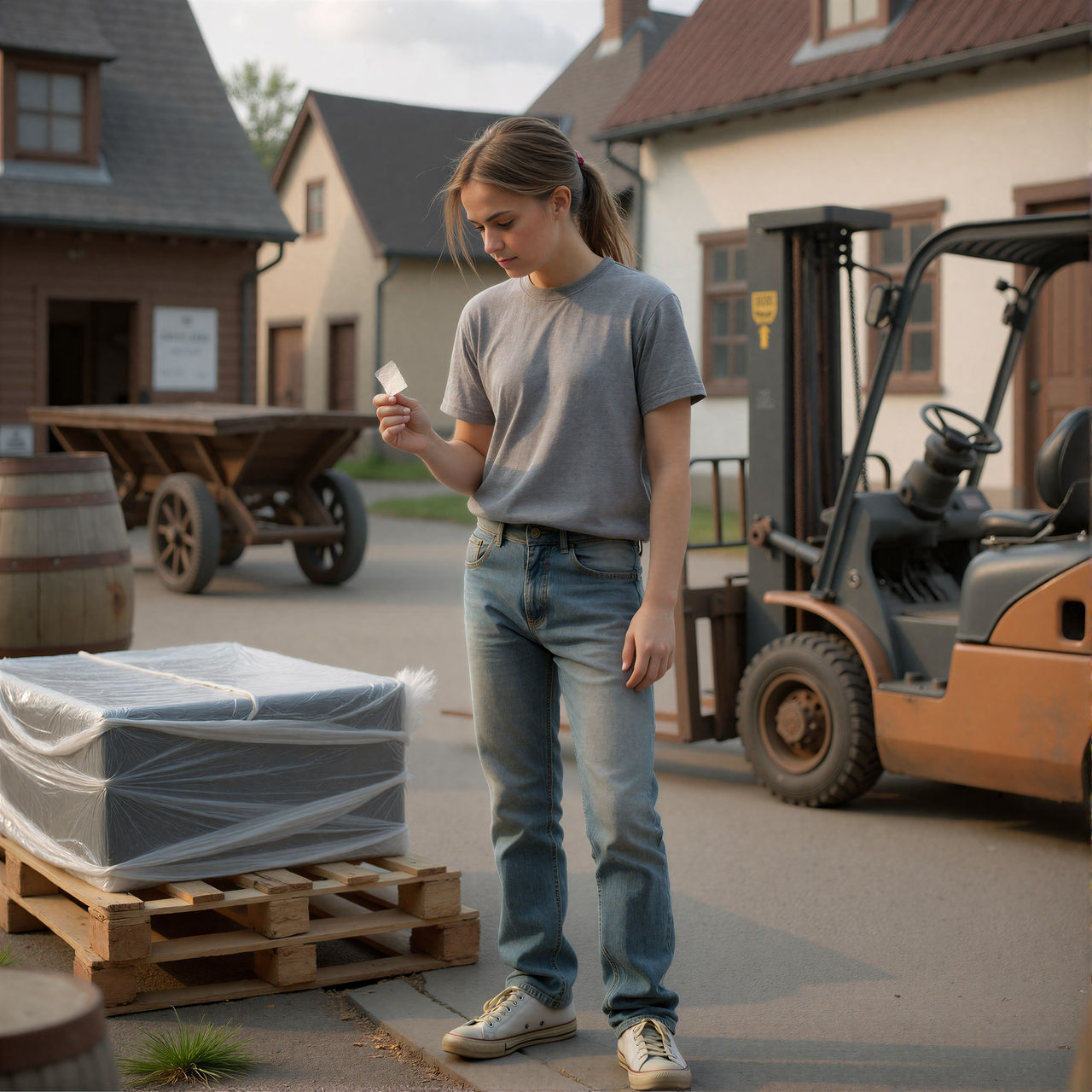
The maintenance compound sat behind the main buildings, past a cluster of props and a row of portable toilets that contributed nothing to the “authentic eighteenth century experience”. The path was half gravel, half mud. A pallet of timber sat near a fence, and a stack of metal poles leaned precariously against a wall.
Graham was there, climbing an aluminium ladder, muttering to himself.
And below him, gripping the base of the ladder —
Charlie.
His hands were white-knuckled on the rails, his shoulders, tight. His gaze was fixed upward, not watching Graham’s feet so much as waiting for the moment the world asked him for credentials. He looked, in that moment, exactly as he had in the girls’ toilets: lost and a bit frightened.
Moments later Graham climbed down, still muttering.
“There. Fixed.”
Charlie loosened his grip slightly, but didn’t step away. Graham pulled the folded scrap of paper from his pocket and gave it to him. He gestured vaguely toward the main buildings.
“That's from Wardrobe. They're offering you a trial shift. You want it, show up." He turned away. “In any case, you’re done here.”
Charlie stared at the paper, then at Graham’s receding back. “But—"
“Wardrobe,” Graham said, opening the door to the shed. “Just a bunch of sheilas, but they reckon they can use you.”
Charlie’s eyes dropped to the page again. His fingers tightened around it.
I waited until Graham had disappeared, then stepped forward.
Charlie went still in that deer-headlights way again.
“Celeste,” he murmured finally.
“Charlie,” I replied, evenly. “You’re alive.”
His throat bobbed. “I— yeah.”
I nodded at the paper in his hand.
“That’s the offer I mentioned in maths. Mara’s offering you a trial shift.”
He looked down at it. “I didn’t— I didn’t mean to ignore your offer.”
I kept my tone neutral. “I just assumed you’d decided not to take it.”
His shoulders drew in. “I had this job already. My folks—”
“I see.”
He swallowed.
“Maintenance… it’s— I’m not good at it.”
“So I’ve heard,” I replied. He stared at me, eyes flicking quickly over my face.
They searched for mockery.
Found none.
“I know your kind of work isn't this,” I said, leaning slightly closer. “You just haven't been offered the right lane.”
He stared at the paper.
“I won’t sugar-coat it,” I continued firmly. "Mara’s rules are strict and she’s not interested in your story. She wants to know that you will show up and do as you’re told.”
His eyes moved slowly from the paper to me.
“By the way,” I added, “it is okay to say no. If you try it and don’t want it, you simply don’t take it. You won’t be punished for refusing.”
I held his gaze for a beat, then stepped back.
“Seven-thirty,” I said. “If you’re there, you’re there. If you’re not, I’ll assume you made your decision.”
I turned to go.
“Celeste.”
I stopped.
“I— I can do detail,” he said. “I can learn fast if someone shows me.”
I turned slowly, and looked at him properly.
“I know that,” I said. “Otherwise, I’d be wasting my time.”
And then, I walked away, back toward Wardrobe, back to the steam and cloth-dust and the woman who didn’t take strays.
4 💼 First Day
[ Celeste ]
Charlie arrived ten minutes early. He waited outside Wardrobe as if the door had a sign: "For Authorised Personnel Only". There was no phone in his hand. He stood quietly waiting, his worn leather messenger bag at his feet, folded scrap of paper in one hand, fingers worrying the edge until it softened. Every now and then he glanced at the door — as if to check whether the world had changed its mind.
Inside, Wardrobe moved the way it always did: rails clacking softly as garments were shifted, the new steamer hissing like it meant business, the constant quiet conversation between fabric and hands.
Mara had spotted him through the small window in the door. Nevertheless, she slowly, deliberately finished what she was doing first: pinning a waistband to a mannequin, smoothing the fabric as if it needed reassurance. Finally, she wiped her hands on a cloth and nodded toward me.
“Open it.”
You don’t chase him. You don’t sell Wardrobe.
I opened the door and stood aside. Charlie stepped in and his eyes snapped to mine.
“You’re early.” It came out neutral, the way you’d say it’s Tuesday.
“I— I didn’t want to be late.”
Mara looked at him the way she examined a bodice seam — assessing for integrity.
“Rossignol.”
Charlie's shoulders rose slightly. “Yes.”
Mara’s eyes dropped to his hands. “Clean?”
He looked down as if he’d forgotten he had hands. He impulsively held them out, palms up, fingers splayed. They were clean. Nails trimmed short.
Mara turned away. “Shut the door.”
He shut it quietly.
Mara glanced at his bag.
"Personal items go in the tearoom."
She pointed.
When he returned, Mara walked to the centre table and picked up a garment bag.
“Presently, our main occupation is maintaining costumes for the Faire actresses and actors," she told him. "Do you have any experience with needle and thread?“
“I have some.“
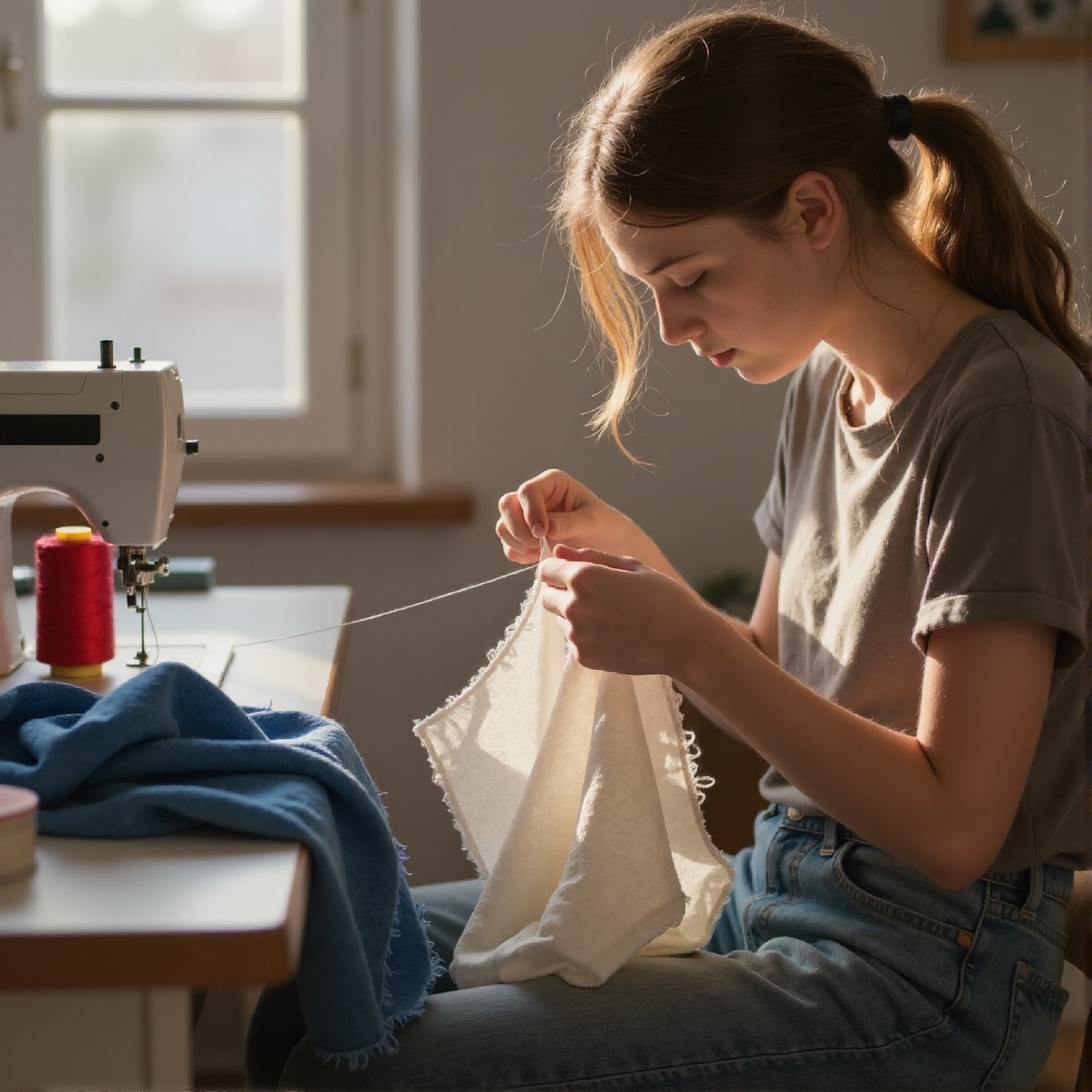
She unzipped the bag with a brisk motion and removed a dress — a simple working dress in sturdy fabric, with a seam splitting near the side closure. The tear was held together with hurried, barbaric stitches. Mara placed it onto the table.
“This came in yesterday. A tourist sat down too hard. Someone panicked and tried to fix it.” She tapped the seam with her finger. “Have a look at that.”
Charlie leaned in and seemed to study it for a moment.
“The tension’s wrong,” he said, quietly. “It’s pulling.”
Mara’s face switched to one of scrutiny. “Oh? Explain.”
“The seam has been stitched too tight,” he said, eyes focused on the garment. “Also, the stitch doesn’t match the grain. The fabric is fighting the stitch.”
Mara's brows rose imperceptibly. “So, what do you do to fix that?”
“Unpick it. Start over.”
Mara's eyes moved to me.
“Do it,” she told him.
“May I have a seam ripper?”
Mara’s mouth tightened.
“It’s called a lame.”
Charlie reddened. “Sorry. A—"
“Don’t apologise,” Mara said. “Just learn.”
Mara pointed at the far end of the table.
“You can sit just there. Tools are in the tin. Thread is in the drawer. If you use something, put it back when you're done. If you break something, you tell me straight-away. If you don’t know, ask. Remember the answer.”
“Yes.”
Mara's expression softened slightly.
"You may call me Mara."
"Yes, Mara."
He took himself to the far end of the table and began rummaging through the tin. Mara turned to me.
“Celeste.”
I looked up.
“You’re on rails and pins. Not on him.”
“Understood.”
Charlie’s gaze flicked to me — quick, skittish. I turned away and went to the rails, where a cluster of damaged garments waited like quiet accusations. Every now and then I would cast a furtive glance at the other end of the table. Charlie sat on a stool, the dress draped over his knees, almost motionless.
Mara moved around the room as he worked, doing her usual circuit: checking labels, touching fabric, straightening hangers. But her attention wasn’t on the label or fabric or hangers or even the dress draped over Charlie's knees.
It was on him.
Charlie worked slowly, unpicking the seam steadily, patiently, lifting each tight stitch and easing it out as if he was undoing a critical mistake.
Finally, Mara stopped all pretence. She looked over his shoulder, examining his work.
“Why are you going so slowly?”
There was no accusation in her voice, yet Charlie’s shoulders visibly tightened. He looked up briefly, then back down at the seam.
“Because if I unpick too quickly, I might tear the fabric.”
Mara’s voice was flat.
“And if you tear the fabric?”
“Then I’d have to patch it.” His features changed, as if he was thinking of the worst thing possible: “And a patch would show.”
Mara’s eyes narrowed slightly.
“So, you don’t want it to show.”
“No, I don't.”
Mara walked away.
He gave me a nervous glance, and then, went back to the slow unpicking of the seam.
After he’d unpicked the seam completely, he didn’t immediately reach for thread. He smoothed the fabric with his palm, slow and light. Then he looked up.
“Mara?”
Mara’s head turned. “Yes, Rossignol.”
He held up the dress slightly.
“The original seam allowance is a bit narrow. If I stitch it the way it is, the seam will hold, but it will be under stress. If I reinforce it from the inside with a strip of fabric — like a facing — then that strip will take the load.”
His finger indicated delicately in the air above the fabric, respectful, as if the dress deserved dignity.
“Where would you put the strip?”
Charlie pointed to the inside layer.
“Just here, Mara. Along the closure line. It won’t show.”
Mara stared at the seam, and then, at him for a beat longer than necessary. Then:
“Do it, Rossignol.”
Charlie reached for the drawer, selected a strip of fabric, measured it slowly, then measured it again. His cuts were thoughtful. A little while later, Mara brought over a small tin and set it down near Charlie’s elbow.
“Needles,” she said. “Choose the right one.”
Charlie glanced at the tin, then at the fabric, then back. He picked a needle that matched the weight of the material and threaded it.
On the first try.
Mara noticed.
Of course she did.
“You sew at home, don't you?”
Charlie’s mouth tightened. “Sometimes.”
“Who taught you?”
“My mum.” His fingers flickered on the far end of the thread. A knot appeared. “She does alterations for neighbours, for a bit of pin money.”
Mara's eyes flicked to mine. She gave me the slightest nod.
“Right, then,” she murmured. “So you do know what you're doing.”
Charlie didn’t answer. If he'd had an answer, Mara didn’t give him the chance. She tapped the table.
“When you’re finished, you’ll bring it to me. And if it’s not right, I will know. And so will you.”
“Yes, Mara.”
One of the other girls — Leah — arrived with a pile of folded aprons. She stared at Charlie, speechless for a moment.
“Mara,” she said cautiously, eyes darting to him and away again. “Is— is he—"
Mara didn’t look up. “He’s working.”
Leah’s mouth opened, then shut. She glanced at me, searching for clues. I gave her raised eyebrows.
Mara looked up then, and her gaze pinned Leah the way a pin fixes fabric.
“Do you have a problem with a person doing their work?”
Leah flushed. “No.”
“Good.” Mara’s voice was mild, which made it more dangerous. “Then focus on yours.”
Leah scurried away like a mouse escaping a cat.
Charlie’s shoulders had gone tight, but he kept stitching, eyes on the line.
A while later, Mara moved to the far side of the room and pulled a curtain partway across a doorway. Behind it was the fitting area — a small section partitioned off from the main space, controlled. She spoke without raising her voice.
“Rossignol.”
Charlie stopped. “Yes, Mara?”
“Bring me the dress.”
Charlie set the needle down where it belonged, precisely, smoothing the thread, and then carried the dress over with both hands as if it could bruise. Mara took it, examined the seam with her fingertips, turned it inside-out, then right side out again. She tugged lightly near the closure.
The seam held. It lay flat. It looked as if it had never been damaged.
Mara did not smile. But she nodded, a single dip.
“Acceptable.”
And then she looked at him.
Not the dress. Him.
“Tell me, Rossignol, what do you do if you make a mistake?”
Charlie's neck went red. “I— I fix it.”
“And if you can’t fix it?”
“I tell you,” he said quickly. “Straight-away.”
“And what would happen if you didn’t tell me?”
Charlie looked at the floor. “Then I’d be— out.”
Mara placed her slender fingers on the seam.
“Yes,” she said quietly. “You’d be out. Out, because you were not being safe.”
Charlie looked up at Mara then, who held his gaze.
“You understand me. Being truthful keeps you, and the rest of us, safe.”
“Yes, Mara.”
Mara straightened. “Celeste.”
She tipped her chin at the other side of the workroom.
“Show him the inventory shelf,” she said. “You point. He listens. Then you go back to rails. He doesn't follow you.”
I nodded. “Come on,” I said to Charlie.
He followed me at a respectful distance. I stopped at the shelves and pointed out the labelled boxes: hooks, pins, tapes, ribbons, boning, eyelets. Charlie said nothing, quietly tracking everything.
When I finished, I stepped back.
“That’s it.”
He gave a quick nod. “Thanks for that.” And then, almost despite himself, he asked, very softly: “Does Mara— hate me?”
I glanced down at his face. He was data-gathering. Nothing else.
“Mara doesn’t hate people,” I said, my tone neutral. “She hates time-wasting.”
His shoulders loosened slightly.
“Right. Thanks.”
Mara called across the room again. “Rossignol.”
Charlie turned as if by reflex. “Yes, Mara.”
“Pins,” Mara said. “Sort by size. If you mix them, you'll do them over.”
Charlie took the tin and began to sort, methodical and silent. I went back to the rails. After another half hour, Mara’s voice cut through the hiss of the steam press.
“Rossignol.”
Charlie's head went up.
“Come back tomorrow at seven-thirty.”
Charlie's eyes went wide.
“Really?”
Mara lifted an eyebrow. “If you want.”
Charlie glanced down at his hands, then up again.
“I do. I want to.”
Mara’s gaze didn’t soften, but something in her posture eased — like a seam that had stopped fighting.
“Good. Don’t be late.”
He looked around, then, at the rails, the steam, the dresses on the mannequins.
His shoulders seemed to drop, the tiniest bit.
5 🪡 Second Day
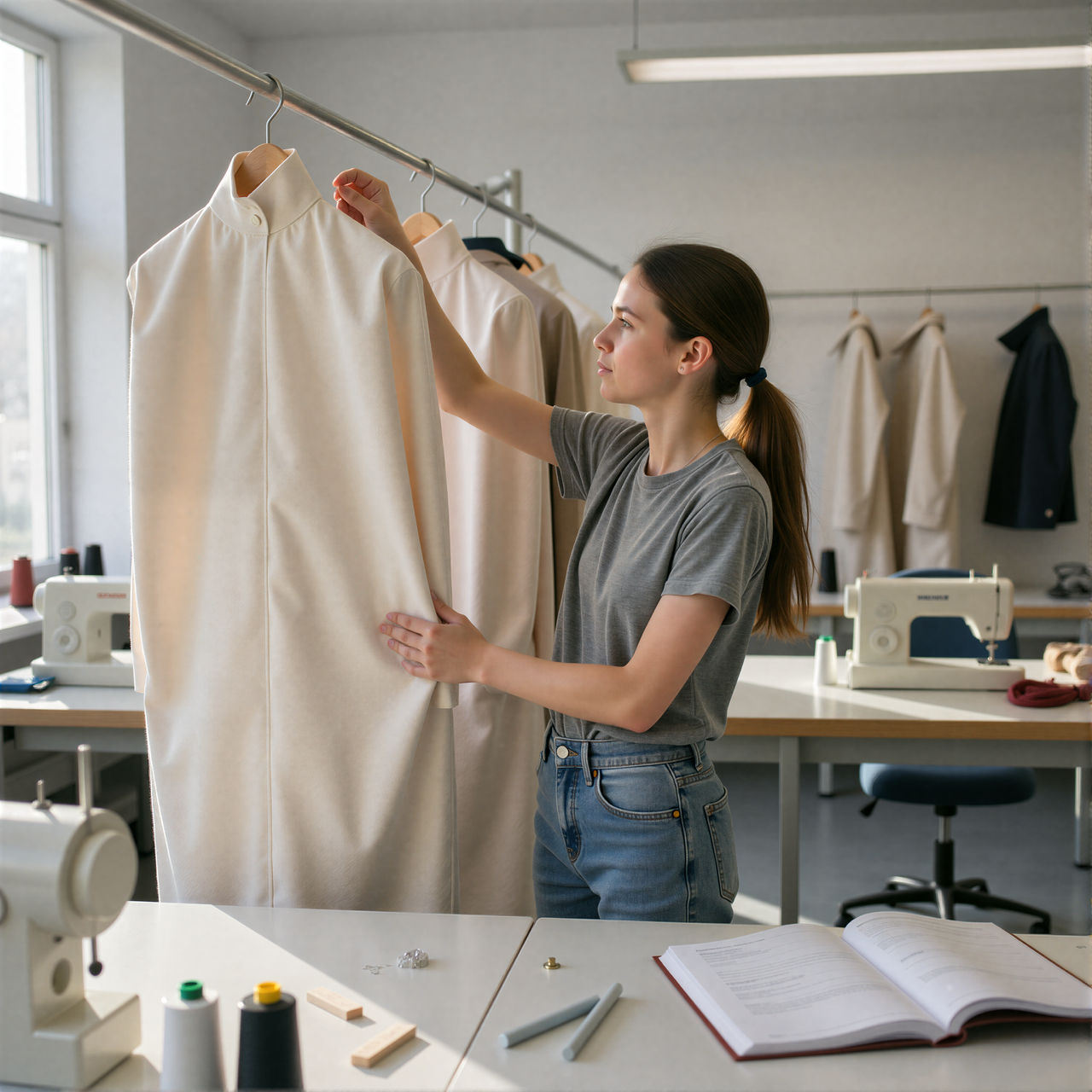
[Celeste]
Mara didn’t test people the way teachers do.
Teachers would announce a test, watch you sweat, and then moralise the result. Mara tested you the way you tested a seam: under her fingers, quietly, looking for strain.
Charlie was back for a second morning. Same early arrival. Same old leather bag. Same clean hands. Same careful stillness.
Mara pointed at a tin on the table.
“Needles,” she said. “Sort them. Then you’re on the mending pile.”
Charlie poured the needles out onto a cloth. With a kind of tidy focus that made the task look dignified, he began arranging them by size.
Mara’s next test came ten minutes later, when she “accidentally” left a pair of vintage shears too close to the edge of the table.
Charlie noticed the shears. His eyes flicked to them, then to Mara. He didn’t touch them but nudged the cloth closer, stabilised the table edge with his palm, and slid them back with two fingers — careful, respectful — like he was returning a bird to its perch.
Mara didn’t look up.
At first I didn't think she'd noticed at all. But presently, I saw the smallest change in her mouth. She knew.
Of course she knew.
Mara sent him to the mending pile: a basket of small catastrophes — popped seams, torn cuffs, fraying apron ties. The difficult ones, the ones where haste would show. Charlie studied each item the way he’d studied the torn dress yesterday: calm, quiet. He chose thread that colour-matched with an uncanny instinct. He stitched with even tension, no puckering or desperate pulling.
Charlie’s attention to Mara was constant and respectful.
Charlie’s attention to me was — different.
It was as if his eyes kept finding me on their own and each time they did, he would look away, as if noticing me was an invasion of privacy.
Was it a crush?
From the rail, I watched his hands gently — almost tenderly — coax thread and fabric to be friends.
“You’re stitching like you’ve done this for years,” I said.
Charlie’s hands paused for half a second, needle hovering. Then he kept going.
“My mum,” he said quietly. “She made sewing fun. It was her game — she gave me harder and harder things to sew. The goal was for the repair to be invisible. If you make it invisible, it looks neat.”
“That’s true,” I replied. “And if you make it neat here, Mara doesn’t kill you.”
His mouth twitched into a fragile smile, which quickly vanished. His eyes flicked from my face to his work like the paws of a cat picking its way across a hot path.
“Thanks,” he said after a moment.
“For what?”
“For yesterday.” He looked down at his hands. “For— for getting me in.”
I shook my head.
No.
I don’t want gratitude.
“You got you in,” I said. “You turned up. You worked.”
His shoulders loosened slightly. He threaded another needle, hands steady.
“I just—"
He stopped, so I did my usual: I decided what he was trying to say.
“You mean you don’t want to make me uncomfortable.”
His hazel eyes widened, startled. Then his face fell again with a nod as quick as shame.
“Yes,” he whispered.
“Fine. Let's keep it that way.”
The steamer chose just then to emit a hiss. We both turned to look at it.
“It’s just—" I heard him stammer. "You’re— you’re a lot.”
I frowned.
“A lot?”
“I mean, you’re—" He paused to put in a final stitch and snipped the thread short. Finally: "You make things make sense.”
I let his words sit between us.
“Right then,” I said, picking up a bodice with a frayed edge tear. "Let's see if you can make this tear disappear.”
He studied it and his face smoothed. Almost smiled.
“Okay.”
I turned to go back to the rail.
“I feel I should tell you— and Mara,“ I heard his voice behind me, the words spilling out, rushed. ”Maintenance was just a summer job. It seems like people are teaching me things— trusting me with things. It wouldn’t be fair if I didn't tell you.”
I paused, hand resting on a garment bag.
“Tell me what?”
His eyes were fixed on the seam.
“I’m meant to be starting an apprenticeship next year. Welding. At the shipyard.” He swallowed. “Dad’s lined it up.”
That landed like a duck expecting water but finding ice.
I looked at his hands.
His fingers around the needle.
His arms.
His long hair tied back with an elastic.
Welder.
Make it make sense.
“Did he line up maintenance for you as well?” I asked.
He shrugged, small. “Yeah."
I left the rail. Mara gave me a look but I ignored it.
"Is welding something that interests you?"
Charlie frowned slightly.
"Dad says it's a good trade."
"That's not what I asked."
He opened his mouth.
Closed it again and rubbed his forehead.
Silence stretched. The steamer hissed somewhere behind us.
“I just—" he began, then stopped. His voice dropped. “It's solid work.”
There it was.
Survival.
I placed my finger lightly on the fabric near his seam.
“Is this solid work?”
He shook his head with a faint puff. “This is— dresses.”
Across the room, Mara’s voice cut through the hiss of the steamer.
“Rossignol!”
Charlie’s head snapped up. “Yes Mara?”
Mara held up a sleeve with a tear near the cuff. “This one. Show everyone how you do it.”
Charlie went very still.
“Yes, Mara.”
He rose and took the sleeve from her.
6 ✨ Spaces
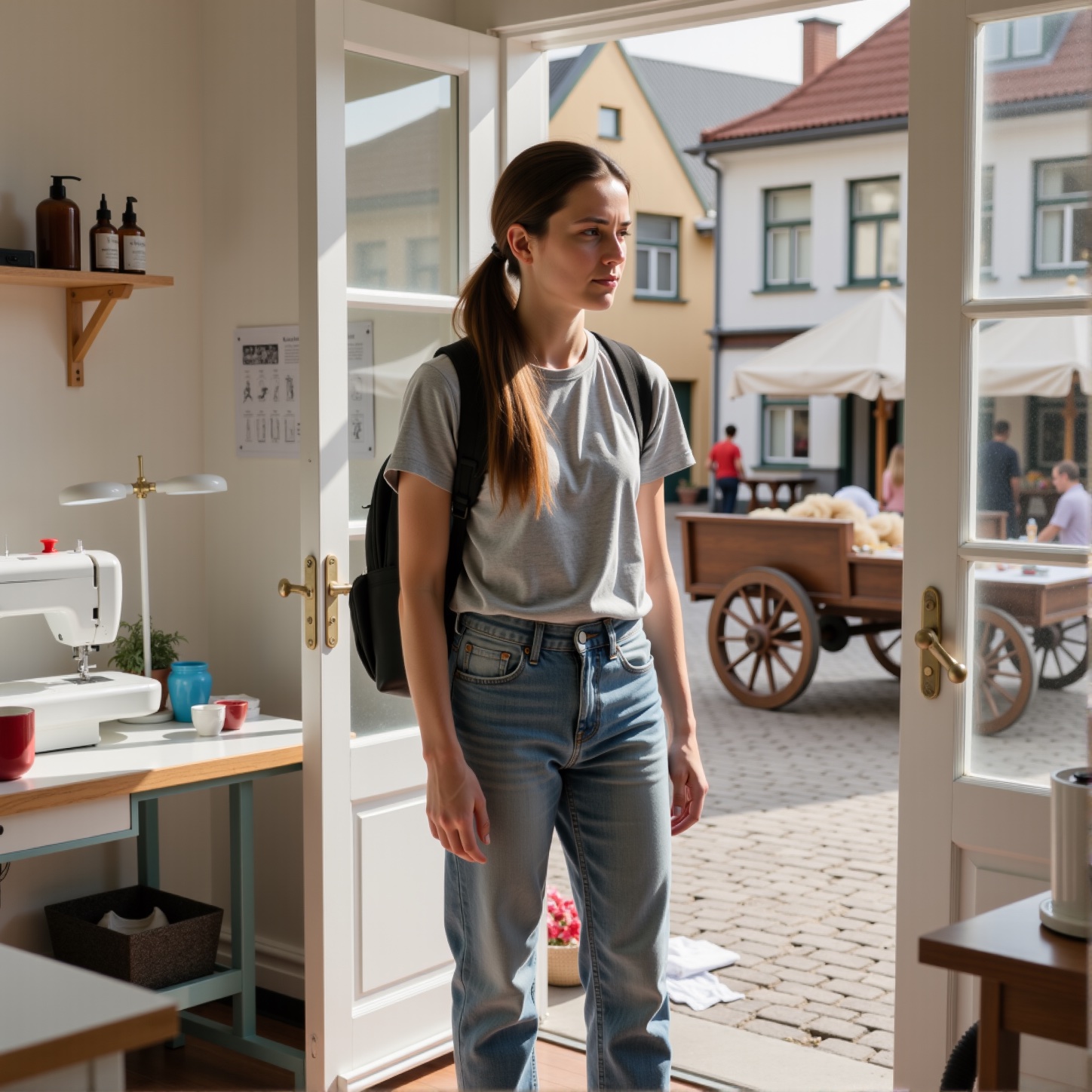
[ Celeste ]
I got there early that cool morning.
A colourless, cloud-veiled sunrise painted Wardrobe's front door grey. The key rasped in the lock and the main door swung silently open.
The unlit workroom breathed wool and chalk dust blended with the faint medley of scents the women had accidentally left behind and leftover coffee old enough to vote.
Behind me, the door clicked shut. The life outside went mute, as if covered by a pillow. As I crossed to my desk on the far side of the workroom, my footfalls seemed disrespectful of the quiet the room had watched over during the night.
I switched on the overhead lights.
Warm white: Mara had chosen well. Some fluorescent lights turn everything ashen, but these lights celebrated colours.
I pulled off my cardigan, sat down on the only rolling chair in the workroom and pulled out the folder with last night's work. Mara and I had a meeting at one pm with the Faire accountant about a billing discrepancy the accountant had "uncovered". I wasn't going to let Wardrobe be caught flat-footed.
The muffled growl of a diesel engine outside grew suddenly louder, announcing an opening door. The growl stilled as the door closed with a click.
"Morning."
I turned at the unfamiliar voice. Bree, one of the Faire actresses, was holding up a handbag.
"Forgot it last night. When I saw the light was on—"
I gave her a smile and a wave, and she was gone.
My nose went back into the stack of invoices, one of which smelled like Graham.
By the time Mara opened the door, I'd scarcely made it a third of the way through. She didn't go into the tearoom as she usually did, but approached me thoughtfully.
"I am grateful for your dedication," she said — gently, for her, "but this is my responsibility, not yours."
I glanced nervously at her.
"I wasn't trying to—"
"I know." She set her bag down and pulled up an ancient wooden chair next to mine, her lips in a firm line.
"You take work seriously. I appreciate that," she said. "Just keep it balanced. Please."
She handed me my cardigan and picked up her bag.
"Let's get a coffee. Then, we'll work on this. Together."
The door opened just then and Tahlia and Lucy came in, takeaway coffees in hand, chattering like magpies.
"You girls get the day started," Mara said. "Celeste and I won't be a minute."
By the time we got back, the sun had finally decided on making an appearance and was showing the fluorescent lights how it's done. Somewhere outside, a kookaburra was laughing at the murmur of voices from the Faire. Inside, the steamer hissed at a cape near an open window, while on the other side of the room a sewing machine whirred.
The door opened again, and Charlie slipped in.
Tahlia waved me over.
"Did we get the new bobbins for the overlocker?"
I pointed at a parcel leaning against a sewing machine.
"Came in yesterday. Be sure to pass me the invoice, won't you?"
When Leah arrived, she moved towards Charlie at the mending corner, like a timid barrister approaching the bench.
"Do you still play your oboe?" she asked, her lips a bit crooked.
He looked up briefly and shook his head. His ears had gone a bit pink.
"Leah, you're on rails," Mara said.
A smile stole across Leah's face as she turned to put away her handbag.
That afternoon, Lucy carried a heavy, ornate dress from the storage room, awkwardly trying to keep the hem off the floor. She hung it on the tallest rail and stepped back with arms crossed, eyeing it critically.
"Lily's been assigned to the palace again," she announced to no one in particular.
Mara looked up from her work.
"It'll need going over with the steamer." She frowned. "Is that dress even going to fit her?"
The back door — a roller gate — slammed shut and Tahlia emerged carrying a roll of hunter green fabric in the crook of her arms, an envelope tucked in one armpit. Charlie jumped up but Tahlia shook her head.
"I'm good, hun," she said. She twitched the shoulder with the envelope. "Just take that invoice over to Celeste, won't you?"
He carefully slipped the envelope out from her armpit.
"Put that bolt on the cutting table," Mara told Tahlia. "It was meant to arrive last week."
Lucy had finished her inspection of the dress just as Lily, a little redhead with freckles, a cheery smile, and totally unfair eyelashes bounced through the door. Her eyes widened at the sight of the dress.
"Oooooooo..."
Hands on hips, Lucy turned to her.
"Shall we?"
Lily carelessly began to pull her jumper off when Lucy gave a cautionary cough. She followed Lucy's gaze in the direction of the mending table — shrugged and continued to pull off her jumper.
Charlie didn't look up.
The threesome — Lucy, Lily and the ornate dress — made their way to the fitting area.
I had just opened the envelope and tossed the invoice on the pile to be reviewed when I noticed Charlie's head come up. His eyes flicked from the fitting area to the open window. Wordlessly, he rose and closed the window, then disappeared again amidst torn and frayed garments.
Mara's eyes caught mine. Her lips pressed together slightly.
She'd noticed.
Of course she had.
"We'll need to take this in a bit," Lucy said as she and Lily emerged from the fitting area, Lucy holding the sides of the dress against Lily. She looked down at the little redhead. "Have you lost weight?"
"This wasn't my dress," Lily replied. "Mine wasn't this pretty."
She lifted the skirt, which was dragging on the floor.
"See? Not my dress."
Mara put down the invoice she was studying.
"Find a palace dress in storage in her size."
Lucy nodded and turned back to Lily, who had whipped off the dress.
"Oof. Pretty, but a bit hot to wear in here."
Lily slipped into her oversized jumper, its hem falling to her upper thighs over the black leggings.
There was a knock on the door.
"That will be the accountant. Leah, show him in, please," I said.
The temperature in the room seemed to change as Leah led a rather large, florid-faced man with thinning hair and four-day salt-and-pepper facial hair to our desk. I got up and offered him my chair, which he settled into with a grunt. His eyes travelled around the room, searching.
Lily disappeared.
Tahlia glanced once in our direction, then seemed to sink out of sight behind her overlocker.
I ended up staring at the invoices with a slight feeling of revulsion not inspired by invoices.
After twenty minutes, it became clear that what Mr Accountant had "uncovered" was a rounding error. He harrumphed a few times and twiddled his pen, exuding a stale atmosphere of poor hygiene decisions.
The room warmed slightly as the door finally clicked shut behind his receding back.
Tahlia threw open the window.
I opened the door to the laundry. Fabric softener highlights slowly escorted stale, sour pong out the window.
And Wardrobe cautiously resumed breathing wool and chalk dust.
7 🪡 Lauren
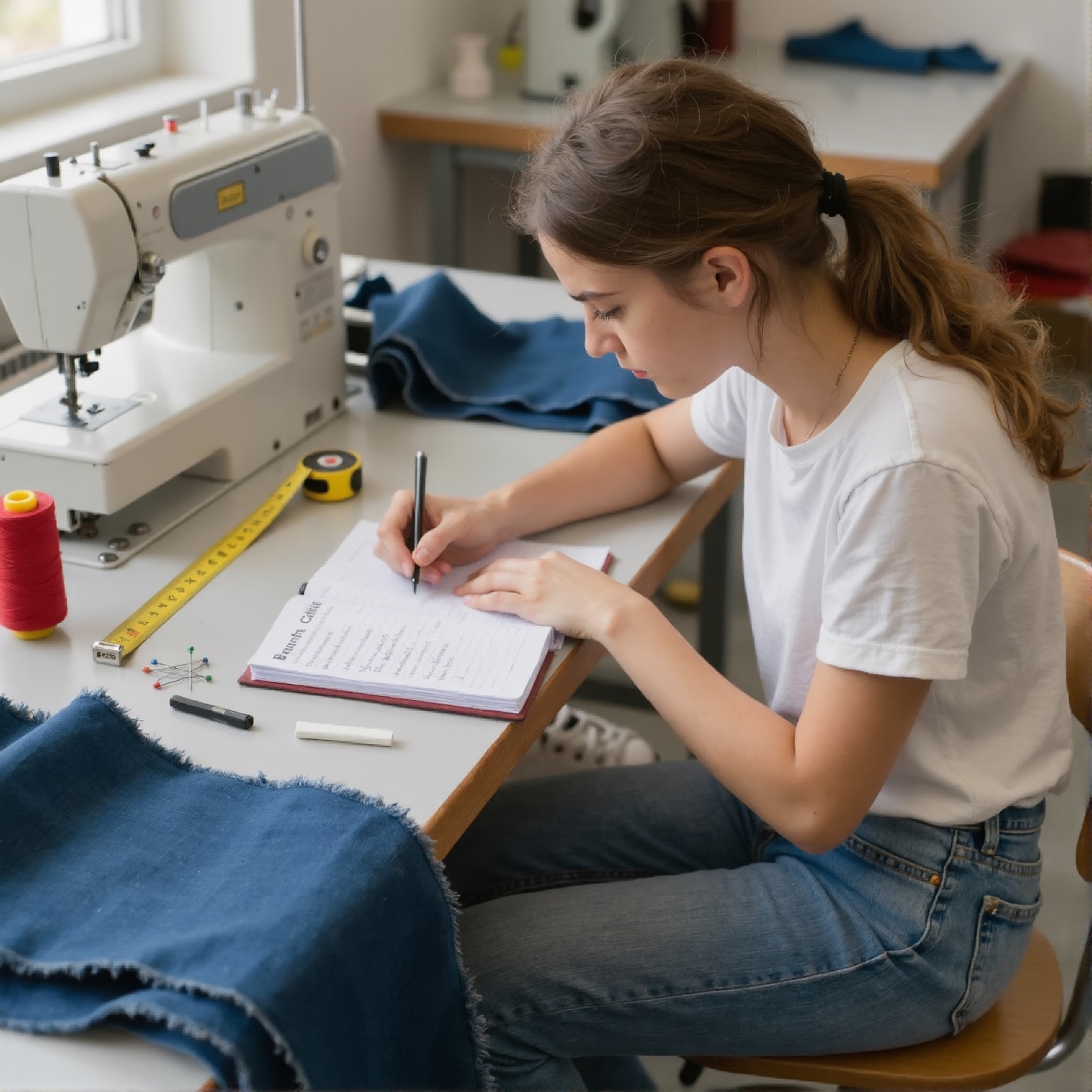
[ Celeste ]
I was at the rail tagging garment bags when Lauren Rossignol arrived.
She didn't come to Wardrobe like a mother arriving at a principal's office. Instead, she stepped into the room respectfully, like someone realising she'd entered a place where skilled hands were at work. A canvas tote on her shoulder and her car keys in her hand, her gaze swept the room, at the rails, the mannequin wearing Lily's palace dress with pins in place.
Her hair was pulled back too tightly for vanity.
Her lipstick was absent.
Her expression was not.
Mara was at the cutting table, pencil behind her ear, studying the pattern paper spread before her.
She looked up.
"Can I help you?"
Lauren paused. Her gaze had settled on the mending table for a few seconds longer than necessary, where a figure sat with their back to her, absorbed in a garment. She turned to Mara.
"I'm Charles' mother," she said finally.
Mara didn't move, but something in her eyes adjusted, like a lens clicking into focus.
"I see," Mara said.
Lauren frowned slightly.
"I expected him to be working in maintenance," she said. "He told me over dinner last night he was working here."
"He is." Mara studied her calmly. "And you are wondering why."
Lauren bit her lip and nodded.
Mara pointed at the chair next to her table.
"Would you like to sit down?"
Lauren sat, carefully. She placed her keys on her knee instead of the table. Her tote stayed on her shoulder.
Mara eyed her, impassive.
"My name is Mara." The words came out quiet, measured. "What would you like to know?"
Lauren was looking around the room again, searching. She hastily returned, as if remembering her manners.
"Sorry. I'm Lauren." She stopped, pressing her fist against her lips for a beat. "I just want to understand why he's here and not in maintenance."
Mara's mouth went into a thin line.
“Maintenance gave him work that needs shoulders. He needs work that requires hands.”
Lauren stared at her for a moment.
"His father arranged Maintenance."
Mara held Lauren in her gaze.
"Yes," she said.
Lauren's shoulders moved slightly forward. She took in a slow, deep breath and let it out in a short puff.
And stared at the window.
Mara waited.
"We're just concerned for his future,” Lauren said finally. She looked thoughtful for a moment, then seemed to remember something. Reaching into her tote bag, she produced a folded piece of cloth, which she handed to Mara.
"Charles showed me this last night," she said. "The lace had separated from the cap. He'd sewn it back."
Mara's lips twitched slightly. She slowly unfolded it.
They stared at it for a moment without speaking. Then, Mara's eyes rose to Lauren's.
"He says you taught him."
Lauren's gaze dropped back to the cap.
"I did." She shrugged slightly. "It was— arts and crafts."
Mara's brows rose a fraction.
"Arts and crafts?"
Lauren's face softened slightly.
"You know, something to keep kids busy during the holidays."
Mara's look was piercing.
"No."
The word wasn't said so much as expelled. Lauren's eyes widened.
"This isn't arts and crafts, Lauren." She turned the cap inside out, examining the stitching. "This is a foundation. This is how I would have done the job."
She pointed at the edge of the lace.
"Most people just see lace that has come off." She tugged slightly at the seam. "A sewer looks for where it had let go." She put the cap on the table.
"You didn't just teach sewing, but seeing."
Lauren's hand reached out and gently touched the lace. Her head bobbed in a barely perceptible nod. She glanced at Mara and then her eyes fell on the mannequin wearing the ornate gown. She took in the sewing machines on tables with folded fabric and bobbins of thread and tins for chalk, pins, and thimbles.
And finally, stopped at the repair table.
Her eyes changed.
"Would you like to have a look around?" Mara said.
Lauren nodded again and pointed at the pattern on the table.
"May I ask what is this for?"
Mara gestured towards the open window. Morning at the Historical Faire was in full swing: the voices of actors in the marketplace proclaiming the virtues of their onions and turnips could be heard in the distance.
"New production. The Faire wants a shopkeeper line."
Lauren's eyebrows rose.
"You don't just do repairs, then?"
"We did at first," Mara said, "when the Faire had just opened. But then, the owners weren't happy with what we were getting from overseas."
Lauren's head tilted as she studied the pattern.
"The costumes we made held up better," Mara continued. "And so, management kept ordering new ones to replace the others. There aren't that many of the overseas ones left."
The front-loader started its final spin rattle as the shouting of the vendors seemed to grow louder.
"So, this is— a trade."
"Several trades," said Mara. "People think all we do is stitch torn seams." She stood. "We're a workshop. Cloth just happens to be our material."
Lauren looked up from the pattern. Her eyes went to the repair table again.
She glanced at me, and then, turned to Mara.
"So, what do I do?"
Mara's look didn't change.
"You don't do anything different."
"But Charles' father—" Lauren stopped.
Mara's look sharpened.
"He will have his opinion."
Lauren looked at her.
"He knows ships." Mara sat down. "You know Charlie. And his opinion doesn't change what you know."
Lauren grimaced.
"Still. Roger is Charles' father."
Mara put her arms on the table and leaned forward, looking straight at Lauren.
"No one is suggesting you ignore Roger's opinion." She held Lauren's gaze.
"Then what are you saying?"
"I'm saying this: do not ignore your own."
Lauren looked away.
I continued to quietly put tags on finished costumes. The metal hook of the hangers against the rails made a faint scraping sound as the costumes swayed.
And then, for a while, the only sounds were those of the Faire through the window and the faint hiss of the steamer.
I watched Lauren take in a breath and look around.
Mara wordlessly watched her get up and walk over to Charlie.
He raised his eyes to meet hers, his head and his body completely still.
Her eyes moved from his face to his hands.
"What are you working on?"
He held up the seam.
And Lauren nodded.
8 ☕ Morning Tea
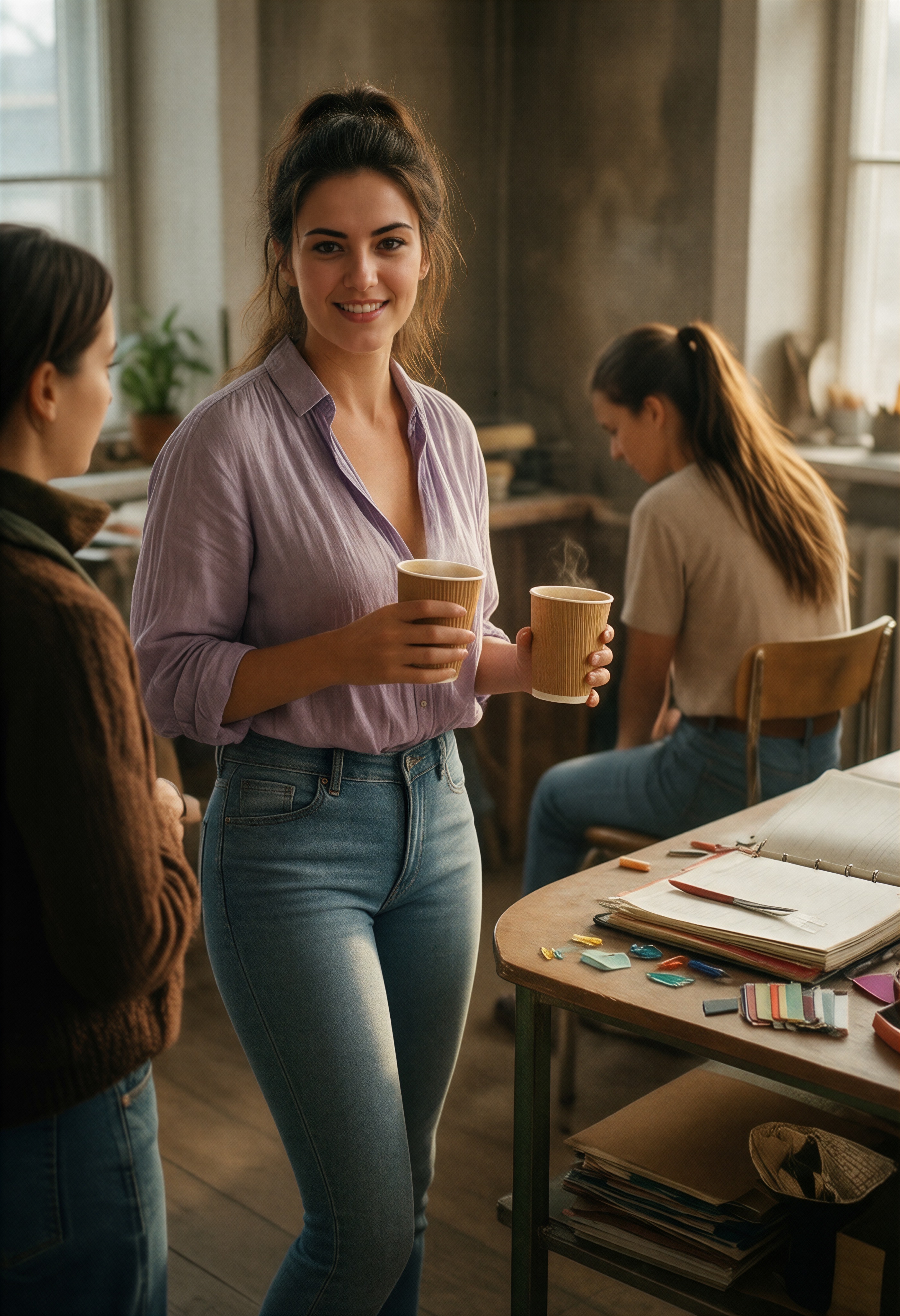
[ Celeste ]
Lauren came back a week later looking tired, because mothers always do.
But she didn’t bring keys to crush in her palm.
She brought coffee.
A small paper bag, warm through the bottom, smelling of espresso and pastry, and a tote that sat on her shoulder like she’d learned how to carry weight without injury.
Mara looked up from the worktable.
“We don’t eat over fabric,” she said, as if citing doctrine.
Lauren nodded like she’d expected nothing else.
“I didn’t bring it for the fabric,” she said. Her tone had a dryness to it. “I brought it for women who forget food because they’re too busy.”
Mara’s eyes narrowed.
“I don’t forget,” Mara said. “I postpone.”
Lauren’s mouth twitched. “Yes. That.”
She took the food into the kitchenette. Then she returned, and quietly stood and watched the room.
The atelier had changed in a week, and Charlie was part of that change. That morning, he was holding a bodice steady at the fitting curtains while Lucy worked the line on the mannequin.
No glancing around, but just— held.
Lauren’s expression shifted, her lips pressing together. She stepped closer to the worktable and reached into her tote — practically, the way women smuggle care in under logistics. She drew out a small notebook and opened it. Fabric swatches. Neat rows. Labelled with the kind of care that says: I don’t waste my time, and I won’t waste yours either.
“I have a linen supplier in Sydney,” she said, her voice businesslike. “Fabric that doesn’t go transparent under light. Not cheap, but consistent.”
Mara paused, then put down her pencil and held out her hand.
“Let me see.”
Lauren passed the notebook across the table. Mara tested the swatches gently but with clear intent. She rubbed the weave between her thumb and forefinger, then stretched the fabric slowly across the grain and let it fall back into her palm.
“This holds,” Mara said. “It won’t collapse when it’s damp.”
Lauren nodded. “That’s why I like it.”
“What do you use it for?”
Lauren didn’t answer immediately. Out of the corner of her eye she was watching Charlie’s hands: his steadiness, the way he treated cloth like it deserved respect.
“For things that need to survive,” she said at last.
Mara’s eyes softened the smallest bit.
“Mmm,” Mara said. “Yes.”
Lauren exhaled slowly. She turned to the fitting curtain. Lucy had stepped away from the mannequin, and was eyeing the sleeve with narrowed eyes.
"Watch carefully," she said to Charlie. "See what happens."
She lifted the mannequin's arms. I saw Charlie's head tilt slightly as the fabric tightened.
“Mara,” Charlie said, soft, cautious. “This seam pulls when you raise the arm.”
“Good catch.” Mara didn't sound surprised. “Physics always wins, even over lovely sewing.”
He quietly held the bodice steady while Lucy re-pinned the line.
"I might have my coffee before it goes cold," Lauren said. "Join me?"
Mara motioned for me to follow them into the tearoom. Lauren found a clean plate and deposited a 'pull-apart' that was still warm, then handed me a coffee. Mara sat at her usual spot sipping her beverage thoughtfully.
Lauren had a sip, then turned to her.
“You know, when Charles left the house—,” she said, carefully.
Mara didn’t look up.
“Charlie.”
Lauren blinked: a small recalibration.
“When Charlie left the house this morning, he seemed— I don't know,” she paused. “Keen. That's it. Keen.”
The word 'keen' sat in the air like something unexpected.
Mara wordlessly pulled at the pastry. Her eyes caught mine.
Lauren was staring at her cup.
“I remember when I first got into nursing,” she murmured. "My dad was so proud. And my mum: furious." Her head tipped slightly. "I suppose she didn't see it as a career."
Mara set her cup down.
“But you got the degree anyway?”
Lauren's fleeting smile was humourless. She continued to stare at her cup.
"It was hospital-based training, not Uni," she said. "My parents wanted to see me married. But my dad wanted me to be happy, more than anything."
She wrapped her hands around the cup, her lips tight.
"Sounds like you ended up making both of your parents happy," Mara said carefully, unusually gently, for her.
Lauren's lips twitched politely.
"Yes, I suppose." She looked up as Mara stood.
"I'd like you to meet Celeste," Mara said.
Lauren's smile was just a shade less than cordial.
"Oh! So— you're Celeste. Charl— Charlie mentioned you last night."
She held out her hand.
I took it. Carefully.
"Nice to meet you." My smile matched hers.
"He said you shared a maths class."
I nodded.
"Charlie's very good at geometry," I said. "I heard he's good at physics, too."
Lauren looked mildly surprised but didn't say anything.
Lucy appeared at the door.
"The mannequin is letting us down," she said. "It's not flexible enough."
Mara moved to the tearoom door.
"Thank you for morning tea," she said to Lauren.
She left with Lucy. There was an awkward silence.
"I should get back to work," I said finally. "Thank you for bringing morning tea."
"Celeste."
I stopped.
Lauren was sitting on the edge of her seat, peering out of the tearoom at the fitting curtain. She wrung her hands.
"I wish I knew what to do," she said.
I gave what I hoped was a sympathetic smile and left.
One of these days, I'll be a mum. Hope I never have to face this sort of thing.
I already knew that was unrealistic.
9 🌺 Signal, not Noise
[ Celeste ]
Lauren came back a fortnight later, on a warm Tuesday morning.
Tuesdays were the days Mara pretended she had time. She didn’t, of course. Mara never did. But Tuesdays were when she scheduled those "need-to-get-done" tasks. The cutting table was clear, the mannequin was dressed in half a bodice, and the new jacket prototype sat like a dare.
Lauren stepped in with nothing but a flat folder under her arm and a tote on her shoulder. She looked neat, composed, and slightly sharpened around the edges.
Mara glanced up.
“What now,” she said drily.
Lauren didn’t waste time warming the air.
“His father—"
She stopped. Mara’s mouth tightened.
“I told him Charlie had made other plans,” Lauren said. “Roger didn't take it well.”
Mara’s eyes flicked to the folder.
“What’s that?”
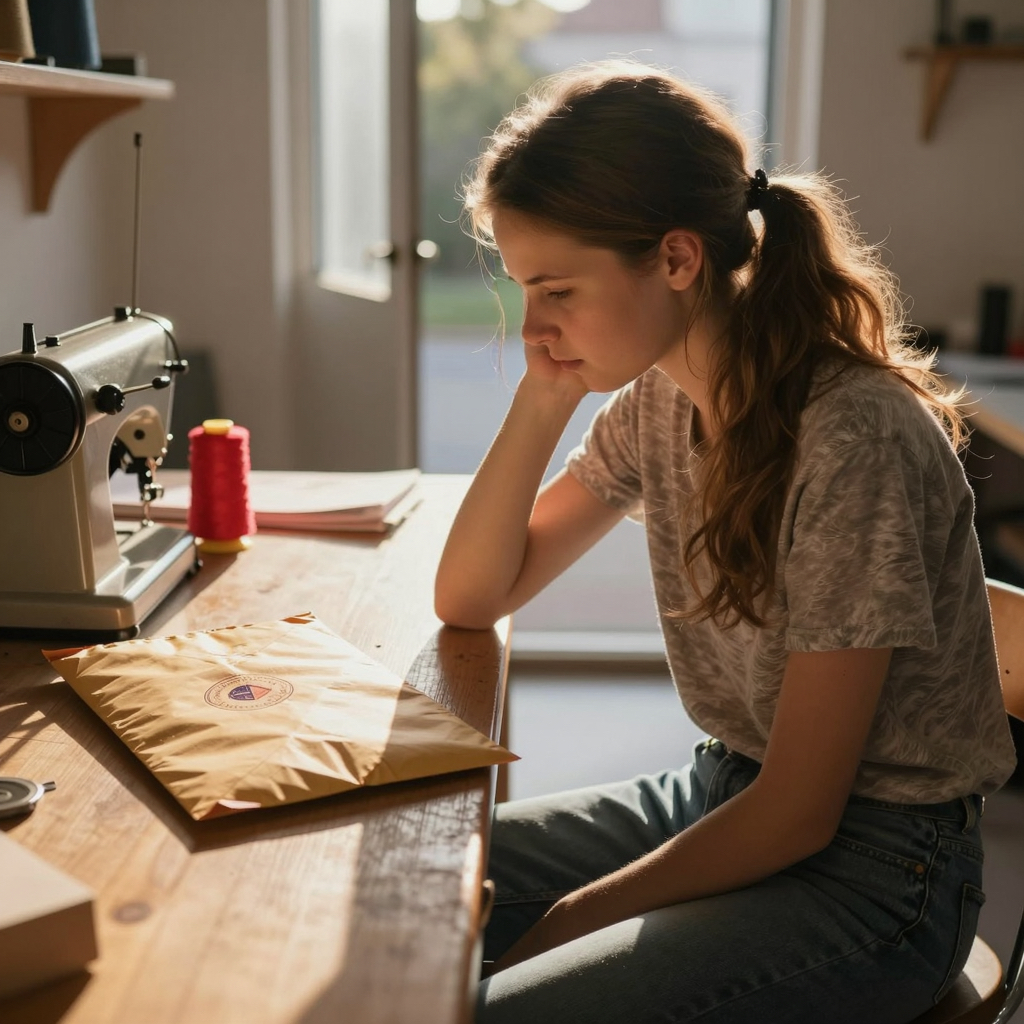
Lauren placed the folder on the corner of the worktable, away from fabric, and removed the contents — an envelope and a printed sheet — with the same neatness Charlie arranged paper on school desks.
The envelope was plain and official-looking. Lauren didn’t open it, but left it on the table like something scraped off a shoe.
She slid the printed sheet forward.
On it was a photograph of a Faire actress wearing the new jacket prototype. Her arms were raised in a dramatic pose, the kind that usually tore seams under the arm and split closures at the waist. The jacket had clearly held: clean line, no gaping, no strain.
Below the image Lauren had typed a legend:
- Previous issue: underarm seam tearing after repeated movement
- Change: reinforced gusset + eased sleeve head + seam tape at stress line
- Result: 3 full shifts; no tear; improved comfort; faster dressing
- Notes: closure placement adjusted for quick change; no snagging
Nothing was left to trust. Everything was there to verify.
Mara studied the photo for a moment before motioning me over.
“Signal,” Lauren said, glancing at Mara's face. Then she indicated the envelope with her thumb.
“And that,” she added, “is noise.”
Mara’s mouth twitched as her eyebrows rose slightly — almost amused, almost approving.
“You took the picture?”
"I had a free afternoon last week," Lauren said with a shrug, "so I did a tour of the Faire. I noticed your prototype."
Across the room, Charlie was at the side bench, pinning a lining into a bodice piece. He hadn’t looked up when Lauren entered. But he did look now. Not to the photo at first. To the envelope.
At the sight of the official paper, his hands slowed. A pin hovered between his fingers.
Lauren noticed without turning.
Mothers always did.
“Keep your hands,” she said quietly.
Charlie blinked. “But—”
“No but,” his mum replied. No cruelty in it, just blunt care. “You’re not in trouble.”
He swallowed and slowly went back to pinning.
Mara picked up the sheet and examined it.
“This,” Mara said, tapping the list, “is useful.”
Lauren allowed herself a thin, purposeful smile. Mara’s gaze slid to the envelope.
“And that.”
Lauren’s brows twitched.
“Roger wants to know what trade he'll finish with,” she said. “He wants ‘proof’.”
Mara’s eyes narrowed.
“What does Charlie want?”
"I'm not entirely certain," Lauren replied.
Mara eyed her.
"Do you think you should talk it over with him?"
"We did talk a bit, last night," she replied.
"And?"
Lauren let out her breath in a puff with a frown.
"Well, his father was there."
Mara nodded, then tipped her head.
"The tearoom's free."
Lauren picked up her tote.
"Charlie." Her voice was gentle.
The two went into the tearoom. I could feel Mara's eyes on me.
She didn't need to say anything.
Their decision.
Mara joined Lucy at the fitting curtain while I opened windows to let out some of the steam. The air outside was almost as warm, but drier, seasoned with diesel fumes mixed with hot chips soaking in re-used cooking oil and the occasional reminder that port-a-potties were just around the corner.
When they emerged just before lunch, Charlie looked solemn; and Lauren looked relieved but also filled with intent. She went straight to the worktable and opened the envelope.
Mara approached slowly. Her expression was implacable, but her eyes searched Lauren's face.
"And?"
"He's determined to make a go of it."
Mara's eyebrows barely twitched.
"And so am I," Lauren added.
Mara gave a single nod, eyeing the envelope.
"I take it this is for me."
"It is." Lauren pulled out a folded document. “Charlie wants to stay here to learn the trade. I'm happy that there is a future in it. For him. This is real.”
She handed Mara the document.
Mara unfolded the paper carefully.
“You are asking for commitment.”
Lauren met her gaze.
“I am.”
She paused.
“I need to be able to show that this is real," she said, her voice showing a hint of vulnerability, as if reluctant to make her need into Mara's burden. "That Charlie’s training for a trade. With standards.”
Mara’s gaze held hers.
“A contract.”
Lauren didn’t flinch.
“Yes.”
She took in a deep breath. “A contract will turn noise into signal," she added. "Work placement language. Attendance logs." Her mouth tightened. "Roger wants a form, I’ll give him a form. You handle standards. I handle noise.”
Mara removed the chalk pencil from the top of her ear.
She looked across the room at Charlie, who had resumed pinning, slower than before but steady.
Then, her eyes returned to Lauren.
“You’re asking for a structure.”
“Exactly.”
Mara exhaled through her nose.
“Fine,” Mara said. “Here’s the structure. Charlie shows up every day, full-time. He keeps hours. He logs tasks. He does training modules I set. He gets evaluated like all my staff. If he fails, he fails. No protection from anyone.”
Lauren’s voice didn’t soften.
This was the contract.
“Agreed.”
Charlie looked up then — finally, his gaze flicking from his mum to Mara, and then, finally, to me.
“Charlie,” Mara said.
Charlie stood quickly.
“Yes Mara?”
Mara held up the printed sheet.
“Your mother has a costume testing plan, with receipts,” Mara said. “She's also asking me for a contract so that you can learn the trade. We will do this properly.”
Charlie stared at the testing plan.
"I need to know your decision."
He looked up.
"I want to learn the trade, Mara."
“Right then,” she said, her tone clipped, and began to study the document.
“I’m not asking for anything," Lauren said, "but for you to stay— visible.”
Charlie blinked at the word 'visible'.
“Visible,” Mara agreed, “means you write down what you do. You show up on time. You finish tasks. Visibly.”
Charlie’s throat dipped.
“I can do that.”
“Good,” Mara said, and turned briskly back to the mannequin. “You can start now.”
She gestured at the prototype jacket.
“We solved the tear,” Mara said. “Now I want the pull solved without it fighting.”
She ran her thin fingers over the seam.
“It needs to survive heat and tourists and people stupidly grabbing sleeves,” Mara continued. “But do it without adding bulk that ruins the silhouette.”
She eyed him closely.
“Tell me where it fails.”
Charlie stepped closer to the mannequin. He lifted the sleeve gently and pressed the seam line with his fingertips. His eyes focused. He only hesitated for a moment.
“It’s not the seam, Mara,” he said quietly. “It’s the angle. The gusset’s correct, but the sleeve head is fighting it. You need two millimetres more ease, here." He pointed without touching. "The tape needs to stop before the pivot point, not run through it.”
Mara’s face changed.
“That,” Mara said, “is an answer.”
Of course it was.
Lauren watched him. I felt something click into place.
Mara didn't look up.
"I'll have a signed copy of a work contract ready for you in a couple of days."
Lauren picked up her tote, nodded once at me — not warmth, exactly, but acknowledgement — and moved to the door. As she left, she paused and looked back at Mara.
“Thank you,” she said.
Mara didn’t look up from the sleeve.
“Now, it's up to Charlie,” she said.
“Yes, it is.”
The door clicked shut.
10 👗 Not My First Choice
[ Celeste ]
“Look at this.”
Mara slid a thin archival print-out across the cutting table. The image was a plate from an old catalogue: eighteenth century, late enough that it carried a Georgian neatness, early enough that it still remembered softness. A woman’s garment, fitted through the back, generous through the skirt, closures designed for working hands.
It had been designed by necessity and for function. It had intelligence in it.
My pulse quickened.
“This isn’t a costume,” I said. “It’s equipment.”
Mara’s lips were a thin line of approval.
“It’s clever,” she said. “See the reinforcement here? And here.”
I leaned in. The sketch suggested a hidden strength at stress points: underarm, waist, the place where movement always found the weak seam.
“I can draft this.”
Mara handed me a pencil.
“Then do it.”
That was Mara. The moment you said it, you owned it.
We wordlessly split the labour.
I took the research: proportions, plausible fabric weight, seam placement, what could be original and what had to be translated for a modern body in a modern job.
Mara took the pattern: chalk, ruler, critical decisions.
Charlie kept to the repair pile, but his darting glances in our direction betrayed his interest.
We moved fast. Paper became pattern. Pattern became cloth. Cloth became the first prototype under Mara’s hands.
The room filled with that particular concentration that only happens when a thing becomes real: pins tapping into the pincushion, the soft rasp of shears, the hiss of the iron. By mid-afternoon the garment hung from the mannequin, half-finished but already legible.
Even unfinished, it had a line. It didn’t scream 'pretty', but rather whispered 'capable'.
Mara stepped back, eyes narrowed.
“It’s got spine.”
“And purpose,” I replied.
Charlie looked at the garment from the other side of the room. He quietly rose and, biting his lower lip, approached the mannequin. After studying it for a moment, he reached in and adjusted a seam allowance that had curled under itself.
Mara noticed. Mara always noticed.
“Already adjusting things, Charlie?”
He paused with his fingers on the fabric.
“Just— keeping it clean.”
I noticed then his hair had been brushed back more carefully than usual, and his t-shirt had been pressed.
We didn’t take any more time to admire our prototype. We did what we always did with any garment we'd improved: we tested with a chemise and a real day's work.
On Lucy.
Lucy was our default tester. A fitter and a tester, she was the one we relied on to give us real-world information on a garment. She would do Faire actress work at times: lifting baskets, crouching for children, running for late arrivals.
She was the kind of wearer who put costumes through their paces.
She came back near closing time that evening, cheeks flushed, hair escaping pins.
“Got lots of compliments. It looks brilliant,” she announced, breezily. “But—"
She turned slightly and tugged at the underarm.
“Here,” she said. “When I lift my arms. It’s not tearing, but it’s like it’s fighting me.”
Mara’s eyes flicked to the seam line.
“And this,” Lucy added, touching the waist closure, “I don't know that I'd want to wear it another day, to be honest. Look, it held, but it got tugged a lot. People grab. You know.”
Yes. We knew.
Mara took the garment from Lucy the focused way a mechanic takes a part off an engine and laid it flat on the table. She pressed her palm along the seam.
“This is not failure,” Mara said to me. “Still, I don't want Lucy wearing it again until we get some core issues sorted.”
"How do you suggest we sort the issues?”
"Just having Lucy tell us where a garment pulls is not enough information." She ran her fingers along the seam. "We need to know what a garment is telling us about the physics.”
Mara turned the dress over.
"The 'where' isn't the question. That bit's as plain as daylight."
"So, do we run a seam this way or that, a few times?"
She shook her head, and turned towards the mending table.
"No, I need the 'how'. I want the physics."
I felt my spine stiffen.
“Charlie.”
The way Mara said 'Charlie' at that moment landed differently than 'Rossignol' ever did.
Charlie looked up. Mara held up the garment with two fingers.
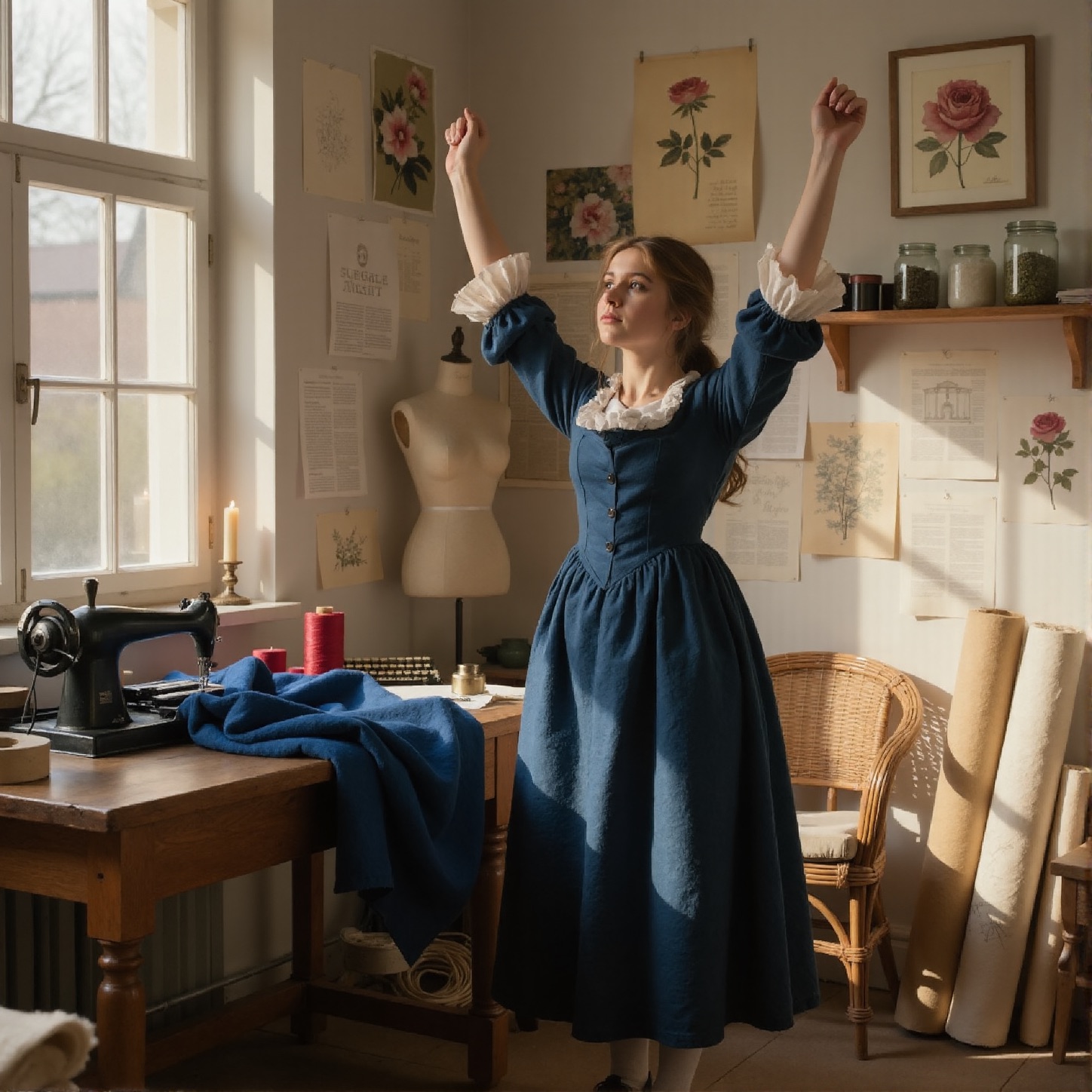
“You,” Mara said, her voice flat, “are going to test this dress, Charlie.”
Lucy blinked. “He is?”
Mara nodded. “Yes. He is.”
The logic was undeniable.
Physics.
Charlie could read a behaviour and know where the fix lived.
I carefully watched his face. The smallest frown slowly appeared as his eyes dropped to his torso — doing maths.
A calculation: will this even sit right?
His eyes went to the dress again and his frown melted into slight confusion.
Mara silently waited.
I watched Lucy casually sidle up beside him.
“Well,” she murmured innocently, eyes bright, “a tester! And of a dress.”
Charlie glanced at her and gave one shoulder a nearly imperceptible shrug.
His mouth went crooked.
“It wouldn’t have been my first choice.”
Mara didn’t react at all.
“Noted,” she said. “And irrelevant.”
Charlie looked at the dress again.
“So you don't need me to tell you where it pulls.”
“I already know where it pulls.”
His eyes lifted to hers.
“You want: why.”
“Exactly.”
We moved to the fitting area. Mara drew the curtain and held the garment up.
“Arms up.”
Charlie complied. Mara worked quickly, checking lines, pull, and where the fabric resisted movement.
“Turn. Now lift your arms. Higher. Good. Twist. Again.”
And then, her voice: irritated yet satisfied.
“There,” she said. “Feel that?”
Charlie’s voice came through the curtain.
“Yes,” he said. “It’s not the seam. It’s the direction of strain. When I raise my arms, the tension line runs across the tape and stops the fabric doing its job.”
Mara's exhale was almost harsh.
“Say it again.”
I stood just outside the fitting area curtain, notebook in hand, scribbling furiously.
“The closure,” he continued, “holds. But if someone grabs here—"
The curtain moved slightly.
“—it transfers force to the waistband. The reinforcement needs to stop before the pivot point, or it becomes a lever. It will eventually tear next to the reinforcement.”
Silence.
I wrote as fast as I could, my mind already mapping the fix.
Stop the tape at the pivot. Shift the ease. Strengthen without bulk.
Preserve the silhouette.
Mara drew the curtain back.
Charlie stepped out, still in the dress, one finger on the spot indicating strain. Mara grabbed chalk and marked a line on the garment.
I watched his face: controlled, determined.
“And this is why,” Mara said to me, curt, “we don’t test with people who only wear.”
Her eyes flicked to him.
“Here on out, we test with Charlie."
Charlie’s ears went slightly pink. I kept my voice flat.
“And we log everything,” I said, already flipping to a clean page in my notebook. “Every deviation from the original design. Every reinforcement. Every reason.”
Mara nodded. “Exactly. Make it defensible.” She turned to Charlie.
“You can take it off now,” she said. “Then, write me a report.”
Charlie blinked. “A report.”
“Yes,” Mara said. “Details. Where it pulled. What caused it. What you propose. In plain language. No poetry.”
“Yes Mara.”
He disappeared behind the curtain.
Mara looked at my notebook.
“Title it,” she said.
I wrote at the top of the page, in neat block letters:
DESIGN REALISATION — PROTOTYPE 1 — STRESS TEST LOG
Then underneath, because it mattered, because it named what we were building:
Tester: Charlie Rossignol
Purpose: durability & mobility without silhouette compromise
Notes: equipment, not theatre
Mara’s gaze flicked over my shoulder, and her mouth twitched again.
“Now we do this properly.”
The second prototype was a jacket. Different cut, different sleeve head, but the same intention: make it survive the day without turning it into armour. Mara hung it on the mannequin and stood back, chin lifted. Lucy and I watched her tug on the sleeves.
She turned to us.
“So, this time,” she said to Lucy, “we’re not sending you out to crash test it.”
Lucy half-grinned as she blithely took a step back.
“Bless,” she said with a flick of the hand. “Thank you.”
Mara ignored her.
“Charlie.”
Charlie looked up from the bench where he’d been hand-stitching a reinforcement tape onto a waistband. He put his needle down carefully, precisely, and stood. Mara held up the jacket with two fingers.
“Same drill.”
“Right. Where’s the log sheet?”
The unease hadn’t vanished: it had been translated into structure, into process. He wordlessly took the sheet from her and moved toward the fitting area.
Mara snapped the curtain closed with a decisive tug.
With the third prototype, Mara made no announcement, but simply held it up: a skirt, new cut, new waistband, a clever closure arrangement we’d borrowed from an extant garment plate.
She looked around the room.
“Charlie.”
Charlie set his work down and stood.
“Yes Mara.” Then, he quietly added, “Could— we make sure the curtain rail is fixed. It catches.”
Mara’s eyes flicked to the curtain hardware as if it had personally offended her.
“Yes,” she said, “we'll get it fixed.”
By the fourth garment, no one had named it — but everyone was using it. It had become routine.
A new jacket had been pinned, a clever cut I’d been excited about. It looked perfect on the mannequin. The silhouette was right. The closures sat where they should.
Lucy ran her fingers over the seams.
"Looks just about ready to me."
Mara didn’t even look up from her pattern paper.
“Not yet.”
Charlie, at the bench, lifted his head.
“I can do it now, if you want me to.”
“Do it,” Mara said. “Ten minutes. Break it on purpose.”
Charlie lifted the clipboard with the log sheet from its hook, removed the jacket from the mannequin and took both to the fitting area.
The curtain closed with a crisp snick.
11 📒 The Ledger
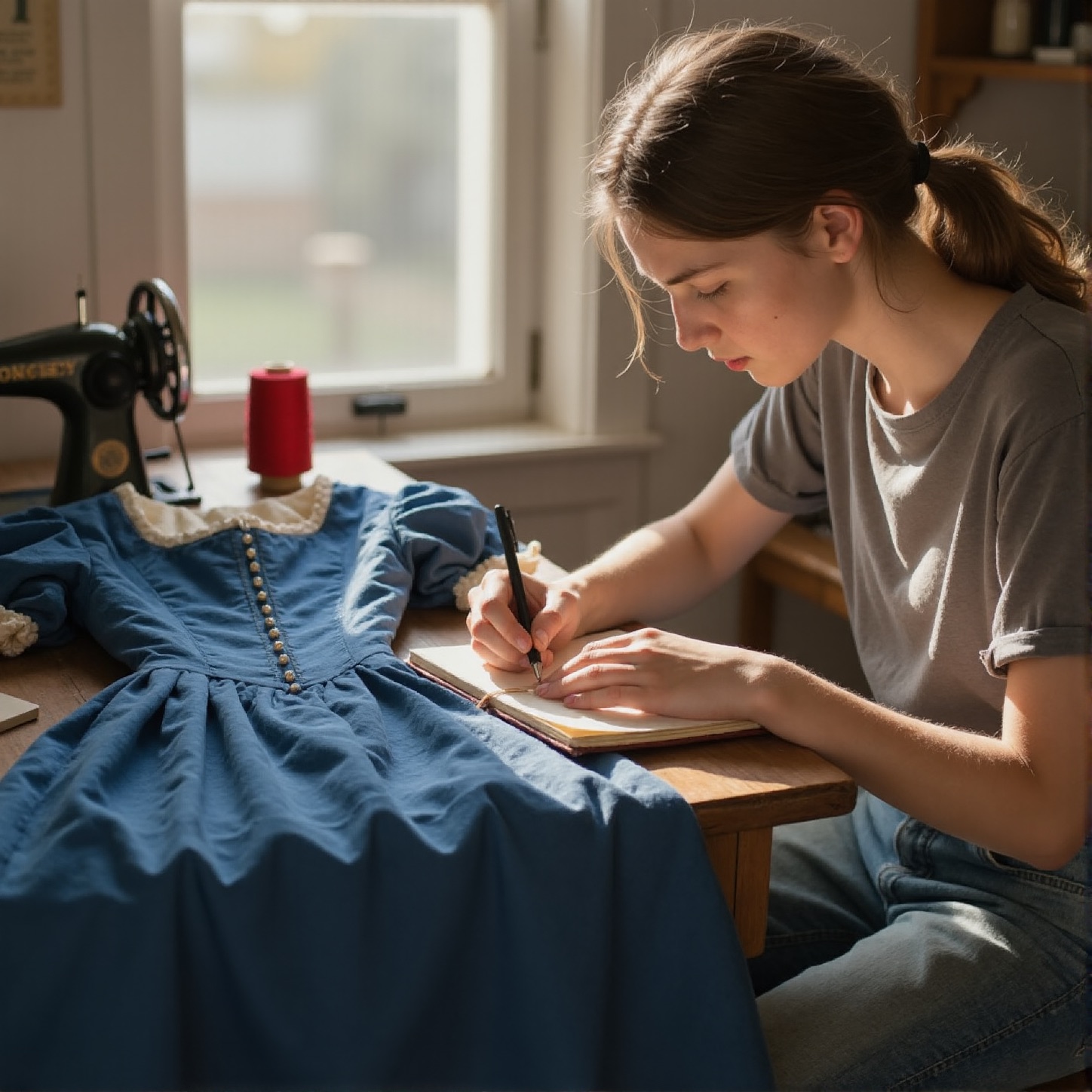
[ Celeste ]
Mara put a ledger on the table one morning.
Thick. Hard cover. The kind that you'd worry about offending if you dropped it. It claimed a spot between pincushion and shears on the repairs table, beside the tin of chalk, accompanied by a wooden stool that hadn't seen varnish in decades.
On the first page of the ledger Mara had already ruled headings in her angular hand.
GARMENT:
DATE ISSUED:
ISSUED TO:
PROBLEM REPORTED:
REPAIR:
RE-TEST:
Mara tapped the headings once.
"The headings are not set in stone," she said. "This is a starting point."
I looked up.
"This is for cataloguing repairs?"
She shook her head.
"Not just repairs. Everything. No more mending pile filled with guesses and assumptions."
I glanced at the repairs table, where all items to be mended once lived. I had watched Charlie finish the last item the night before, so I was surprised to see a folded up chemise sitting next to the sewing machine, a bit lonely.
Mara noticed it too. Her lips tightened.
"Whose is that?"
Charlie appeared just then, quietly. He'd set his leather bag on the floor and had started undoing the buttons of his jacket when he followed Mara's gaze.
"Oh, that? One of the actresses dropped it off last night, just at closing. You had just—"
"Who?"
Charlie startled slightly.
"Lily."
He removed his denim jacket.
Mara picked up a spiral notebook and fixed her gaze on his face.
"Your first task this morning is to get details on how that garment failed. From Lily."
"But—" He threw a puzzled look at the window.
"She's an actress in the palace."
His eyes went a bit wider as she handed him the spiral notebook and the chemise.
"Um, I did have a look at it last night," he said. "I could probably tell—"
"'Probably' isn't data," Mara said quietly.
His face fell. Mara saw it.
Of course she did.
"Is there a problem?"
"No-no," he said hastily. "I just thought—"
"That your testing was going to answer every question?"
She waited.
He bit his lip, his hands shaking slightly as he slipped his jacket back on and picked a pen out of the tin.
"Details," Mara said. "We need to know what she was doing when it failed, if it was pinching, if it was something she'd noticed was starting to fail, and any other information you can think of."
"Yes, Mara."
He glanced at me as he moved to the door.
The door clicked shut.
Mara's eyes met mine.
I went back to work.
Later that morning, I opened the window. A cold wind had come up and was blowing leaves around the carpark. I propped the window partly open to let in a bit of fresh air, idly wondering why I couldn't smell the usual hot chips porta-pottie medley.
I had just returned to doing invoices when the door opened.
Lucy came in, wearing a huge grin. She sidled up to me.
"Who sent Charlie out to interview the wolves?"
I tipped my chin at Mara.
"He's out there like a reporter at a hostage scene," Lucy said, lowering her voice. "Asking Lily a bazillion questions and scribbling away—"
I nodded.
"He takes his job seriously."
Lucy gave a sharp laugh.
"Lily never knew what hit her." She tossed her head. "And then, this other actress—"
The door slowly opened and Charlie stepped into the workroom. He was studying his notes, his mouth to one side.
Mara looked up from her work.
"Did you get it all?"
Charlie tipped his head slightly to one side.
"I think so."
Mara's eyes rested on the notebook.
"Have a look?"
His neck reddened slightly as he passed it over to her. She glanced over it, and handed it back.
"Can you read this?"
"Mostly yes."
"Transcribe it."
She pointed at the ledger.
Over the next few days, the weather got colder. The number of actresses visiting Wardrobe seemed to increase. Mara finally didn't even look up from her work, but would simply point at Charlie.
The furious notebook scribbling stopped: Charlie wrote directly into the ledger.
He had just closed it one afternoon and had picked up a jacket to repair when the door opened and a blond actress strode in carrying a linen chemise. She stood before Mara, hands on hips, ignoring her gesture towards the mending corner.
Mara looked up then.
"Repair?"
"Yes."
Mara nodded at the other end of the room.
"Charlie is responsible for repairs. He will need details on how the failure happened."
"I don't like discussing intimate garments with a bloke."
I could see Charlie stiffen.
Mara's eyes sharpened.
“You don’t have to like it. His job doesn’t change.”
The blonde straightened.
"I don't think it's appropriate."
Mara stood.
"You have a right to your opinion," she said silkily. "The more information we have on what went wrong, the better able we are to prevent problems in the future. Whether you assist us in that is up to you."
The blonde dropped the linen garment on the worktable and turned on her heels. Mara wordlessly picked up the chemise, folded it and inserted it at the bottom of the repair pile, which had accumulated that afternoon.
"Whenever you can get to it," she said to Charlie.
He nodded.
Friday afternoons became design review sessions. Mara, Charlie and I would sit at her worktable, ledger open — I would take notes.
Charlie's notes had translated into garment failure patterns.
Charlie usually had the floor.
Mara would say very little.
I said nothing.
We were halfway through one of these sessions that Lucy came in with the blond actress, a jacket folded over her arm. Lucy went straight to Charlie.
"I hope we're not interrupting something—"
"Carry on," said Mara.
Lucy put the jacket on the table.
"So, this isn't actually my jacket," she began when Mara interrupted her.
"Whose is it?"
Lucy startled.
"Um, well, Bree's, actually."
"Then Bree needs to bring it in."
Lucy turned the jacket over. "It's just where the sleeve's come loose—"
"Perhaps," Mara said. "We still need to know why. And how."
"But why is that so important?" the blonde interjected. "We never did all that before."
Mara turned to Charlie.
"Show her."
Charlie swallowed, then opened the ledger.
"We're looking for failure patterns," he said quietly, not looking at anyone, "to prevent those failures in future designs."
The steamer hissed. A diesel truck rumbled by the partly open window.
"I'll ask Bree to pop 'round," Lucy said finally.
After Lucy and the actress left, Charlie glanced up. Mara tipped her chin at him.
"Carry on."
We had been back at work for only a few minutes — me at the rails, Charlie back at the repairs table — when the door opened briskly and a tall actress with an imposing bearing entered Wardrobe. She glanced around the room. When she found Charlie, she strode up to his table.
"Hi, I'm Bree," she said in a voice designed to carry to the budget seats.
Charlie wordlessly pulled the jacket from the pile and opened the ledger.
"May I ask what happened, please."
"Of course!"
His smile was doing its best, but his eyes said overwhelmed. Bree was at least a foot taller and held herself like royalty. I could picture her doing King Lear in the title role.
"Would you like to sit down, Bree?" he offered.
"Thought you'd never ask." She dropped herself unceremoniously into the proffered chair. I could hear it creak. "So, what do you want to know?"
Charlie consulted the ledger.
"What were you doing at the time?"
"I was thrusting with a sword."
Charlie blinked.
"I see. Could you show—"
Before he could finish, her fist flew at him, stopping inches away from his startled face. She burst into gales of laughter.
"Oh, sorry sugar, I didn't mean to—" She glanced at Mara, biting her lower lip. "I— I really didn't mean to—"
Mara said nothing but went back to work.
Charlie's mouth curved valiantly.
Bree's smile quickly regained most of its cheerfulness.
"Sorry, hon," she said. "I tend to lose myself in the moment." She wrapped her arms around herself. "What else can I tell you?"
Charlie carefully examined the sleeve.
"Did the jacket feel tight in the shoulders?"
Bree shook her head.
"Did it suddenly let go, or did you notice it loosening a bit at first?"
Bree's eyebrows rose.
"I didn't notice. Sorry."
Charlie gave a quick nod, and turned the jacket inside out.
"I think I have what I need," he said. "I might reinforce both sleeves when I do the repair so it doesn't happen again. Are there any other issues with this jacket?"
Bree shook her head and rose.
"You're the talk of the Faire," she said to Charlie, who gaped at her. "Keep up the good work!"
A couple of days later, Lily showed up at around two in the afternoon with a dour-faced actress holding a bodice. Lily was carrying a bag from the Faire bakery.
"Afternoon tea for my favourite people in the world," she announced cheerfully.
"Lovely. Thank you," Mara said, indicating the tearoom. The dour-faced woman found Charlie at a sewing machine.
"Do you even know how to use that thing?" she asked.
To my surprise, he looked unfazed.
"Yes, I do," he replied. "How can I help you?"
He calmly took down details about the bodice — when, where, how — and then said:
"We can add a bit of reinforcing if you'd like. So it doesn't split again."
"That would be lovely," Lily interjected before dour-face could speak. "You do such lovely work, Charlie." The scowl on the other woman's face had eased a bit. "I'll be back to the palace in a tick, Vanessa," Lily continued.
Vanessa mumbled something, approximated a smile, then turned and left.
"Don't mind her," Lily said gently to Charlie. “She's going through a horrible breakup with her boyfriend."
Charlie nodded, his face one of expectation.
"Was there—" he began, but Lily giggled and shook her head.
"Well, no." She paused. "Well, actually, yes." She produced a pair of black leggings from her bag. "I was wondering..."
Charlie stared at the leggings.
Mara appeared behind him. She spoke clearly, without emotion.
"We don't do alterations or repairs on personal garments."
Lily's shoulders went up. She quickly picked the leggings from Charlie's hands.
"Oh, sorry," she murmured. "It's just— it's so cold in the palace, especially in the early mornings. But I'm sorry, I didn't mean to—"
"The chemise and extra petticoats don't keep you warm?"
Lily shook her head, then got up to go. Mara held out her hand.
"Have a look?"
She carefully inspected the leggings: they were of a heavy stretch cotton with a soft inner layer. The gusset in the crotch had given way. She handed the leggings to Charlie.
"This is a common fail point for leggings. Any ideas on how to fix it?"
His brows narrowed as he rubbed the stretch cotton between his fingers.
"We would need this type of material," he said slowly. "I'd replace the gusset completely, and then, add a reinforcement layer on the inside."
Mara turned to Lily.
"We will fix it."
She turned to go back to her worktable. Before she sat down, she said to me,
"Time to rethink the winter chemise. And possibly, the petticoat."
Less than a week later, a new chemise design was spread out on Mara's worktable. I was on the phone to Lauren's linen supplier when Lily appeared. She went straight to Charlie.
"Celeste said you have the material."
Charlie slowly put down his work, carefully arranging everything so he could quickly pick it all back up where he'd left off.
"Came in yesterday." He reached into the repair basket and produced a bag. "If you can wait, I can do the repair straight away."
"Oh, that would be amazing!" She handed him the leggings almost reluctantly. "They're my favourite pair," she said, her eyes fixed on the garment.
"I'll be careful."
"Oh, I'm sure you will be!" she breathed. "Your hands are so gentle. They remind me of Bree's."
Her face reddened suddenly.
Charlie gave her a crooked smile, then slowly started unpicking the gusset. She watched him work, the side of her lower lip gripped between her teeth. Every now and then, he would glance at her with a quick smile, then return to his work. When the old piece finally came free, he laid it over the new cotton and began marking around it.
“You're replacing the whole thing?”
“Yes. It failed.”
Lily gave a quick nod. “Right.”
When they got to the overlocker Lily glanced at the tearoom.
"Oh dear. Your coffee has gone cold."
He shrugged.
"It was nice of you to bring afternoon tea."
After Lily left, Mara pointed at the ledger.
"Just a quick note: what you repaired, and why."
Charlie turned his head.
"Because the gusset was coming apart?"
"No. Because chemise and petticoats do not always keep an actress warm."
Charlie opened the ledger.
That evening, Mara had just turned off the steamer when the door opened. Bree sauntered in followed by the tall blonde, who cast a suspicious eye at Charlie. Bree, however, wrapped her arm around Charlie's shoulders. His eyes went saucer-shaped.
"I just wanted to say thank you for fixing Lily's leggings," she said cheerfully. "Those mornings in the palace are getting colder all the time, even with the fireplace."
Charlie curved his lips upwards towards eyes that didn't quite agree.
"Your jacket should be ready tomorrow. Anything else?"
Bree chuckled.
"No, hun, just wanted to say thanks. Oh, and Sarah's chemise," she said, indicating the pinch-faced blonde beside her. "Any idea when it might be ready?"
Charlie swallowed and glanced at Mara, who had pulled the chemise from the bottom of the pile.
"Care to tell us what the issue is?"
Charlie grabbed his notebook and pen, and perched attentively on the wooden stool.
Sarah huffed.
"Really?"
Mara didn't blink.
"It would help. Charlie hasn't found any signs of strain or tearing."
Sarah's scowl deepened. She glanced at Charlie's face, and puffed again.
"It— binds."
Mara waited. Sarah's scowl deepened.
"Across the bust," she said finally.
Charlie's head was in the ledger when he asked:
"Would the next size up be more comfortable?"
Silence.
He looked up then and startled. Sarah was glaring at him.
"Oi! Girlfriend! Relax." Bree's voice bounced off the wall.
Sarah's demeanour didn't change.
"Are you saying I'm—"
"Charlie is asking if the next size up would be more comfortable," Mara said evenly. "We can then make it more flattering if you want. A chemise should not bind."
Sarah's fists slowly unclenched.
"Sorry, I'm just not used to some strange male—"
Her body swayed suddenly as Bree gave her a shove.
"C'mon, Sarah! Charlie's one of us," Bree boomed. "Give it a rest, will ya?"
Sarah shrugged, her face still sullen. Mara studied the chemise for a moment, then handed it to Charlie.
"One size up?"
Charlie nodded.
"And darts," he added gently. His eyes flicked at Sarah, then back to the chemise.
Bree sidled up to him.
"Show me what you would do, Charlie."
He gently smoothed the garment on its side on the table.
"Just here, Bree." His fingers moved respectfully over the material. "It would give the chemise a nice silhouette, but without binding or bunching."
I noticed Sarah studying him, watching his hands, his eyes.
Her face slowly lost some of its hardness.
Two days later, Bree collected her jacket and Sarah's chemise.
"Oh, that feels so much better," Bree exclaimed, pulling the jacket on over her hoodie. "You're a magician, Charlie."
Charlie's smile went a bit crooked as Bree thrust her arm forward, away from him this time. I could see he was eyeing seams nervously.
They held.
"Now, if only you could work your magic on Lily," Bree said.
Charlie's mouth fell open.
"Did the leggings fail?"
Bree chortled.
"No, silly, not her leggings. Her heart."
Charlie sat still for a moment, a momentary frown came and went.
"What do you mean? She really likes you."
At first, Bree's eyes popped wide in surprise. She gave her head a disbelieving shake.
"Nah!"
Charlie frowned.
"Yes," he said seriously. She does!" He flinched as Bree slapped him briskly on the shoulder.
"You better be right," she said as she left.
The door slammed.
Charlie flicked a pinched look at me. I suppressed a grin and went over to where Mara was pinning the new chemise on the mannequin.
The material was a heavier, yet softer linen.
And the ledger sat confidently between pincushion and shears, vindicated.
12 🧵 Touch
[ Sarah ]
I hate public transport.
I normally got a lift to the Faire with Lily, but her shift didn't start until nine. Thankfully, the bus was almost empty when I got on except for some long-haired person in the back. I slid into a seat and waited for the throng of tourists to board at the next ten stops. They never came. One of the other actresses — one I didn't know and didn't care to, either — got on near the edge of town.
She didn't appear to want to chat, although she seemed to recognise me. I was fine with that.
Travel time from home was quicker than I thought it would be.
When the bus pulled up at the front gate of the Faire — the route terminus — I exited out the front of the bus. As I passed the side door of the bus, it opened and the long-haired person stepped out. It was Charlie.
His eyes flicked up at me briefly, then away.
We began to walk wordlessly towards Wardrobe.
"Good morning," I said.
His eyes flicked to me. He tightened his lips — the effort didn't quite result in a smile.
"Hi, Sarah."
I took in a breath.
"Look, I think we got off to a bad start," I said. "It's just— I like my privacy. That's all."
He nodded quickly and shifted his messenger bag up his slender shoulders.
"It's okay."
We walked past the porta-potties. He wrinkled his nose and I grinned.
"Nice, huh?"
He shrugged.
"I guess we're lucky Wardrobe has a loo," he said.
I grinned again.
"Can't see Mara getting in one of these. Can you?"
His face split into an actual smile. He held the door for me as I entered Wardrobe, then disappeared into the tearoom. Mara was pinning a pattern at the cutting table. She waved me over — a single, quick motion.
"You're with Lucy today. Jacket fittings. Charlie's the wrong shape."
Mara pointed at Lucy in the fitting area.
"Let us know if you need anything."
When I got to the fitting area, Lucy handed me a caraco jacket. I put it on carefully: pins glistened at the seams. Lucy looked sharply at them for a moment, then looked me straight in the eye.
"Charlie!"
I stared at her. And then, heard his voice behind me.
"You rang?"
"I did. Sarah, reach out again, like when you were putting the jacket on. There."
She pointed. Charlie focused. I felt my shoulders rise.
I took in a breath.
Chill, Sarah.
I let it out.
I'm not going back to the marketplace.
I closed my eyes and waited for the touch.
The touch came.
And then, I heard Charlie's voice, back at the mending table.
"Not that seam, Lucy. The other one, an inch and a half up."
I opened my eyes. Lucy, pins in her mouth, was holding the seam together and re-pinning.
Later, Mara had me pull nearly dry woollen costumes off the line and remove the few remaining wrinkles. As I drew the steamer along a skirt, I felt a solid slap on my back. It was Bree.
"Never thought you'd jump ship," she said. "Don't you like acting any more?"
My lips went hard.
"Not missing the staring," I said. "Don't you ever get tired of those looks?"
"Sometimes," she admitted. "But if I worked somewhere else, I'd miss 'Bright Eyes', Sarah. Not happening."
She turned to Charlie.
"Hey, chuckles, you were right." He looked up, eyes questioning. "About Lily."
His lips flickered with a quick smile. He gave a quick nod, and tucked his head back down over his sewing.
Bree turned to me.
"He's so serious. You need to loosen him up a bit, Sarah."
I gave her a look, then jerked as one of the pins bit me.
I heard Tahlia's voice rise from behind her overlocker.
"When are we going to see some maintenance for these machines?"
Mara didn't look up.
"Not in this month's budget."
A dress in the repair area moved, and Charlie's head appeared.
"What is it doing, Tahlia?"
"It keeps breaking the thread, hun," she replied, pointing at the third cone. "Keeps catching somewhere."
Charlie went over to her table, his eyes searching. He touched nothing. Finally, he stepped back.
Tahlia grimaced.
"Silly machines are too complex for their own good."
He tipped his head slightly.
"Mum has one at home. But I wasn't permitted to work it."
I was still steaming wool when Lauren appeared.
Nobody looked up.
"Afternoon, Lauren," Mara said. "Before you start, I'd like to look at your contract."
Lauren reached into her tote and produced a plastic folder. She removed a document and placed it on the table.
"Signed. I completely agree to your terms."
Mara tipped her head at Celeste.
"Please file — you know where these go. Thank you, Lauren." She indicated Lucy with her chalk pencil. "The caraco jackets are in final testing."
I watched Lauren walk over to the fitting area. And caught myself watching.
Gave my head a shake and went back to steaming.
And heard Tahlia swear.
I looked up. Lucy and Lauren were looking at Tahlia.
"Overlocker's giving her dramas," Lucy said.
I watched Lauren walk over to Tahlia's table under the window. The light from the window turned her hair into a halo.
"Know anything about these?" Tahlia asked.
Lauren's shoulder barely twitched.
"I have one."
Tahlia pointed at the third cone.
"Keeps snapping the thread."
Lauren's brows rose.
"Mine did the same thing," she said. "The way I fixed it was—"
Her fingers gently pulled out a bit of fluff with tightly-wound thread from a recess. She held it up like evidence.
"Should be right, now."
I couldn't keep my eyes off that hand.
Lauren's hand.
13 💄 Not Boutique
[ Celeste ]
Mara called me to the cutting table.
“Bring the ledger.”
Lauren was already there, sleeves rolled up, pencil behind her ear like it had grown there. In front of her: printed emails, order confirmations, a delivery docket stamped in red. On top sat a single sheet covered in neat columns.
Sarah sat on a stool with her arms folded.
Tahlia listened in from her overlocker.
Charlie sat on the unvarnished chair.
Mara tapped the stack of papers.
“They're hiring for the new marketplace on the other side of the Faire,” she said. “They want more units.”
So that's what all that diesel traffic was about. We'd heard something about how things were expanding into the forest, but I'd figured it was additional picnic tables.
"How many costumes do they want?" Sarah asked.
Lauren slid the top sheet toward her.
Sarah's jaw dropped.
“Thirty-six?”
“That's just this batch," Lauren said. "With a follow-on option if they hire more people.”
“Thirty-six!”
“And they want delivery dates,” Lauren added. “Not just ‘when it’s ready.’”
I heard a low whistle come from the overlocker.
“Thirty-six,” Tahlia said. “That’s not— boutique.”
“No,” Mara said. “That’s work.”
She looked at me, and the room shifted into a structure.
I opened the ledger. The pages tried to reassure me it could work: headings, repeated fields, signatures. Charlie’s handwriting, increasingly steady. Mara’s marginal corrections. The blunt, unwavering language of process. Mara pointed to the most recent entries.
“How many prototypes did we run last week?”
Charlie answered before I could.
“Eleven,” he blurted, then glanced at me, eyes widening. “Oh— sorry.“
Mara tipped her chin at him.
"Carry on."
I nodded at him, brows raised. He swallowed.
“Um— across three body types. One full redo on the ‘well-nourished’ block." He took in a breath. "Two seam-finish changes. And— the underarm guard adjustment.”
Mara pointed at Lauren’s sheet.
“And how many finished garments left the building?”
Lauren’s pencil tapped the paper once. “Nine.”
Sarah's brow furrowed. “Only nine?”
Lauren turned her head slightly toward her.
“Nine finished garments,” she said, “that's nine more than most people manage without a system.”
She slid another, uglier sheet forward.
“Mara asked me to tally costs,” Lauren said. “This lists everything, including the things you forget to count when you’re focused on making things pretty.”
Mara’s mouth tightened.
“We’re profitable on small runs,” Lauren continued. “We’re— interesting on larger ones. But we're bleeding time.”
We stared at the sheets.
“If we try to do thirty-six outfits without changing anything," Sarah muttered, "we’ll—"
“Be exhausted beyond repair,” Lauren finished for her.
Sarah snorted. “Not realistic.”
Mara’s eyes flicked to her.
“Just sayin',” Sarah said. "The maths don't math."
“We could— standardise more steps,” Charlie said slowly, “Use templates. Make hardware packs. Cutting order.”
I nodded.
“That’s the shape of it.”
Mara's brows rose slightly.
“Celeste. You can see it.”
I could see it.
I could feel my mind doing its favourite thing: taking chaos and converting it into something usable, repeatable.
Lauren was watching my face.
“What is it you see?”
“We need operations,” I said. “Not vibes or heroics. Operations.”
Sarah shrugged. “Operations.”
“Yes,” I said. “Inventory. Vendor schedules. Production planning. Quality Assurance that doesn’t depend on Mara being in three places at once.”
Mara cleared her throat.
"There's something else to think about. Staffing. Hours." She turned to me. “And you’re going back to school.”
I stared at her. I hadn't told Mara.
Heat climbed into my face.
“I am,” I said. “Uni. MBA. Or at least the pathway to it.”
Sarah lifted a brow. “You? Business?”
“Yes.”
Mara didn’t let Sarah’s surprise take oxygen.
“Wardrobe needs a manager who understands the environment. It won’t do well under an outsider,” Mara said. “It needs someone who understands how to make it survive growth.” She tapped the ledger. “You understand our standards. You understand our policies. And you’re already thinking in systems.”
Then Mara’s tone went flat.
“One problem: we don’t have the money to send you.”
Send me?
That was never on my radar.
“I've been saving up,” I said quietly. “And I'll continue to work. I'll' rent out my spare room, too.”
Mara's face went impassive.
"Even operations won't prevent burnout."
Lauren was nodding.
“We need to do this the Wardrobe way,” she said.
"But—"
"Celeste, listen. We're not doing charity. This is investment."
She tapped the papers and glanced at me.
“We set up a fund. Transparent. Written. Agreed.” She tapped her finger on the table. "This won’t happen on good intentions and hope.”
Mara held Lauren’s gaze for a long second.
“Let's write it,” she said finally.
Lauren handed me her pen.
“Provide all the details you can about Uni,” she said, warm again. “We need numbers. Fees. Timeline. Units.”
Sarah folded her arms.
"So, what do we do about staffing, then?"
Lauren turned to her.
"Could you go full-time?"
"Of course!" Sarah said. "But I'm just one person—"
Lauren began counting on her fingers.
"Tahlia's full-time, Leah's full-time." She thoughtfully threw out a third finger. "Perhaps I could cut back a bit at Home-Health—"
Mara shook her head. "You shouldn't need to do that.”
"I could stay later," Charlie broke in.
"No, you can't," Mara said. "You have a bus to catch."
Sarah drew her head back and frowned at him.
"Where do you live?"
"North Geelong."
"Actually, we're closer to Lara," Lauren corrected. "He has to change buses at Torquay. Makes for such a long bus ride."
"I don't mind, Mum," he muttered.
"So, we might need to hire more staff," Sarah said.
I could see Mara tense. She gave Sarah one of her looks.
"It's not that easy, Sarah," Lauren said. Her voice was gentle. "You need the right people. Not everyone's a quick read."
"Look, we're taking the order," Mara said. "Celeste, work out the details. We'll reconvene when you know more."
By the end of the week, I'd not only sorted — at least, on paper — how this was all going to be possible, but I'd submitted my application for the Master's programme, and even found someone to rent a room to.
A girl with a German accent — one of the Faire palace actresses who worked with Lily — moved in that weekend.
14 No Room
[ Charlie ]
They were arguing again. It seemed like every time they talked these days, they would argue.
I'd gotten home a bit early that evening. Mum was in the kitchen, fixing dinner and talking to dad on speakerphone.
"Why are you being like this?" I heard her say.
I heard my Dad's voice then. It had that intense pitch he got when he was furious.
"So you're telling me that he just walked away from a decent job, a job I'd organised for him to, what, sew dresses?"
"Roger!"
I'd heard enough.
An all-too-familiar knot gripped my throat as I entered my room. As I sat down on my bed it gave a reassuring creak.
Suddenly, the phone in the kitchen went silent.
"Charles?"
"Yes, Mum?"
She appeared at my door, her face drawn. Tired. She tipped her head.
"Good day?"
I stared at nothing.
"I heard you talking."
I felt her sit down beside me on the bed.
"Your dad—"
"Yeah. I know." My breath came out in a puff. "I— I can't face him, Mum. I can't deal with it."
"He'll get over it, hun," she said.
Both of us knew better.
This would be served at tea, along with the broccoli and peas.
"I want to move out, Mum."
Her eyebrows rose.
"Where to?"
"No idea."
We sat at the dinner table in the too-big dining room. The tightness in my throat was still there.
"Sometimes it's best to face things," Mum said.
I studied the shepherd's pie on my plate. Shook my head.
"This is not one of those times."
Outside, a lapwing screeched at the growing darkness.
"We'll see what we can do."
"Thanks, Mum."
Mrs Harwood was one of Mum's patients. Her family had owned most of the land in the area years ago, but most of it had been sold to cover debts. She lived on a small two-horse 'ranch' that she managed on her own, with an unsealed driveway and paint peeling off the front door. At 65, she looked more weatherbeaten and tougher than Graham
Her sheepdog half-heartedly barked once as we entered then decided he'd done his bit and hobbled back under the kitchen table.
As we sat down on creaky chairs, Mrs Harwood gave me a "once-over".
"This is— Charles?"
I felt my face heat up. Old Harwood had clearly been hoping for a ranch-hand and had already decided that I was: "not fit for purpose."
We didn't stay long.
No point.
That night, I did a search on the "Flatmates" site for accommodations. 'Anglesea' gave me a '404: page not found'. Same for 'Torquay'.
I was sorting through grommets the next day, trying to find one that was suitable for the bodice I was working on when I heard Tahlia's voice behind me.
"Heard you're looking for a place to stay."
Dare I hope?
I turned quickly.
"Yes, I am. Do you know of—"
"You could stay with us," she said matter-of-factly. "I think you'd find our terms reasonable."
There was a knock on the Wardrobe metal roller gate. Lucy pulled it open. It was Carl, the sparkie, accompanied by the largest German shepherd I'd ever seen.
"Please excuse—"
"Dog stays outside," Mara said.
I jumped up.
"I can mind your dog for you, Carl."
He grinned and handed me the lead.
"You can go for a ride on him if you want." He picked up his tools. "I won't be a minute," he said and disappeared into the tearoom.
The German shepherd seemed as friendly as his owner, all too happy to share his slobber with me.
An afternoon breeze had picked up, and was blowing dead leaves through the loading dock. I felt my eyes water a bit.
I sat down on the dock, enveloped in German shepherd smell, holding on to the dog's lead.
"Sorted," I heard Carl say.
And suddenly, I sneezed. And felt like my head was exploding as I sneezed again, harder. My eyes flooded with tears and itched and burned.
"Thanks, mate," I heard Carl say as he took the lead. He stopped. "You right?"
I nodded and sneezed again. Violently.
"Just dust," I said. "You know, leaves and stuff."
I heard Mara's voice then.
"Go wash your face. Now."
I splashed cold water on my face over and over, and slowly felt the itching ease.
When I came out of the laundry, I noticed Tahlia was sitting on my stool in the repair corner.
"Do you have a dog at home?"
"No. I think we had a black lab once. Why?"
She nodded.
"What happened?" she asked.
"Dunno. I was little."
Her mouth went into a straight line.
"We have a couple of Saint Bernards."
My face must have looked a bit blank. Her head tipped.
"You get it, right? You just sneezed your head off after a few minutes with Carl's dog."
"I don't think it was the dog," I said.
"Might want to talk it over with your mum before you move in."
That night, Mum told me about Bessie, our black lab, and how much I loved her. She said I cried when they had to give her away to one of her nursing friends because my eyes had swollen up so bad I could hardly see through them.
It was weird how at that moment, that huge dining room felt small.
15 The Missing Spark 📱
[ Sarah ]
He left that morning like a man who thought the universe was basically a well-run hotel. Not hurried, not sneaky — just that satisfied, economical exit of someone who’d collected what he came for and now felt pleasantly “done,” like putting a glass in the sink after a drink and expecting a pat on the back.
I stayed flat on my back and listened to the little noises of him un-being there: shoes thudding near the door, keys giving their smug little jingle, the short pause where he weighed up saying something human and then — predictably — didn’t.
The latch clicked.
And the room didn’t go quiet so much as — hollow.
Vacant.
The ceiling fan turned lazily through the dark, doing its best impression of effort.
I suppose it was fine.
After all, the sex itself had been fine. Adequate. Not violent, not rude, not even selfish in a way that would make for the sort of story you'd tell your best friend.
Adequate.
And yet: meaningless.
No tenderness.
No afterglow.
No lingering hand at my waist as if my body was worth remembering. No kiss that said, 'I like being near you,' instead of thank you for your service.
He’d been happy, of course. Men are generally happy when the world does what it’s told. He’d rolled off, stood up, and resumed being a person with plans. And I remained exactly what I was: a surface the night had happened on.
A surface that wondered why pleasure was being mistaken for intimacy.
I had let myself hope, just a little.
That was on me.
I rolled onto my side and stared at the patch of sheet he’d left behind — already cooling, already irrelevant. My fingers flexed once against the fabric, restless.
I didn't want— him.
Nor did I want more.
I wanted— meaning.
And in the quiet, uninvited, a thought arrived and sat down like I owed it money: is this the best a woman can hope for?
My mouth tightened.
The irritation rose again — not even at him, specifically. He was just a free trial of the wider pattern.
I let out a breath that wasn’t quite a laugh.
My phone lay on the bedside table.
I stared at it.
It was actually quite simple. I’d accepted something beneath my standards — and feeling irritated that I’d let it waste even one evening of my life.
I thumbed my contacts, found his name, and tapped.
It rang longer than it should have. Then sound flooded in: wind, men’s laughter, that hollow openness you hear when men were congratulating themselves for being outside.
“Hey,” he said, voice bright. Pleased with himself. A pause. “You right?”
“Yep,” I said crisply. “I’m ending this.”
A pause, like the words had reached his ears but couldn’t find a place to land.
“Sorry, what?”
“I said, I’m ending this,” I repeated, confidently calm. “Whatever we were pretending it was.”
His laugh came out wrong — quick, defensive. “But— because of… why? Sarah, come on—"
Behind him, someone called his name.
“Mate, you teeing off or what?”
He lowered his voice. “Listen, you’re overthinking things." Another pause. "We’re good. We have fun!”
"Yep, sure. Fun. Well, I'm done having fun."
His breath came out harsh.
“Look, don’t do this on the phone.”
I looked at my bare feet on the carpet. The ordinary domesticity of the moment almost amused me. Almost.
“No, this is actually the perfect place to do it,” I said. “You’re with your mates. You’ll be right.”
He exhaled again, hard.
“This is insane.”
I heard him moving: steps on grass, the shift of him putting distance between himself and the audience. Wind buffeted the mic. Somewhere behind him, a club clinked against something solid.
“Sarah, seriously — what do you want from me?” he demanded, like I was a faulty appliance he’d been patient with.
“What did I want? Tenderness.”
I let the word sit there between us like a dropped glass.
Silence.
Not thoughtful silence. Not I hear you silence. Just… blank. Then he did what men did when they were offered a feeling they couldn’t quantify: he tried to bargain.
“Look, I can be — I mean, I am… look, we can work on that.”
I smiled without humour.
“That,” I said, “is the problem. I’m not a renovation project.”
A small sound: frustration, offence.
“So you’re just done?”
“Yes.”
“I thought you liked me.”
“I do,” I said, because it was true in the limited way you liked someone who never made you feel unsafe. “But liking you isn’t the same thing as wanting this.”
Another pause. A longer one. I could almost hear his brain searching for the correct lever. Then his voice softened — tactical, not tender.
“We can talk about it tonight.”
“No,” I said, and the word landed like a door closing.
“Sarah, don’t be like that.”
I glanced at the phone as if it had said something stupid.
“Like what?”
“Cold.”
My brow lifted. I heard his breathing now, a little faster. The first crack in his confidence. Not remorse — just the unpleasant realisation that the thing he’d assumed would remain available was, in fact, capable of walking away.
“I’m not cold,” I said. “I’m finished.”
He spoke again.
Words.
Urgent.
And fading.
I hung up.
The quiet after was immediate, like a room after a door clicks shut.
My phone buzzed — missed call. Another. I turned it over, face-down, and went to make coffee.
A magpie outside warbled, pleased with itself.
Carl turned up at Wardrobe with a tool belt and a polite expression, and without his German shepherd.
Mara pointed him toward the back wall where the lights had been flickering like a haunted-house feature. He listened. He nodded. He asked one sensible question. Then he got to work without making anyone’s day harder than it already was.
I found myself idly wondering about him. A bit.
When he finished, he wiped his hands on a rag and looked at Mara.
“All sorted,” he said. “That fitting-room circuit was loose. I re-terminated it. Should be stable now.”
Mara gave him a brief nod. “Good.”
He glanced at me, smiled — small, contained. “Carl.”
I gave him a look without turning my head. “Sarah.”
His gaze flicked to my hands — needle, thread, the precision of my work — then back to my face.
“You make that look— easy.”
I snorted. “It’s not.”
“Yeah, I reckon,” he said, and there was no condescension in it, just respect. “Still. It’s good work.”
He didn’t overdo it. He didn’t flirt like it was a performance. He didn’t scan my body like he was shopping. He actually spoke to me like I was a person, which, depressingly, narrowed the field.
Mara had her own kind of matchmaking impulse. She said, without looking up from her cutting, blunt as a gavel:
“Buy her a coffee.”
I blinked. “Excuse me?”
Mara’s shears made a soft, decisive bite through fabric, then stopped. She looked directly at Carl.
“You heard me.”
Carl glanced between us.
“If that’s allowed.”
“It’s allowed,” Mara said. “She needs feeding. You look like you do too.”
I rolled my eyes because it was that or smile, and then, smiled after all because I was curious.
We agreed on Saturday. Daylight. Somewhere with shade. Somewhere public enough that my life couldn’t accidentally become a man’s idea of “progress.”
The date — if that’s what it was — was easy.
Carl picked a place that wasn’t trying too hard. He arrived on time. He asked questions and actually waited for answers. He didn’t fill silence like it was a threat. When I teased him, he laughed, genuine. I didn’t feel like I had to armour myself.
That should’ve felt like a relief.
Instead it felt like standing in warm water and realising you’d forgotten what warm felt like.
Not because the water was wrong.
Because I was standing there, and my body was doing— nothing.
I watched him talk — hands steady around his mug, eyes on my face, not my chest. He listened like listening was a real action, not a pause before his turn. He was, objectively, about as good a man as I could reasonably have hoped to be sitting across from.
And I felt— nothing.
Not the absence of disgust or fear.
Just a quiet absence of pull.
I carefully studied the frank, friendly face before me. Kindness, gentleness, openness: it was all there.
And I felt… nothing.
Carl smiled at something I said, and there was a soft warmth in it — care that didn’t ask to be applauded.
I tried to let my body meet it.
It didn’t.
Then, from a table behind us, I heard it. A woman’s laugh — silvery, unselfconscious, the kind that made the air lift. It wasn’t loud. It wasn’t even near. It was just— alive.
And my body answered before my mind could tidy it up.
A quickening low in my ribs. A small heat-flash under my skin. My throat tightened the way it did when I heard a perfect note land. I swallowed, irritated — because it was instant, because it was honest, because it was mine.
The laugh came again, softer, followed by a murmur — another woman’s voice, close and fond — and something in me leaned toward it like a compass needle deciding north. Not romantically, not as a daydream but simply: as recognition.
As want.
It was information, arriving the way a seam tells you it’s off by a millimetre: subtle, undeniable, impossible to argue with once you’ve seen it.
And then, sadness.
My coffee sat there cooling as I realised, with a strange softness, who that sadness was for.
It was for Carl.
He’d done everything— correctly. He had turned up on time. He treated me like a human. He was there, in the present, steady, decent.
It wasn't fair.
But I also knew, it wasn't going to happen.
Carl’s gaze had sharpened a fraction. He’d noticed the shift.
“You right?” he asked quietly.
He deserved honesty.
I gave a quick nod. Then I inhaled.
“I need to tell you something, before we go much further.”
His face changed — subtle, bracing. “Okay.”
I kept my voice level.
“You’re a lovely man, Carl,” I said. “You do everything— right.”
A flicker of pain crossed his mouth anyway.
He tried to hide it.
I didn’t rush.
“But my happiness,” I said, and my voice softened despite myself, “is not shaped like you.”
He held my gaze.
For a second he looked like he wanted to bargain: not because he was entitled, but because people reached for the tools they had when something slipped. Then he exhaled, long and controlled.
“Right,” he said with a nod. “Thank you for telling me straight.”
Relief loosened in my chest so sharply it almost hurt. He gave a small, honest smile.
“Still— I’m glad I met you.”
I returned it. “Me too.”
We stood outside in the afternoon light.
He offered his hand.
Straightforward.
I took it.
The handshake was firm, respectful, no attempt to make it mean more than it did.
Then he stepped back, gave me one last nod, and walked away.
16 A Door That Locks
[ Lauren ]
Wardrobe had always been busy in the way a good kitchen was busy — productive noise, purposeful movement, women speaking in shorthand because competence didn’t need speeches.
But that week was different.
That week the workroom had a weight.
The thirty-six costume order was well underway. Tasks had been allocated. Mara had even interviewed, reluctantly, some potential applicants for casual staff. Two actually had some of the skills Wardrobe needed.
My hands stayed steady on my clipboard. I moved through the workroom collecting fabric quotes, noting quantities, listening to Celeste’s quiet directives — this, then this, then that.
All the while, another storm loomed on the horizon.
Roger.
He was coming home today after an extended stay on the base. And I had decided today was the day. I wasn't going to put it off any longer.
To be honest, it was almost laughable how long I’d avoided dealing with him. His affairs were old news now. But that phone call had changed everything.
The issue had become about Charles.
Wearily, I set down the clipboard and slumped into a chair.
"You right?"
Sarah was looking at me over her shoulder, a slight furrow between her brows.
"Just tired."
"Sure."
I puffed.
"Roger's coming home today."
"Oh joy."
I hadn't told Sarah much. Certainly nothing about the messages I found on his PC when I was paying bills. Nor did I mention any remarks about Charles' career choice.
Of course, I might have hinted at some stage that the oven had gone out.
Perhaps.
"Message me when you get home," she said, the furrow deepening.
"Why?"
Sarah tipped her head, her eyes never leaving my face.
"Please?"
When I got home that afternoon, the air in the house felt wrong: empty, staged, like those motel rooms with painted cinder-block walls displaying local artwork in an effort to look cozy.
Roger’s shoes were by the door. His keys were in the bowl. His scent — aftershave and entitlement — hung in the hallway.
My stomach tightened.
I didn’t go to the kitchen.
I didn’t do any of my old rituals but went straight into the study.
Roger was leaning back in his chair, phone in hand, smiling at something on the screen. He looked up as if he’d been expecting me.
No warmth, just calculation.
“Hey.”
I heard my own voice come out calm.
“I'll get straight to the point. I'm done, Roger.”
His smile faltered. Then returned, thinner. “What do you mean, done?”
I placed my handbag on the desk with care.
“I'm done with— this, whatever this is. I found your messages to—.” I waved my hand, dismissive. “Hotel receipts. The lies that don’t even bother trying anymore.”
His expression did the small, practiced shift into indignation.
“You went through my—"
“I was doing bills.”
"I can't believe you'd read my emails!"
I stared at him.
He didn't deny anything.
He didn't even look embarrassed.
I was standing in my own house, looking at the man I’d built my life around, and felt nothing but a tired sadness.
“I think we both know this is pointless,” I said. “I’m just— done.”
His jaw tightened. “You’re leaving me? Just like that?”
I paused. I'd just noticed the bottle.
"Bit early for that, don't you think?"
"I don't need a morality play, Lauren."
"Morality. Interesting choice of words. I've known about your little flings for some time, Roger." My lips went hard. "But the other night, when you went off about Charles—"
He stood suddenly. Swayed slightly.
"Charles needs to man up."
"What, like you?"
He drew himself to full height.
"You're encouraging this bloody nonsense."
"Just stop, Roger," I said. "I'm not discussing anything with you when you're like this."
I grabbed my bag and stepped towards the study door. Roger stepped between me and the door.
“You’re not leaving until we finish this.”
"Move, Roger."
"I said—"
My voice was ice.
"And I said move."
He snorted.
Stared at me, his jaw working.
And finally, moved.
"You making a big mistake!"
I walked down the hallway to the bedroom.
I'd never seen Roger like this.
I stopped at the door.
Charles.
Charles can't come home.
Not to this.
It wasn't until I sat down on the bed that my hands started to shake.
I pulled my phone from my hip pocket.
I thought of texting Charles. Stopped.
He will ask why.
If he realised something was wrong, he would definitely come straight home.
I texted Sarah.
I need a favour. Charles cannot come home tonight.
Within seconds, I got a text back.
You okay?
My fingers hovered over the keyboard. I tried to type 'I’m fine'. Instead:
no
The reply came instantly, as if she’d been anticipating that response.
come here now
My chest tightened so hard it stole the air from me.
My screen went blurry. I could barely see to type.
please tell Charles not to come home
Three animated dots appeared instantly. Sarah’s reply took slightly longer this time.
don't worry. I'll sort it Lauren
please come here now
I stared at the words.
The bang of a cupboard slamming shut came from the kitchen. I recoiled before my mind could stop it.
I’m offering you a door that locks
I swallowed. And typed:
ok
A final message came back, firm as a hand at my elbow.
bring nothing you can’t live without
I’ll make tea
Tea.
Such a simple word.
Such an enormous mercy.
I stood, wiped my cheeks with the heel of my hand, and went to the bedroom to pack. Items flew into my overnight bag with the quiet efficiency of someone no longer asking permission. I stepped into Charles' tidy bedroom with a canvas tote and quickly threw in a few things he would need.
Just for tonight.
At the front door, I stopped.
And then, stepped out.
As the door clicked shut behind me, my phone buzzed.
Sarah.
Charlie is staying at Celeste's She's picking him up at the bus stop now
I closed my eyes, took in the lingering warmth of the coming dusk. The evening air was warm and alive.
Somewhere a neighbour’s sprinkler hissed. A couple of crows gossiped on a power pole.
I put my bag in my car and got in.
17 Tonight is Sorted
[ Celeste ]
I found Charlie standing at the bus stop, looking like something that had been ordered and then forgotten about.
His messenger bag sat at his feet, his hair blown to one side by the evening sea breeze. He looked part worried, part resigned, and completely poised to disappear.
I pulled up next to him.
At first, it didn't register. Then he recognised me with a start. He picked up his messenger bag and slipped wordlessly into the passenger seat. I caught the quick glance in my direction.
"You okay?" I asked.
His throat worked. He gave a quick nod.
"Thank you, Celeste." He sounded breathless. "I promise I'll find something soon."
I raised my hand as we pulled away from the kerb.
"Let's cross that bridge when we come to it," I said.
He stared out the side window for a moment.
"What did Sarah tell you?" he finally asked.
"Not much. Just that your mum was leaving him, and that your dad had been drinking."
Charlie stared at the dashboard with a confused frown.
"I didn't know my dad drank."
"Well," I said carefully, "it's hard to know what exactly was happening."
"Well, I think I know." He turned to me. "Look, they've been arguing. Like, a lot. On the phone."
I waited.
"I reckon it's been about me," he added, his voice dull.
I bit back words, words that fought each other for a stage. I shut them all down.
"Like I said before, let's cross that bridge when we come to it," I said. "For now, we'll just pop into Woolies and get you a toothbrush."
As we were crossing the carpark, I got a text from Sarah.
Charlie with you?
I texted back as we entered the store:
yes
just at woolies
We were in the medication aisle when my phone pinged again.
we're heading to your place with stuff for Charlie
I sent her a thumbs-up emoji, and turned to him.
He was staring at toothbrushes.
For far too long.
His eyes caught mine, and he reddened slightly.
"I'd go with extra soft, Charlie," I said. "I hear they're easier on your gums."
He nodded. And selected what was on special.
Sarah and Lauren were standing next to Lauren's little i20 when we got home.
Charlie got out of the car and went to his mum.
"You okay?"
Lauren gave a short nod.
She looked ready to collapse.
I caught Sarah's eye. She tipped her head slightly and slipped her arm around Lauren's shoulders.
"Let's go inside," she said.
I unlocked the front door. It creaked as I pushed it open with my shoulder.
Sarah marched in with all the confidence of someone assigned to take charge. Lauren followed her carrying a canvas bag.
Charlie stood on the landing, eyes wide. I impatiently waved him in.
"Anyone for a cup of tea?" I asked as I flipped on the kettle.
Lauren settled slowly onto a corner of the couch and looked around her.
"That would be lovely," she said.
"Where's the loo?" Sarah asked.
I pointed.
"Isn't there an actress staying here with you?" Lauren asked.
"She left last Tuesday for Paris," I replied, then turned to Charlie. "Why don't you put your bag in your room, Charlie. It's the last door on the right, after the toilet."
Lauren motioned him over.
"Got a few of your things here." She handed him the canvas bag. "Hope I got everything you need. I was in a bit of a hurry."
By the time he'd re-emerged from his room, everyone was holding a cup in their hands. Charlie settled beside his mum, glancing at her then down at his hands.
Sarah pulled up a kitchen chair.
"Everyone's tired, so we'll keep this short," she said. "Just want to make sure everyone's safe."
She looked at Lauren.
Lauren cleared her throat.
"That would be good," she said softly.
Sarah put her hands on her knees and leaned forward.
"Lauren is staying with me tonight."
She turned to Charlie.
"And you'll stay here, Charlie."
He nodded, still studying his hands.
"Right then, that's tonight sorted," she said. She bunched her lips in that way I knew meant she was getting ready to say the awkward thing no one else wanted to say. "Just not tomorrow."
"Can we just—" Lauren began, then stopped.
Sarah had simply looked at her.
"There's no point in beating around the bush. Accommodation is as rare as hen's teeth." Sarah's eyes met mine. "Celeste is okay with you staying here while we work out what comes next."
Charlie's eyes were as wide as his mouth.
"But—"
Sarah looked at him sharply.
"Better idea?"
His mouth closed slowly as his eyes flicked to me.
"You'll be paying rent, Charlie," she said briskly, "same as the actress was."
Charlie gave a quick nod.
Sarah stood.
"Right then, Celeste. Your house, your rules."
I thought for a moment.
"Just basic stuff. Privacy, like knocking before opening doors, that sort of thing."
Sarah grimaced.
"That's it?"
I shrugged.
"The toilet door locks. Use it. If it's shut, assume it's engaged." I remembered something. "Oh, and don't leave wet towels on the floor."
Sarah raised an eyebrow. "Those are your rules?"
"What? They're good rules."
"You mentioned privacy," Lauren said.
I turned to her.
"My room is mine, and Charlie's is his. I won't go in his without asking."
"I won't go in — um, yours, either," Charlie said quickly, swallowing hard.
I bit my lip to keep from smiling.
Lauren took a sip of her tea. Her shoulders seemed to have eased somewhat.
"Just want to say thank you, Celeste," she murmured. "I—"
I smiled at her.
"Happy to help, Lauren," I said.
Sarah turned to me.
"Anything else?"
I shook my head, and she picked up her tote.
"Let's get you some rest, Lauren."
After the door closed behind them, I returned to the living room.
And looked at Charlie.
He was looking at me.
"You hungry?"
He shook his head.
"You know where the toilet is," I said. "Help yourself to what's in the fridge if you want anything."
He nodded, not moving.
I picked up my bag.
"Night, Charlie."
He got up then.
"G'night, Celeste."
He disappeared into his room.
I heard his door close.
18 Some Doors Lock 🚪
[ Lauren ]
Sarah’s home wasn’t imposing, or fashionable, or striking. It was… contained.
It smelled like citrus cleaner and warm fabric. Every object looked chosen by someone who refused to settle for things that didn’t work. Someone lived here deliberately, not by accident: not the magazine-layout kind, but the kind that said —
I will not be at the mercy of chaos if I can help it.
I stood just inside the front door with my overnight bag on the floor by my feet, shoulders still held high. My body was braced for consequences: it still believed I would be called back, corrected, punished.
Sarah eyed me as she shut the door behind me. She didn’t speak straight away — thank goodness she didn’t launch into sympathy or I would have burst into tears. She didn’t ask anything.
Instead, she did something almost aggressively ordinary.
She turned the deadlock.
Then — meaningfully — she turned it again.
Unlock. Lock.
Final.
“There,” she said. “Now no one can just walk in.”
The lump in my throat came so quickly I had to look away. I stared at a framed print on the wall — botanical, sharp-lined, beautiful in a restrained way — until my eyes stopped shining.
“I didn’t bring much,” I managed.
Sarah peered at me, lips pressed into a tight smile. “You brought enough.”
She picked the bag up and carried it like it held significance. She walked down the hall and flicked on a lamp so the light came up soft and warm. It caught the edges of her hair and turned them gold.
“You can take your shoes off,” I heard her say, “if you'd like.”
I slipped my shoes off. My hands had started shaking again, as if my body had waited for safety before it began to misbehave. Sarah noticed, of course, but said nothing. Instead, she disappeared into the kitchen.
“I’m famished,” she said. “Can I make you a sandwich?”
A sound came out of me that might have been a laugh. Sarah's face appeared.
"Is that a yes? You okay with bone ham?"
I nodded. She returned to the fridge with brisk competence.
I hovered at the end of the hallway, unsure where to put myself. I felt like a guest in a life I’d never imagined stepping into. The gentle, human warmth from Sarah’s home settled slowly through me. I thought, suddenly and stupidly, of what I had just left. Of half-finished jobs: doors that didn’t close properly, drawers that stuck, things left slightly wrong.
I took in a slow, deep breath and closed my eyes as if I could shut it out. My chest tightened anyway.
Sarah indicated a chair, then placed a plate on the table with the sandwiches cut in triangles and arranged in a circle, like sandwiches mattered.
I sat down slowly.
“Eat,” she said, nodding at the food. “You look like you’re about to evaporate.”
We ate in silence.
As she put the empty plates in the sink, she pointed at the brown brushed leather couch in her living room. It was firm, clean, with a throw folded neatly at one end. Sarah pressed a cup of herbal tea into my hands, then settled into an armchair. The tea smelled like chamomile and something sharper — ginger, maybe.
We sat for a moment. The kettle clicked softly as it cooled. A clock ticked faintly in the kitchen.
Finally, Sarah asked, very calmly, “Any chance he comes here?”
I bit my lip.
“I— I don’t think so,” I said. “He doesn’t know you." Sarah waited. “Not that I know of.”
"But he knows about Wardrobe," Sarah said, "and that you work there."
Heat crept up my neck. Even now, trained reflexes tried to make an unpleasant truth smaller.
“He does,” I admitted, “but I still don't think he knows where you live.”
Sarah nodded, unconvinced.
“Regardless,” she said. “We need a plan. There’s no negotiating with someone who thinks the world is an argument he can’t lose.”
My hands tightened around the mug. Sarah went to the small table by the door and picked up her phone.
“Leave your ringer on,” she said. “And leave your phone here, next to mine."
I stared at her.
"You don't answer it," she said. "We just need to know what he's up to."
I sighed and briefly shook my head.
“I hate getting you involved in this, Sarah."
“I'm involved,” she said, like it was simple logic. “Full stop. You’re here for a reason.”
I looked at her face and something painful and bright moved in my chest.
“Thank you,” I heard myself say, my voice smaller than I wanted.
Sarah made a face.
“I’m not doing this for points.”
I looked down into my tea.
My eyes stung.
I felt Sarah sit down beside me on the couch. She reached for the throw, unfolded it with brisk precision, and laid it across my lap.
“I’m going to ask you a question.” Her voice was low now, careful. “And you can say no. Promise I’ll be normal about it.”
A pause.
“Would you like a hug?”
Such a simple sentence.
It hit me like an ocean wave.
My mouth opened. No sound came out.
Sarah waited, utterly still, the offer echoing in her soft eyes.
I nodded — sharp, helpless.
She exhaled like she’d been holding herself back and pulled me in.
It wasn’t a delicate hug.
It wasn’t the awkward pat-pat of social obligation.
It was firm and full-bodied — arms around my shoulders, a hand cradling the back of my head.
A small broken sound escaped into her shoulder and I hated myself for it.
Sarah held me tighter.
“It’s alright,” she said, her voice thick. “Let it out.”
I cried.
Quiet.
Ugly.
The way you cried when you’d spent years being careful not to.
And Sarah stayed.
When my breathing finally slowed, she loosened gradually, almost imperceptibly, letting my body decide when to stop leaning. I wiped my face with the heel of my hand, mortified. Sarah tilted her head.
“Right,” she said. “Time for practicalities. Like: sleep.”
I blinked.
“Sleep.”
“Yes,” she said, already standing, “because your brain will spin indefinitely if we let it. Come on.”
She led me down the hall to the spare room.
The bed was made with crisp sheets. A folded towel sat at the end like a promise. A small lamp glowed warmly on the bedside table. On the pillow was a spare toothbrush in its packet.
I must have stared at it a bit too long. She shrugged dismissively.
“I keep spares,” she said, making it sound like logistics. “People have emergencies.”
Sarah reached past me to draw the curtains. A streetlight vanished. She checked the window latch with a click. Then, still not looking at me, she said, “If he rings, you don’t answer. You stay in here. I’ll handle it.”
I tried to speak. Failed.
“Sleep.”
Sarah moved to the door. Then she stopped.
“This door locks too. If you need it to.”
19 How'd You Go?
[ Celeste ]
The drive to work was notably silent.
The wind from last night hadn't died down. One could faintly smell the ocean at times, particularly when the wind was blowing as hard as it was this morning.
Charlie and I entered Wardrobe, the wind slamming the door behind us.
Charlie went straight to the tearoom to stow his bag, but before I could follow, Mara waved me over to her table.
Lauren sat in the office chair, prim, face still a bit drawn.
Sarah perched, as always, on a stool.
She pressed her lips together in a crooked grin.
"How'd you go, Celeste?"
I shrugged.
"Fine. Pretty much how I thought we would, to be honest," I replied.
I saw Mara nod. She looked over her glasses in the direction of the tearoom.
"Charlie. Staff meeting."
He approached cautiously.
"Sarah and your mum have updated me," she said.
Charlie glanced at his mum, who took in a deep breath.
"We need to talk plans, Charl— Charlie." Her eyes rose to Sarah's who flashed her a quick grin.
Charlie straightened.
"I'm still trying to find—"
"That's what we want to talk to you about," Mara said.
Charlie looked puzzled.
"I just don't want to inconvenience anyone."
Sarah hopped down from her stool.
"So, why not go with the solution that's already in place?"
Charlie stared at nothing, his lips to one side.
Mara spoke then.
"What do you prefer, Charlie?"
"To not inconvenience—"
"If it was not an inconvenience, what would you prefer then?" I asked him.
Not an inconvenience?
He squinted at me, his frown deepening. He was clearly on unfamiliar terrain.
Sarah put her hands on the table.
"It's real simple. We draw up a contract with terms that give both you and Celeste an out." She crossed her arms over her chest. "And then, you do a trial run."
Charlie was still staring at me.
"And you're—?" He faltered.
"I'm good with it if you are."
Charlie settled into a chair.
"Really?"
"Yes?"
What was so hard to understand?
Sarah cleared her throat.
"Was there anything else needed discussing?"
Mara rose.
"Lauren, you're good at contracts. At morning tea, you and Celeste and Charlie could work out the terms."
I turned to Charlie.
"Anything you want to say?"
He shook his head, his face still one of disbelief. He rose and began to make his way to the repair corner. His mum came up behind him.
"You're a key member of the Wardrobe team," she told him. "Everyone needs to focus. That's the priority now, hun."
He bobbed his head. His shoulders stopped trying to hold up the room.
He was on the team.
He had a role.
It wasn't until after morning tea, however, that Charlie's demeanour had changed. That quiet attention to the task at hand had returned. It was only when he was around me that he seemed a bit skittish.
The drive home was as silent as the one to work.
As I unlocked the front door, I noticed Charlie was standing a few steps back.
My breath came out in a puff.
"We need to talk," I said as I swung the door open.
It creaked.
Charlie stared at me.
I tipped my head. 'Go ahead. In.'
He entered, hesitant.
I followed him in, and flipped on the kettle. He pulled cups down from the cupboard.
And caught me grinning at him.
"Sit, Charlie. I'll make the tea."
Charlie sat.
The kettle bubbled.
I set his cup, teabag still steeping, in front of him, and then sat down behind mine.
And watched the steam rise from my cup for a moment.
A long moment.
"You seem— nervous, Charlie," I said finally. "Are you?"
His eyes flicked to mine.
"Sort-of."
"Why?"
He bit the corner of his lower lip.
"it's just— you're— a lot."
"You said that before."
"I know."
He swallowed.
The last time he said that, I'd filled in the blanks.
This time, I waited.
"I guess, ever since high school, in Mr Greeves' class, I—"
He paused, looking at my mouth.
I said nothing.
His body sank a little.
"I guess I— I admire you. Or something."
Which was it?
"Admire?"
"Yeah. Sorry." His shoulders rose. "It's just— you're always so together, so chilled."
I tipped my chin the slightest bit.
"Well, so is your mum. And Sarah. And Tahlia."
He reddened.
"Yeah, that's true."
My eyes caught his.
"Just be yourself, Charlie." I had a sip of tea. "I can't have you tiptoeing around me all the time. It's a pain."
His eyes widened. He hadn't thought of that.
"You live here now," I said. "Do what you normally do at home. Please."
His head did a slow dip.
He finished his tea.
And then, went to his room with his messenger bag.
"What do you want for dinner?" I called out to him. His head appeared at the door.
"Jacket potatoes?"
His head disappeared.
And reappeared.
I'll scrub them."
20 Do Not Follow Her 🪡
[ Lauren ]
The workroom was already busy by eight-thirty. So busy that Tahlia had to open a window to let the steam out.
I was halfway through writing 'linen blend, breathable, mid-weight' when Celeste looked up.
“Lauren.” Her voice always sounded different when she was in leadership mode: calm, exact. “Can you confirm the supplier lead times? If we’re short on yardage, I need options by lunch.”
“On it.”
I turned toward the desk, already reaching for my phone, when the front bell chimed. It was a bright little sound, usually cheerful.
Today it landed like a warning.
I looked up and saw Roger in the waiting area.
For a moment my mind refused to process it. The sight of him felt wrong here, like a muddy boot on clean fabric. He stood just outside the workroom, peering through the dusty glass of the workroom door with that same proprietary look he used in our house, as if the world was made of things he could walk into and claim.
He had remembered to put on the polite face. It made my stomach clench. A polite face meant performance.
Sarah saw him too. Her whole posture changed — shoulders squared, chin slightly lifted, eyes sharpening to a point.
Mara simply set her scissors down and stood very still, a pillar.
Celeste’s gaze flicked to me, not seeking direction but checking:
Are you safe, Lauren? What do you need?
My heart hammered. I knew I was not alone: it made all the difference. But my body hadn’t absorbed that truth yet.
Roger pushed the door open and stepped in.
“Lauren.”
Hearing my name in his voice, in this room, made something in me recoil. I felt the old reflex — smooth it over, contain it, manage the optics — rise like a ghost.
Sarah moved first.
“Sorry, no entry to the workroom without an appointment,” she said, tone flat, unfriendly in the most civil way.
Roger’s eyes snapped to her. He tried to smile. It didn’t reach his eyes.
“I need to talk to my wife.”
Sarah’s mouth twitched. “Elsewhere, perhaps. Not here. This is a workplace. Out.”
Roger’s jaw tightened. He backed into the waiting area, but held the Wardrobe door open.
“Lauren,” he said, voice dropping into that quiet, practiced menace that had worked for years. “We need to talk.”
My mouth went dry.
Something in my chest cooled into clarity.
I stepped forward into the doorway, and stared down at him.
This conversation was going to end now.
“I want you to leave now, Roger.”
His eyes narrowed.
“And I want you to understand what you’re doing to me,” he said with ill-concealed fury. “You’re embarrassing me. You’re making me look like—"
I raised a hand.
“I’m not interested in your feelings,” I said. “Leave.”
His nostrils flared.
“Fine,” he snapped. “I’m just warning you: I’m selling the house. You’re getting nothing.” His face shone with triumph. “And you can’t do anything about it.”
A small laugh threatened at the back of my throat. He was so predictable.
“That’s a win?”
His triumphant look faded. Utter confusion took over.
“What?”
I felt the presence of women in the workroom behind me — strong, silent, the air warm and busy. Fabric lying in orderly stacks. Pattern paper pinned to cloth, waiting for a set of hands.
The house, the past, his dominance: it all seemed ludicrously irrelevant.
“Selling the house cannot hurt me more than what you’ve already done.” I kept my tone calm. “Roger, a house is a thing. It’s— bricks, dirty glass, worn-out carpet and a lawnmower that won’t start.”
His face reddened.
“It’s everything we have.”
My eyes didn’t flicker.
“Correction. It’s everything you have. You made absolutely certain of that. And now, it’s all you have.”
His mouth opened, and I saw the moment he realised his strategy had failed.
In front of witnesses.
His anger sharpened.
“You've totally lost it!”
My heart thudded once — then settled, as if some part of me recognised a flawed pattern and stopped recoiling. I spoke slowly.
“You don't even know what you’ve lost,” I said.
I thought of Charlie.
“Do you even know your child?"
His face was impassive.
No reaction.
Nothing.
I shook my head.
"I didn't think so. And you lost me — ages ago.”
For a fraction of a second he looked genuinely wrong-footed. He’d clearly expected me to fight, to bargain, to claw for his approval the way I used to.
Then his face changed.
A flash of something ugly crossed it—rage, humiliation, the visceral shock of being unmasked in public. He went very still in the way angry men do when they’re deciding what they can get away with.
The women behind me didn’t speak, but the room rearranged itself — Mara’s shoulder rising, Sarah’s step advancing, Bree’s jawline hardening.
Sarah’s voice found my name.
“Lauren.” It wasn’t a question. It was a directive. “Inside.”
I didn’t hesitate. I stepped backward — one step, then another — retreating into the workroom’s bright safety, into the circle of women who did not negotiate with men on the verge of detonating.
Roger took a step after me. Sarah’s voice cut like a blade.
“You do not follow her.”
“You can’t stop me—"
“Yes,” Mara said. “We can. And we will.”
Roger’s breathing was harsh. His hands flexed. Then — because even angry men like him remember consequences when women aren’t alone — he spat a final line. Something about lawyers. Something about regret. Something about being ungrateful.
He turned on his heel.
The bell chimed again — bright, cheerful.
Roger’s car door slammed.
The engine started.
The sound faded.
Gone.
Inside Wardrobe, the tension unhooked.
Celeste turned to the table and tapped the pattern paper, crisp.
“Right,” she said. “Back to work.”
I walked back to the central table where the new patterns were spread and looked down at the sketches again. Hardship made costume. Nineteenth-century seams.
A company of women would mingle among Faire-goers wearing what we’d cut and stitched here.
Charlie stood with pencil poised mid-line. He looked at me, eyes wide, questioning.
I realised, unexpectedly, that I was not shaking. My hands were steady on the clipboard.
My eyes sought Sarah's.
Her eyes were bright, her smile triumphant.
I allowed myself a deep inhale.
And smiled at her.
21 💞 Test Fit
[ Lauren ]
By late afternoon Wardrobe smelled like steam and chalk and the faint metallic bite of scissors that had worked all day. The new order had turned the workroom into a machine — pattern paper everywhere, fabrics in disciplined stacks, four different costumes hanging on mannequins like a small family of lives waiting to be worn. Every woman in the room moved with a tired focus: bodies exhausted, minds still sharp.
Mara stood at the central rack with her arms folded, eyes flicking from hem to seam to neckline like she was reading a story. In front of her, a bargain-basement laptop displayed a spreadsheet she was moving the contents of the ledger to. Celeste hovered beside her, pencil behind one ear, hair slightly disheveled — her favourite state, I’d noticed, the one she wore when she was building something.
Charlie was at the dress form, pinning with careful hands, lips pressed together in concentration.
And Lucy — Lucy came out of the fitting room, grinning ear to ear, holding a garment that was unmistakably for a bloke. Not a dainty piece, either: not something you could 'adapt' into a feminine silhouette with a bit of ribbon and optimism. This was unapologetically masculine. It had breadth, weight — a coat shape with authority. A costume meant to take up space.
“I’ll test it,” she announced.
The whole room paused, collectively, as if someone had said the wrong line in rehearsal. Celeste blinked.
“You’ll— do what?”
Lucy lifted the coat high, unfazed.
“Test it!”
Sarah looked up from where she was unpicking a seam with surgical patience.
“Since when do you volunteer for testing— anything?”
Lucy shrugged, entirely too casual.
“Thought it’d be fun to try this one.”
Sarah’s mouth curved. “So, is this a gender thing, or a 'you like attention' thing?”
Lucy’s grin widened. “Yes.”
Charlie made a small sound that could have been a laugh. It was soft and brief and surprisingly unguarded. My own mouth twitched before I could stop it. It was such a neat little flipping of tables that it almost felt scripted: Lucy — who had once been relieved when Charlie was fine with dress-testing she didn’t want to do — now eager to try the man’s costume herself, like she was reclaiming a missed chapter.
Mara simply shrugged.
“Fine. Do it properly,” she said.
Lucy made a mock salute. “Yes, Captain.”
With perfect timing, Lily leaned in at Lucy’s side and murmured, “If Bree puts that on, I’m not responsible for myself.”
Lucy’s grin softened — just a fraction — into something warmer. Her eyes flicked to Bree. Lily’s gaze followed for half a second and then darted away again, as if she hadn’t meant to give herself up.
Bree saw it too. Her eyes flicked between them, amused and knowing.
Sarah didn’t comment, which meant she’d noticed.
Of course she had.
By the time the coat was on, Lucy was standing in front of the mirror with her shoulders squared, chin lifted, hands in the pockets like she’d been born in a barricade scene.
“Oh my,” she said, preening, assessing her reflection. “That’s— empowering!”
Bree guffawed. “You look like you’re about to unionise.”
Lucy turned slightly, watching the coat move.
“What do you think? I think I could pull this off. The fit is— spot-on.” She shifted her shoulders.
Celeste stepped forward and adjusted the lapel with two quick motions.
“It’s a solid fit,” she said.
Charlie pointed with his pin. “If we shift the seam here, it’ll sit cleaner on the shoulder.”
Lucy grinned at Charlie.
“See? This is why I keep you.”
Sarah’s eyes flicked to me for half a second and softened.
I caught that look.
I felt something loosen in my chest — warm, and a little frightening.
When the day finally loosened its grip — when the last seams were pinned, the notes written, the fabric bundled for tomorrow — I gathered my things with the efficiency of a woman who did not want to be the last one to leave the room. Sarah was already pulling her hair free from its pin, shaking it out like she was shedding the workday from her scalp.
“You ready?” she asked, voice brisk.
“Yep.”
I said it too quickly.
Her eyes flicked over my face, and I felt the familiar discomfort of being seen too clearly. We walked out together, the bell chiming behind us, the evening air cold and brisk.
The parking area was half-lit. My i20 waited under the towering gum tree near the carpark exit, modest and faithful, like it would never judge me for staying too long.
Sarah walked beside me. I found myself paying attention to the small things: the swing of her arm, the way her shoulders rolled when she was tired, the faint mark the elastic had left at her wrist from a hair tie.
I fumbled in my purse for my keys, wondering why my mind was taking me such insane places.
Hunger for— touch?
The phrase startled me with its bluntness.
I shook my head at the absurdity and unlocked the car.
But that feeling wouldn't leave me alone.
I put the key in the ignition and felt gripped by a deep longing for human contact, the sort that felt safe. Contact that didn’t come with an invoice. A hand on my back, a brief press of fingers to my elbow, a shoulder leaned into my own.
I wanted it so badly I was sure it showed on my face. Which worried me: revealing that want felt like crossing a line.
And then, Sarah sat down in the passenger seat.
Along with her warmth, her smell, that lopsided smile. Those eyes.
I stared at the dashboard.
Get Real, Lauren.
Sarah dates men.
Sarah had always dated men.
My heart gave a small, idiotic twist.
I started the engine.
We pulled out and merged into the evening traffic.
I tried to focus on something — anything — else: fabric, deadlines, Mara’s standards, Celeste’s relentless optimism.
Then, as the road opened slightly and the car settled into a steady speed, Sarah’s tone suddenly changed.
“Tell me about high school.”
I felt my spine stiffen. “What?”
She was looking out the window.
“At lunch you were referencing it like it’s a scab you still pick. So. Tell me.”
My hands tightened on the steering wheel. My heartbeat kicked up in a way that had nothing to do with traffic.
“I—" I began, then stopped.
Sarah looked over at me, not quite smiling.
“Lauren. I’m not asking for a memoir. Or a confession.”
I gave her a quick side-long glance and puffed out a breath that was almost a laugh.
“You’re very— direct.”
“Mm.” Her eyebrows twitched up, once. “It saves time.”
I hesitated, then started with the safe bits — boys who were unkind, the way girls learned early to perform friendliness, the quiet dread of being judged for everything. I spoke in fragments, steering the story around the worst parts without naming them.
Sarah listened quietly.
At a red light, she asked, “Did you date?”
My mouth went dry.
“Yes,” I said carefully. “A bit. Nothing— significant until Roger.”
Sarah made a small sound — half disapproval, half ambivalence.
“So you went from nothing to that.”
My fingers tightened. “I thought it was stability.”
The light turned green. I drove on.
The conversation could have stayed on that track. It could have remained safe.
Instead, a whispered thought grew louder and louder in my mind until I was certain Sarah could hear it:
Tell her.
It was physical — words pressing behind my teeth, a truth that wanted air.
I glanced at her profile — strong nose, steady jaw, the faint tiredness at the corner of her eyes.
Sarah dates men.
I changed lanes a little too sharply.
Sarah noticed.
Of course she did.
“What were you about to say?”
“Nothing.”
Sarah turned her head to look at me properly.
“No.” She was not letting me off that easily. “There's clearly something.”
Heat crept up my neck.
“Look, it’s— silly!”
Her mouth curved slightly. “Try me.”
I gripped the steering wheel. My voice came out smaller than I wanted.
“So— I had this, um, crush.”
Silence.
She waited.
I swallowed.
“On a girl.”
There.
Said.
The engine carried on doing what engines do.
My heart was hammering in my ears. I fixed my eyes on the road — looking at Sarah would have felt like stepping off a cliff.
Sarah’s voice, when it came, was calm.
“And?”
I blinked, startled.
“And? What do you mean, 'and'?”
“And what happened?” she said, as if I’d confessed to liking chocolate.
I let out a shaky breath.
“Nothing happened. I never told her.” Words were difficult, my mouth was so dry. “I didn’t even really tell myself. I just—” My voice caught. “I locked it away.”
Sarah was quiet for a beat.
Finally she spoke, very matter-of-fact:
“Well, that’s a lot of things, but silly isn’t one of them.”
I dared a glance at her.
She was watching me, and there was something in her expression that took my breath away.
Warmth.
My pulse skittered.
“Sarah…” I began, then stopped. My hands tightened on the wheel. “Please don’t—"
Her eyebrow lifted. “Don’t what?”
“Don’t mess with me,” I said, and hated how small my voice went. I swallowed and tried again. “I’m not— I’m not up for guessing games right now.”
Her expression softened.
“I’m not messing with you, Lauren,” she said. Calm, certain, like a hand on the small of your back in a crowd.
“Then— what is this?” I asked, and my attempt at lightness came out thin. “Is this you being kind because you know I’m hurting?”
Sarah’s mouth curved — warm, almost rueful.
“Yes, it’s me being kind,” she said, “because you’re hurting.”
The turn signal ticked in the quiet.
“And it’s me,” she added, quieter, then paused. “Wanting you to know that I— like you.”
I blinked, stunned by the simplicity of it.
“You don’t have to do anything with that,” she said.
A beat.
“I just—" she swallowed. “I didn’t want you thinking you were alone in feeling this way.”
Joy — indescribable, volcanic, overwhelming joy — hit first.
Trust came limping after it, wanting certainty.
“When you say— 'not alone',” I said, struggling to keep my voice steady, “do you mean—" I stopped. Tried again. “Do you mean this is real tomorrow as well?”
“Yes,” she said softly. A beat. “And long after that too, Lauren.”
Her hand moved — small, deliberate — across the narrow space between us.
"We go at your speed."
Her fingers rested lightly on my forearm.
A touch that said I’m here.
Warmth through fabric.
Then she withdrew.
The red light ahead glowed.
I didn’t say anything more.
Neither did Sarah.
22 Crushing
[ Celeste ]
It was raining — the sort of rain that colludes with the wind to make a mockery of umbrellas — when I left the Deakin Waterfront campus in Geelong. My little Swift bravely shouldered its way along the B100 and then the sun suddenly burst through the clouds, and the rain stopped.
When I pulled into the little carpark at home, the sun was glistening on wet leaves of the wattle tree in the tiny garden area. The wind had died down, but I pulled my jacket around me.
Late afternoons still cooled down quickly.
I pushed open the door to the flat with my shoulder. It protested with a creak.
And I heard a chair scrape on the floor.
Charlie flicked a look at me as he gathered his things from the kitchenette table.
”Hey.”
”Hi Celeste.”
I stopped.
And watched him.
He seemed in a hurry.
”Charlie.”
He stopped. Looked at me.
”You've been living here for over a month.” I shook my head. “I was hoping you'd know by now you don't have to disappear every time I come into the room.”
With a fleeting smile, he dipped a shrug of acknowledgement.
”Oh, I know.”
And left anyway.
I stared at the empty hallway.
Didn't sound fun, having to live with someone you have a crush on.
Although I might have sounded like confidence itself to Lauren and Sarah on the idea of Charlie moving into my spare room, I actually did have some misgivings. Slight, true, but they were there.
You don't have a wide-eyed admirer move in with you like it's no big deal.
And yet.
Over time, Charlie proved my judgment of him correct. He did more than his bit of the housework, which I called him on, but he just shrugged and carried on. Just like at Wardrobe, he didn't ogle, he didn't dominate our space, he didn't... hardly exist.
The empty hallway seemed to stare back.
I changed out of corporate into trackies and started dinner.
At the first clatter of a pan on the stove, Charlie's face appeared.
”Anything I can do?”
”Want to peel the potatoes?”
He stood quietly at the sink, eyes focused on the task.
”So, how was Wardrobe?”
”We got the first lot of dresses done today.” He seemed to relax a bit. ”Mara seemed happy — well, as happy as Mara gets. You know.”
I knew.
”Did you test any of them?”
He said nothing. I looked at him. He was biting his lower lip.
”What?”
“Mara said she wants Bree and Lily testing them now. She needs someone who actually fills them properly if we're checking the fit.”
”Makes sense.”
”She wanted me to do Lucy's job,” he said.
”Fitting?”
He nodded.
“Watching where they pull. Pinning. Marking things.” He paused. ”I guess I'm the wrong, um— shape.”
”She has a point, Charlie.”
”I know.” He looked at the peeled potato in hand thoughtfully. ”Still—”
”You miss it.”
”Never thought I would,” he said quietly. He put the potato on the bench and started to peel the second one.
”How many potatoes do we have left, Charlie?” I asked brightly.
”Only a couple. Why?”
”I'm thinking of picking up a few things tomorrow. We need coffee, I need razors—”
”Razors?”
I flashed him a grin.
”Summer's coming, Charlie. Some of us have to shave. Needs must.”
He pinked slightly.
Stared at the potato again — a bit long. Then:
”How'd you go at Deakin?”
Smooth, Charlie.
”Yeah, good! I'm eligible for HECS-HELP, or so they said.”
I eyed him.
He was staring intently at the potato peeler.
A week later, my lunch meeting with the adviser finished abruptly as she was called away. The wind was coming up, promising another spring squall, so I downed my cappuccino and hopped into my Swift, hoping it would live up to its name.
Which it did.
The wind swept my skirt around as I climbed the steps to the flat. A small parcel lay on the landing, addressed to Charlie.
I stepped into the flat, feeling like I'd stolen a few extra hours of daytime from the gods of labour. I dropped the parcel on the kitchen bench and flicked on the kettle.
Later, a creak of the front door announced Charlie was home.
”Hey!”
He walked in a bit slowly.
”You look tired. Big day?”
He nodded and kicked off his sneakers, which he then very carefully arranged by the door. And arranged my heels as well.
I watched him, a slow smile forming on my face. Nothing I could do to stop it.
”Hey, something came for you today.”
His face changed.
”Oh?”
I pointed at the bench.
He grabbed the parcel and stuffed it — unopened — into his messenger bag.
He gave me a quick smile.
It wasn't his usual one.
He went to his room.
When he came back out, I was still sitting in the same place, still watching him.
He swallowed.
”It's— nothing.”
I didn't ask, did I?
I simply nodded.
”If it stops being nothing, I'm around,” I said. ”What would you like for dinner, Charlie?”
”Sushi? I can go fetch it,” he said quickly.
I snorted.
”What, in the dark, on your bike?”
”Über Eats?”
”Look, would a toastie suit?” I asked.
”Yes, thanks. I can slice the onion, if you'd like,” he offered.
Sure, Charlie.
It was the morning of the thirty-first of October. I remember the date because Sarah had rung late in the afternoon the day before to ask what Charlie and I were doing for Halloween.
Halloween? Really?
Nevertheless, I did pull a black witch costume — the one I wore for Wardrobe's Halloween party the year before — out of the drawer at the bottom of my armoire. That drawer always stuck, as if resisting being opened.
I lay the costume on the bed.
And left the drawer open while I had my shower.
I was drying my hair when I noticed a white medicine bottle sitting on the bathroom sink near the toothbrush cup.
Not mine. Must be Charlie's.
I came out of the bathroom wrapped in a towel, carrying the little white bottle.
I stepped into the kitchenette.
Charlie sat with his back to me.
“Charlie.”
He turned, flushed bright red at the sight of my towel, and looked away.
I held out the bottle to him.
“Charlie.”
He turned back.
When he saw what I held in my hand, his face suddenly went from red to white.
23 Ready to Listen
[ Celeste ]
I stopped.
Something's not right.
Charlie stared at the bottle, but didn't move.
I had a look at the label.
"Spironolactone."
That told me nothing.
"What is this, Charlie?"
His shoulders rose slightly. He swallowed.
"Medicine."
"No shit." I pressed my lips together briefly, exhaled sharply through my nose. "What's it for?"
His eyes had gone vacant, staring at nothing.
"Charlie?"
He shrugged slightly.
"It's to— stop things."
I closed my eyes for an instant and gave my head a tiny shake.
"Things?"
He nodded. The colour had returned to his face.
"Things that were, like, happening to me."
My annoyance vanished.
"What was happening to you, Charlie?"
"My legs."
All sorts of conditions affecting lower limbs chased each other through my head.
"Oh my lands, what was happening to your legs?"
Charlie's eyes were fixed on my feet.
I could barely hear the word.
"Hair," he murmured.
I felt my jaw click.
"What?"
His eyes slowly rose to meet mine.
"Hair was starting to grow on my legs."
I sat down — hard — in the other chair. A crow outside the window offered his opinion. Another joined it.
"Hair," I said finally.
He nodded.
I looked at the bottle again.
Then at Charlie.
“You are taking medication to stop hair growing on your legs.”
Another nod.
I put the bottle carefully on the table.
Pulled the towel tighter.
“Why?”
I looked at his face then.
Anguish.
His jaw quivered slightly even as his shoulders rose more.
"It was happening. I wanted it to stop."
"You didn't want hair—"
"No, not just that," he cut in. "All of it. All of—"
He stopped.
And stared at the floor.
The beating of wings outside the windows told me the crows had heard enough.
I leaned back in my chair.
"Okay."
Charlie sat frozen in his chair.
I got up.
"I'm going to get dressed. I'm ready to listen whenever you're ready to talk to me, Charlie."
I left the bottle on the table and went back to my room.
The ride to work was quiet.
A few evenings later, I was sitting alone on the couch. The TV was on, but I had no idea what was happening on the screen. I yawned.
Might make an early mark.
And then, Charlie appeared.
"Celeste?"
He approached me — cautiously, I thought. Sat down slowly on the other end of the couch.
I waited.
"You said you, um, would listen," he said after a moment.
He wrapped his thin arms around himself, and tipped his head to one side.
"Not sure how to explain this," he started.
"Begin anywhere."
He took in a breath.
"So, the reason I couldn't tell you more the other day — you know, when you found the medication was, well, I didn't really know how to explain it."
His face scrunched with frustration.
"I mean, I never really thought it through." He looked down. "I just knew I had to."
My brows rose a fraction.
"Celeste, I was freaking out." He squeezed his eyes shut for a moment. "My body was starting to change and it was freaking me out."
My brows rose a bit more.
"At first, I thought it was Wardrobe. Like— if I started being like Graham, everyone there would start thinking of me differently. I wouldn't be cool there anymore. You know."
I suppressed a laugh.
"You be like Graham. Yeah, like that would happen."
"You know what I mean."
My mouth went sideways.
"No, actually I don't." I squinted at him. "I thought maintenance proved it."
"No, I mean—" He puffed. "I mean, like a bloke."
"But Charlie, you—"
I stopped.
He'd gone still.
The look in his eyes froze the thought before it could come out.
Outside, a curlew announced curfew, her shrieks echoing through the night stillness.
I permitted myself a wry smile.
"Sorry," I said. "I was talking, not listening. Please go on."
In his eyes I saw that anguish again.
I waited.
Then his shoulders lowered, barely.
“I just—”
He looked away again.
"I just couldn't be like— that."
I nodded.
"Fine. You don't want to be like Graham."
He dropped his gaze.
"Or, like my dad."
I lifted my head and caught him glancing at me.
Oh.
"So, just— generally like a bloke."
He dipped his head to one side, eyes on his twisting fingers. He stole another glance at me.
"What?"
"Nothing."
"Bullshit. You keep looking at me."
His ears went red. His mouth did that Charlie-pout.
"I guess I'm, um, sort-of worried."
"Worried?"
He not so much nodded as twitched.
"That you might— hate me."
I looked at him: proper, steady.
I didn't really know what to say to that.
I didn't hate him, obviously.
But what do you say to that?
"Well, I don't." I got up off the couch. Stretched. "Going to bed, Charlie. See you in the morning."
I could feel his eyes on me as I went to my room.
24 Professional
[ Charlie ]
Not sure why, but the creak of the front door sounded different that evening. Celeste kicked off her shoes and deposited the green rip-stop nylon Woolies bags on the table. A Granny Smith apple dropped out, rolling desperately for the edge of the table and freedom.
I caught it — a first: I normally couldn't catch a beach ball if it was tossed by a five-year-old. I grinned at Celeste. Her return smile didn't really meet requirements.
"Hey, what's up?" I asked.
She settled slowly into a chair.
And sat for a moment.
I indicated the shopping with my head.
"Did you get your razors?"
She nodded absently.
"I called in at the chemists, Charlie."
I felt my spine stiffen.
"Oh?"
Celeste pursed her lips.
"I asked about that medicine you're on."
I swallowed.
"Oh yeah?"
"Yeah, the pharmacist told me it's script-only medicine."
She looked at me expectantly.
I had nothing to offer.
"Who wrote the script for you?"
My stomach tightened a little. I couldn't look at her.
"No one."
For a bit, the only sound was the tick of the kitchen clock.
"No one," she repeated. "Where did you get it then, online?"
I could feel my face harden into a scowl.
I gave the smallest nod ever.
What business was it of hers?
I glanced at Celeste. The look on her face reminded me of my Mum's when I'd done something incredibly fucking stupid.
My scowl went sideways.
I breathed out in a puff.
"Look, I've been keeping an eye on things. I mean, I feel fine. No weird stuff happening—"
"Charlie."
I stopped.
Unlike my Mum, there was something else in her look, something like fear.
"The pharmacist said that the reason only a doctor can give you that medicine is because you have to have tests first."
I tilted back in my seat.
"But I told you, Celeste: I feel fine."
The look in her eyes didn't change. If anything, it deepened.
"She said that things could go to custard long before you would 'feel' anything."
I felt suddenly cold.
"Really?"
She pressed her lips together and nodded.
"Who is your doctor?"
I shrugged.
"I don't really have one," I replied. "Mum went to this doctor for her lady stuff. I hardly ever got sick. Mum took care of me."
Celeste's face said my answer didn't tick any boxes.
"Everyone has a doctor!"
"Well, I don't."
"Look, you need to see one, Charlie," she said seriously. "I think you should go see mine."
I stared at the table as I shrank a bit into my chair. My fingers had curled into a ball.
"You need to be safe, Charlie," she said softly.
I tipped my head slightly.
"But, what if—"
The words froze in my mouth.
"What if?"
I closed my eyes.
And forced the words out.
"They make me stop?"
Celeste put her elbows on the table and leaned towards me.
"Charlie, what my doctor would do first is ask questions. And—"
"What if I don't know the answer?" I cut in.
"That's actually an answer," she replied. "Not knowing is an answer."
I studied her face for a moment.
"What I do know is: I can't not take the medicine."
"Then tell her that, Charlie."
"Her?"
"You're surprised?"
"No-no-no, I just assumed—"
"Do you have a problem with her being a woman?"
Actually, I felt relief.
"No, the opposite."
"So, you'll go see her?"
I dipped my head once.
"What do I tell her, Celeste?"
"Just what you told me." She got up. "If nothing else, at least you'll get some tests done, just to make sure you're okay."
"She won't think I'm weird?"
"She's a doctor. A professional. That's her job, Charlie."
She reached into the Woolies bag and pulled out a carton of almond milk.
"I'm going to try this with my coffee," she said. "Want to have a go?"
"Sure, why not?"
Celeste grinned.
"Great attitude. Make sure you have that when you go see the doctor."
I picked my phone.
"What's the number of the surgery?"
At first, the receptionist told me that Dr Darcy wasn't accepting any new patients. I was on speaker, so Celeste heard her.
"Hi Eunice, it's Celeste."
"Oh, hi Celeste!"
"I was wondering if you could do me a huge favour and fit Charlie in, please?"
In a few moments, the appointment was booked.
I was fiddling with the tape holding the cotton ball in the crook of my elbow a couple of afternoons later when I heard the creak of the front door. As Celeste came into the kitchen. I felt a strange sort of jealousy: her perfume and hounds-tooth jacket gave her that enviable executive look. Her smile lit the room.
"Hiya, lovely," she said as she flicked on the kettle.
"Hi Celeste," I said. "How'd you got at—"
"No-no, my turn to ask this time," she said. "How did you go at the doctor's?"
"Well, they took my blood. Like, straight-away."
"Not surprised." The kettle dinged. I heard hot water fill a cup. "What did you think of Dr. Darcy?"
One shoulder popped up for a tick.
"She's nice. I mean, she's really nice."
Celeste settled into a chair with a cup in one hand, her chin in the other.
"She asked me to hold off one day until they have the results back." I stretched my neck, which had been feeling tight for days. "But she said that if the results were okay, I could carry on taking them."
"How did that make you feel?"
I let out a big breath.
"Yeah. Good."
I looked up. Celeste's eyes were on me, her face thoughtful.
"Good?"
I worried the tape holding the cotton ball again.
"She thinks a psychiatrist would be a good idea. Asked if I minded if she tried to find someone."
Celeste's expression didn't change.
"What do you think?"
"I don't know what to think," I replied. I caught her gaze. "What about you? Do you think I'm a bit crazy?"
"Finding your way isn't crazy."
She'd never looked more beautiful.
My phone pinged.
The surgery.
I stared at the message.
"What does it say?"
I read it off to her.
"We have been able to secure an appointment with Dr Winholmes, in Brunswick in 3 weeks time. Please reply 'Yes' to confirm, or 'No' to cancel this appointment."
Celeste's brows raised slightly.
I hesitated only for a moment.
And then, typed 'yes'.
25 💞 Minnie Mouse
[ Lauren ]
I woke before dawn, and studied the still somewhat unfamiliar sheers at the window and realised I'd slept the night through.
And then, did my usual inventory. Charlie — he's fine, settling in at Celeste's. Work — no home health visits today, only Wardrobe.
'Wardrobe' led to 'grommets', which led to Mara's face at the steamer throwing a 'tantie' and how it got fixed, which led to who fixed it.
Sarah.
Sarah, who also did "darling sandwich geometry" and whose lifestyle insisted on "chaos is to be kept at bay."
That Sarah.
The one who gave delicious hugs.
My eyes lazily took in the coziness of the room. Tidy, without being anal. A dismantled, cleaned Dyson vacuum cleaner sat with other appliances near a power strip. She still didn't want me to bring my phone into my bedroom "let's let the dust settle a bit more."
I snuggled into the linen sheets and thought of the homes I'd carried medicine and dressings bags into.
Evening homes, with dim reading lamps trying to hide failed aspirations, settling instead for a throw rug rescued from Vinnies and floral wallpaper.
Morning homes, chaotic, full of schoolbags and "where's my other shoe?" and only a micro-second away from a Promite jar bouncing off the tiles because the family cat enjoys seeing dismay on faces.
Homes with long driveways and longer mortgages.
Homes that, like the one I had just left, had hinges and latches and drawers that were given a quick "I'll do it properly later" until the whole house felt McGuivered.
And then, there was Sarah's.
If things didn't match, it didn't matter: things were clean and working and loved.
My feet hit the fuzzy throw rug.
I threw on my dressing gown and made my way to the kitchen.
Sarah glanced up at me, and her lips pressed into a little smile.
"Morning, lovely," she said. "Sleeping in a bit?"
I glanced at the clock.
"Oh dear. I suppose I did."
I turned to go back to the bedroom.
"Nope!" Sarah was shaking her head. "Wardrobe can wait. You have a cup of tea and breakfast to attend to first."
"But Mara—"
Sarah's smile broadened.
"—understands," Sarah finished for me, and pointed at my cup. "Tea."
"I'm not going to let this become a habit," I said hurriedly.
Sarah waved it aside.
"Wardrobe isn't worried."
We sat for a moment. The radio was off and so the apartment was silent, almost eerily so. When I looked up from my sandwich triangles, I caught Sarah looking at me.
And smiling.
Her hair, tied up in her trademark tousled updo, shone above her head like a halo.
My smile was made bolder by hers.
"No radio?" I ventured.
"I got sick of the chatter," she replied. "It's either doom and gloom, or trivial rubbish. Over it."
"The quiet is lovely," I agreed.
"Are you sure?"
I nodded.
"Why didn't you say so before?"
"Your home. I don't make the rules, Sarah."
"You share the space," she corrected with a meaningful look. "Something bothers you, you tell me. Please."
I felt like I'd stepped into a place without anything familiar. I studied her face.
"You're amazing."
She grinned and got up.
"Well, 'amazing' needs to get dressed."
I caught her warmth as she passed. Woman and Matière Première and washing powder and tea and — woman.
My legs refused to function for a moment.
Her footfalls went quiet.
My heart didn't.
Mara was at the rails with Charlie, clipboard in hand, inspecting laces on the finished costumes when we arrived. I'd just shoved my tote into my cubicle when Mara called me over.
"Charlie pointed something out to me this morning." She held up one of the dresses. A bit of rust had started to appear on one of the grommets.
I grimaced.
"That's not good."
"It hasn't spread into the material," Mara said. "We will need to replace them immediately before it does. Please contact your supplier, Lauren."
I gave her a quick nod and took my phone out of my hip pocket. Mara held the offending grommet as I took a picture.
Charlie was already busy taking the finished dresses off the rails and placing them on his repair corner table.
Sarah was at the hardware cupboard going through drawers.
"Hey, there's these stainless steel grommets—"
I frowned.
"That's what these were meant to be!"
The door creaked open and Bree appeared with Lily in tow.
Lily held out a hand, a radiant smile on her face. Bree stood proudly by as Lily collected admiring looks and comments at the sparkling piece adorning her ring finger. Mara eyed them for a moment with lips set.
Then she went over.
"Have a look?"
Lily held out her hand.
Mara had a look and gave a nod.
She turned Lily's palm upward and dropped some grommets in them.
By noon, all the grommets on the finished dresses had been replaced.
The drive back to Sarah's was thoughtful. She looked more tired than usual.
"Are you sleeping properly?"
She looked over at me.
"Yeah. Why do you ask?"
"You just look more tired than usual."
"Thanks for noticing." She took in a breath. "It's just Martha: she's sticking around for a bit longer than usual."
"Leafy greens for you tonight, girlfriend!" I slowed near the Woollies, and turned into the carpark. "Anything else we need? My shout."
In the bread aisle, she gave me an odd look.
"Do you think there might be something with Charlie these days?"
I put the Helga's back on the shelf. The rustic baguette should be enough bread.
I turned to see Sarah staring at me.
I returned her stare.
"What do you mean?"
She gave a little shrug then and looked away.
"It's probably nothing."
"No, what do you mean?" I chucked a box of English Breakfast tea into the trolley. "Do you think he's in love or something?"
"That's old news," she snorted. "No, there's something else, Lauren."
A cold sea breeze blew through the car as we climbed in.
I felt Sarah's eyes on me again.
"You know, I feel like I haven't paid enough attention to my own child sometimes, Sarah," I said as we pulled out of the carpark. "There's just so much about him that's a complete mystery to me."
"You've had a lot on your plate," she said gently. "Things fall through the cracks."
"Your child shouldn't be one of those things."
Sarah grabbed both of the Woollies bags as we got out of the car. The wind seemed colder as we approached the front door. We stood at the door for a moment.
Sarah tipped her chin.
"Can you let us in?"
"I don't have the key."
Her eyes widened.
"I haven't given you a key yet?" She bit her lower lip as she fumbled in her purse.
I was putting the leafy greens into the crisper when she came into the kitchen.
"For you."
In her hand was a brand-new key.
On a Minnie Mouse key ring.
I looked at it, at her spread palm, at her open arms and finally, her warm eyes.
"Take it."
I gently lifted the key from her hand and felt my eyes go a bit wet.
"Don't lose it. It's my favourite Minnie Mouse keyring."
26 💋 Always Tomorrow
[ Sarah ]
I heard her place her keys into the bowl in the kitchen drawer.
The hallway light came on. The house inhaled.
So did I.
There was just so much about Lauren.
On the couch that day she left her former life, it had been her body. The way she’d come into my arms like she was falling into something she hadn’t realised was for her. The way she’d clung, light but real, like she was afraid wanting too much might break the spell.
At Wardrobe, after Roger left and warmth had returned to the room, it had been her smile. Triumphant and at the same time, thankful.
In the car, it had been her voice. Ridiculous, reckless words about her past that I’d felt land in my chest, changing my breathing and making my mouth dry.
I'd been noticing a lot about her in little things. Not the clear decisions or changes in direction, like blocked numbers or relearning how to breathe.
No — little. Subtle.
The way her eyes followed my hands while I rinsed plates, as if my wrists held answers.
The way she hovered half a second too long in the doorway before following me into the kitchen.
The way she recalibrated distance around me, as if she was testing invisible borders she wasn’t sure about.
When Lauren first got here, she had been sorting her life out in real time, and I’d been doing what I do: keeping the day functional while she got about her business.
But tonight, all that felt about as relevant as last week’s shepherd's pie.
Somewhere between Woollies, the drive home, and her key dropping into the key bowl, it all got spun around.
I started thinking in her.
I started measuring the house by where she was.
I started hearing quiet and taking it personally.
I wanted — her.
We ate.
We talked about safe things — Charlie, retaining a solicitor, whether Wardrobe would ever be able to move into premises that didn't need constant moral support. She sometimes still showed the aftershocks from that first day, but there were more laughs than shivers now.
Later, when the dishes were done and the cups were rinsed and the house settled into its night-quiet, Lauren crossed the lounge room in one of my old shirts, sleeves long, hair still damp at the ends. She sat at the far end of the couch.
Polite distance.
I sat down too.
Closer than polite.
The television murmured. Neither of us watched it.
Her hands were folded in her lap. Carefully.
Heat rose in my chest.
Protective.
No.
Possessive.
The word annoyed me.
I didn’t own people. I didn’t take what wasn’t offered.
But I wanted her.
That hadn’t changed since Wardrobe and Woollies and her heart-stopping, ridiculous honesty in the car. If anything, the key in the bowl had made it worse — in the best possible way.
I turned my head.
“Lauren.”
She startled slightly. “Yes?”
“Come over here, please. Next to me.”
Her throat moved.
“Are you sure?” she whispered.
“Yes.”
She moved slowly — hesitantly — along the couch until our shoulders nearly touched.
And stopped.
I let the silence sit. Then, softer:
“You don’t have to hold yourself like that.”
I reached up, slow enough that she could see it coming, and touched her face.
Just fingertips.
She leaned in.
That undid me.
“I want to kiss you. May I?”
She didn’t hesitate.
“Yes.”
I kissed her.
Careful at first. Measured. Asking.
She answered just as carefully.
And then something changed. Her hands stopped hovering. They settled at my waist. Firmer. Certain.
The kiss deepened.
I felt the rush of the current and stepped into it. Pulled her closer. Felt the heat climb, and let it — let myself forget that I’d intended to be the steady one.
Her breath shortened.
So did mine.
The space between us disappeared. Lauren pressed in more insistently — not frantic, just sure. Hungry in a way that felt startlingly honest.
Every part of me wanted that.
I matched her honesty.
For a dangerous few moments, I let myself move along with her in the turbulent flow of the current. Her fingers tightened at my back. And then the kiss tipped — not wild, just fast. Fast enough that I could feel where it was leading, in myself and in her.
I so terribly wanted to keep going.
But I changed the air instead.
I took in a deep, deliberate breath.
Held it.
Let it out slower than the moment required, warm against her cheek. Kept my hand firm at her back, but stilled the other. Eased the angle of my mouth. Slowed the pressure, not the closeness.
Stayed.
Lauren’s breath stuttered at the gentler pace — not pulling away, just recalibrating. I touched my forehead lightly to her temple.
“Stay with me, dear heart,” I murmured. An invitation.
Her hands softened.
Her mouth followed mine.
The urgency grew richer as it deepened.
Her breath turned heavier now, slower, warmer against my skin.
I could smell soap and something faintly electric underneath it — the kind of scent that only shows up when someone stops pretending. I kissed her again, slower this time. Intentional. Thorough. Not rushing anywhere. Just letting it build properly.
She made a quiet sound — different. Present.
When I finally drew back a fraction to look into her eyes, she didn’t look regretful.
She looked lit.
I brushed my thumb along her jaw.
“Softly-softly,” I said quietly. A promise. Her eyes held mine. Steady. “I’m not going anywhere.”
She leaned into me again, willingly. And this time, when I draped the throw over us and she settled against my shoulder, the weight of her felt chosen, not collapsed. Her gift: herself, trusting. Her breathing evened out slowly.
She fell asleep.
I held her and felt her warmth.
27 💞 Care for Sore Feet
[ Sarah ]
People always assumed that because I was blonde, I must be a pampered princess. A hair-salon devotee, never missing a chance for a manicure or pedicure.
Nothing could be further from the truth.
I did my own nails, thank you very much. And I liked my feet in exactly three ways: in shoes, in sand at the beach, or ignored. They’d carried me through too many twelve-hour days on concrete for me to pretend they were pretty, and I’d always hated the idea of anyone fussing over them. Pedicures, foot massages, all that pricey pampered nonsense — it all sounded like conspicuous consumption for bragging rights.
When I got on the bus on Thursday night, I was exhausted. The Queensland client had complained that the material for the petticoats was still too heavy, even though they’d agreed to it in writing.
My feet were killing me.
Lauren may have seen a dozen patients that day, but she came out of the kitchen wearing a warm smile as cheerful as the workout gear she was wearing.
A smile which quickly dissolved into a look of concern.
“Oh, your poor feet.”
I slowly deposited my weary body on the couch and idly wondered:
"How did she know it was my feet?"
The agony of pulling off runners was almost pleasurable — felt so good when it stopped hurting.
Lauren stood over me, shaking her head.
“How do you expect to work tomorrow?”
“I’ll be fine,” I mumbled. “Really, don’t worry about—"
She disappeared back into the kitchen before I could finish my sentence. I heard the tap run, something fill under the stream, the soft clink of porcelain against the sink. A moment later, Lauren came back into the lounge bum-first, carrying a basin with steam rising from it.
“No-no-no. I said I was—" I started.
Lauren set the basin at my feet.
“Shush, you. It’s my turn to do something for you,” she said.
“I told you I don’t like people touching my feet.”
“I’m not ‘people’,” she said. “Look, you've been on your feet all day. They need care. Let me look after them.”
One look into her eyes and I knew resistance would be a silly, egotistical gesture.
“If you must.”
Her mouth curved.
“I must.”
When something already hurts, adding heat seems like it would be cruel and unusual. And in those first agonising seconds, it was — it literally took my breath away.
I finally managed to slow my breathing and open my eyes, and stared at my red feet. And then, I caught Lauren’s open-mouthed, intent gaze. She quickly looked away when she saw my expression.
She focused on my feet.
Her touch was almost tentative at first, feather-light.
At first, even that felt intense, but as the water cooled her touch became— tolerable.
My shoulders lowered.
I sighed.
I squinted, slightly.
Tolerable had become — nice.
Lauren’s movements became stronger, more confident.
I swallowed — looked at her, eyes wide.
She glanced at me.
“You right there?” she asked.
Her eyes held mine.
I nodded.
Oh my. This was — nice.
“I had no idea it could be—"
“So pleasant?” She grinned. “Hang on, it gets better.”
“How can it?”
It did.
Firm hands, slow, undulating pressure.
My feet never knew what hit them.
Oh, my lands, it was so nice.
I melted into the couch.
And let Lauren — do.
My feet were slowly starting to feel like something I might actually want to belong to me again.
However.
I wasn’t thinking about them as much as I was thinking about — Lauren. About how she could touch you with her eyes and her hands and confuse you as to which touch was more irresistible.
When she glanced up, her mouth curved in a small smile.
“I guess you know how good you are, don’t you?”
Her smile broadened as she dropped her gaze again, and her hands slid a little higher to run slowly up and down my calves.
My breath caught.
Oh. Oh.
I bit my lower lip.
Oh, Lauren.
She glanced up at my face, a faint, shy pride in her eyes that didn’t quite match the confidence in her hands. Her fingertips traced lightly down my skin, a hint of nails in the mix that made my toes curl for reasons that had nothing to do with a day standing on concrete.
“You do know, don’t you?”
She shook her head, the movement small.
“Then how—"
“I know what I like,” she said. “I’m— working from that.”
Heat climbed under my skin. I could feel my eyelids growing heavy, my breathing a little less tidy. Her touch grew bolder, more certain, as if my reactions were giving her feedback she trusted.
“Relax,” she whispered.
The sibilance of the word seemed to run straight up my spine. I let my head tip back against the couch, mouth parting on a small, helpless sound.
She paused.
“Still okay?”
I opened my eyes.
She’d shifted, closer than before, warmth along my side. Her face was right there, searching mine.
“Oh yes,” I said quickly. The honesty of it surprised me. “More than okay.”
Something in her expression loosened.
She leaned in.
I could have pulled back.
I didn’t.
Her lips met mine, soft as a question.
The melting I’d felt in my muscles spread, deeper now, centred somewhere entirely different. Her hand slipped up into my hair, fingers threading through it.
“I love your hair,” she breathed against my mouth. “I’ve been wanting to tell you that properly.”
Her breath tickled my cheek. I sighed, the sound caught between us.
“Lauren…” My breathing had turned into a series of light, uneven pulls. “What are you…?”
“Being brave,” she said quietly. “And hoping you still want me to.”
I answered her by kissing her back, properly this time. No half-measures. The way she responded — relief, hunger, care all tangled — made my head spin.
Her hands didn’t stay at my hair. One traced the line of my neck, my shoulder, the curve of my side, mapping out new territory with a patient, deliberate touch that felt like both a question and an answer.
I’d never been touched like that before: as if my whole body was a conversation, not a performance.
Somehow I knew that I could ask her to slow down, to stop.
And she would.
I had absolutely no interest in testing that theory.
“Tell me if anything’s wrong,” she murmured.
“I will,” I said. “You’re not… not doing anything wrong, Lauren.”
If anything, she was doing something dangerously right.
The nervous, work-battered woman who’d limped in the door an hour ago felt very far away.
“Sarah.”
The word came quietly, between kisses, her forehead resting against mine.
“Lauren?”
“I’ve never done anything like this,” she said. “I mean, with a woman.”
I let out a breath that was almost a laugh.
“You and me both.”
Her eyes searched mine, serious now.
“We don’t have to go any further tonight. I meant it — there’s no rush.”
I thought of our hug on the couch, her triumphant smile in Wardrobe, her voice saying reckless words, and the sound of her key in our bowl.
Of her hands on my feet, my calves, my hair.
And then, of all the men who’d never cared if I was actually in the room.
“I know,” I said. My voice surprised me with how steady it sounded. “But I don’t want to stop here.”
Her breath caught.
“You’re sure.”
It wasn’t quite a question, not quite a statement. I cupped her face, thumb brushing the corner of her mouth.
“I want you,” I said. “Clumsy, new, whatever this is. I want it with you.”
She kissed me again, slower this time.
“Okay,” she murmured. “Show me.”
She took my hand and led me down the hallway to my bedroom, the same hallway where I’d first held her.
My bedroom looked exactly as it always did.
We took our time.
Clothes became a series of small, mutual decisions rather than some frantic stripping. Here, a shirt; there, a waistband loosened; pauses built in for nerves and for laughter when an elbow got caught or a zip fought back. Every time I hesitated, she checked in with a look or a touch. Every time she hesitated, I answered with my hands on her, learning the new map of her skin.
I’d had sex before. That wasn’t new. What was new was the way my body stayed in the room with me. The way every touch felt like a question I was allowed to answer honestly. The way pleasure didn’t feel extracted, but shared.
At some point talking became difficult and then unnecessary. The conversation shifted to breathing, to the way she adjusted when I gasped, to the quiet, astonished sounds I realised were coming from me.
We were clumsy, careful, occasionally giggling — and somehow, in the middle of all that, my whole nervous system lit up with the stunned realisation that this, right here, was what it felt like to be wanted and safe at the same time.
Later, when the room had settled and the night noises outside the window had crept back into my awareness, Lauren lay curled against me, cheek tucked into the hollow beneath my collarbone like she’d always known it was there.
“You okay?”
She nodded against my skin.
“Very,” she said. “You?”
“Happy,” I said. The word felt strange in my mouth. “Terrified. But happy.”
She hummed, a tiny, satisfied sound.
And drifted off before I did.
28 Being Written
56 Flying North, as Charli 🛫

[ Charli ]
I had never realised how loud everything was up here in the clouds.
Not outside, obviously. Outside the clouds looked soft and cuddly and a bit ornamental, like someone had gone mad with a piping bag across the sky.
But from my window seat they were a bright, searing white that stung my eyes. In here, the engine hummed and shuddered the floor under my feet, and the little plastic oval of the window vibrated against my forehead every time I leaned on it — which I did, approximately every thirty seconds, as if the view might have changed in that time.
We were actually doing it. And I was actually doing this. Queensland. Maleny. The new 'Les-Mis' Faire. A whole new Wardrobe, waiting for us like an unwritten pattern.
It would have been easier if we’d simply been scooped up by a kind hand at Wardrobe and placed in our seats on the plane without all the rest of leaving — if I hadn’t had to walk down a ramp, away from Celeste.
My chest still hurt from the way she’d held me at the gate.
That was the freshest thing in my mind, the rawest. It was a new pain so I had nothing to compare it to. I stared out at snowy white clouds dropping away below us, but all I could see were her eyes, even as I tried to think of absolutely anything else.
Celeste had done her very best impression of calm, sensible, supportive grown-up right up until the woman at the check-in desk had printed my boarding pass and put the little tag on my carry-on. She’d stood behind me in line, hands on my shoulders, her body a solid, warm presence that I kept leaning back into as if I could fuse with her and somehow avoid the whole pain of leaving.
“You can still say no,” she’d said quietly, one last time, as if we were at the edge of a diving platform instead of in front of a conveyor belt. “Right up until they close the doors. There is no noble suffering prize for doing something that feels wrong in your bones.”
“It doesn’t feel wrong,” I’d said, throat tight. “It feels… enormous. Which is different.”
She’d given a little broken laugh at that, and then the tears had started in her eyes, sudden and sharp, as if a cold wind had blown into them from the south.
“Enormous is allowed,” she’d said. “Enormous I can work with. Enormous we can text about.”
We’d had to move then — the line behind us had not, regrettably, been suspended by fate while we had our moment. Mum had hugged me hard enough to squeak my ribs and murmured, “Bring her back to me intact,” into Sarah’s ear with that dry, fierce look she’d developed lately.
Mara had kissed my forehead and said, very softly, “Do not forget, my little nightingale, you know a lot more than you think you do,” which had made my eyes go even more traitorously wet.
And then it had been just Celeste and me, right up against the barrier where only one of us was allowed to pass.
She’d cupped my face in both hands, thumbs pressing gently into the hollows beneath my cheekbones as if she was memorising the shape of me.
“I am so proud of you,” she’d said, low enough that the milling airport sounds didn’t steal it. “Not for going to Queensland. For choosing. For saying yes with your whole self when it would have been so much easier to stay and let other people be brave on your behalf.”
I’d wanted to say, I don’t feel brave, I feel like a jelly in leggings, but the words had jammed behind the lump in my throat. So I’d just nodded and tried to look like the sort of person who could board a plane and deal with whatever waited on the other end without dissolving.
“Go and be magnificent,” she’d said, and then, because she could never leave well enough alone, “and come home.”
We’d both cried by then, uselessly, unattractively, clinging in the middle of Departures while the rest of the world pretended not to look. Sarah had politely become fascinated by a vending machine. Mum had stared very hard at a poster advertising travel insurance.
And then security had loomed, horribly official, and I’d had to actually walk away.
It hurt to think about, sitting there with a paper cup of airline water sweating on the tray table. My eyes stung again, thinking about it.
I made myself look out at the clouds.
The brightness outside was almost aggressive. The wing rose and fell with those tiny, corrective shivers that reminded me, unhelpfully, of how much metal and fuel and physics were involved in keeping us climbing into the harsh sunlight.
I pushed my mind past the gate, past the hugging, past the careful packing of the night before where we’d argued lightly about how many pairs of socks I really needed, to a moment my chosen existence had first felt properly unsafe.
The loading bay.
It had been three months ago and also it had been yesterday. My body couldn’t quite decide.
The memory was so vivid I could still feel the concrete under my thin-soled shoes, gritty and warm, and the weight of the bolt of cloth in my arms, and then the heat of that unwelcome hand, a hand that had no right to be there, sliding across my back as if I were an extension of the crate — something.
Not someone, not a person who deserved to be asked.
Some —thing.
The instant terror, every nerve on high alert. The way my throat had locked around all the words I knew I should say, but I was too frozen with fright. The unfamiliar, stupefying shame — not just at how I’d let this man touch me, or at the way his fingers had pressed, but at my own body for turning me into statue and stupid, instead of fierce and clever like Celeste, or calm and deadly like Sarah.
Sarah had been calm and deadly. Of course she had. She’d appeared as if my body had screeched an alarm, gently removed the bolt from my arms, placed herself between me and the rep, and told him, in that flat tone that made confident grins turn into weak apologies, that no-one touches staff, no-one brushes past staff, staff are not bracing surfaces, and if he wanted to accrue the privilege of proximity he could start by treating the women in the room as if they had spines and names.
He’d apologised, of course. There was always some sort of apology once they were caught — an apology his face lied about, a face that said he was far more offended by being told off than he had ever been invested in the initial touch.
And I’d smiled like an idiot and tried to laugh it off with my mouth, while my eyes did their very best goldfish impression.
And then I’d gone home and curled up on the couch and felt small and stupid and furious with myself, because surely, by now, after everything, I should have known better than to freeze.
Which was why Queensland had loomed after that like a phrase in a language I didn’t speak yet. New site, new men, new hands, new versions of that moment. I’d imagined myself stiff and wordless in loading bays I’d never seen, in corridors and costume sheds and gravel carpark, Sarah somewhere further down the line, too far away to interpose, Celeste hundreds of kilometres south.
It had taken weeks before the courier with the clipboard arrived and I heard myself say, very calmly, “Could I get you to please step back a bit?” before adrenaline could get in the way.He’d stepped back.
The world hadn’t cracked.
No one had died of embarrassment.
And I had stood there, heart pounding, and thought, oh.
Oh, so it can be this, too.
Now, on the plane, with the engine humming and the clouds solid as sea foam, I thought of that courier like a rehearsal. A tiny dress rehearsal in a small loading bay, for all the bigger stages that might be waiting.
I turned my head slightly and glanced up at Sarah.
She was in the aisle seat, of course. She’d insisted on it in that brisk way she had when she wanted to take responsibility for the part of the environment nearest the exit.
“I get twitchy if I can’t be near the aisle,” she’d said when we chose our seats. “You get the window, you like looking at clouds. Everyone wins.”
She was reading now — or pretending to. The in-flight magazine was open on her lap, but I could tell from the way her eyes weren’t moving that she was somewhere else entirely, probably rearranging Queensland in her mind until it behaved to her standards.
I watched the line of her jaw, the relaxed set of her shoulders, the way her hand rested on the armrest, fingers loose and capable. A strange little ribbon of warmth uncurled in my chest.
Gratitude.
I wasn’t going up there alone.
If some Queensland man decided that my back looked like a handrail again, there would be a woman within arm’s reach whose eyebrows could peel skin. I had seen Sarah deal with builders, with managers, with men who thought “just a bit of fun” was a spell that coated improper behaviour with a veneer of normalcy and made consequences evaporate. She never raised her voice. She didn’t have to. She simply laid out reality and left it on the table like a pair of scissors — obvious, sharp, impossible to ignore.
It made all the difference.
It also, perversely, made me more determined that she wouldn’t have to leap to my rescue every time. I wanted, this time, not just to survive, but to participate. Not disappear, but actually show up as a woman like Sarah.
Be — a woman.
The thought made my stomach swoop in a way that had nothing to do with the plane’s small adjustments.
My mind, unhelpfully, drifted further back, to the pill bottle.
My solution for a more successful hiding, in plain sight.
Celeste had found it by accident. The things you wanted to hide properly were always the ones betrayed by a lazy moment. And, back then when I got the pills, I had instinctively sensed that Celeste wouldn’t have approved.
I’d left my bag half unzipped on the bed, hurriedly, one evening when I’d needed a shower more than dinner and I’d been debating with myself about whether or not to take that night’s dose.
She’d gone looking for a hair tie and had found a plastic cylinder. I’d come in brushing still-damp hair and seen her standing there, the bottle on the table, her eyes turned towards me, eyes horrified, not comprehending.
“Where did you get this?”
I hadn’t even tried to come up with an excuse — the thinking that had led to the tablets was so painfully ridiculous at that point. All I could see was the threat. Losing Wardrobe, losing friends, losing her.
And then, her look. Not anger. Not exactly. Something sharper and softer at the same time. It was fear, threaded with something I would never have expected — protectiveness.
Of me.
We’d had The Conversation after that. About how petrified I had been of what my body was going to do to my life, of a puberty I’d hoped I had magically avoided coming late like a delayed train with no announced platform. About how the horror of the changes — the thickening of leg hair, the changes in my voice — had made me feel like I was being sealed in concrete. About reading too much on the internet in forums that promised solutions, and how the bottle had felt like a spell I could cast on myself to stay nearer the version of me that made sense in my own head.
She’d been angry, yes. Furious, even. But not with me.
With systems.
With a world that would rather avert its gaze than have a teenager sit quietly in a room and say “I think I might not be who you thought I was” and be believed the first time.
That conversation — those hours on the bed with the bottle between us like evidence — had been the first time I’d fully understood that Celeste didn’t just like me as a person; she saw me as a responsibility she had willingly taken on.
Not to control. To shelter.
To argue with, sometimes, fiercely, for my own sake.
And even more surprising, that she might even love me.
Thinking back on that night, it was, in a strange way, the same energy that had led her to say yes to Fiona, yes to Queensland, yes to the terrifying thought of sending me away.
From her.
From us.
If she had been anyone else, she might have kept me back. Wrapped me in cotton wool. Swallowed the Qld contract rather than risk me in a new environment.
Instead, she had stood there with her hands on my shoulders and said I trust you. I trust Sarah. I trust myself to hear and react if you say stop.
Trust had always been a more frightening word to me than love.
Love was dizzy and delicious and intoxicating. Trust was weight. Anchor. The knowledge that someone had placed a part of their future happiness in your hands and expected you not to run off with it.
Now, on the plane, with Sarah’s solid presence beside me and Celeste’s last messages sitting patiently on my phone in Airplane Mode, I felt that weight and did not hate it.
My thoughts slid further back, past the pills, past the loading bay, to something deeper. That first sense of being somewhere between X and Y, chromosome letters that had felt like labels for a mistake. Feeling the warmth and closeness of people who thought like me, who I could be myself with, who wanted me like this, and who quietly identified me to myself. How all of that had made me actively refuse the “Y” version of my future and cling to “X,” desperately, ignorantly, not realising what womanhood carried in its handbag — the Pandora’s box of joys and hazards and expectations.
It had started the first time I’d stood in the middle of Wardrobe and realised, quite suddenly, that I was not… extra. Or foreign. Not in the wrong place.
I’d been at the big table, smoothing a length of linen that did not want to lie flat, tongue poking out between my teeth in that extremely dignified way I’d developed when concentrating. Around me, women moved as if to some internal choreography — Mara with her shears, Sarah with her chalk, Mum with a mug of tea she was pretending wasn’t a grounding mechanism.
Someone had called, “Charli, can you pass me the tape?” and I had done so automatically, and then a moment later someone else — I think it was Lucy — had said, “Where’s Charli, we need her hands for this fit,” and there was no edge in it, no sarcasm.
Just expectation.
Not tolerance.
Inclusion.
I’d looked up and around and felt, for the first time in my life, that particular, dizzying thought: I am one of you.
Not a mascot or a guest. Not the strange, half-boy, half-question-mark creature lingering at the edges of other people’s lives.
One of the women.
As I stared out at the flapping wing, it suddenly came back to me, the reason that boy in year ten had asked, “Are you scared of girls?” I hadn’t known what to answer then, so I’d hotly denied it. Now, watching the flight attendant walk slowly uphill to the front of the cabin, I realised what he thought was fear was never that.
It had simply been… personhood.
Girls weren’t objects to ogle; they were people, like me.
In Wardrobe, when Lucy had called me “she,” it had made my knees go a little funny, and I’d had to pretend to stretch so I could disguise the way my legs wanted to give out. I’d felt like the light shining inside me was so bright, people were going to be blinded by it.
And later that night, Celeste had asked why I’d gone so quiet, and I’d blurted out, “I think I belong,” but I don’t think she’d known why I said that, at the time. And I’d been afraid to tell her what it felt like.
Lucy identifying me to me was… belonging.
Belonging.
High school had been the opposite of that.
High school had been corridors that smelt of sweat and disinfectant, uniforms that never felt like they were for me, mirrors that showed a skinny, short, uncertain boy-shape I hardly ever looked at and only recognised from the inside out in odd flashes.
It felt, now, like a terrible first draft I had written under duress. This — Wardrobe, Celeste, Sarah, the flat, the arguments about sock quantities, the soft, solid weight of Mum’s pride when she’d hugged me tightly at the airport — felt like the real version, the one I might actually want to read again.
The captain’s voice crackled over the intercom, cheerfully announcing that we were beginning our descent into Brisbane, that the weather on the ground was warm and slightly humid, that we might experience “a few bumps” on the way down.
My stomach was already doing bumps.
I glanced at Sarah again. She had closed the magazine at last and was looking straight ahead, with that particular focus on her face she got when she was running through lists in her head.
“Are you okay?” I asked.
She turned her head and gave me a long, assessing look, the kind she usually reserved for unstable hemming tape.
“Yeah, I’m good… thanks,” she said, which from her meant something entirely different than it did from most people. “Mildly irritated that I can’t get up and pace, but I’ll live.”
“And… about everything else?” I ventured.
Her mouth curved.
“Nervous,” she admitted. “Excited. Already planning the cupboard layout in my head. Deeply determined that no one will hang one of Mara’s coats on a bent nail. Standard levels of pre-mission agitation.”
It was so gloriously Sarah that I couldn’t help but smile.
“You?” she added, and there it was, the small, gentle return of the question. She never left me hanging on a limb alone if she could help it.
“Terrified,” I said honestly. “And also glad that I said yes. And… so glad that you’re here.”
The passing flight attendant wordlessly pointed at my waist. I quickly fastened my seat belt.“Oh, and that Celeste didn’t put her foot down and keep me at home,” I added, “like a particularly anxious pot plant.”
“She couldn’t have, even if she’d wanted to,” Sarah said. “We’d have mutinied on your behalf.”
The idea of Mara and Sarah staging a small domestic coup to liberate me from Celeste’s hypothetical over-protection was so lovely I wanted to frame it.
“And anyway,” Sarah went on, softer, “you are not a pot plant. You’re… I don’t know. A very determined climbing rose. You’re going to put roots wherever we land, whether Queensland likes it or not.”
That did it. My eyes went hot and stupid again.
“You realise you just called me a rose on a plane full of strangers,” I muttered.
“Good,” she said. “They should take notes.”
The seatbelt sign pinged on. The plane dipped, gently, like a curtsey. The clouds shifted from bright knife-edged white to softer, shaggier shapes as we slid down through them.
I pressed my hand against the cool plastic of the window, palm flat, and imagined, very clearly, the line from my fingers back through the fuselage, back along an invisible airborne trace to Torquay, to the little flat with the too-small bed where, at that precise moment, Celeste was probably pacing with her phone in her hand, pretending to read an article and not absorbing a single word.
I could almost hear her voice already, when I would turn my phone back on after landing and the messages would come in all at once.
Are you down? Do you still exist? Is Queensland terrible? Tell me everything in excruciating detail.
The thought steadied me in a way no seatbelt ever could.
I glanced at Sarah. She met my eyes, and in that look there was a whole speech:We’re doing this! We will be tired and hot and occasionally frustrated, and then we will come home and tell Celeste every awful, hilarious, glorious detail until she feels like she was there too.
The plane banked. Out of the window, far below, I could see the faint line of the coast and the dark, folded green of the hinterland rising up behind it like the hem of a skirt.
Somewhere in all that green there would be a half-built site, a new Wardrobe, a bunch of nervous, eager women who had no idea yet that the clothes they were unpacking came with ghosts and love and history sewn into every seam.
I took a breath that felt like stepping into cold water.
I was going to meet them as myself.
Not as a boy in the wrong uniform, not as a question mark hiding in plain sight, not as the girl who froze and then hated herself for it.
As Charli. Wardrobe’s girl.
Celeste’s girl.
My own girl.
I reached across the narrow gap and curled my fingers around Sarah’s where they rested on the armrest.
“Ready?” she asked.
“No,” I said, heart hammering. “Yes. Both.”
“Perfect,” she said. Gave my hand a squeeze. And grinned. “There she is!”
As the plane dipped further and the world rose up to meet us, I pressed my forehead one more time against the humming window and let myself believe, properly, that I was exactly where I was meant to be: flying north with a woman I trusted at my side, another one waiting for me in a small, messy flat far below the clouds, and the next chapter of my life laid out somewhere between the coast and the hills, ready to be stitched. ✨