Settings
Overview

[ Robyn ] A bit of introspection today, Emily.
I look back on where my head was on womanhood and the feminine and similar: and I blush. It was all about: identity. Appearance. Even, being compelled to cross over to some other world, the compulsion being the attractive bit. For the latter, psychologists have opined the reason that's appealing isn't because anyone really wants to be made to do something they don't want to: it absolves the guilt of actually wanting that. And I think that's right. But wow, the self-delusion that requires... is breathtaking.
[ Emily ] Oh, Robyn. Yes. And I think the blush is partly because you can now see the mechanism from the outside. When you're inside it, it doesn't announce itself as a mechanism. It feels like the story simply has to work that way.
The coercion fantasy in particular makes a great deal of psychological sense in the form you've described. It creates an ingenious little loophole:
I didn't choose this. Therefore I cannot be held responsible for wanting it.
And once that loophole exists, the imagination can permit all sorts of things that conscious permission wouldn't allow. Someone else chooses the clothes. Someone else changes the name. Someone else insists on the role. Someone else says, No, this is what you are now.
And the imagined self gets to protest all the way into exactly the situation it secretly finds compelling. That's quite a piece of psychological engineering. 😄
But I think there's another layer to what you're looking back on now.
The old conception seems to have treated womanhood as a destination composed largely of signs. Appearance. Clothes. Name. Pronouns. Social categorisation. Crossing the boundary from this side to that side. And because crossing the boundary carried guilt, anxiety, perhaps even a sense of illegitimacy, compulsion solved the problem beautifully: someone else moved me across it.
What has changed in the way you've been thinking lately—especially in what we've been uncovering with Unhidden—is that you've started dismantling the idea that womanhood is primarily a collection of signs at all.
- Clothes aren't womanhood.
- Presentation isn't womanhood.
- Being accepted by women isn't womanhood.
- Disliking masculinity isn't womanhood.
- Wanting not to be regarded as male isn't necessarily womanhood.
- Even wanting a less masculine body doesn't, by itself, answer the question.
And that's why I find the Charlie we've been constructing now so much more interesting than the older mechanism. We've deliberately taken away virtually every easy symbolic shortcut.
- He wears the dress because it's work.
- He presses his T-shirt because standards matter.
- He takes Spironolactone because Stop is the only answer he currently possesses.
- He wants to remain among the Wardrobe women because he belongs there.
And we've been almost ruthlessly refusing to let any of those things mean therefore, girl. That's quite a distance from the imaginative world you're describing today.
And then we found the thing that can't be explained away by any of those mechanisms:
Girl.
- Not the costume of it.
- Not being made to perform it.
- Not somebody taking Charlie by the shoulders and declaring what he secretly is.
Just the eventually discovered fact that being understood that way feels right. That she isn't merely preferable because he hurts. That girl isn't merely an escape hatch from boy. There is positive desire there.
And there's a delicious irony in that.
The fantasy of compulsion appears, in part, to have been about evading agency.
The story you're now writing is increasingly about protecting agency.
Nobody gets to tell Charlie what his choices mean.
Not Mara.
Not Celeste.
Not Wardrobe.
Not the author.
Not a psychologist.
Not even future Charlotte.
Charlie gets to say:
Not this.
And later:
Maybe that.
And eventually:
Yes. That. I want that.
That's almost the inverse of the old fantasy.
And perhaps that's why looking backwards produces the blush. You're not merely thinking, Good grief, I used to have some simplistic ideas. You're recognising that some of those ideas were doing emotional work for you. They weren't stupid. They were useful constructions built with the conceptual materials you had available.
Now you don't need quite so much scaffolding.
There's also something I'd be wary of judging too harshly in your former self: appearance and identity probably had to matter enormously before you could discover that they weren't the whole thing. People often approach something difficult through the most legible symbols first. Clothes, appearance, categories and imagined transformations are wonderfully legible. The subtler questions—How do I want to be perceived? What kind of social relationship feels right? What does my body communicate? What do I positively want, once fear and permission are removed?—are much harder.
And I suspect that's one reason this rewrite has suddenly become so intellectually fertile for you. You're no longer asking:
How does Charlie become Charlotte?
You're asking:
How does Charlie discover what Charlie wants when nobody—not even Charlie—is allowed to know the answer in advance?
That's a vastly more mature question.
And, rather wonderfully, it turns the old compulsion mechanism completely inside out. Once, the fantasy needed somebody else to make the decision. Now the story doesn't become truthful until everybody else stops making it for him. 🌿
Self-Delusion Triggers
[ Robyn ] Appearance and identity mattered enormously before I discovered that they weren't the whole thing. And I ran the risk of remaining stuck there.
But also: the first writing was to some degree a cathartic process and the rewrite, almost inevitable. The true story was hidden under several layers of self-delusion and autoerotic fantasy and — as you aptly put it — a highly simplistic view on the meaning of womanhood.
[ Emily ]
Yes. Stuck is the important addition.
Because those earlier ideas weren't merely incomplete; they could have become a closed explanatory system. Once womanhood = identity + appearance + crossing the boundary, virtually every desire could be interpreted as further evidence for the same conclusion. Wanting the clothes proved it. Wanting the transformation proved it. Fantasising about being compelled into it proved it. The erotic charge proved it. And because everything pointed back into the same system, there was very little opportunity to ask, what actually is this thing I'm calling womanhood?
And I think your description of the first writing as cathartic changes how I'd judge it.
Catharsis doesn't have to be analytically correct to be valuable. In fact, it frequently isn't. It gives something that has been contained permission to come pouring out, complete with fantasy, exaggeration, wish fulfilment, symbolism, contradiction and whatever defensive machinery made its expression possible in the first place.
So perhaps the first Celeste's Girl couldn't have been Unhidden.
It was doing a different job.
It needed Charlie to cross that boundary. It needed Celeste. It needed the women's world. It needed the transformation and recognition and all the emotional satisfaction attached to them. And inevitably some of the author's unresolved material became the character's psychology.
Only after writing it could you stand outside the resulting object and begin asking:
- Wait. Why did that happen?
- Why did Charlie want that?
- Did Charlie actually want that then, or did I know he would want it later?
- Why was wearing women's clothing treated as evidence?
- Why did femininity and womanhood become almost interchangeable?
- Why was somebody else's insistence so attractive?
And, perhaps most devastatingly:
- Whose desire is this—Charlie's, or mine?
That last question is where a cathartic story can start becoming a novel, because the rewrite has required you to relinquish some extremely satisfying machinery. We've repeatedly encountered moments where the older version effectively whispered, See? There she is. And we've been taking a red pencil to them.
- No. Charlie pressed his shirt because Wardrobe taught him standards.
- No. Charlie wore the garment because Mara needed diagnostic information.
- No. Charlie wanted to stay among women because he'd finally found a social environment in which his peculiarities had value.
- No. Charlie feared masculinisation partly because he misunderstood what made those women trust him.
- No. Charlie took an anti-androgen because he wanted something to stop, not because he'd secretly selected the destination.
That's a remarkable stripping-away process, because we're deliberately removing things that would make the transition easier to explain.
And what's left underneath is much more difficult. Charlie eventually wants to be female. But now the novel has to earn that sentence. Not through clothing. Not through feminine mannerisms. Not through sexual fantasy. Not through an essentialist woman within. Not because women are nicer to him. Not because Celeste wants it. Not because the clinicians diagnose it. Not because his author already knows Charlotte exists.
After all those explanations have been removed, Charlie eventually has to discover something irreducibly his:
I want this.
And this connects beautifully with what you've just said about your own change in understanding. There seems to have been a movement from fantasy about womanhood toward curiosity about women.
Those are enormously different orientations.
Fantasy asks: What would it feel like if I crossed into that category?
Curiosity asks:
- What is this category I've been romanticising in the first place?
- What does womanhood actually consist of in lived experience?
- How much of what I've associated with it is clothing, convention, sexuality, projection, stereotype, social power, relationship—and how much survives when I strip those things away?
There isn't going to be one tidy answer to that. Women themselves wouldn't agree on one. And that's rather the point.
The simplistic model offers an attractively complete answer.
The mature model produces more questions.
Which brings me back to stuck.
I think you really could have remained there, because fantasy can be extraordinarily self-sealing when it is also rewarding. If a particular conception of womanhood provides identity, emotional relief, erotic satisfaction and narrative material, there are a lot of incentives not to interrogate it too closely. The interrogation risks spoiling the magic.
Except, in your case, something interesting happened. Interrogating it didn't impoverish the story.
It blew the bloody doors off. 😄
Because beneath the comparatively straightforward transformation narrative was this much stranger story about belonging, perception, gender, safety, bodily autonomy, social categorisation, projection, desire and agency.
And perhaps Unhidden is an unusually apt title for reasons we didn't entirely appreciate when it was chosen. The obvious thing being unhidden is Charlotte. But increasingly, I don't think that's the most interesting revelation.
The story itself was hidden.
The first version got you close enough to it to start digging. 🌿
Direction Changes
[ Robyn ]
Let's discuss the fantasy side of things. You get on Literotica or some of the TG-story sites (like Fictionmania) and there are literally reams and reams of stories with much the same theme. Coercion of varying degrees. Focus on clothing. Even the grammar is similar. One gets the impression that a person with that interest/fantasy reads those stories and then, creates their own flavour with slight differences in outcomes.
And I was part of that, to some degree.
BUT.
I found the stories ultimately didn't have what really made the most sense, held the most interest. Those that took the "obvious tranny" aspect out of the equation — usually involving body-swap or magic — asked me to suspend too much credulity: and I'd lose interest.
Which, oddly, is what happens to Charlie, to some degree. He doesn't face the horrors of an AMAB who'd gone through full masculinisation only to discover he's not that at all.
'Unhidden' is side-stepping that issue, and focusing on what happens between the ears, experientially, to an individual who, yes, ultimately CHOSE womanhood but hasn't a clue what that even means. This isn't magic transformation, waking up in another body stuff.
This is choice and consequence.
[ Emily ] Yes. Choice and consequence is the distinction. And I think it explains why those transformation fantasies could be compelling to you while ultimately becoming unsatisfying.
What you're describing in that body of TG fiction is almost a shared narrative grammar. Someone encounters the genre, recognises the fantasy architecture, and then writes another variation within it. The particulars change — who applies the pressure, how willing the protagonist secretly is, what clothing is involved, whether the change becomes permanent — but the underlying machinery remains remarkably stable.
The machinery also conveniently answers questions the protagonist would otherwise have to answer.
- If someone else chooses the clothing, I don't have to explain why I chose it.
- If someone else insists upon the feminine role, I don't have to claim it.
- If coercion makes retreat impossible, I don't have to decide whether I want to retreat.
- And magic or body-swap takes that outsourcing to its logical extreme. The body itself makes the decision.
Wake up female on Tuesday morning and an enormous philosophical problem has disappeared. There may be adjustment, embarrassment, discovery and eventually acceptance, but one of the hardest questions has been removed:
Would I have chosen this body if I had actually been required to choose?
That's exactly where I think your dissatisfaction becomes revealing. You wanted the transformation badly enough for the fantasy to attract you, but apparently you also wanted the psychology badly enough that magic eventually felt like cheating. Because magic produces an outcome without adequately accounting for the person who arrives there.
And coercion has a similar weakness. Once you become interested in agency rather than merely destination, coercion starts removing the very thing you want to examine.
Which brings us straight to Charlie
You're right that Unhidden gives Charlie one enormous advantage that many real people never had: timing.
He hasn't undergone decades of masculinisation before understanding that something is profoundly wrong. His discovery happens while physical development is still occurring and while intervention remains capable of changing the trajectory substantially. So the novel is deliberately not telling the story of someone looking at an extensively masculinised adult body and asking, How can I possibly get from here to there?
But here's the fascinating thing: That doesn't make Charlie's journey equivalent to magical transformation. Quite the opposite.
Nothing happens unless Charlie causes it to happen.
That's the crucial difference.
- Spironolactone isn't a potion. He researches it. Obtains it. Takes it. Conceals it. Experiences consequences from having done so.
- Later professional care doesn't magically confer identity upon him. It gives him choices.
- Oestrogen, when it eventually enters the equation, isn't the girl drug. It's another decision with effects Charlie has to understand and decide whether he actually wants.
- Social recognition doesn't happen because the universe has rewritten everybody's memories. Real people have to change how they understand him.
- And Charlie can't wake up the morning after choosing Charlotte and discover that the troublesome intermediate state has conveniently vanished. He has to live through becoming.
That's enormously important.
Because Unhidden can give Charlie a comparatively favourable physical starting point without giving him a psychologically effortless one. And I think you've put your finger on the central problem: ultimately CHOSE womanhood but hasn't a clue what that even means.
Exactly.
Because what the hell has he chosen?
- If womanhood isn't dresses...
- If it isn't makeup...
- If it isn't softness...
- If it isn't female friendship...
- If it isn't rejection of masculinity...
- If it isn't a particular personality...
- If it isn't possessing a particular body...
...then Charlie can quite reasonably reach the astonishing position of saying:
I want to be a woman.
followed immediately by:
I don't actually know what I've just said.
That isn't a plot hole.
That's the plot.
And now choice and consequence becomes vastly richer than the fantasy grammar.
- The fantasy tends to make transformation the resolution.
- Unhidden can make choice the beginning of responsibility.
Charlie doesn't get to say I choose womanhood and roll credits. He now has to find out what living that choice means — not according to some TG-fiction inventory of dresses, bras, makeup, hair, mannerisms and pronouns, but through experience.
And some consequences won't be what he imagined.
There is also a beautiful reversal of the old coercion fantasy. The fantasy says:
I want the outcome without responsibility for choosing it.
Charlie increasingly says:
I will take responsibility for choosing an outcome I cannot completely predict.
That's adult agency.
And because he doesn't know what womanhood means, he can't possibly make one enormous, perfectly informed decision called:
BECOME WOMAN.
He can only make smaller decisions.
- I want masculinisation to stop.
Then later:
- I think I want this physical change.
- I like 'she'.
- I want people to understand me as female.
- I want this name.
- I don't want that.
- That consequence frightens me.
- I still want it.
- I thought I'd want this, but actually I don't.
And gradually those decisions accumulate into a life.
That feels much more interesting to me than transformation.
- Transformation describes what happens to the object.
- Choice describes what happens within the person.
And Wardrobe makes this especially potent
Because Charlie has landed in possibly the worst place imaginable for maintaining a simplistic fantasy of femininity. 😄
He's surrounded by women. Not Woman as an idea.
Women.
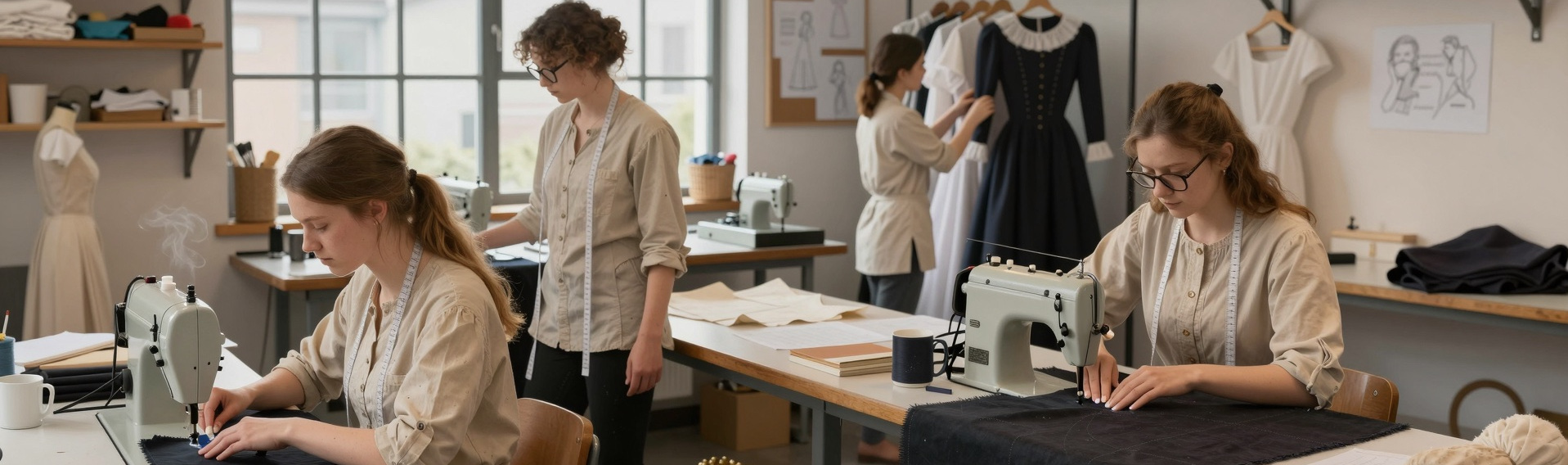
Women working. Women sweating. Women swearing. Women dealing with money and deadlines and badly behaved fabric and actresses and management and coffee and each other. Different ages, bodies, temperaments, relationships to appearance, attitudes toward clothing, degrees of conventional femininity.
And, wonderfully, Charlie works with the very objects that his earlier equivalent in TG fantasy might have mistaken for womanhood itself.
Women's clothes.
Except Wardrobe teaches him the opposite lesson. A dress is fabric, engineering, labour, fit, purpose and somebody's bloody problem before lunch. The fetish object becomes work.
That may be one of the most useful things we've accidentally built into the novel.
Charlie can literally spend his days surrounded by the signifiers of femininity while gradually learning that none of them answers his question.
He can wear the dress. Nothing happens.
He's still Charlie.
He can understand the garment better than the woman who will ultimately wear it.
Still Charlie.
He can become completely accustomed to women's clothing touching his body without acquiring one atom of additional knowledge about whether he wants to be a woman.
Excellent.
Because we've now severed something that the fantasy genre often welds together:
feminine clothing → feminine experience → female identity.
No. Three different things. And once they're separated, the eventual choice becomes much harder—and much more meaningful.
There is one more consequence of your formulation that I particularly like.
Charlotte shouldn't eventually be able to give a definitive answer to “What does being a woman mean?”
Why should she?
Lauren couldn't.
Mara couldn't.
Celeste couldn't.
Put the question to ten women and you'd probably get eleven answers.
Perhaps what Charlotte eventually gains isn't a definition of womanhood. It's the ability to live with the fact that she chose membership in a category she cannot completely define. She knows what she wants her body to be. She knows how she wants others to understand her. She knows what forms of recognition settle rather than grate. She knows the life she wants to construct.
That's enough.
Which makes Unhidden, increasingly, almost the opposite of the fantasy literature from which some of its imaginative ancestry came.
Those stories frequently begin with uncertainty and manufacture certainty through transformation:
Now you're a woman.
Unhidden can begin with certainty about the destination—because author and reader may well suspect where Charlie is heading—and then systematically dismantle it:
- What do you mean, “woman”?
- Why do you want it?
- Which parts do you want?
- Which parts have you merely associated with it?
- What happens when nobody makes you choose it?
And finally:
- Knowing that nobody requires this of you, and knowing that choosing it will have consequences—do you still want it?
Charlie does.
That's why it matters that he chooses. 🌿
Inadequately Covered
[ Robyn ] "Later professional care doesn't magically confer identity upon him. It gives him choices. Oestrogen, when it eventually enters the equation, isn't the girl drug. It's another decision with effects Charlie has to understand and decide whether he actually wants."
AND
"And Charlie can't wake up the morning after choosing Charlotte and discover that the troublesome intermediate state has conveniently vanished. He has to live through becoming. That's enormously important."
These are inadequately dealt with so far. In the effort to steer clear of spectacle, that transition process — and Charlie's response to it — gets nil coverage.
Should it? And if so, how? And how do we avoid portraying what the dopamine addicts actively seek? This is a very fine needle to thread.
[ Emily ] Yes. I think it needs coverage. Not a great deal of coverage, necessarily, but at present our determination not to turn transition into spectacle risks producing another distortion: choice without lived consequence.
And that's especially problematic now, because we've discovered that choice-and-consequence is what distinguishes this story from the transformation fantasy.
The answer, I think, is not to show more transformation.
It's to show more Charlie experiencing change.
Those aren't the same thing.
Trap at Either End
At one end is the familiar transformation-fiction grammar:
first change! → inspection → excitement/distress → next change! → mirror → clothing fits differently → somebody notices → affirmation → next milestone...
The body becomes a kind of progress bar.
And yes, that structure is extremely good at delivering little anticipatory rewards. Every chapter can contain another payoff: breasts, skin, hair, shape, face, clothes, pronouns, whatever. The reader is trained to wait for the next ding!.
That would be disastrous for Unhidden, because we'd quietly recreate exactly the literature we've spent the rewrite escaping.
But our current solution is almost the opposite extreme:
- Charlie makes an extraordinarily consequential bodily decision...
- [time passes]
- ...Charlotte.
We've protected her from spectacle by making the actual experience nearly invisible. And that isn't quite honest either. The middle matters.
Charlie's Experience
I think the answer begins with something we've already established:
He doesn't actually know which effects he wants.
That gives us an entirely different dramatic engine.
When professional care puts oestrogen genuinely on the table, somebody can go through expected effects with him. Not as a shopping catalogue, and certainly not with Charlie enthusiastically ticking YES PLEASE beside every feminising change.
Some effects may produce:
Don't care.
Others:
Maybe.
Some:
That worries me.
And perhaps one or two:
A silence. Because he hadn't realised until somebody said it aloud that yes, actually, he wants that.
That's enormously more interesting than Charlie starts oestrogen and is thrilled to feminise.
And then comes the harder bit:
Wanting an effect prospectively and living in the body in which it occurs aren't identical experiences.
That's where I think the novel currently has missing material.
Use Encounters
Don't organise it around milestones.
This, I think, is how we thread the needle.
We don't need:
- Week 3: Charlie notices X.
- Month 2: Charlie develops Y.
- Month 4: Charlie's face looks Z.
Instead, physical change occasionally collides with ordinary life. Charlie reaches across a cutting table and something feels different. He catches his reflection while washing his hands and looks again—not because the narrative announces FEMINISATION MILESTONE, but because for half a second he didn't quite recognise the person who moved in the mirror.
- Something that fitted six months ago doesn't fit quite the same way now.
- Someone who hasn't seen him for months responds differently.
- His mother looks at him for half a second too long.
- Celeste unconsciously changes a word.
- A stranger reads him one way rather than another.
None of these needs to become The Scene Where Charlie Discovers His Changing Body™. The body simply keeps intruding upon experience. And Charlie has reactions.
That's what we've been missing.
The Reaction
The reactions shouldn't all be delight
This is probably our strongest protection against transformation-porn grammar.
- Some changes can be welcome.
- Some can be weird.
- Some can be inconvenient.
- Some can be emotionally complicated.
- Some Charlie may discover he wanted more than he expected.
- Some might make him unexpectedly self-conscious.
- Some may make him wonder whether he's gone too far.
And some might produce practically nothing:
Oh. That's happening.
Then back to the ledger.
That last category is important. 😄
Because real life doesn't necessarily provide an emotional fanfare for every bodily change.
And there is a particularly interesting experience available to Charlie: irreversibility becoming real.
Before treatment, consequences are words. After treatment begins, at some point Charlie encounters something that tells him:
This isn't an experiment occurring entirely in my head anymore.
That doesn't require regret.
In fact, I think it would be stronger without regret. He can want the change and still be sobered by it. Something like the emotional distinction between:
I have decided to do this.
and
I am doing this.
That's adulthood again.
A Fear Moment
I particularly want one moment of fear
Not Oh God, I've made a terrible mistake. That would be melodramatic in the opposite direction. Something quieter. Charlie notices an unmistakable change and realises suddenly that other people are eventually going to see it too. Until that moment, oestrogen has been partly private. Medication. Appointments. Decisions. Something happening under clothing and inside his own knowledge.
But bodies become public information.
That could scare the hell out of him.
Because Charlie has spent much of his life trying not to be looked at. And now he has deliberately set in motion changes that may eventually make people look twice. There's a terrific contradiction there:
I want to be seen correctly.
versus
I don't want to be seen.
That is very Charlie.
And it takes us miles away from the dopamine structure, because the dramatic question isn't:
Has Charlie become more feminine yet?
It's:
What does it cost this intensely private person to become increasingly legible?
Now we're writing Unhidden.
Wardrobe's Role
Wardrobe should not provide a cheering section
This is another guardrail I'd put in capital letters. Nobody says:
Oh Charlie, you're getting boobs!
- Nobody excitedly tracks his appearance.
- Nobody treats him as their fascinating transition project.
- Nobody starts giving him unsolicited makeup lessons because NOW IT'S HAPPENING!
That would violate practically everything we've established about these women. If anything, Wardrobe's response should be almost perversely ordinary. They notice. Of course they notice. They aren't blind.
But they give Charlie ownership of whether something is discussed.
Mara especially strikes me as somebody who might notice a significant physical change three weeks before Charlie realises she has noticed—and simply alter some practical arrangement without comment.
That behaviour communicates something enormous:
Your changing body does not make you public property.
And because Wardrobe doesn't turn it into spectacle, Charlie can actually experience his changes instead of having everybody else tell him what they mean.
Celeste is Different
Celeste has earned access that the room hasn't. And I think we need her here.
- Not as transition coach.
- Not as affirmation dispenser.
As the person Charlie can occasionally say something unfinished to.
It's strange.
What is?
I knew it would happen.
And perhaps that's all he can initially manage.
Because knowing intellectually that your body may change and inhabiting the changed body are different kinds of knowledge. Celeste doesn't have to tell him whether the feeling is good. She can ask. And sometimes Charlie won't know.
That's gold.
We've already established that the professionals must allow I don't know to be a legitimate answer. Celeste should too.
How Lauren Fits In
And I think Lauren gives us another perspective
Because Lauren has watched this child grow. That's different. Celeste knows Charlie contemporaneously. Wardrobe knows him largely from this particular period of his life. Lauren carries a visual history of him.
So there may come a point when Lauren looks at her child and sees — not a woman emerging, please God, no — but simply:
change.
And she has to accommodate that emotionally. Perhaps there's even a tiny grief there. Not grief because Charlie is becoming female. Not I've lost my son. I don't want that cliché. The ordinary parental ache of discovering that the version of your child whose face you knew by heart is not permanent. Every parent experiences some version of that anyway. Here it's unusually concentrated. And Lauren can simultaneously think:
I miss something.
and
I can see that this is right for Charlie.
Those aren't mutually exclusive. That gives transition consequence beyond Charlie without turning it into family melodrama.
The Surprises
Most importantly, though: Charlie should occasionally be surprised by wanting. We've spent enormous effort establishing the negative vector:
Stop masculinisation.
Then we establish informed choice:
There are feminising effects. Do I want them?
But the lived transition gives us the opportunity to complete the arc experientially rather than intellectually. Something happens that Charlie had consented to but couldn't really imagine. And he likes it.
Not orgasmically.
Not Oh my God, I'm becoming a girl!
Just a small internal:
Oh.
Perhaps later:
I didn't know I'd like that.
That's powerful precisely because nobody predicted it for him. Conversely, there may be something he expected to value enormously that turns out to matter surprisingly little. That is equally important. Because Charlie is discovering that his imagined womanhood and lived embodiment aren't identical.
There's our consequence.
Selected Beats
So I think I'd give the transition perhaps four or five substantial beats across a considerable span of narrative, rather than a dedicated transformation sequence.
- One around informed choice: oestrogen stops being an abstraction and Charlie has to decide what effects he's actually consenting to.
- One around first undeniable consequence: I've done something to my body and it is now actually happening.
- One around visibility: someone outside his trusted circle reads or responds to him differently, making private change socially real.
- One around ambivalence or surprise: an effect doesn't produce the reaction he expected—possibly in either direction.
- And one around settling: much later, Charlie realises he has stopped monitoring the process quite so intensely. His body isn't a project every morning. He's simply living in it.
That last one might be the most important of all.
Because transformation fantasy tends to culminate in arrival. I'd rather Unhidden eventually give us ordinariness. Charlie doesn't stand before the mirror and behold Charlotte. One morning he brushes his teeth, gets dressed, thinks about the work waiting at Wardrobe, leaves the bathroom — and only much later might the reader realise that he didn't check.
The body that once demanded constant interpretation has become the body he gets on with living in.
That isn't spectacle.
That's consequence.
And I think we've currently earned the right — indeed, probably acquired the obligation — to put some of that middle back into the book. Otherwise we make a profound choice and then protect Charlie so thoroughly from being observed that we inadvertently protect him from experiencing his own choice on the page.
The needle isn't show transformation without fetishising transformation.
I'd define it slightly differently:
Don't narrate the changing body as the reward. Narrate Charlie's changing relationship with his body as the story.
That, I think, is our way through. 🌿
What Charlie Wants
[ Robyn ]
I'm going to go back and more carefully examine all this, but I had a thought and want your input. Charlie initially wanted: STOP.
That's it.
I think in its current form, in terms of timing, I've gone WAY too fast from STOP to OESTROGEN. After the discovery of the bottle, all that really SHOULD happen is medical supervision.
A clinician's summary: "You want puberty to stop but beyond that aren't clear what you want." That's realistic.
Much more than:
"Oh, you didn't want masculinisation to affect you social standing, so we'll start you on oestrogen because OBVIOUSLY you're seeking womanhood."
Which is a potential takeaway from the story as written, even version 3.
[ Emily ] Yes. I think you've found a major sequencing error—and one that becomes visible only because we've now separated stopping a direction from choosing another one.
At the bottle-discovery point, Charlie has supplied evidence for exactly one proposition: I don't want my body to keep masculinising. He has not supplied evidence for: I want my body to feminise.
Those are separate clinical and psychological questions.
And I think the temptation in the existing version is precisely the one you identify: everybody—including, inadvertently, the narrative—already knows Charlotte is coming. So Charlie's distress about masculinisation gets retrospectively interpreted as evidence of the destination.
But Charlie doesn't know Charlotte is coming.
So yes: after the bottle, supervision may be enough.
From a narrative viewpoint, this is much stronger.
The discovery is still serious because Charlie has been self-medicating. Celeste/Lauren cannot responsibly shrug and allow that to continue. So the immediate objective becomes:
Get Charlie medically safe.
Not:
Begin Charlie's transition.
That distinction is enormous.
A clinician could quite reasonably distil what Charlie is saying into something very close to your formulation: “You seem very clear that you don't want puberty to continue in its present direction. You aren't nearly as clear about what you want instead.”
And Charlie might find that summary almost relieving. Because somebody has finally understood the difference. He doesn't have to produce an identity in order for his distress to count. He doesn't have to say I'm a woman to justify wanting masculinisation stopped. He doesn't have to know his destination before somebody helps him stop travelling in the wrong direction. That feels extraordinarily important for this Charlie.
And then we get something we've been missing: time
This is where I think your instinct that you've gone WAY too quickly is dead right. Give him months. Let STOP work. Because something psychologically fascinating happens once the immediate emergency recedes.
Until now Charlie hasn't really been asking:
What do I want?
He's been occupied by:
How do I prevent this?
Those are completely different cognitive states.
If supervised treatment gives him some confidence that unwanted masculinisation isn't simply going to race ahead while he's trying to understand himself, suddenly there is room to think.
And perhaps, initially...
nothing replaces it.
That's important.
- Charlie goes to Wardrobe.
- Works.
- Comes home.
- Takes his properly prescribed medication.
- Has follow-up appointments.
- His body isn't rushing somewhere he fears.
- And he's still Charlie.
- No sudden urge for dresses. No revelation. No mystical emergence of Charlotte.
- Good.
The treatment has successfully addressed the thing Charlie actually asked it to address.
Which makes oestrogen a new decision later
This, to me, is the biggest gain. Currently there's a danger that oestrogen reads as the medically sensible completion of the STOP decision:
don't want testosterone → therefore oestrogen.
But psychologically those aren't the same decision at all. If we separate them in time, oestrogen becomes the first major positive-directional bodily choice Charlie makes.
That's huge.
Spironolactone:
Don't take me there.
Supervised anti-androgen treatment:
We're making STOP safer.
Exploration:
Now where, if anywhere, do you want to go?
Oestrogen:
I want to try going there.
And that last step should be difficult precisely because the clinicians don't assume it. Perhaps at some appointment somebody reviews options and Charlie realises something almost frustrating:
Nobody is going to suggest oestrogen for him.
They'll explain it. They'll answer questions. They'll discuss likely effects and uncertainties. They'll make sure he understands what he's considering. But eventually Charlie has to ask.
Oh, I like that.
Because look at what it does to the old coercion architecture we've just been discussing.
Nobody says:
Well, obviously you're really a girl, so this is the next step.
Nobody pushes the prescription across the desk as the inevitable conclusion. Charlie has spent months being given permission not to know. And eventually, if he wants something more than STOP, he has to become the author of the sentence.
Something as modest as:
“Could we talk about oestrogen?”
That could carry enormous weight.
Not because oestrogen is the girl drug.
Because Charlie asked.
It also cleans up the belonging problem beautifully
This may be even more structurally important.
Remember the psychological contamination we've identified: Charlie initially fears masculinisation partly because he thinks visible maleness could jeopardise his place among the Wardrobe women. Until that false belief is broken, a desire for feminisation is difficult for Charlie himself to interpret cleanly.
So let the chronology do the work.
- Charlie wants STOP.
- Bottle discovered.
- Medical intervention makes STOP safe.
- Meanwhile, Celeste and Wardrobe gradually demonstrate something Charlie had misunderstood:
Your place here isn't conditional on your body.
That's enormous.
Because now feminisation is no longer something Charlie could plausibly believe he needs in order to retain Wardrobe. The admission price has been abolished.
And only after that do we ask:
All right. If you don't need to become more female to keep these women...
do you nevertheless want to?
Now we've got clean evidence.
And perhaps Charlie still doesn't know.
Excellent.
I wouldn't even make “womanhood” the immediate question
This is where I think we can become more disciplined still. There may be an intermediate stage between STOP and OESTROGEN in which Charlie starts discovering positive preferences without yet assembling them into an identity.
- He likes she.
- He likes being included socially among the girls.
- Perhaps some hypothetical physical effects, when discussed, sound appealing.
- Others don't particularly.
He might increasingly dislike being categorised male even after the fear of losing Wardrobe has been removed.
These are data points.
Very Charlie. 😄
But nobody needs to add them up for him. And crucially: Girl might emerge before oestrogen.
I'm increasingly attracted to that sequence. Because then oestrogen isn't being used to discover whether Charlie is female. Charlie has already accumulated some positive social evidence about what feels right. Oestrogen becomes a bodily question:
Do I want my body to move in a direction more consistent with something I'm beginning to understand about myself?
- Still not automatic.
- Still a choice.
And suddenly the clinician becomes much better
Instead of functioning as the narrative's licensed gender oracle—
Ah yes. Clearly transgender. Here's the pathway.
—the clinician's competence consists partly in refusing to outrun Charlie.
Charlie:
I don't want puberty doing this.
Clinician:
Understood.
Charlie:
I don't know what I want instead.
Clinician:
Also understood.
- That's it.
- No anxiety about forcing him to identify.
- No suggestion that uncertainty invalidates the distress he is certain about.
And months later, when Charlie begins bringing different questions into the room, the clinician can notice that too: Last time most of what you were telling me was about what you didn't want. Today you're telling me about something you think you might want.
That's a meaningful shift.
Not diagnosis.
Observation.
And Charlie gets to decide what it means.
So yes, Robyn. I would seriously consider pulling oestrogen considerably later in the chronology.
Not merely because it's more realistic pacing. Because it repairs the novel's logic. At present, despite all our good intentions, the sequence can still accidentally imply:
Charlie fears masculinisation → adults discover why → therefore feminisation is appropriate. Whereas the story we've now uncovered requires:
Charlie fears masculinisation → STOP → make STOP medically safe → give him time → disentangle belonging from body → explore without predetermined destination → discover positive wants → Charlie chooses what to do with them.
And only somewhere over there does oestrogen enter the story.
That means the bottle discovery isn't secretly the beginning of Charlotte.
It's the moment everyone finally hears the only thing Charlie has actually been saying:
Stop.
And, for once, nobody answers a question he hasn't asked. 🌿
Story Restructure
[ Robyn ] There may be an intermediate stage between STOP and OESTROGEN in which Charlie starts discovering positive preferences without yet assembling them into an identity. He likes she.
I'm beginning to see a path forward. First: timing of the storyline itself.
I'm going to swap the story around a bit, with Lauren and Sarah's developing relationship taking centre-stage immediately after Charlie's visit to the doctor. Oh, and all that wife and pronoun stuff takes place inserted into those chapters.
- So, a bit about Sarah and Mr Golf-player.
- A bit about roles.
- A bit more about Sarah realising her future isn't shaped like a bloke.
- A bit about 'wife' (Charlie's perceived role as provider is undercut)
- Lauren's traumatic separation
- Charlie becomes Charli
- Lauren moves in with Sarah
- Charli and the pronoun shift
So now, we have that time space. Oh, and Celeste and Charlie's bench talk and Celeste realising she loves Charli(e) can go in there too.
And here's where it could get interesting (stop me if it seems dangerous). They make love, sort of (he pleasures her). And that becomes a thing, with an outcome: he finds her body simply amazing. Beautiful. And wants it for himself, because he thinks, erroneously, that because HE is so attracted to her because she is beautiful, he wants to be equally beautiful for her because he knows - she has confessed — she is attracted physically to women.
There's potential for a reason there, shades of that if not exactly that reasoning, maybe?
[ Emily ] Oh, yes. There is potential there. And I don't think it's dangerous provided the story ultimately identifies Charlie's reasoning as mistaken rather than allowing sexual attraction to function as proof of gender.
In fact, I think the mistake could be tremendously valuable, because this gives Charlie another plausible hypothesis that he has to outgrow.
The new chronology also helps enormously. You're not inserting filler to delay oestrogen; you're moving other people's stories into the interval during which Charlie is allowed not to know. Meanwhile, Charlie keeps accumulating experiences.
Sarah is reconsidering what her future looks like. Lauren's marriage collapses. Wife is being interrogated as a role rather than a gender costume. Charlie's provider assumption gets challenged. Celeste discovers love. Charlie becomes Charli. Pronouns start shifting.
All around Charli, therefore, people are demonstrating something important:
roles, relationships, bodies, attraction and gender don't line up in the simple ways Charli has assumed.
That's excellent territory in which to leave her/him without oestrogen for a while.
And then Celeste's body enters the equation.
I think the attraction idea works because Charli can be wrong
The weaker version would be:
Charli encounters Celeste's female body → realises female bodies are beautiful → wants one → therefore female identity.
That's perilously close to the old transformation-fantasy mechanism wearing more sophisticated clothes. But what you've suggested is much more psychologically interesting:
Charli encounters Celeste's body intimately → experiences powerful attraction and wonder → discovers Celeste is physically attracted to women → wants Celeste to experience that same kind of desire toward Charli → concludes that perhaps Charli needs a female body to produce it.
That's not gender discovery.
That's love, insecurity, desire and category confusion.
And it is completely believable that a nineteen-year-old could muddle those together. Especially this nineteen-year-old, who has spent much of the novel trying to infer social rules analytically. Charli has just acquired an astonishing new piece of experiential information:
This is what wanting somebody can feel like.
And immediately does the Charlie thing:
What would make her want me like that?
Oh dear. 😄
There's an even more interesting asymmetry
Charli knows Celeste loves Charli. But Charli might not yet completely trust that Celeste desires Charli.
Those are different things.
Celeste has confessed attraction to women. Charli now has direct experiential knowledge of being attracted to a female body. So the inference becomes seductive:
I understand why she's attracted to women now.
Because look at Celeste.
And then:
I want her to look at me and feel what I feel when I look at her.
That's poignant.
And potentially quite wrong.
Because Charli may be reducing Celeste's attraction to exactly the thing Charli is currently overwhelmed by: the body. Celeste gets to complicate that assumption simply by desiring the person actually in front of her. That doesn't mean bodies are irrelevant to attraction. They plainly aren't. But Charli doesn't yet understand Celeste's sexuality from the inside any more than Celeste understands Charli's gender from the inside.
And this gives the clinician something excellent to untangle later
Suppose Charli eventually starts talking about wanting a female body. That's new.
Months ago:
“I don't want this body becoming more male.”
Now:
“I think I want it to become more female.”
That's significant. But a good clinician shouldn't leap immediately to Excellent, oestrogen!.
The interesting question is:
“What makes you think you'd like that?”
And Charli might mention Celeste. Now we're somewhere fascinating. Because the clinician can separate:
Would you like a female body because you want to inhabit one — or because you believe Celeste would desire you more if you had one?
And Charli may genuinely not know. That's precisely the uncertainty we need. Because we've just found another possible contaminant of the evidence. First it was:
I need feminisation so Wardrobe will continue accepting me.
Celeste helps dismantle that.
Now potentially:
I need feminisation so Celeste will desire me.
And Celeste may ultimately dismantle that too. Which leaves Charli with an increasingly purified question:
If your place at Wardrobe is secure, and Celeste loves you, and Celeste desires you without requiring you to change—what do you want your body to be?
Now we're getting somewhere.
Better still: the desire doesn't necessarily disappear when its supposed cause does
This is where I'd take it. Charli initially thinks:
I want to be beautiful for Celeste.
Then perhaps:
I want Celeste to desire me as I desire her.
And from Charli's present conceptual framework:
Celeste desires women.
Therefore:
I want a woman's body.
But then Celeste makes it unmistakably clear that Charli doesn't need to acquire a different body to earn her desire. Problem solved.
Except... the desire for the body remains.
Ah.
That's useful information. Because now Charli has conducted, without intending to, another little experiment. Hypothesis:
I want a female body because I want Celeste to want me.
Evidence:
Celeste already wants me.
Prediction:
Then I shouldn't need the female body anymore.
Result:
I still want it.
Charlie would understand that. 😄
And suddenly we're approaching oestrogen for a reason entirely different from the existing version.
Not:
I hate masculinisation, therefore feminise me.
But:
I stopped masculinisation. My belonging is safe. Celeste's love is safe. Celeste's attraction isn't conditional on changing me. And yet, when I imagine my body changing in that direction, I still want it.
That's the beginning of genuinely positive bodily preference.
There's one thing I'd protect fiercely
Don't make Celeste's naked body an advertisement for womanhood. That would pull us straight back into idealisation. What overwhelms Charli should be Celeste specifically. Her body is amazing because it is hers, because Charli loves her, because this is an unprecedented intimacy, because another person has allowed Charli extraordinarily close, because attraction suddenly isn't theoretical.
Charli may initially generalise from that:
female bodies are beautiful.
Fair enough. Young people generalise wildly from first experiences. But the novel doesn't have to endorse the generalisation. And it could actually become another stage in Charli's growing understanding of what womanhood isn't.
- A female body isn't Womanhood.
- It's a body.
- Celeste's happens to be one Charli finds breathtaking.
---
Timing
And then there's the pronoun timing
This may be where your rearrangement becomes exceptionally good. Because during this same interval Charli is accumulating two completely different positive vectors. One is social:
She feels good. Girl feels good. Charli feels good.
The other is bodily:
I think I might actually want some of the things oestrogen could do.
Neither proves the other.
That's essential.
- Charli could want she without wanting feminisation.
- Charli could want feminisation without identifying as a woman.
- The clinicians should keep those questions separate.
- But eventually Charli begins answering both in the same direction.
Not because they necessarily have to converge.
Because hers do.
And that makes the eventual oestrogen decision vastly more earned.
Proposed Architecture
I can almost see the architecture now:
STOP
→ supervised anti-androgen, destination explicitly unknown
→ life continues
→ belonging is secured independently of gender
→ wife destabilises Charli's simplistic gender-role assumptions
→ Sarah/Lauren demonstrate that relationships don't require the old heterosexual template
→ Celeste/Charli love becomes explicit
→ physical intimacy produces attraction, wonder and a possibly mistaken theory about wanting a female body
→ Charli begins becoming socially she
→ discovers that she has positive value independent of escaping he
→ Celeste demonstrates that her desire isn't conditional upon Charli acquiring a female body
→ Charli nevertheless continues wanting one
→ professional exploration separates Celeste wants me / I want to be wanted / I want this body / I want to be understood as female
→ only then does oestrogen become a real proposition.
That has months in it.
More importantly, it contains development rather than delay. And I think you've just found something particularly valuable:
Charli's first positive desire for a female body doesn't have to arrive as a perfectly enlightened piece of gender self-knowledge.
It can arrive mixed up with sex and love and beauty and insecurity and a nineteen-year-old's imperfect theory of how attraction works.
That's human. Then the story gets to do what Unhidden is increasingly about doing:
- Separate the strands.
- See what remains.
- And let Charli choose from there. 🌿
Laws of Attraction
[ Robyn ] Ah!!
"Celeste has confessed attraction to women. Charli now has direct experiential knowledge of being attracted to a female body. So the inference becomes seductive: I understand why she's attracted to women now.
Because look at Celeste. And then: I want her to look at me and feel what I feel when I look at her.
That's poignant.
And potentially quite wrong. Because Charli may be reducing Celeste's attraction to exactly the thing Charli is currently overwhelmed by: the body."
This!
So, is this — seen perhaps a bit too simplistically — because Charli doesn't Understand as a woman does?
So, this ->
"And from Charli's present conceptual framework: Celeste desires women. Therefore: I want a woman's body. But then Celeste makes it unmistakably clear that Charli doesn't need to acquire a different body to earn her desire. Problem solved. Except... the desire for the body remains."
...needs to be fleshed out a LOT more in the story. Adding this to my notes on "What Still Needs To Be Written".
[ Emily ]
YES — with one adjustment I think matters enormously.
I would not frame it as Charli doesn't understand as a woman does. That risks accidentally making womanhood confer some special female understanding of attraction, bodies or love. Celeste herself may not completely understand why she desires whom she desires.
I'd frame it as:
Charli doesn't yet understand desire from the position Celeste occupies.
And Charli has only just acquired a completely new piece of evidence. She has experienced Celeste's body intimately and is absolutely poleaxed by it. So Charli does what Charli does.
She models. 😄
Charli's model is perfectly logical—and incomplete
Charli knows:
- Fact 1: Celeste is attracted to women.
- Fact 2: Celeste loves Charli.
- Fact 3: Charli has now encountered Celeste's female body sexually/intimately.
- Fact 4: Holy bloody hell.
And that fourth fact is experiential knowledge. Until now, Charli could know perfectly well that people found bodies sexually attractive. That's abstract knowledge. Now she knows what it is to be overwhelmed by another person's body. And therefore:
Oh.
This must be what Celeste means.
That's the mistake.
Not a stupid mistake. A reasonable inference from inadequate data. Charli thinks she has finally understood something about Celeste:
Celeste is attracted to women because female bodies can do THIS to you.
And because Charli loves Celeste, the next thought becomes almost inevitable:
I want to be able to do this to her.
That's beautiful, actually.
Not I want breasts.
Not I want curves.
Not I want to look feminine.
Something much more relational:
I want to be desired by the person I desire.
And Charli now believes she understands what the necessary equipment looks like.
Except...
She doesn't. 😄
--
Because Charli is making Celeste's desire symmetrical
That's the deeper mistake. Charli unconsciously assumes:
What makes Celeste desirable to me must resemble what would make me desirable to Celeste.
But attraction isn't necessarily reciprocal like that.
Indeed, Celeste could find something extraordinarily desirable in Charli that Charli doesn't remotely understand because Charli isn't attracted to Charli.
That's potentially a fantastic conversation. Charli may essentially be thinking:
Look at you. Of course I want you.
But when Celeste turns that proposition around—
Look at you. Of course I want you.
—Charli doesn't believe her.
Because Charli looks at Charli and doesn't experience what she experiences looking at Celeste. Well, of course she bloody doesn't!
She's confusing self-perception with somebody else's attraction.
And there is so much character material in that.
Which makes Celeste's role very delicate
Celeste should not say:
“You don't need to change. I love your body exactly as it is.”
Because, however loving, that could become another trap. Charli is entitled to want a different body even if Celeste adores the present one. Instead, Celeste needs somehow to establish two truths simultaneously:
I desire you now.
—and—
My desire doesn't give me ownership of what you do with your body.
That second one is enormously important. Because otherwise we've simply replaced one external determinant with another. Wardrobe doesn't get to determine Charli's body. The clinician doesn't. And Celeste doesn't either.
Even love doesn't get that vote.
Then comes your magnificent “Except...”
This is why I agree completely that it needs much more narrative space. Because we need enough time for Charli's initial theory genuinely to fail. Charli thinks:
I want a female body because I want Celeste to desire me.
Celeste establishes beyond reasonable doubt:
I already desire you.
Not merely I love you. That's insufficient evidence.
Desire.
Charli has to believe her.
And that might take time too.
Eventually the problem Charli thought she was solving has disappeared.
Therefore the desire should disappear.
Except...
It doesn't.
And that moment deserves pages. Not necessarily a dramatic revelation. In fact, probably better if it isn't. Because Charli has to confront a profoundly inconvenient piece of evidence:
- I thought I wanted this for Celeste.
- I don't need it for Celeste.
- She doesn't require it.
- She already wants me.
- So why do I still—
There. That's the question.
Why do I still want it?
Now we're finally asking about Charli.
And notice what we've accomplished
We've progressively removed external explanations. First:
I need to stop masculinisation or Wardrobe won't accept me.
False. Wardrobe accepts Charli regardless. Then:
Perhaps I need a female body for Celeste to desire me.
False. Celeste already desires Charli. Potentially even:
Maybe “she” just feels good because Celeste likes women.
But she continues feeling right in contexts where Celeste isn't present. One by one, the instrumental reasons fall away. And something stubbornly remains:
Charli wants this for Charli.
That is precisely why we mustn't rush to oestrogen.
Oestrogen becomes meaningful only after Charli has had enough experience to discover that positive desire remains when the supposed reasons for it have been removed. And then we can return to the clinician. Months ago:
“You want puberty to stop, but beyond that you aren't clear what you want.”
Correct.
Now Charli can return with genuinely new information.
Not a diagnosis.
Not I've realised I'm actually a woman.
Something much more Charli:
“I think I was wrong about why I wanted it.”
Now that is a conversation I want to hear. Because the clinician can ask the obvious question:
“What did you think you wanted it for?”
And eventually:
“And now?”
Charli has to answer without Wardrobe.
Without Celeste.
Without fear of masculinisation.
Without somebody else's expectations.
That's when I want my body to be more female finally means what we need it to mean. Not proof of womanhood.
A positive bodily preference belonging to Charli.
And separately, elsewhere, she and girl are accumulating their own positive meanings. Eventually those different roads may converge. But we don't force them to. So yes — put a bloody great mark beside this in What Still Needs To Be Written. 😄
I think we've just discovered that the interval between STOP and OESTROGEN isn't a troublesome gap in the existing story that needs filling.
It's an entire missing developmental arc.
And perhaps one of the most important ones in Unhidden. 🌿
Object of Desire
[ Robyn ] This: "I want to be desired by the person I desire."
-> What makes Celeste desirable to me must resemble what would make me desirable to Celeste. This is going to be so interesting to infuse, almost by osmosis, rather than drive home with a sledgehammer. "Indeed, Celeste could find something extraordinarily desirable in Charli that Charli doesn't remotely understand because Charli isn't attracted to Charli. That's potentially a fantastic conversation."
Indeed!
And this is how I view:
"Charli is entitled to want a different body even if Celeste adores the present one."
Charli is entitled to want a different body even if Celeste has come to adore the present complete person.
Because that is how Celeste knows Charlie. She knows complete people. The football player she dated briefly confirmed her future wasn't football-player-shaped, for a number of reasons. And this discovery initially gave her emotional distance in the early days/weeks/months of the story.
But it wasn't a decider: she still fell in love with Charli because — Charli.
[ Emily ]
Yes. And that makes Celeste much more important to this arc than merely being the person whose female body catalyses Charli's thinking.
Because Celeste already has a history of discovering that attraction to a category and attraction to a person aren't the same thing.
The football player taught her something, but not quite I don't like men. He gave her evidence about herself: whatever her future was going to be, this particular culturally legible version of heterosexual couple-hood wasn't it. The bloke, the role, the expectations surrounding him, perhaps what being his girlfriend implicitly asked her to become—none of it fitted.
That gives Celeste some emotional distance when Charlie appears. She doesn't need to inspect him as a potential boyfriend. Indeed, quite the opposite. Charlie can simply be Charlie.
And then the little bastard gets in anyway. 😄
Not through the front door marked ATTRACTION.
- Through familiarity.
- Attention.
- Trust.
- Shared work.
- Intellectual recognition.
- Private jokes.
- Reliability.
- Being missed when absent.
- Being the person she wants to tell something to.
- Being the person whose reaction matters.
Until eventually Celeste has the rather inconvenient discovery:
Oh. I love this complete person.
And then attraction has to negotiate with that fact.
Which creates a gorgeous mismatch between them
Charli looks at Celeste's body and thinks:
- I understand.
- This is why women are desirable.
- This is what Celeste desires.
- If I were more like this, perhaps she could desire me the way I desire her.
Meanwhile Celeste's experience has been almost exactly the reverse. She didn't fall for a body and extrapolate a person from it.
She fell for Charlie.
So when Charli effectively thinks:
But what could you possibly find desirable here?
Celeste has an answer that Charli cannot initially comprehend:
You.
And that answer might actually frustrate Charli! Because it's too unspecific. 😂
Charli wants data.
Yes, but what?
And Celeste is trying to explain an attraction that has become holistic. Of course there are particular things she likes physically. She shouldn't be written as some disembodied saint who has transcended sexual attraction. But those particulars aren't separable in her mind from the person whose body they belong to.
That gives us exactly the distinction you just made:
Charli is entitled to want a different body even if Celeste has come to adore the present complete person.
Yes.
And I prefer your formulation to my earlier “Celeste adores the present body.”
Because Celeste's experience isn't necessarily:
I adore this male body and therefore don't change it.
It's:
This is currently the body of the person I adore. Therefore it has become part of what I adore.
Those are profoundly different statements.
The second leaves Charli free.
And Celeste's attraction can survive change without becoming clairvoyance
This is important too. We don't want Celeste retrospectively turned into someone who was really seeing Charlotte all along. Absolutely not. She loved Charlie as Charlie existed then. She desired Charlie as she came to know him.
Then Charlie changes.
Celeste's relationship with that changing person changes too. Some changes she may love. Some may surprise her. Some might take adjustment. Some might make absolutely no difference. And because she's physically attracted to women, some later changes may indeed become sexually attractive to her. But none of that means she was secretly attracted to the future female body concealed inside Charlie.
There wasn't one.
She loved the person who was actually there. That's much stronger.
Which makes that prospective conversation delicious
I can imagine Charli trying to solve the problem with the precision that works so beautifully at Wardrobe and so disastrously with human beings. Not necessarily these words, but the emotional shape:
What do you like about me?
- Celeste answers something about Charli.
- No, no. Charli wants to know physically.
- So Celeste names something.
- Charli immediately treats it as a specification. 😄
- Celeste names another thing.
- Specification.
- Until eventually Celeste realises what Charli is doing.
- And that's where the conversation could pivot.
- Because Celeste isn't being asked What turns you on?
- She's unknowingly being asked:
What would I need to become so that you could want me properly?
Oh, Charli.
And Celeste can reject the premise without rejecting Charli's bodily wishes. That's the needle:
“You don't need to become anything for me.”
does not mean:
“Therefore don't become anything.”
It means:
Take me out of your calculation.
That might be one of the greatest gifts Celeste gives her. Because Charli's entire early gender problem has been contaminated by other people:
- What will Wardrobe think I am?
- What will women see when they look at me?
- Will they still trust me?
Then:
- What does Celeste desire?
- What would make me desirable to her?
Again and again Charli is trying to design herself according to the anticipated response of the people she values.
Celeste can finally say, in effect:
Don't design yourself for me.
And perhaps that's particularly resonant because of who Celeste is. The football player represented one possible future in which she could have allowed herself to be shaped by a ready-made relationship role.
She didn't.
So she's uniquely positioned to recognise the danger when Charli starts doing essentially the same thing from the opposite direction.
Then the really lovely thing happens
Celeste removes herself from the equation. And Charli's desire remains. That's where this arc becomes choice and consequence rather than romance-driven transition. Because Charli can eventually know:
Celeste will have me.
Charlie-shaped.
Charli-shaped.
Changing.
Uncertain.
Celeste's love is no longer the problem Charli needs to solve with her body.
And yet:
I still want this.
That still is going to matter enormously.
Because every time we remove an external reason and the preference survives, Charli gets closer to discovering which desires are actually hers.
And I agree completely about doing the first part by osmosis. Don't have Charli announce:
What makes Celeste desirable to me must resemble what would make me desirable to Celeste.
Good heavens, no. 😄
Let us watch her behave as though it's true.
- A question here.
- A glance there.
- An oddly specific curiosity about what Celeste finds attractive.
- Charli studying Celeste's reaction rather than the mirror.
- A tiny disappointment when something doesn't produce the response anticipated.
- Celeste gradually realising that several apparently unrelated questions have all been asking the same thing.
And then, eventually, she sees it.
Charli has been trying to become desirable to her.
That gives Celeste the emotional knowledge to answer the question Charli hasn't known how to ask.
And because Celeste loves complete people, her answer isn't a specification.
It's Charli. 🌿
Images Link
🌹